
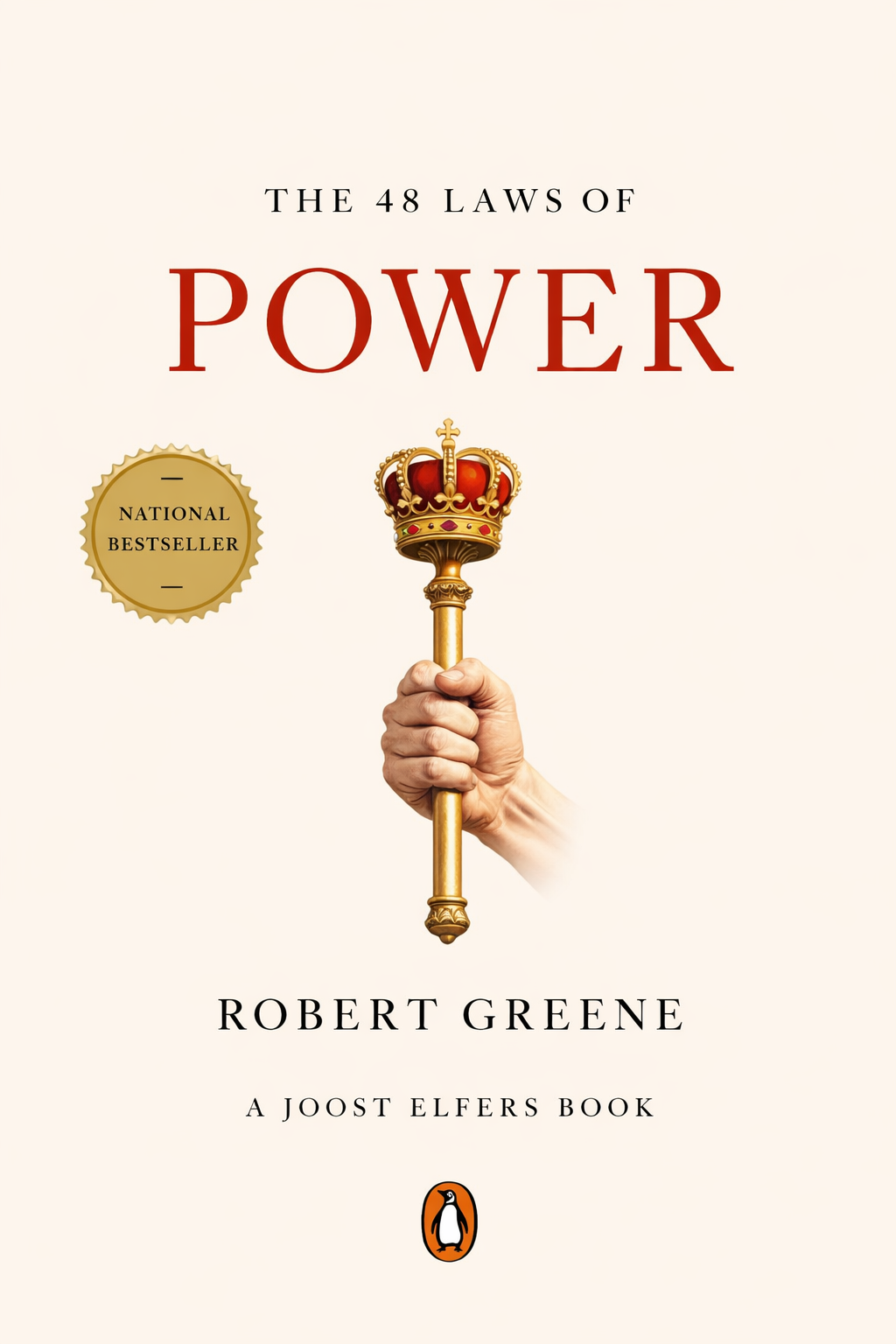
The 48 Laws of Power by Robert Greene
This course provides a systematic analysis of power, social influence, and reputation management based on the principles established in Robert Greene's "The 48 Laws of Power." It treats power as an ongoing social game where success depends on perception, restraint, and the calculated control of information. Participants will examine the fundamental dynamics of hierarchy, including the risks of outshining a superior and the strategic use of friends and enemies. The curriculum emphasizes the importance of concealing intentions and maintaining a reputation that serves as a tool for leverage. By focusing on the effects of actions rather than stated intentions, the course teaches how to navigate complex social structures through emotional control and strategic dependence. Regarding tactical execution and long-term positioning, the curriculum covers self-reinvention, the creation of spectacle, and the management of strategic absence. It details methods for gathering information through observation, the necessity of planning to the final outcome, and the psychological impact of boldness. Learners will explore the use of mirroring and the strategic value of selective surrender. The final sections focus on the transition from rigid tactical control to a state of formless fluidity. This state of adaptability allows an individual to remain effective regardless of changing circumstances. The course concludes by evaluating how to manage victory, avoid the traps of envy, and maintain a legacy of influence within a competitive environment.
Opening: Power as Perception, Not Just Force
Opening: Power as Perception, Not Just Force
The 48 Laws of Power by Robert Greene is a book that has been banned in American prisons, passed hand to hand in corporate offices, and debated in philosophy seminars — and the reason it provokes that kind of friction is that it names something most of us prefer not to say out loud. Robert Greene, a man who worked dozens of jobs before he ever wrote a word of it — translator, construction worker, Hollywood scriptwriter, magazine editor — spent years watching how power actually moved through rooms, and then he went to the historical record to confirm what he had seen.
The key idea at the heart of the book is a tension, not a formula. Greene asks what happens when ordinary virtues — openness, friendship, brilliance, honesty — collide with status insecurity and self-interest. His answer is uncomfortable: those virtues can get you punished. Not because the world is purely cynical, but because perception, Greene argues, often matters more than merit. What people see, fear, assume, and remember about you shapes what they do to you.
This episode will not endorse every tactic in the book. It will explain Greene's argument, the psychological mechanism underneath it, and the ethical tension that comes with it. Greene builds his case through historical case studies — figures from European courts, ancient Rome, Renaissance Italy — and distills patterns into laws.
We will move from the ego of the person above you, through the alliances around you, all the way to the reputation that walks into a room before you do. And it starts with a party that destroyed a man.
Law 1: The Dangerous Gift of Brilliance
That party — the one that destroyed a man — is Greene's first case study, and it is worth sitting with for a moment, because the lesson inside it is not what you might expect.
Nicolas Fouquet was the finance minister of Louis XIV. He was brilliant, wealthy, and by most accounts genuinely talented at his work. In 1661, he decided to host a celebration at his château of Vaux-le-Vicomte — a party so magnificent, with finer food, grander architecture, and more dazzling entertainment than anything the young king himself possessed, that it was meant to impress. And it did impress. It impressed Louis so thoroughly that within three weeks, Fouquet was arrested on charges of embezzlement and spent the rest of his life in prison.
Greene's argument is not that Fouquet was innocent or guilty of the charges. The argument is about what the party communicated. Fouquet displayed his magnificence as his own. He made the king feel small. And Greene contends that in a hierarchy, making the person above you feel small is one of the most dangerous things you can do — not because it is unfair, but because it is psychologically predictable.
The key idea here is that the danger was never Fouquet's talent. It was the superior's felt loss of status. Greene argues that superiors — kings, bosses, patrons, mentors — can have fragile egos tied to their position, and a subordinate who shines too brightly can trigger insecurity and resentment even in someone who appears to admire them. The admiration and the resentment can coexist. That is what makes this law so easy to violate.
Now consider what Galileo did differently. When Galileo discovered the moons of Jupiter, he named them the Medicean Stars — after Cosimo de' Medici, his patron. He did not present the discovery as a monument to his own genius. He framed it as a celestial tribute to the Medici family's greatness. The same level of scientific achievement, the same quality of mind — but presented as a reflection of the patron's glory rather than a challenge to it. The result was powerful patronage and protection.
Greene uses these two figures as a contrast not to suggest that Galileo was dishonest or that Fouquet deserved his fate. The point is about presentation. Fouquet displayed magnificence as his own. Galileo made his discovery feel like it belonged, in some meaningful sense, to the man above him. One framing triggered status threat. The other satisfied it.
Greene's practical claim is not to suppress your ability. It is to make the master feel secure, admired, and indirectly responsible for your success. Let them shine. Attribute credit upward. Frame your achievements as extensions of their vision. And Greene warns readers not to assume that even an enlightened or intellectually generous superior is immune to this dynamic. Even the most rational person above you has limits to how much brilliance they can comfortably absorb from below.
That is the first law's real weight. It is not a lesson about hiding who you are. It is a lesson about reading the ego of the person above you and staging your talent in relation to it. Talent, Greene argues, is not enough. Talent must be managed in relation to the psychology of whoever holds power over you.
And if the person above you is that psychologically charged, what about the person beside you — the friend, the ally, the one you trust most? That is where Greene's next provocation begins, and it is, if anything, even more unsettling.
Law 2, Part One: Why Friends Can Become Risky Allies
The friend, the ally, the trusted one — that is where Greene turns next, and the move is deliberately unsettling.
His argument in Law 2 is this: the person you trust most may be the person you evaluate least clearly. Not because they are secretly malicious, but because the emotional logic of friendship and the structural logic of power pull in opposite directions. And when those two things collide, Greene argues, the results can be quietly catastrophic.
For example, consider what happened to the Byzantine emperor Michael III. Michael had a childhood friend named Basilius — a man who had started life as a stable hand, with no wealth, no title, no standing. Michael elevated him. He gave Basilius access, rank, and eventually real power. By any ordinary measure, this was an act of extraordinary generosity toward someone who owed everything to the relationship. According to the digest, Basilius later had Michael murdered and seized the throne.
Greene uses this story not as a tale of pure villainy but as a case study in structural mismatch. The friendship between Michael and Basilius was built on equality — two people who knew each other before power entered the picture. But the moment Michael elevated Basilius, the relationship was no longer equal. It became hierarchical. And Greene's argument is that friendship does not adapt well to hierarchy. The friend who was once your peer now occupies a subordinate position, and that gap — between what the relationship used to feel like and what it now requires — can quietly generate resentment.
The key idea is that friendship assumes equality, but power creates hierarchy, and the mismatch between those two things is where the trouble lives. A friend placed in a position of dependence may feel humiliated by that dependence, even while benefiting from it. They may expect favors that a more neutral colleague would never presume to ask for. And when those favors are not forthcoming, the grievance feels personal in a way it simply would not with a stranger.
What Greene is pointing at is something subtler than betrayal. It is envy. He argues that success witnessed up close — by someone who knew you before you had it, who perhaps believes they are equally capable — can be harder to absorb than the success of a distant rival. A distant opponent is easy to dismiss or admire from afar. A friend who watches you rise while they remain in your orbit has a front-row seat to the comparison. And that comparison, Greene contends, is corrosive in ways that neither party may fully acknowledge.
Think of it this way: a colleague you barely know does not feel entitled to your good fortune. But a friend who has shared meals with you, who has seen your doubts and your failures, who considers the relationship a kind of equity — that person may feel, at some level, that your success is partly owed to them. And when the power structure does not reflect that feeling, the debt curdles.
Greene is not saying that friends are bad people or that friendship itself is a liability. His warning is more precise than that. It is that importing the assumptions of friendship — the expectation of equality, the presumption of forgiveness, the blurring of professional judgment — into a context where power is at stake creates a specific kind of vulnerability. You choose someone for emotional comfort rather than competence. You overlook their failures because the relationship makes criticism feel like betrayal. And you end up, as Greene puts it, choosing the person who feels safest rather than the person who is most reliable.
That raises an obvious question: if friends carry these hidden risks, what about the people who were never your friends at all — the ones who opposed you, challenged you, or stood on the other side? Greene's answer to that is where the law gets genuinely strange.
Law 2, Part Two: Turning Enemies Into Incentivized Allies
And that is exactly where Greene's argument takes its sharpest turn.
If friends carry hidden risks because the relationship assumes equality, then the person who was never your friend — the rival, the opponent, the one who once stood against you — carries a completely different set of assumptions. And Greene argues those assumptions can make them, in certain contexts, more useful.
Think of a former opponent who has just been brought into your circle. They know the terms of their position are conditional. They know that every mistake will be watched more closely than a friend's mistake would be. They have no reservoir of goodwill to draw on, no history of shared meals or old loyalty to cushion a failure. That awareness, Greene contends, sharpens them. It makes them more vigilant, more motivated to perform, and more careful not to give you a reason to regret the decision.
The digest offers two examples that illustrate this logic. The first is a Chinese emperor who was asked to choose between two candidates for an important appointment. One was a longtime loyal friend. The other had once been his enemy. The emperor chose the former enemy. His reasoning, as Greene presents it, was precise: the friend would assume the relationship was enough. The former enemy would work tirelessly to prove that it was not a mistake to trust him. The incentive structures were simply different.
The second example is King Louis XI of France, who Greene presents as someone who consistently preferred to employ men who had once opposed him. Louis understood that their conversion represented something more durable than passive loyalty. A man who had crossed from the opposing side had made a deliberate choice, and that choice carried weight. He had something to demonstrate. A lifelong supporter, by contrast, might feel that his loyalty was already banked — that the relationship owed him something rather than the other way around.
That means, in Greene's framework, reliability is not primarily a product of affection. It is a product of aligned self-interest. The friend operates under the assumption that the relationship is sufficient collateral. The former enemy knows it is not. And that knowledge, Greene argues, produces a different quality of attention.
It is worth being careful here. Greene is not saying that enemies are always more loyal, or that converting a rival is a guaranteed strategy. His argument is more conditional than that. He is saying that the incentive structure around a former enemy is often sharper, and that sharpness can translate into a more vigilant and self-aware kind of collaboration — provided the conversion is genuine and the terms are clear.
Greene's practical advice, as the digest frames it, is not to abandon friendship entirely. He suggests keeping friends for emotional support and private life. But when it comes to the exercise of power — when competence, reliability, and clear judgment matter most — he advises applying standards that friendship tends to blur.
And that is the clean contrast the episode has now built across two laws. Law 1 says manage the status of the person above you. Law 2 says manage the incentives of the people around you. Both laws rest on the same foundation: psychological realism rather than moral idealism. Greene is not describing how people should behave. He is describing, in his view, how they actually do.
With status and alliances now in place, the episode moves to a third arena where perception becomes power — not who is above you or beside you, but what any of them are allowed to know about what you are actually trying to do.
Law 3, Part One: Conceal Your Intentions
Most people leak their intentions constantly. Not through confession, but through the small signals they cannot help sending — the questions they ask, the things they avoid, the enthusiasm that surfaces at the wrong moment. Greene argues that this leakage is one of the most common and costly mistakes in any competitive environment. If the people around you can read what you want, they can position themselves ahead of you, block you quietly, or simply wait until your hand is fully visible before they respond.
But silence alone is not enough — it can raise suspicion on its own. A person who suddenly goes quiet, who stops sharing plans they used to discuss freely, who becomes guarded where they were once open, may actually draw more attention than before. The target notices the absence of information and starts looking harder. That is the trap Greene identifies at the center of Law 3: concealment is not the same as hiding. Hiding creates a void. What Greene is describing is something more active — filling the space with a story that satisfies the other person's need to understand, so they stop looking.
The distinction matters. When you give someone a plausible explanation for your behavior, even a false one, you are not just withholding the truth. You are answering the question they were about to ask. And once a person believes they have understood your motive, Greene argues, they tend to stop investigating. The curiosity is resolved. The suspicion dissolves. And whatever you are actually doing proceeds without interference.
Greene presents Otto von Bismarck as one of the clearest illustrations of this principle in action. Bismarck's ambitions for Prussian dominance were enormous, but he did not announce them. He cultivated a reputation for moderation, for reasonableness, for being the kind of statesman who preferred negotiation to confrontation. His opponents read him as a pragmatist, someone they could work with, someone who understood limits. That reading was the decoy. While they operated from that picture of him, Bismarck moved toward objectives they had not anticipated, because the picture they were working from was incomplete. He gave them something to believe, and they believed it.
The contrast Greene draws with Ninon de Lenclos works differently but follows the same logic. Where Bismarck used the appearance of political moderation, de Lenclos used the appearance of emotional openness. She seemed warm, accessible, transparent about her feelings — and that apparent transparency was itself the misdirection. Her admirers thought they understood her because she seemed to offer herself freely. What they were actually receiving was a carefully managed performance of openness, one that kept them engaged and guessing without ever giving them the real picture. The surface was inviting. The interior remained controlled.
What connects these two examples, in Greene's account, is not the specific tactic but the underlying mechanism. In both cases, the target's need to understand is met with something believable. Bismarck's opponents got a coherent story about a reasonable statesman. De Lenclos's admirers got a coherent story about an emotionally available woman. Neither story was the full truth. But both were plausible enough to satisfy, and satisfaction is what stops the search.
Greene names the tools here as decoys and red herrings on one side, and bland or friendly behavior masking competitive intent on the other. The first sends people in the wrong direction by giving them a false trail to follow. The second works by making the concealer appear so ordinary, so unthreatening, so easy to read, that no one thinks to look more carefully. Both depend on the same human tendency: once we think we understand something, we move on.
That tendency is what makes this law work. And it is also what makes it dangerous to underestimate in others.
Law 3, Part Two: Smoke Screens and the Cost of Opacity
Concealment is not just keeping quiet. In Greene's account, it is giving people the wrong thing to believe — and the most reliable way to do that is not through silence but through warmth.
Suppose someone expects you to be harmless. Agreeable. A little dependent, even. Greene's argument is that you do not need to correct that impression. You let it stand. You perform it, gently and consistently, until the expectation becomes camouflage. The person watching you has already decided what you are. Their curiosity is satisfied. And a satisfied mind stops looking.
What makes this work, Greene contends, is that sincerity is almost impossible to fake badly and still be caught. When someone appears genuinely open — when they seem to offer their feelings freely, when their manner is warm and their tone is unguarded — the observer relaxes. Not because they have been fooled in any obvious way, but because the performance answers the question they were unconsciously asking: can I trust this person's face? A convincing yes shuts the inquiry down. The target does not feel deceived. They feel they have understood you. And that feeling of understanding is exactly what Greene says the skilled concealer is manufacturing.
The performance has to be consistent, though. Greene is clear that a single unguarded moment — a flash of real ambition, a tone that does not match the mask — can undo months of careful work. The smoke screen holds only as long as the behavior behind it holds. That is the discipline the law demands: not just a story, but a sustained performance of that story across time and context.
Remember, this is Greene's argument about competitive environments — not a general claim about how all relationships should work. And that distinction matters, because Greene himself introduces a limit here. In intimate or long-term relationships, he cautions, excessive concealment tends to backfire. Not because the tactic stops working mechanically, but because the relationship itself changes what the other person is looking for. A close partner, a long-term colleague, someone who has known you across years and contexts — they are not just reading your surface. They are accumulating a picture. And when that picture starts to feel incomplete, or when small inconsistencies begin to accumulate, the result is not confusion. It is distrust. The very opacity that protected you in a competitive context becomes the thing that corrodes the relationship in a personal one.
Greene's point is not that concealment is always wrong. It is that the law requires calibration. The same behavior that reads as composed and strategic in one setting reads as evasive and cold in another. Knowing which setting you are in is part of the skill.
That means the law is less a fixed rule than a context-sensitive judgment. And the judgment starts with a question Greene keeps returning to throughout the book: what does the other person already believe, and how can that belief be used?
Which brings the episode to its next pressure point. If revealing your intentions is dangerous, then the most common way those intentions escape is not through deliberate disclosure. It is through speech — the unguarded word, the over-explanation, the moment when the mouth moves faster than the strategy. That is where Greene turns next.
Law 4, Part One: Say Less, Hold the Center
Speech is where hidden intentions escape. Not through deliberate disclosure, but through the unguarded word, the over-explanation, the moment when the mouth moves faster than the strategy. That is the pressure point Greene turns to in Law 4.
Over-explanation, in Greene's account, is not just inefficient — it is a signal. When someone elaborates at length, justifies a decision no one questioned, or rushes to fill a silence, Greene argues they are broadcasting something: a need for approval, a search for permission, an anxiety about how they are being read. The words themselves may be harmless. But the impulse behind them is legible. And legibility, in Greene's framework, is a form of vulnerability.
The principle Greene draws from this is stark. Powerful people impress and intimidate by saying less than necessary. The more you speak, he contends, the more ordinary you appear — and the more likely you are to say something that gives an opponent material to work with. Words are currency. The more you spend, the less each one is worth.
For example, Louis XIV made this into a governing technique. When courtiers came to him with elaborate petitions — carefully constructed arguments, flattery, appeals to his generosity — the king would often respond with a single phrase: "I shall see." Not yes. Not no. Not an explanation. Just that. And the courtier would leave the room with nothing to hold onto, no way to plan, no way to push back. The ambiguity was the point. Louis had not revealed his thinking, his preference, or his timeline. He had given the petitioner a phrase to interpret, and interpretation is a form of waiting. The courtier was now doing the work. The king had moved on.
Greene calls this the Sphinx-like mode of communication. Rare speech. Careful ambiguity. The ability to make others fill the silence with their own projections and anxieties. The power dynamic inverts: instead of you revealing yourself, others reveal themselves to you. They talk to fill the gap. They offer concessions to break the discomfort. They explain themselves more than they intended, because the silence felt like a demand.
Greene's behavioral advice here narrows to one thing: the pause. Before speaking, stop. Let the silence exist for a moment longer than feels comfortable. That pause is not emptiness — it is pressure, transferred. The person waiting for your answer feels it. You do not.
Now, the mechanism behind this is not mystery for its own sake. Greene is not arguing for coldness or deliberate cruelty. The argument is structural. The person who controls how much they reveal controls the terms of the interaction. Every word you add is a data point. Every data point narrows the range of what others have to imagine about you. And imagination, Greene suggests, is often more powerful than information. A courtier who knows exactly what Louis XIV thinks has a fixed target to work with. A courtier who only has "I shall see" has to keep guessing — and guessing keeps them deferential.
What the courtiers of Versailles could not know, standing outside that closed expression, was what the silence was costing them. Days of uncertainty. Weeks of positioning. The king's economy of speech was their expenditure of energy. That asymmetry — his stillness, their motion — is what Greene is pointing at. And the question the episode has not yet answered is what happens when that restraint fails. When the person with the power and the talent cannot hold the center. When the words come out anyway.
Law 4, Part Two: When Speech Undoes Power
Louis XIV held the center by giving nothing away. Coriolanus lost the political field by giving everything away — and he did it himself.
Greene presents Coriolanus as a brilliant Roman military leader and a disastrous politician, and the contrast between those two roles is the point. On the battlefield, Coriolanus was decisive, feared, effective. In the political arena, he was undone by his own mouth. When he sought the consulship, Roman custom required him to speak humbly to the citizens, to ask for their votes, to perform a kind of public deference. He could not do it. Instead, he spoke at length and with contempt, making his disdain for the common people audible to everyone in the room, including the people who were waiting for exactly that.
The tribunes Brutus and Sicinius did not need to defeat him directly. Greene's account makes this clear: they recognized that his volatile speech was a weapon he was handing them. So they provoked him in public. They knew what would happen. Coriolanus ranted. He insulted the populace. He confirmed every suspicion his enemies had been quietly circulating. And then he was exiled. Not because a clever rival outmaneuvered him. Because he exposed himself.
Like when a general wins every battle in the field and then walks into a negotiation and announces exactly what he cannot afford to lose — the enemy does not need to be brilliant. They just need to listen.
Greene's argument here is precise. Every extra word is a data point. Every data point narrows what others have to imagine about you. And the moment your opponents stop imagining and start knowing, they have something to work with. Coriolanus gave Brutus and Sicinius not just a grievance to exploit but a performance to replay — a public record of his contempt that could be used to turn the crowd against him. The speech was the weapon. He supplied it.
Greene is not prescribing muteness. The discipline is narrower than that: control over the moment when the useful words have been said and the dangerous ones are still coming. Louis XIV stopped before that moment. Coriolanus never found it.
Now, Greene does acknowledge a reversal. There are narrow cases, he argues, where speaking more is tactically useful — when the goal is to confuse, to overwhelm, to flood an opponent with information and watch them lose the thread. But he treats these as exceptions. The default posture of power, in his account, is economy. The person who controls how much they reveal controls the terms of the interaction. Words are currency. Spend too many and each one loses weight.
Remember, this is Greene's framework, not a claim that silence wins every room. The law is a warning about a specific failure mode: the moment when emotion, ego, or the need to be understood overrides the strategic judgment to stop. Coriolanus had the talent. He had the record. What he could not do was hold the center when it mattered most.
Every signal he sent in those moments became part of how Rome remembered him. That accumulated memory — what people carry about you before you enter the room — is where Greene turns next.
Law 5: Reputation as Stored Power
Every signal you send accumulates. The pause before you answer, the credit you quietly redirect upward, the alliance you chose not to make, the sentence you stopped before it became dangerous — none of those moments disappear. They settle into something durable. They become what people carry about you before you walk in.
That means power is not only what you do in a moment. It is what people have been trained to expect from you before the moment begins. Greene calls reputation the cornerstone of power, and the word cornerstone is doing real work there. A cornerstone is not decorative. It is structural. Everything else is built on top of it.
Greene argues that reputation precedes a person into every room and shapes how others perceive and treat them before they act. Think of two people entering the same negotiation. One has a reputation for patience and precision. The other has a reputation for volatility. The terms of that room are already different before either of them speaks. The first person's reputation is doing quiet work — lowering resistance, raising credibility, making the other side calculate more carefully. The second person's reputation is also doing work, but it is working against them. Their opponents are already looking for the provocation, already planning around the outburst. The reputation arrived first and set the conditions.
Greene contends that a solid reputation can allow influence without direct confrontation, because people's expectations and fears do some of the work for you. That is the efficiency of it. You do not have to win every room from scratch if the room has already been shaped by what people remember.
Now, what the earlier laws have been building toward is exactly this. Managing how you appear to the person above you — that is Law 1 protecting the image a superior holds of you. Choosing allies by incentive rather than sentiment — that is Law 2 keeping the wrong associations from contaminating what others assume about your judgment. Concealing intentions, restraining speech — both of those are, at their core, acts of reputation management. Every unguarded word Coriolanus spoke became part of how Rome remembered him. Every careful phrase Louis XIV withheld became part of how his court feared him. Reputation is where those choices accumulate.
Greene frames it as stored perception. The memory of past behavior that changes the cost of future action. A person with a strong reputation for reliability does not have to prove themselves each time — the proof is already on deposit. A person whose reputation has been damaged has to spend energy just to get back to neutral before they can move forward.
What Greene is pointing at, across these first five laws, is less a set of separate rules than a single recurring argument: that power often turns on what others have been given reason to believe about you, not on what you are actually doing in any given moment. The laws are variations on that theme — different arenas where perception either works for you or against you.
The question the episode has not yet answered is what to do with that argument once you have it — how to hold Greene's framework without letting it flatten every relationship into a calculation. That is where the episode turns next.
Closing Synthesis: Reading Greene Without Becoming Greene's Villain
So what do you do with all of this?
You have seen how Fouquet's party became a weapon against him — not because he lacked talent, but because he aimed it at the wrong ego. You have seen how Coriolanus handed his enemies exactly what they needed, not through weakness, but through words. Two figures, separated by centuries, undone by the same failure: they did not account for how their actions would land in the minds of the people watching.
That is the argument underneath all of it. Greene is not primarily writing about ruthlessness. He is writing about a gap — the gap between what you intend and what others perceive, between the merit you have and the power that merit actually earns you. His claim is that this gap is where most of the action happens, and that most people walk through their professional and social lives without ever looking at it directly.
The five laws this episode has covered form a single ladder, though Greene would not call it that. Do not let your brilliance threaten the person above you. Do not confuse the warmth of friendship with the reliability of aligned incentives. Do not let others see what you are actually pursuing. Do not give them more words than they need to read you. And protect the accumulated image that arrives in every room before you do. Each law is a different arena, but the underlying question is always the same: what are others perceiving, and are you shaping that perception or leaving it to chance?
Remember — these are Greene's arguments about power, not proof that every relationship is a battlefield or that every superior is a Fouquet waiting to happen. Greene draws on historical anecdotes and biographies and distills them into patterns. Those patterns are interpretive. They are not scientific laws, and they are not moral commandments. The digest itself includes reversals: concealment can corrode trust in intimate relationships; verbosity can occasionally be a tactical tool. Greene is not offering a formula. He is offering a lens.
And that distinction matters for how you hold the book.
There are three ways to read Greene, and they are not mutually exclusive. The first is diagnostic. You can use his framework to recognize dynamics that are already operating around you — the colleague whose helpfulness carries a competitive edge, the manager whose praise comes with a subtle need to remain the smartest person in the room, the alliance that feels solid but is built on sentiment rather than shared interest. Greene gives you a vocabulary for things that were already happening. That is genuinely useful, regardless of whether you ever act on a single one of his laws.
The second is ethical. Greene's framework, read carefully, is also a map of how power can be abused — how concealment becomes manipulation, how incentive-thinking becomes cynicism, how reputation management shades into image over substance. Knowing the playbook does not mean running it. It means you can see it when it is being run on you, and you can decide what kind of person you want to be in response. The ethical reader uses Greene to raise their own standards, not to lower everyone else's.
The third is strategic — and this is the narrowest application. There are environments where Greene's warnings are simply accurate: where openness is punished, where friendship is weaponized, where the person who speaks least holds the most ground. In those environments, naive self-sabotage is a real cost. Understanding that merit alone does not determine outcomes is not cynicism. It is realism about how status, perception, and incentive actually function in competitive institutions.
Now, the book's reception is itself a kind of evidence. The 48 Laws of Power has been banned in a number of U.S. prisons — Utah State Prison among the documented cases — with officials citing concern that its treatment of manipulation and power could exacerbate conflicts inside. That is a striking response to a book. It suggests that the people making that decision believed the framework was operational, not merely theoretical. Whether you find that alarming or clarifying probably depends on which of the three reading modes you bring to it.
What Greene is really asking, across all forty-eight laws, is that you stop assuming the social world is organized around merit and start noticing the psychological architecture underneath it — the status anxieties, the incentive structures, the information asymmetries, the reputational weights that shape every interaction before it begins. You do not have to agree with his prescriptions to find that diagnostic project valuable. The chessboard is already there, whether you see it or not. Greene's argument is simply that you are better off seeing it.
And yet the chessboard metaphor only takes you so far. Because Greene is not just describing a game with fixed pieces. He is describing something more unsettling: a game where the rules themselves are invisible to most of the players, and where the people who suffer most are often the ones who believed the official version of how things work.
Think of what connects Fouquet and Coriolanus at the deepest level. Fouquet believed that demonstrating excellence would earn admiration. Coriolanus believed that military achievement entitled him to political deference. Both men were operating on a model of the world where merit flows naturally into reward. Greene's argument is that this model is not wrong exactly — it is incomplete. It leaves out the psychological layer. It ignores the fact that every act of excellence is received by a specific person, with a specific ego, in a specific social position. And that reception is where the outcome is actually decided.
That is the hidden architecture underneath all five laws. Not a set of tricks, but a single diagnostic claim: that social and institutional life runs on two tracks simultaneously. There is the official track — merit, competence, loyalty, honesty — and there is the psychological track — status, envy, incentive, perception, reputation. Greene's contention is that most people only see the first track, and that the second track is where most of the actual power moves happen.
Now, this does not mean the official track is irrelevant. Fouquet was genuinely talented. Coriolanus was genuinely a brilliant general. Their abilities were real. But Greene argues that ability without psychological awareness is like a map without a compass. You know where you want to go. You just cannot navigate the terrain between here and there.
The laws this episode has covered are essentially navigation tools for that second track. Law 1 says: before you display your talent, read the ego of the person above you. Law 2 says: before you trust an ally, examine the incentive structure underneath the relationship. Law 3 says: before you reveal your intentions, consider what your target will do with that information. Law 4 says: before you speak, ask whether the words serve you or expose you. Law 5 says: every signal you send is being stored somewhere, in someone's memory, shaping what they will expect from you next time.
What Greene is really mapping, across all of these, is the gap between intention and reception. You intend to impress; the master feels threatened. You intend to be loyal; the friend feels entitled. You intend to be transparent; the opponent uses your openness as a blueprint. You intend to make your case; the audience hears insecurity. The gap between what you mean and what lands is, in Greene's framework, the primary site of power.
For example, consider what happens in the Coriolanus case when you look at it from the tribunes' perspective rather than Coriolanus's. Brutus and Sicinius do not need superior arguments. They do not need to be more talented or more popular. They simply need to understand that Coriolanus's self-image and his political situation are in direct conflict, and that if they apply the right pressure at the right moment, he will resolve that conflict by destroying himself. That is a precise description of what Greene means by working the psychological track. The tribunes are not playing the official game of Roman politics. They are playing the second game, the one about perception and provocation and the management of someone else's emotional response.
Greene's method throughout the book is to find historical moments where that second game becomes visible — where the gap between the official story and the psychological reality is wide enough to see clearly. Bismarck's apparent moderation masking Prussian ambition. Galileo's naming of the moons as a piece of strategic flattery. Louis XIV's single phrase holding an entire court in suspension. These are not just interesting anecdotes. They are moments where the psychological track surfaces long enough to be studied.
The takeaway, and this is the one the episode wants to leave you with, is not that you should run these plays. It is that you should be able to see them. Because the alternative — moving through professional and social life on the assumption that the official track is the only track — is not innocence. It is a kind of strategic blindness that Greene argues costs people dearly, often without their ever understanding why.
Remember: Greene frames these laws as patterns distilled from history, not as moral prescriptions. The reversals are real. Concealment corrodes intimacy. Verbal restraint can become evasion. Incentive-thinking, taken too far, hollows out the relationships that make a life worth living. Greene is not telling you to become Bismarck or Louis XIV. He is telling you that Bismarck and Louis XIV understood something about how power actually moves through human systems, and that understanding it — even if you choose not to use it — puts you in a fundamentally different position than not understanding it at all.
The book's value, finally, is not the forty-eight laws themselves. It is the habit of attention they train. The habit of asking, before you act: how will this land? Whose ego does this touch? What does this signal about my intentions? What does this add to or subtract from the reputation I am building? Those questions do not make you cynical. They make you clear-eyed. And in Greene's account, clarity about how power actually works is the beginning of the only kind of agency that holds up under pressure.