
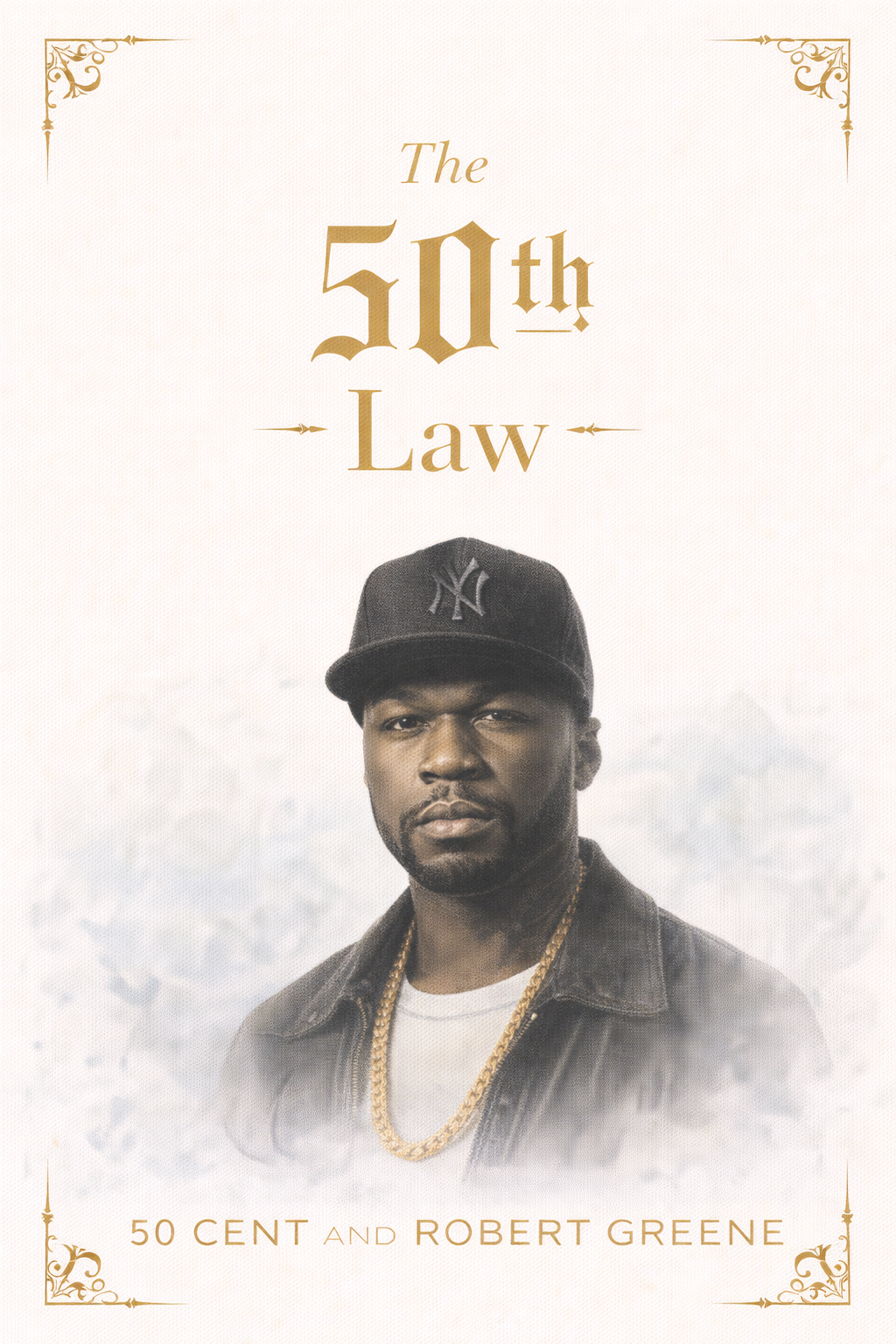
The 50th Law by 50 Cent & Robert Greene
This three-lecture audio course walks listeners through the complete teachings of The 50th Law by 50 Cent and Robert Greene, following the book's exact section structure from title page to final chapter. The first lecture covers the book's origin, the partnership between the rapper and the author, and the early concepts of intense realism that set the stage for a fearless mindset. It examines how the authors define fear, introduce the core premise that the greatest fear people have is being themselves, and lay out the initial principles of seeing reality as it is rather than as you wish it to be. This foundation establishes the practical, unsentimental lens through which the rest of the book operates. The second lecture focuses on self-reliance and opportunism, drawing from the middle chapters where the authors unpack calculated momentum, aggression, and authority. Listeners learn practical strategies for claiming ownership of every situation, transforming setbacks into opportunities, and building the bold, active mindset that distinguishes the fearless type, with historic and contemporary examples illustrating each law. The final lecture completes the framework with the last five laws: connection, mastery, self-belief, confronting mortality, and the ultimate synthesis of fearless living. It covers environmental awareness, disciplined practice, and limitless confidence, and treats the acceptance of death as a catalyst for bold action rather than a source of paralysis. Taken together, the three lectures show how these principles interlock to create lasting power and freedom, giving listeners the full arc of the book and a usable framework for applying it in their own lives.
Foundations of Fearlessness: From the Title Page to the First Real‑World Lessons
Foundations of Fearlessness: From the Title Page to the First Real‑World Lessons
Welcome to The 50th Law by 50 Cent & Robert Greene, a book that argues your fears are a prison you can escape by walking straight into them. What if the, the same mindset that keeps someone alive on the streets of Queens could also run boardrooms and record labels? 50 Cent is the stage name of Curtis James Jackson III, born in South Jamaica, Queens, New York, on July 6, 1975, and Robert Greene is an American author from Los Angeles, California, who wrote The 48 Laws of Power.
The authors argue that this single fiftieth law extends Greene's earlier forty-eight laws, pairing a street-hardened strategist with a scholarly observer of power. Greene expected a stereotypical gangsta rapper when they met, and instead found a disciplined, observant negotiator whose calm contradicted his public image. In the book's view, the drug economy was a brutal apprenticeship, because where misjudging someone could cost your life, you learn to read people fast.
His story anchors the argument: orphaned young after his mother was murdered, pushed into the street economy as a teenager, he built a radical self-reliance most people never need. Then, in 2000, he was shot nine times, including once in the face, and instead of living in fear afterward, he moved as if he had nothing left to lose. The authors contend this fearlessness is not bravado but a practiced discipline, rooted in total acceptance of reality and in acknowledging death itself.
The law itself is plain: your fears confine you within a limited range of action, and moving toward them breaks you out. The book promises ten principles drawn from 50 Cent's own language, pairing his life with figures like Napoleon, Malcolm X, and John D. Rockefeller, who each converted extreme adversity into advantage. And the, the paradox of a rapper channeling Stoic wisdom dissolves, the authors say, once you see that the street and the corporate arena are both hostile, competitive games of power and reputation.
The first principle is intense realism: seeing things exactly as they are, not as you wish them to be. Lying near death after the shooting, 50 Cent experienced a radical stripping away of illusions, recognizing he had naively ignored warning signs. Greene argues most people never shed their infantile narcissism; they filter reality through vanity, mistake self-opinion for how others see them, and surround themselves with voices that only confirm what they want to hear.
That denial, in the author's framing, makes people predictable and exploitable, while the realist gains a strategic edge simply by seeing what others refuse to see. Think of Ernest Shackleton's clear-eyed rescue of his crew, or Rockefeller's unsold, cold assessment of the coming oil oversupply crash. The methods are practical: seek negative feedback, read actions rather than words, observe people over time, study your own irrationality, and adopt the memento mori discipline of the Stoics and Samurai. After the shooting, 50 Cent rebuilt himself as a patient observer, converting realism into mixtape dominance and his deal with Eminem and Dr. Dre. Realism, as the author sees it, is not pessimism but clear sight, the prerequisite for everything that follows.
The Power of Self‑Reliance and Opportunism: Turning Adversity Into Advantage
What does a, a young hustler from South Jamaica, Queens understand about power that most employees never learn? The author argues that if you depend on a boss, a patron, or an institution, you become expendable the moment you stop being convenient, and 50 Cent, abandoned young and schooled by the drug trade, absorbed that truth early. The principle the book builds from it is making everything your own: dependence breeds fear and submissiveness, a kind of modern serfdom, while ownership turns every task into your personal enterprise and every setback into fuel for independence.
Last time we saw that intense realism, seeing things as they are, is the prerequisite for everything else, and here it gets tested. In the book's account, Columbia Records shelved his album after he was shot nine times in 2000, so instead of waiting for rescue he flooded the streets with independently produced mixtapes until the industry could no longer ignore him. That leverage, once Get Rich or Die Tryin' hit, let him secure ownership of his masters and his own imprint, G-Unit Records, exactly the kind of creative and financial control the author sees in Michelangelo facing down Pope Julius II and John D. Rockefeller owning every stage of oil production.
The second principle is opportunism, which the authors bluntly describe as turning, well, as they put it, turning shit into sugar. Being blacklisted became 50 Cent's chance to bypass gatekeepers entirely, and his hospital recovery became a period of strategic re-planning plus a powerful personal narrative, a double victory from one disaster. The author contrasts this with the victimhood mindset of resentment, blame, and waiting for rescue, which drains power, and instead points to Stoics like Epictetus and figures like Napoleon, Frederick Douglass, and Malcolm X, for whom adversity was resistance training for the mind.
Their practical framework is a reversal reflex: reframe negative events quickly before bitterness sets in, identify the openings adversity creates, and act boldly before others adjust, cold assessment followed by aggressive action. The author contends this is not naive optimism but disciplined sight, because people raised in comfort lack the emotional immune system that hardship builds. Adversity, in this view, is not the exception to strategy, it is the raw material.
But ownership and opportunism go nowhere without fluidity, the principle that rigidity leads to death while adaptation leads to power. Returning to Queens after the shooting, 50 Cent found the drug trade had shifted, so he chose reinvention over restoration, a move the author illustrates through Miles Davis's repeated stylistic reinventions, from bebop to Kind of Blue to Bitches Brew, each driven by daily experimentation rather than fixation on outcomes. The process-oriented mind treats setbacks as feedback; the goal-obsessed mind experiences them as verdicts. Mastery, as in the long apprenticeship under Jam Master Jay, is cumulative and cannot be shortcut.
The flip side of fearlessness is emotional discipline, because uncontrolled emotion is a form of slavery: anyone who can provoke you, controls you. The author argues that 50 Cent's near-death experience processed fear so completely that everyday provocations felt trivial, letting him bait rivals into overreacting while he stayed composed. And finally there is the strategic use of absence, since constant presence breeds contempt and habituation, while scarcity and calculated withdrawal create a void that makes others acutely aware of your worth. Own your work, exploit your adversity, stay fluid, stay composed, and know when to disappear. That, the authors say, is, that is really the whole architecture of fearlessness.
Connection, Mastery, Self‑Belief, and the Sublime: Completing the 50th Law
How long does real mastery actually take, and why does everyone who skips the wait eventually fall? In the book's view, our culture worships overnight fame, but the author argues that people who rise quickly without skill inevitably collapse under their own weight. The brain, the author contends, is built for slow, incremental learning, and no shortcut can bypass the roughly ten thousand hours that mastery demands.
Last time we saw that owning your work and exploiting adversity form the architecture of fearlessness, and this lecture completes that structure. The author frames 50 Cent's years grinding in Queens' underground hip-hop scene as the essential apprenticeship most observers never noticed. He wrote constantly, hustled mixtapes independently, and studied the business side of music after Columbia dropped him following the shooting. Those years, as the author sees it, gave him skills, self-knowledge, and leverage that instant celebrities never acquire.
Benjamin Franklin's self-directed apprenticeship as a printer and writer reinforces the same model, according to the author. The framework offered has three stages: deep observation of the field's rules, skill acquisition through repetition and tacit knowledge, then experimentation toward an individual style. Those who respect the process develop, what the author calls, a feel for the game. Those who skip it stay dependent on luck and validation forever.
The book then turns to what most people refuse to look at directly, which is death itself. The author argues that passive denial of mortality produces anxiety, attachment to status, and a numbed, half-lived existence. The alternative, drawn from Seneca, Marcus Aurelius, Montaigne, Zen Buddhism, and the Bhagavad Gita, is deliberate practice of memento mori. You rehearse loss through negative visualization, treat each day as possibly your last, and let finitude become the ultimate deadline that forces priorities into focus.
50 Cent's shooting in 2000, when he was struck nine times, serves as the book's anchor case for this confrontation. That brush with death, the author contends, burned away his fear of judgment, career setbacks, and conventional risk. It produced an audacity competitors lacked: he could part ways with labels and bet everything on Get Rich or Die Tryin'. Seneca's life offers the historical parallel, surviving near-execution under Caligula, exile, and eventually forced suicide with composure, because he had rehearsed loss daily and treated time as the only true possession.
Here is the strange part: the fruit of this practice is not gloom but what the authors call the sublime, a calm expansiveness where time feels more abundant, not less. The petty ego dissolves before something larger, whether through vast landscapes, deep art, or philosophy. Michelangelo worked into his late eighties, and Matisse invented paper cutouts while bedridden, which the author reads as proof that confronting decline can catalyze new creative forms. And no, you don't, you don't need to literally face death to access this state.
Disciplined reflection, hardship, travel, and deliberately frightening challenges can simulate the same confrontation, according to the author. But the author warns against both distortions: compulsive denial that breeds distraction and status games, and morbid obsession that paralyzes. The healthy path treats mortality as an advisor. Before each decision, ask whether the feared outcome truly matters given limited time. Set deadlines that impose finitude, periodically subtract comforts, and reframe aging as accumulated perspective rather than decline.
This closes the 50th Law's final logic: fearlessness culminates in accepting death, and from that acceptance flows the courage to act entirely on your own terms. Mastery supplies the substance, the internal structure and intuitive command of a craft. Mortality awareness supplies the urgency and freedom from social fear. Together, the author argues, they produce the complete fearless individual.
Patient enough to respect the process, present enough to live each project as if it were the last. Liberated from the small fears, ridicule, rejection, loss of status, that govern conventional lives, and that, the authors say, is the whole point of the book.