
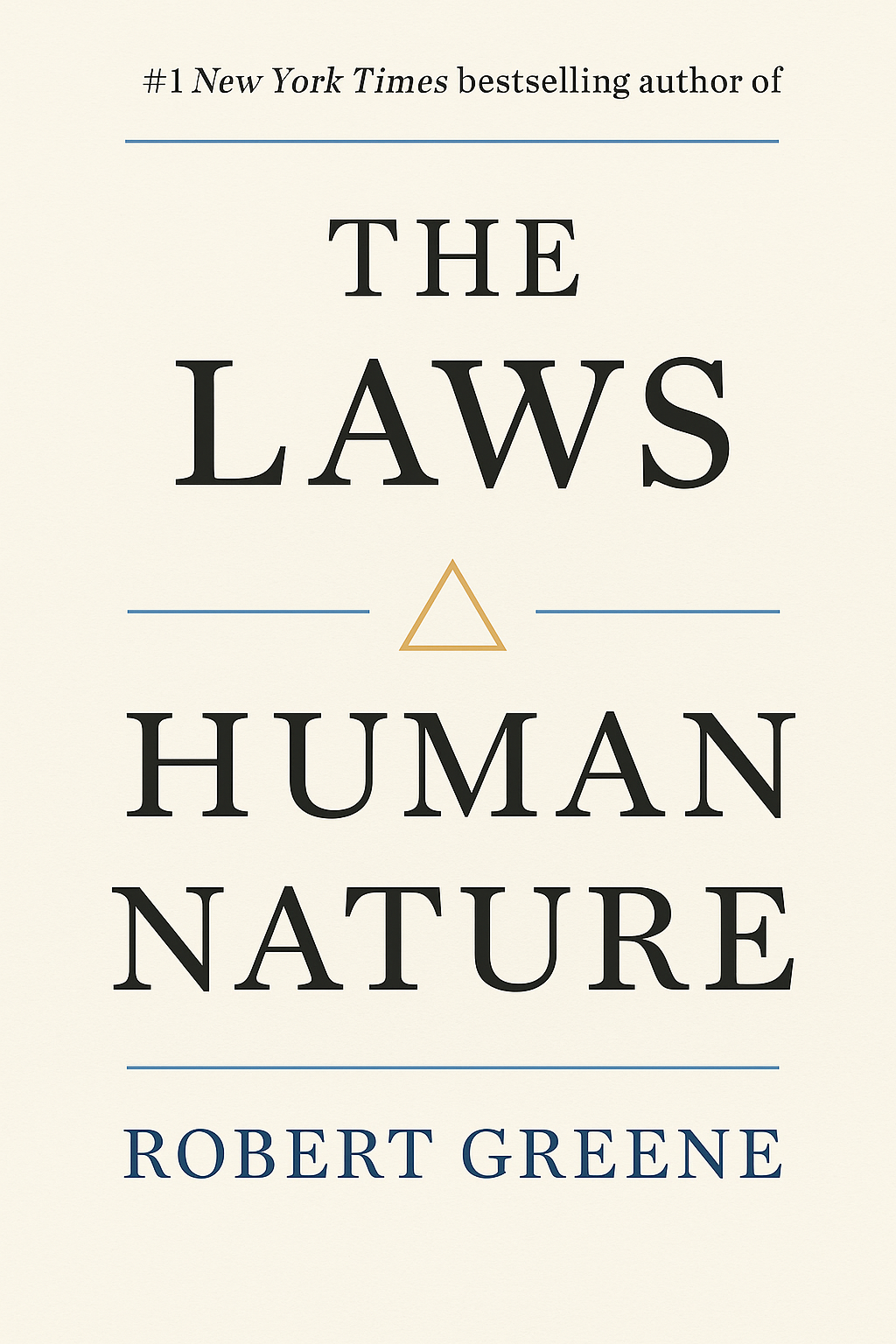
The Laws of Human Nature by Robert Greene
This nine-lecture audio course distills Robert Greene's "The Laws of Human Nature" into a structured program covering the hidden forces that shape human behavior. The course begins with the Law of Irrationality, teaching a three-step process to recognize biases, identify inflaming factors, and apply strategies that tame emotional impulses. It then moves through the narcissism spectrum, showing how self-absorption can be transformed into genuine empathy, and how to read people accurately while protecting yourself from toxic types. Later lectures examine the law of compulsive behavior, explaining how people's compulsions reveal the architecture of their character, and how covetousness fuels desire. The course also addresses shortsightedness and defensiveness, offering practical tactics for expanding your perspective and lowering others' resistance by confirming their self-opinion. The second half confronts the self-inflicted barriers of self-sabotage, repression, envy, and grandiosity, then analyzes rigid gender scripts and the law of aimlessness, showing how a clear sense of purpose redirects energy toward meaningful goals. You will learn to resist group conformity, manage the fickleness of followers, and channel aggression productively. The course also covers generational myopia, teaching you to recognize when your historical moment calls for decisive action. The final lecture addresses mortality, showing how accepting death sharpens priorities, and explains how the book's bibliography and index support continued study. Together, these lectures provide a complete roadmap for understanding yourself and others, with concrete strategies for lifelong mastery of human nature.
Mastering the Emotional Self: The Law of Irrationality
Mastering the Emotional Self: The Law of Irrationality
Welcome to The Laws of Human Nature by Robert Greene — a book that answers the question most of us run from: why do people, including you, act against their own interests so predictably? Greene claims the thing you trust most, your own reasoning, is often just a story your emotions wrote after the fact. And the man making that case? A writer who held roughly eighty jobs before he ever published a word.
Greene opens by attacking a cherished belief: that we are rational beings. He argues our behavior is actually governed by unconscious emotional forces and primal desires we refuse to examine. We construct post-hoc rationalizations for decisions that emotion already made. Drawing on evolutionary biology, the author describes a layered brain: the newer rational cortex sits atop far older emotional structures. Those older structures frequently override conscious thought without our awareness. This self-deception, in his view, is the root of most human misery, conflict, and failure. Intelligence offers no protection here. Even the most accomplished people fall prey repeatedly. The author calls his project radical realism, not cynicism. He wants us to see people as they actually are, not as we wish them to be. The stakes are real: those blind to these forces get manipulated by those who understand them. Self-awareness becomes a strategic advantage. Greene then catalogs specific biases that function like mental viruses. Confirmation bias makes us seek information that validates existing beliefs.
Conviction bias mistakes the intensity of a feeling for proof of its truth. Appearance bias judges by surface impressions and charisma. Then there's the group effect, where we adopt our social circle's beliefs without examination.
The list goes on, and it gets uncomfortable. Blame bias externalizes responsibility for our failures. Superiority bias means nearly everyone believes they are more competent and rational than average — which is, statistically, impossible. Yes, we can't all be above average, but we all feel we are. Shortsighted bias prioritizes immediate emotional relief over long-term consequences. Conformity bias aligns us with group norms even when they're clearly wrong. The most dangerous form, Greene warns, is high-grade irrationality. It masquerades as reason, so people genuinely believe they're thinking clearly while emotions steer every conclusion. So what's the antidote? The author points to Pericles, the Athenian statesman who faced panic, invasion, and plague. Pericles refused to be swept up in the emotional tide. He delayed decisions, absorbed public anger without reacting, and returned consistently to long-term strategy. He wasn't emotionless. He had learned to observe his own emotional states without being controlled by them. That's the model: cultivating what Greene calls the rational self.
The methodology starts with self-awareness — recognizing the physical signals that an emotional reaction is taking hold. Tension, urgency, the desire to lash out, the feeling of absolute certainty. He prescribes creating mental distance between stimulus and response. Slow down decisions in high-stakes situations. Actively seek disconfirming evidence. Abraham Lincoln practiced this by writing angry letters he never sent. Disciplined emotional processing, one unsent letter at a time. The author also introduces negative capability: tolerating uncertainty without rushing to premature conclusions. The goal is observation, not suppression. Emotions carry information and energy. Productive ones like enthusiasm and curiosity can fuel excellent work. Reactive ones like envy, resentment, and anxiety distort judgment. Finally, Greene addresses the social dimension of irrationality. Humans evolved in small tribal groups, so our brains are exquisitely sensitive to social approval and rejection. That vulnerability enables groupthink, mob mentality, and mass delusion when social contagion takes hold. The author recommends cultivating a strong internal identity and values as an anchor against conformity pressure.
Deliberately seek out dissenting opinions and people who challenge rather than validate your thinking. The overarching frame is transformation. You move from passive victim of human nature to active, clear-eyed observer. Rationality is not a natural state. It's a discipline, Greene insists, one you must actively practice and maintain. It underlies every other form of competence — leadership, persuasion, creativity, and interpersonal skill. Master this first law, and the rest of the book becomes possible.
From Self‑Love to Empathy and the Masks We Wear
Last time we left off with a hard truth: your emotions write the story, and your reason signs it afterward. Today the author turns the lens outward, toward other people, and asks why we fail so badly at reading them. The answer, he argues, starts with narcissism, and not the kind you think.
The author calls this the Law of Narcissism. Most people, he contends, walk around with their attention pointed inward, at their own feelings, desires, and worries. That default self-focus, in his view, causes most interpersonal failures. The fix isn't self-erasure. It's empathy, which he frames as a learnable skill, not an innate gift. Genuine empathy is a discipline. It means consciously redirecting your attention outward, again and again. And no, being emotionally sensitive doesn't count. That's often just projection wearing empathy's clothes. So what does real empathy look like? The author describes what he calls visceral attunement. Truly empathic people listen with their whole body, not just their ears. They notice posture, tone, micro-expressions, the energy a person gives off. The progression he outlines is concrete. First, cultivate genuine curiosity about someone's inner world while suspending judgment. Then attend to physical and emotional cues, especially the ones that contradict their words. Finally, develop analytic empathy.
That means using what you know of a person's background to understand why they think and feel as they do. The payoff is practical: people who feel understood become loyal and cooperative. People who feel unseen get defensive and resistant.
Now the second law, and it's, it's where things get strategic. The author calls it the Law of Role-playing. From childhood, he argues, we learn to perform, presenting a socially acceptable face while suppressing fear, envy, and weakness. In any social or professional setting, you're almost never dealing with people as they truly are. You're dealing with their performance. The gap between the mask and the reality beneath it is where misunderstanding and manipulation flourish. Reading through masks is both defensive and offensive. It protects you from deception and enables deeper influence. So how do you actually read a mask? Words, the author insists, are the least reliable channel, because they're the easiest to control. Instead, watch micro-expressions that flash across the face before the mask snaps back. Listen for shifts in pitch, pace, hesitation. Read the body. Posture, the direction of feet and torso, self-touching, openness or closure. A critical concept here is baseline behavior. You can't spot a deviation until you know what a person looks like relaxed and neutral.
A sudden stiffness, an odd laugh, a shift in vocal tone, those are the tells. He warns against fixating on any single cue. Read clusters of signals, and watch people under stress or when they think nobody's looking. Those moments strip the performance away. The author also identifies recurring mask types. The Performer, the Pleaser, the Rescuer, the Passive Aggressor, each driven by a distinct emotional need. And here's the uncomfortable part. The most dangerous individuals are often the ones whose masks are most convincing. Which brings him to the deeper requirement: self-awareness. Our own biases and desires distort perception, making us see what we wish to see. The people most easily deceived are often the least aware of their own blind spots. The discipline runs both directions. Calm observation of others, and clarity about your own tendencies. Greene insists this isn't cynical manipulation. When you see people clearly, you can respond to who they actually are, not the role they're playing.
And past behavior, observed over time, remains the best predictor of what comes next. Master that, and you hold one of the most valuable capabilities a person can possess.
Decoding Character Strengths and the Desire to Be Desired
Last time we watched people perform, and learned to read the masks they wear. Today the author asks a stranger question: why do we want what we can't have, and why does having something easily make it worthless to us? His answer is the Law of Covetousness, and it's, it's not flattering.
The author argues that desire isn't triggered by what's present and fully understood. It's triggered by what stays partially out of reach. When something is scarce or hard to get, the mind assigns it greater value. When it's everywhere and completely legible, it loses all power to fascinate. Availability kills attraction. So do transparency and eagerness to please. The person who explains everything, who's always there, who needs you too obviously, becomes invisible almost overnight.
His recurring example is Coco Chanel, who engineered her own mystique with real precision. She revealed just enough of her past to intrigue while deliberately obscuring anything that might make her seem ordinary. Her power came not from talent alone but from her refusal to fully explain herself. People never knew where they stood with her. So they stayed perpetually uncertain, and therefore perpetually engaged. The author frames covetousness not as a moral failing but as a social force you can consciously direct.
The practical strategies are consistent throughout. He recommends intermittent absence, withdrawing from circles periodically so your presence lands harder when you return. Keep a rich inner life and outside interests others aren't privy to, because that signals depth and independence. Cultivate ambiguity. Don't explain yourself fully, let people work to interpret you, since that effort itself generates attachment. Association with prestigious people and places amplifies desirability too, because desire is contagious. People rarely want things in isolation, they covet what others appear to want. He draws on medieval courtly love, where obstacles and distance were built into the pursuit because the chase itself was the pleasure. And he warns against the opposite tendencies: over-sharing, seeking constant validation, making your needs obvious. All of it signals insecurity and collapses the mystery. Enough warmth to draw people in, enough independence to keep them curious.
Then the lecture pivots to the Law of Shortsightedness, a different but equally dangerous wiring. We naturally focus on what's immediate, visible, and emotionally charged, while undervaluing what's distant or slow-moving. The author calls this an evolutionary inheritance. Quick reactions to immediate threats once served survival, but now they're a liability. The most consequential forces, social trends, institutional decay, the slow accumulation of resentment, operate on timescales our instincts can't track. So we're perpetually surprised by outcomes that were entirely predictable. We react to crises years in the making and mistake temporary conditions for permanent realities.
The antidote is disciplined elevation of perspective. Detach from the present moment, he says, and ask what a situation looks like in five, ten, or twenty years. He points to Abraham Lincoln, who absorbed criticism during the Civil War rather than deciding in haste, and achieved outcomes reactive leaders would have squandered. Study history, he urges, to recognize recurring patterns in panics and upheavals. It grants a kind of temporal x-ray vision. He also names the social forces that reinforce shortsightedness. Crowds amplify short-term emotional reactions, creating feedback loops where everyone validates everyone's myopia. The person holding the longer view gets isolated or dismissed until events prove them right, as with the investors who saw the 2008 housing bubble coming. Reactive thinking exhausts us. Strategic thinking, driven by a clear sense of future position, is what he wants instead. He recommends journaling about long-term goals, scheduling regular strategic reflection, and cultivating advisors outside your emotional field.
At the organizational level, he contrasts firms destroyed by quarterly pressure and manufactured false urgency with Toyota, which built decades of value through methodical patience. The thread connecting both laws is simple: power comes from working against instinct. Resist the urge to be fully available, and resist the pull of the immediate.
Broadening Perspective and Softening Defensiveness
Last time we saw how chasing the immediate blinds us to slow-moving forces. Today the author aims his lens at two invisible structures that quietly run our lives: self-image and attitude. One governs how we influence others, and the other governs how we sabotage ourselves.
The author calls the first one the Law of Defensiveness, and it starts with a hard truth. People are deeply protective of their self-image, which insists they are competent, good, and reasonable. Threaten that image and you trigger automatic resistance. Argument, criticism, even gentle contradiction, all read as attacks. So the skilled influencer works with the self-image, never against it. Which means, yes, your brilliant logic is usually the problem, not the solution.
The techniques he offers are concrete. Mirror people's values and language back to them, so they hear themselves in your words. Give them ownership over decisions, because people act most freely when they feel the choice is theirs. And practice what he calls strategic empathy, deliberately seeing the world through another person's eyes. Not as altruism, as a tool. The author warns that rational argument backfires because it implicitly challenges someone's intelligence or moral standing. The best communicators make others feel smart, capable, and good. Even while steering them somewhere specific. That takes suppressing your own ego, your need to be right. And it compounds, because people gravitate toward whoever makes them feel good about themselves.
Then the author turns the lens inward, to the Law of Self-sabotage. Most people, he argues, blame their unhappiness on external forces, bad luck, difficult people, unfair systems. But their own ingrained attitudes are the real architects. He draws on the psychologist Alfred Adler, who broke from Freud to claim that goals and attitudes, not past traumas, determine behavior. People with identical difficult backgrounds can arrive at radically different outcomes depending on the lens they adopt. He catalogs the patterns: the hostile attitude that reads neutral signals as threats, the anxious one that avoids risk, the avoidant one that retreats into fantasy. The depressive attitude makes helplessness self-fulfilling, and the resentful one locks people in bitterness. Crucially, these are learned responses, not fixed traits. They can be identified and changed.
His central example is Anton Chekhov, who grew up in poverty under a tyrannical, abusive father. Chekhov consciously worked to, his words, squeeze the slave out of himself drop by drop. He deliberately cultivated openness, warmth, and curiosity, and it shaped both his writing and his relationships. The author's framework starts with tracing recurring patterns, the conflicts and missed opportunities that repeat across different contexts. Then recognizing limiting beliefs as interpretations, not objective truths. Then applying what he calls the reversal, actively cataloging evidence that contradicts your negative assumptions. That's discipline, not positive thinking. He also says act as if you already have the attitude you want, because behavior and attitude reinforce each other. And he warns against the seductive comfort of cynicism and victimhood, which feel sophisticated but function as excuses. Perception is the lever of change. Change how you interpret events and you change the world you inhabit, no external shift required.
So both laws share one thread, and it's worth pausing on. People act and think most freely when they don't feel judged or threatened, and circumstances shift when the internal orientation that created them shifts first. Perception is the lever. The author frames this internal work as among the highest forms of self-mastery available. Because it operates at the source, the level where all experience begins. Change what you notice, how you interpret events, and what emotions you cultivate, and you effectively change the world you inhabit. No external conditions required.
And here's the part that, that catches most readers off guard. Self-sabotage is not destiny, the author insists, it's a habit of mind. A habit that, once identified, can be systematically dismantled and replaced. Replaced with attitudes that generate connection, opportunity, and resilience instead. That's the whole promise of this lecture. Master the self-image in others, and the attitude in yourself, and you hold both levers at once.
Overcoming Self‑Sabotage, Repression, Envy, and Grandiosity
Last time we saw that your attitudes, not your circumstances, build the world you live in. Today the author takes on an emotion almost nobody admits to feeling. He calls it the Law of Envy, and it's, it's the one force he says we're most blind to.
The author argues that envy is hardwired into us because we're comparative creatures. We measure success not in absolute terms but relative to the people around us. That's why a stranger's triumph rarely stings, but a peer's success can feel like a personal insult.
Envy strikes closest to home. It hits hardest between people close in age, profession, or social position, because that gap feels both insulting and closeable. The colleague who gets promoted, the sibling who buys the bigger house, those are the wounds that fester. And here's the uncomfortable part, the author says envy almost never shows its face directly.
Instead, he argues, it disguises itself as moral outrage, harsh criticism, or backhanded compliments. It shows up as sudden coldness after your good news, or sabotage dressed as helpfulness. The root, in his view, is the fragile ego, an unstable sense of self-worth that experiences another's success as an attack.
Envy also has a destructive streak, a wish to see the envied person brought down, not just to acquire what they have. It targets what seems effortless or unearned, which is why natural success provokes more resentment than visible struggle. The author splits it into micro-envy between colleagues and siblings, and macro-envy aimed at distant celebrities. The first kind, he insists, is far more corrosive, because it operates where you actually live and work.
So how do you defend yourself when you become the target? The author's first principle is that the most envied people aren't the most successful, just the ones who display success too openly. Learn to read the disguised signals early, disproportionate criticism, faint praise, or a subtle chill after your achievements.
Then he offers concrete deflections. Strategic modesty means downplaying advantages and attributing success to luck, effort, or collective help. Share the credit. Make others feel included, even display your own vulnerabilities to humanize yourself. Give potential enviers a sense of participation, or let them feel superior in some domain. But he warns these gestures must be genuine, because transparent flattery or false modesty backfires and intensifies resentment.
He also cautions against reassuring envious people with excessive kindness, which only draws attention to the gap between you. The durable strategy is building relationships on genuine mutual respect and shared purpose. Now flip it around, because the author turns the lens inward too.
Unacknowledged envy, he argues, poisons judgment and leads to bitterness and stagnation. Rather than suppressing it or dressing it up as moral disapproval, treat irritation at another's success as diagnostic data. It reveals what you actually want. The transformative move is converting destructive envy into what he calls emulative envy, studying how the envied person succeeded and using it as a model. The antidote to chronic envy is a secure internal foundation, a strong sense of your own identity and direction.
Accepting that envy exists, in yourself and in others, is maturity, not cynicism. Those who think they're immune are the most vulnerable to sabotage from apparent allies. Read the signals, deflect with grace, and channel your own envy into striving.
So here's where it all lands, and it's, it's simpler than you might expect. The author treats envy awareness as a core social skill, like reading masks or managing attitudes. Notice it, name it, and it loses most of its power over you.
The stakes are real, because envy operates where trust matters most. The sabotage that hurts comes from colleagues and friends, not strangers, and it wears the face of support. That's what makes it dangerous.
So run the check the author prescribes. When someone's success irritates you, ask what that feeling is telling you about your own ambitions. Then study how they got there, and get to work.
Balancing Gender Dynamics and Finding Purpose
Last time we learned to catch envy wearing its disguises, in others and in ourselves. Today the author asks a question that cuts deeper than any law so far. What if you were trained, from childhood, to abandon half of who you are?
The author calls this the Law of Gender Rigidity, and his claim is bold. Through cultural conditioning, parental influence, and social pressure, most people suppress roughly half of their psychological potential. Men are trained to deny empathy, receptivity, and aesthetic sensitivity, while women are pushed to bury assertiveness, risk tolerance, and directness. He draws on Carl Jung, who named the feminine within men the anima, and the masculine within women the animus. And here's the key. The author argues these repressed qualities don't disappear. They operate unconsciously, and often destructively. In men, the author contends, the buried anima surfaces as irrational emotional outbursts. The tough guy who explodes over nothing, that's not strength, that's leakage. In women, he says, the suppressed animus shows up as rigid, domineering behavior. The result is an internal division that narrows emotional range and generates chronic conflict. It also drives projection, where we dump our disowned qualities onto romantic partners.
We demand they complete us psychologically, and that demand breeds dependency and resentment.
So what does integration actually look like? The author's paradigm case is Queen Elizabeth the First, and she's, she's worth pausing on. She combined traditionally masculine political cunning and strategic ruthlessness with traditionally feminine emotional sensitivity. That combination made her exceptional. She could play the game in a male-dominated political world while inspiring deep personal loyalty. Leonardo da Vinci, Coco Chanel, and Abraham Lincoln appear too, each drawing fluidly on both energies. Lincoln paired extraordinary empathy with iron strategic resolve, which is rarer than it sounds. And the author is careful about one thing, so let's be clear. He's describing psychological qualities on a spectrum within every individual, not biological sex or social gender identity. He explicitly distances himself from identity politics here. In his framing, gender fluidity is a strategic asset, not a fixed identity category. Creative people across history, including male artists and composers, describe their most productive states as accessing a receptive, fluid, feminine mode of consciousness.
The muse, it turns out, is internal.
The practical framework unfolds in stages, and the first is honest self-assessment. Identify which qualities you've suppressed, and watch for moments of overreaction or inexplicable attraction. Strong irritation toward the opposite gender, the author says, often signals projected anima or animus energy. Second comes deliberate practice, and his advice splits by tendency. Men are told to slow down in conversations, listen deeply, cultivate aesthetic awareness, and trust intuitive responses. Resist the urge to immediately problem-solve, which, yes, is harder than it sounds. Women are advised to practice strategic detachment, take on more risk, speak directly, and set boundaries. Stop accommodating everyone.
But the author warns against overcorrection, and this matters. Men becoming passive or emotionally manipulative in the name of sensitivity miss the point entirely. Women turning needlessly combative or cold in the name of assertiveness miss it too. True integration means holding both sets of qualities simultaneously, deploying them with situational intelligence. You're not swapping one half for another, you're reclaiming the whole. Then comes sustained reflection, folding these experiences into your self-concept rather than treating them as anomalies. The closing argument frames this as both liberation and strategy. Gender rigidity, in the author's view, is self-limitation imposed from outside, serving conformity at the expense of individual power. The psychologically complete person gains a wider repertoire of responses and becomes more persuasive through genuine empathy. They develop a richer inner life that fuels creativity, and they no longer need others to complete them. That's real independence. The author calls this internal wholeness one of the most important investments a person can make.
It's a lifelong practice, not a destination. Continuous self-awareness, honest examination, and the willingness to tolerate discomfort against ingrained conditioning. That's the price, and the author says it's worth paying.
Resisting Group Conformity and Managing Fickleness
Last time we reclaimed the half of ourselves that conditioning buried. Today the author asks what happens to your mind when you're surrounded by other minds. His answer is the Law of Conformity, and it's, it's not flattering.
The author's claim is unsettling: in groups, individual intelligence and moral judgment deteriorate rather than improve. The social brain, evolved to manage belonging and status, becomes hyperactivated and overrides deliberate reasoning. This isn't weakness, it's biology, because for our ancestors exclusion from the group meant death. The author describes viral emotions, where fear becomes panic, excitement becomes mania, and anger becomes mob rage. Feelings spread and amplify. Even smart people get cognitively compromised, which is, yes, the uncomfortable part.
He draws on Solomon Asch, whose experiments showed people denying their own senses to avoid contradicting the group. Gustave Le Bon's crowd psychology appears too, tracing how collective settings dissolve independent thought. The mechanism is simple and chilling. People stop asking whether something is true or right, and start asking what the group thinks. And this operates everywhere, not just in mobs. Boardrooms, military units, political cabinets, workplaces, even families exert the same quiet pressure. History's greatest disasters came from suppressed dissent, not individual stupidity.
So what's the antidote? The author prescribes a court of opinion within, an internalized sense of self that resists group validation. He rejects both extremes, neither antisocial withdrawal nor reflexive contrarianism. Instead, participate outwardly while preserving independent judgment inwardly. His strategies are concrete. Watch for the cues of group influence, a certainty that seems to come from the crowd, reluctance to voice doubts, mirroring the mood around you. Adopt the observer's eye, stepping back like an anthropologist watching the dynamics unfold. Notice when contagion spreads. Maintain relationships outside your primary circle, since isolation within one group accelerates conformity. Study the shadow culture, the unspoken rules and real power dynamics beneath stated norms. Find at least one trusted ally inside the group for candid conversation. Preserve a private mental space, through journaling or inner monologue, where group pressures cannot intrude. He warns against charismatic leaders who demand total surrender of judgment.
And watch for the us versus them dynamic, because demonizing outsiders signals a group has lost its rational footing. That's the clearest warning sign.
Here's the twist most readers miss: leaders become victims too. Subordinates filter information, telling leaders what they want to hear, and echo chambers distort reality. Leaders become prisoners of the image followers project, performing rather than thinking. Military commanders surrounded by yes-men have made catastrophically poor decisions that seemed rational inside their bubble. The feedback loop validates everyone's biases. The author's fix is structural: solicit dissent, reward bad news, and periodically step outside the group's frame. He admits resisting conformity is genuinely uncomfortable, since we're wired for belonging. But dissenters, scientists, executives, soldiers who refused unethical orders, were almost always proven right in retrospect. Manage the social costs strategically: choose battles, frame dissent around the group's stated values, build credibility first. Time your challenges for receptive moments, and know when the group is right versus leading everyone toward error.
Groups that tolerate dissent consistently outperform those that suppress it. The independent thinker becomes an anchor of rationality, protecting something precious and fragile. Individuality requires active defense. That's the discipline, and the author says it's worth every uncomfortable moment.
Last time we reclaimed the half of ourselves that conditioning buried. Today the author asks what happens to your mind when you're surrounded by other minds. His answer is the Law of Conformity, and it's, it's not flattering. The author's claim is unsettling: in groups, individual intelligence and moral judgment deteriorate rather than improve. The social brain, evolved to manage belonging and status, becomes hyperactivated and overrides deliberate reasoning. This isn't weakness, it's biology, because for our ancestors exclusion from the group meant death. The author describes viral emotions, where fear becomes panic, excitement becomes mania, and anger becomes mob rage. Feelings spread and amplify. Even smart people get cognitively compromised, which is, yes, the uncomfortable part. He draws on Solomon Asch, whose experiments showed people denying their own senses to avoid contradicting the group. Gustave Le Bon's crowd psychology appears too, tracing how collective settings dissolve independent thought. The mechanism is simple and chilling.
People stop asking whether something is true or right, and start asking what the group thinks. And this operates everywhere, not just in mobs. Boardrooms, military units, political cabinets, workplaces, even families exert the same quiet pressure. History's greatest disasters came from suppressed dissent, not individual stupidity.
So what's the antidote? The author prescribes a court of opinion within, an internalized sense of self that resists group validation. He rejects both extremes, neither antisocial withdrawal nor reflexive contrarianism. Instead, participate outwardly while preserving independent judgment inwardly. His strategies are concrete. Watch for the cues of group influence, a certainty that seems to come from the crowd, reluctance to voice doubts, mirroring the mood around you. Adopt the observer's eye, stepping back like an anthropologist watching the dynamics unfold. Notice when contagion spreads. Maintain relationships outside your primary circle, since isolation within one group accelerates conformity. Study the shadow culture, the unspoken rules and real power dynamics beneath stated norms. Find at least one trusted ally inside the group for candid conversation. Preserve a private mental space, through journaling or inner monologue, where group pressures cannot intrude. He warns against charismatic leaders who demand total surrender of judgment.
And watch for the us versus them dynamic, because demonizing outsiders signals a group has lost its rational footing. That's the clearest warning sign.
Here's the twist most readers miss: leaders become victims too. Subordinates filter information, telling leaders what they want to hear, and echo chambers distort reality. Leaders become prisoners of the image followers project, performing rather than thinking. Military commanders surrounded by yes-men have made catastrophically poor decisions that seemed rational inside their bubble. The feedback loop validates everyone's biases. The author's fix is structural: solicit dissent, reward bad news, and periodically step outside the group's frame.
He admits resisting conformity is genuinely uncomfortable, since we're wired for belonging. But dissenters, scientists, executives, soldiers who refused unethical orders, were almost always proven right in retrospect. Manage the social costs strategically: choose battles, frame dissent around the group's stated values, build credibility first. Time your challenges for receptive moments, and know when the group is right versus leading everyone toward error. Groups that tolerate dissent consistently outperform those that suppress it. The independent thinker becomes an anchor of rationality, protecting something precious and fragile. Individuality requires active defense. That's the discipline, and the author says it's worth every uncomfortable moment.
Navigating Aggression and Seizing Historical Moments
Last time we saw how groups dissolve independent judgment, and how leaders become prisoners of their own echo chambers. Today the author finishes one law and opens a darker one. He asks what happens when hostility stops announcing itself and starts wearing a smile.
The author first wraps up the Law of Fickleness, and his core claim is this. Authority is never a static achievement, it must be continuously renewed and actively managed. Followers, he argues, project their ideals onto leaders, then feel disillusioned when those leaders reveal human limitations. The most effective ones cultivate genuine presence, combining authentic confidence, emotional self-control, and the ability to make people feel seen. Charm alone collapses under pressure. Followers sense the hollowness beneath the performance the moment circumstances turn difficult. His strategies for sustaining authority are concrete. Project consistency in values while adapting tactics, and tie loyalty to a shared mission rather than your personality. Use symbolic gestures and rituals that reinforce group identity over time. He warns against over-reliance on fear or material rewards, because those produce compliance, not genuine commitment. Crisis becomes the critical test. Leaders who acknowledge mistakes honestly and treat followers as intelligent adults deepen trust. Those who deflect blame accelerate its erosion.
On internal dissent, he advises drawing critics into dialogue, since suppression creates martyrs and underground opposition. And yes-men, he insists, are the quietest disaster, cutting leaders off from reality before discontent becomes crisis.
Then the lecture pivots to the Law of Aggression, and here's the uncomfortable truth. Aggression is a primal, universal drive that doesn't disappear in civilized society, it goes underground. It hides beneath politeness, charm, and apparent goodwill. The author distinguishes overt aggression from the far more common passive aggression, indirect hostility expressed through chronic helplessness, guilt-tripping, and victimhood performances. He introduces the aggressor type, a personality that channels competitive drives through social camouflage. Warmth itself becomes a weapon. Envy functions as the primary engine here, and people rarely admit it even to themselves. They rationalize hostile behavior as righteous criticism or principled concern instead. His advice is to track behavioral patterns over time, not react to isolated incidents. Subtle put-downs disguised as jokes, advice that undermines confidence, manufactured crises, consistent victim-playing when confronted. Those are the tells. So how do you respond? The author recommends maintaining emotional distance and refusing to take the bait when provoked. Deny aggressors the reaction they seek.
Then he turns inward, introducing controlled or rational aggression, the deliberate, goal-oriented channeling of your own aggressive energy into focused work. Not suppressing it entirely, not unleashing it destructively. Directing it. Great leaders, artists, and entrepreneurs, he shows, have harnessed aggressive drives to fuel ambition and competitive excellence. People who deny their aggression often become passive-aggressive, resentful, or ineffective. Those who acknowledge and direct it maintain greater psychological clarity. He also warns against projecting benign motivations onto others, a natural bias that makes us susceptible to manipulation. The unifying thread across both laws is a call for clear-eyed, unsentimental understanding of human nature. Recognize the fickleness of followers and the disguised hostility of competitors. That recognition, the author insists, is the essential foundation for lasting influence and self-protection. See people as they are, not as you wish. Master both currents, the shifting loyalty of crowds and the hidden aggression behind smiles, and you hold the levers of influence.
It's uncomfortable work, but the author says it's the only work that counts.
Reflecting on Mortality, Sources, and the Complete Guide
Last time we saw how aggression hides behind smiles, and how channeling it beats suppressing it. Today the author closes with a law about time itself. He calls it the Law of Generational Myopia, and it asks why you can't see the water you swim in.
The author argues every generation develops a distinct spirit, forged by the traumas and opportunities of its formative years. Yet people remain largely blind to these shaping forces, mistaking conditioned responses for timeless truths. Your preferences, he contends, are often artifacts of a particular historical moment, not personal choices. This myopia causes people to misread trends, misjudge timing, and make decisions that feel rational but are actually generational groupthink. The trap is invisible. You can't correct a bias you don't know you have. The antidote, he says, is disciplined historical self-awareness, the capacity to inhabit your own time while observing it from a distance. So how do you build what he calls a generational radar? Because each generation defines itself in opposition to its predecessor, he urges careful study of the cohort before you. Understand what they valued, feared, and overemphasized, and you can anticipate what the rising generation will reject. Equally important is watching the youngest adults, whose frustrations mark the leading edge of cultural change.
Study the formative events too, wars, crises, technological revolutions, that imprint psyches for decades. Napoleon succeeded by sensing his era. Not luck, the author insists, but cultivated clarity plus the courage to act on it.
The central theme here is unmet emotional needs. Every generation carries psychic wounds and unfulfilled desires from its formative experiences. These undercurrents, what people hunger for and feel is missing, represent enormous opportunities for those who address them directly. His framework for reading the spirit of the times involves immersing yourself in popular culture, slang, and current obsessions. Then identify the anxieties running beneath public discourse, and channel those energies into your work. But authenticity matters. People sense manipulation versus genuine understanding, and cynical pandering backfires. He warns against two symmetrical traps: nostalgia that idealizes a past era, and presentism that assumes whatever is new is automatically superior. Both errors fail to think historically.
The psychological core requires a kind of ego dissolution. You must question values absorbed simply by living through a particular moment. The author illustrates the cost with businesses and figures that couldn't adapt to a shifting generational mood.
They spoke the language of a passing era while their audience had already moved on. His ultimate argument is that history isn't something that happens to you. It's a force you can read. Every generation faces a unique window of circumstances, technologies, and tensions that will never recur the same way. Those who recognize it and act decisively can shape history itself. Those locked in generational assumptions find their ideas failing without understanding why. Wisdom is surfing the waves, not drowning. That's the author's closing vision, and it completes the journey we've taken together.
So here we are, at the end of a long road together. Nine lectures on human nature, and the author leaves us with mortality itself. Not a, a light closing, but an honest one. The author argues that death awareness, not denial, is what gives life urgency and shape. Most people, he says, push mortality out of mind, and that avoidance makes them passive. They drift, deferring the work that matters, as if time were unlimited. His prescription is the opposite: keep death close, deliberately, as a clarifying force. Mortality becomes a compass. When you measure choices against a finite life, trivialities fall away fast. Urgency is the gift death offers. A strange gift, yes, but the author insists it's the real one. He also turns to his sources, and this part matters for how you read him. The book draws on evolutionary psychology, historical biography, and classical philosophy in equal measure. Figures like Pericles, Napoleon, and Chekhov aren't decoration, they're evidence.
The author treats history as a laboratory for human behavior, tested across centuries rather than semesters. Patterns repeat because nature repeats. That's why he returns to the same names again and again. The claim is that these laws hold across eras, cultures, and circumstances. Human nature is the constant. Everything else, the technology, the costumes, changes around it. And the complete guide, taken whole, is really one argument in many forms. Every law we've covered points the same direction: see clearly, then act deliberately. Rationality over reactivity, empathy over projection, strategy over impulse. The author never promises this is easy, only that it's learnable. Discipline, not talent. He frames mastery as a lifelong practice, maintained daily, never finished. Awareness is the beginning of power. And power, in his sense, means influence over your own life first. So that's the journey, from irrationality to mortality, and everything between. The masks, the envy, the groups, the aggression, the generations, all one map.
The author's final wish is that you use it, not just admire it. Read people as they are, read yourself the same way, and act on what you find. That's the whole guide. It fits in one sentence, and it takes a lifetime. Start now, he says. Thank you for walking all nine lectures with me. Go use what you've learned.