
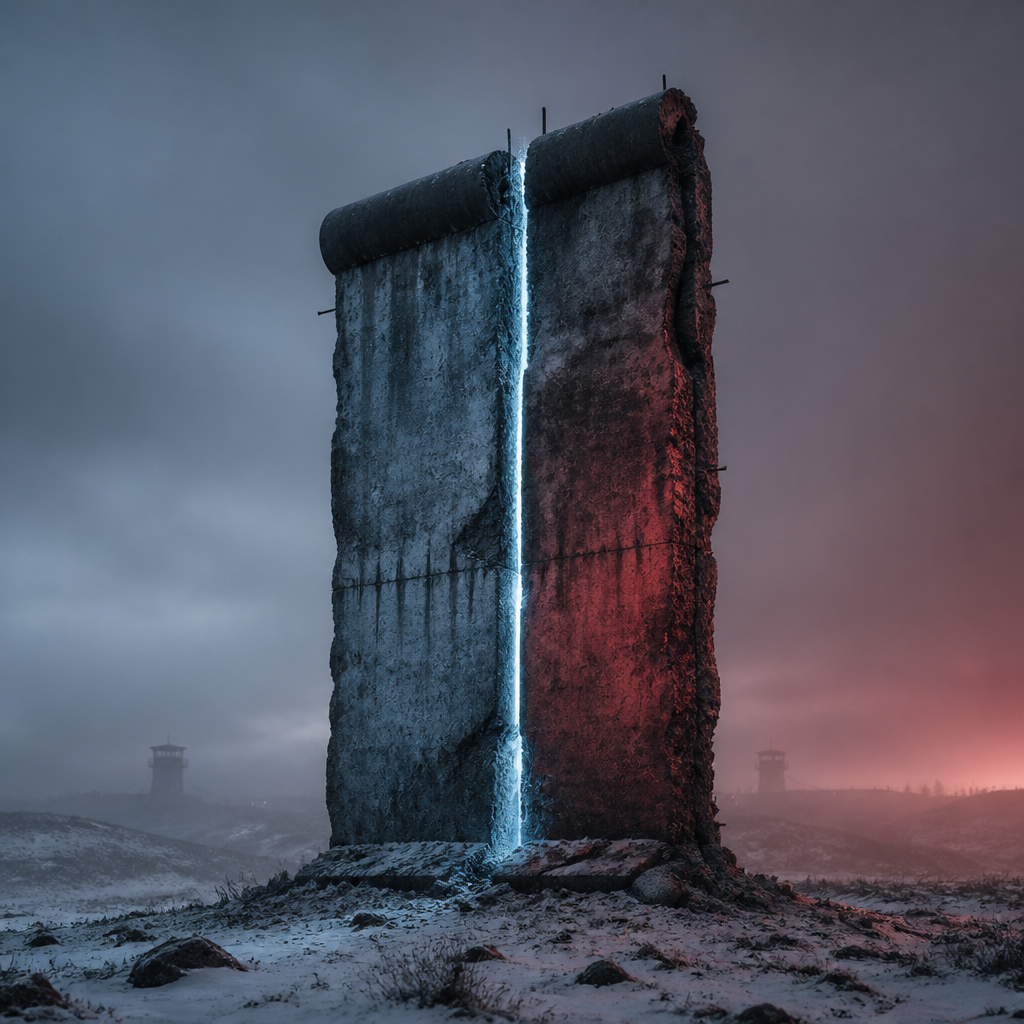
From Allies to Enemies: How the Cold War Began
This six-lecture audio series traces the Cold War from its post-World War II origins to the Soviet collapse in 1991. The opening lecture covers the unraveling of the wartime alliance: the Yalta and Potsdam conferences of 1945, George Kennan's Long Telegram, Churchill's Iron Curtain speech, and the Truman Doctrine and Marshall Plan of 1947, which together established containment as American policy. The second lecture turns to the first concrete confrontations—the 1948 Berlin Blockade and the Allied Airlift that answered it, NATO's founding in 1949, and the Korean War of 1950-1953—showing how containment became armed commitment. The third lecture examines the nuclear dimension: the Soviet 'Joe-1' atomic test in 1949, the American hydrogen bomb test 'Ivy Mike' in 1952, the doctrine of Mutually Assured Destruction, and the civil defense culture of duck-and-cover drills and fallout shelters. The fourth lecture follows the rivalry into space, from Sputnik in 1957 and Gagarin's orbit in 1961 to Kennedy's Moon pledge and the Apollo 11 landing in 1969, each framed by both sides as proof of ideological superiority. The final two lectures cover the thaw and the endgame. The fifth lecture details détente through the SALT I and ABM treaties of 1972, the Helsinki Accords of 1975, and Nixon's 1972 visit to China, while also explaining why the relaxation of tensions eventually broke down. The concluding lecture traces the 1980s: Reagan's 'Evil Empire' speech and Strategic Defense Initiative, Gorbachev's perestroika and glasnost reforms, the 1989 revolutions in Eastern Europe and the fall of the Berlin Wall, and the formal dissolution of the USSR in December 1991. Several lectures use two-speaker dialogues—a historian paired with a Berlin diplomat, a NASA engineer with a Russian space historian, a political analyst with a former Soviet negotiator—to present contrasting perspectives on each turning point. The result is a chronological account of how a bipolar world order formed, hardened, negotiated, and finally dissolved.
From Allies to Adversaries: The Birth of the Cold War
From Allies to Adversaries: The Birth of the Cold War
Picture the scene. February 1945, Yalta, on the Black Sea. Roosevelt, Churchill, and Stalin are sitting at the same table, planning a shared postwar world. Within two years, that partnership was dead. That's not a slow fade — that's a collapse. The leaders at Yalta talked through Eastern European governments, Germany's future, the United Nations, and Soviet entry into the war against Japan. And the Soviet Union agreed, in general terms, to freely elected governments in the liberated lands of Eastern Europe. Adam, here's the puzzle that kicks off our whole course: how does an alliance that just won a world war turn into a forty-year standoff? And why do so many historians say the Cold War wasn't really born until 1947?
Start with the mistrust itself. The United States and the Soviet Union had competing political ideologies, and those beliefs shaped everything after the war. Think of it like two business partners who only cooperated because a bigger competitor threatened them both. Once Germany was defeated, that glue dissolved. Germany itself became the flashpoint. The United States, Britain, France, and the Soviet Union each occupied separate zones. Berlin sat deep inside the Soviet zone, and the city itself was divided too. Disagreements over Germany's future helped drive an early Berlin crisis. There was friction elsewhere as well. A U.S. National Archives symposium account points to the dispute over Soviet forces lingering in Iran after the war as one of the earliest confrontations between the former allies. The key idea here is simple: the wartime alliance was always conditional. Remove the common enemy, and the contradictions surface fast.
Now, the moment interpretation hardened. In 1946, a U.S. diplomat named George Kennan, stationed in Moscow, sent a lengthy analysis of Soviet policy back to Washington. It became famous as the Long Telegram. Kennan warned American officials against trusting Soviet leaders. That's it — that's the core. But the effect was enormous. His cable helped push the United States toward a much more active international role. Remember, before this, plenty of policymakers still hoped negotiation could work. Kennan told them, in effect, no — the Soviets don't think like you do. Was he right? In the sense that Soviet motives weren't purely cooperative, largely yes. In the sense that this framed an entire worldview around permanent suspicion, that framing would shape American policy for decades. That same year, Winston Churchill stood in Fulton, Missouri and spoke of an Iron Curtain descending across Europe. Controversial stuff. Even many Americans bristled at it — the war was over, and here was Britain's former prime minister painting an ally as a threat. But the speech captured a mood already forming, and it gave the split a phrase people could repeat.
So how does an analyst's idea become official policy? You need a crisis. In March 1947, Truman went to Congress. Britain could no longer sustain its role in the eastern Mediterranean, and Greece and Turkey looked vulnerable. Truman asked for support, and he went further — he pledged American aid to governments threatened by armed minorities or outside pressure. That became the Truman Doctrine. Notice the scale of that leap, Adam. The United States wasn't just helping two countries. It was committing itself, everywhere, to resisting pressure. And then came the follow-through. In 1947, Secretary of State George Marshall announced an aid program for European recovery — the Marshall Plan. The logic was economic: rebuild war-damaged economies, restore stability, and reduce the appeal of communism. That's aid as strategy. And that's exactly why many historians mark 1947, not 1945, as the Cold War's true birth year. Not when the shooting stopped — but when the United States committed, in policy, to containing a rival.
The takeaway from all of this? Wartime cooperation didn't just end — it transformed into rivalry, and it did so through identifiable steps. Yalta's promises. The occupation zones. Kennan's warning. Churchill's curtain. Truman's pledge. Marshall's money. Each step made the division deeper and more official. Later came the Western consolidation of their German zones, the Berlin Blockade of June 1948, and the airlift that flew food into a cut-off city until the Soviets lifted the blockade on May 12, 1949. Those stories are coming in our next lecture. The Cold War began the moment the allies stopped having a reason to trust each other — and started having reasons not to. That, more than any single date, is where it all began. And now you know how.
Blockade, Alliances, and the First Hot War: Berlin 1948‑1953
Speaker 1
So last time we ended with containment on paper — the early Cold War doctrines. I've been thinking about what a Deutschmark could possibly have to do with a war scare.
Speaker 2
Everything, actually. June 1948, the Western powers introduce the Deutschmark in their zones, and extend it to West Berlin to revive the economy and kill the black market.
Speaker 1
A currency. That's the spark?
Speaker 2
The Soviets saw it as a move toward a separate German state — a casus belli short of actual war. On June 24, 1948, the Soviets cut every road, rail and canal link to West Berlin. Even electricity and coal.
Speaker 1
Everything? Two million people just... sealed in?
Speaker 2
Roughly 2.1 million West Berliners, yes. And here's a common misconception — you'd think the Allies either shoot their way in or pull out. Truman rejected both.
Speaker 1
So what's the third option?
Speaker 2
The air. The four‑power agreements left air corridors open — the blockade did not shut them down. So on June 26, the U.S. launched Operation Vittles. Britain followed two days later with Operation Plainfare.
Speaker 1
And that actually fed a city?
Speaker 2
At scale nobody believed. Almost 278,000 flights, more than 2.3 million tons of cargo — food, coal, machinery, daily necessities.
Speaker 1
Wait. Two point three million tons by air?
Speaker 2
I know. And the peak — the Easter Parade, April 16, 1949 — moved 12,940 tons in 1,398 flights in one day. A landing about every 63 seconds.
Speaker 1
Every sixty‑three seconds. Sorry — say the tonnage again, the daily figure?
Speaker 2
Twelve thousand nine hundred forty tons in twenty‑four hours. That was the record day, not the average.
Speaker 1
Okay. And the human side of it — was it all coal and flour?
Speaker 2
There's a pilot, Gail Halvorsen, who started dropping sweets on little parachutes to kids near Tempelhof. By January 1949, over 250,000 of those parachutes had fallen. They called him the Candy Bomber.
Speaker 1
Candy over the Iron Curtain. Okay, that's a detail to remember. So how does it end?
Speaker 2
The Soviets lifted the blockade on May 12, 1949. But the airlift kept flying until September — building stockpiles, in case the blockade came back.
Speaker 1
So the blockade failed. But here's what I don't get — didn't it still work out for Stalin somehow?
Speaker 2
Counterintuitively, no — it backfired badly. The crisis accelerated Western security cooperation. The North Atlantic Treaty was signed in 1949: the U.S., Canada, and the Western European countries.
Speaker 1
And the core of that treaty?
Speaker 2
An armed attack against one member is an attack against all. Collective defense — the opposite of Soviet aims.
Speaker 1
And Germany itself?
Speaker 2
Also 1949. The Western zones became the Federal Republic of Germany, the Soviet zone the German Democratic Republic. The division Stalin tried to prevent, he, he ended up institutionalizing.
Speaker 1
His own blockade built the wall before the wall. Okay — so containment holds in Berlin. Then Korea. Where does that even start?
Speaker 2
June 25, 1950. North Korean troops invade South Korea. And the U.N. Security Council authorized member states to assist — the U.S. led the unified command.
Speaker 1
But why 1950? What led the Soviet leadership to support the North Korean invasion?
Speaker 2
Two things changed his calculus. The Soviet atomic test in 1949 — and developments in China. He judged the balance had shifted.
Speaker 1
So he bet the Americans wouldn't intervene.
Speaker 2
And lost that bet. U.N. Command forces, North Korea, then Chinese forces — the front eventually stabilized near the 38th parallel. A three‑year stalemate.
Speaker 1
And how it ended — that's the part I find strange. No peace treaty?
Speaker 2
Right. On July 27, 1953, military commanders for the United Nations Command, the Korean forces, and the Chinese forces signed the Armistice Agreement at Panmunjom.
Speaker 1
Commanders. Not foreign ministers, not—
Speaker 2
Exactly. Generals suspended the fighting. They drew a four‑kilometer Demilitarized Zone as a buffer. No permanent peace — North and South Korea remain separate to this day.
Speaker 1
It seems a pattern emerges — fight, freeze, armistice, without a final resolution.
Speaker 2
That's the takeaway. Containment stopped being a doctrine on paper in these five years. Berlin proved it could be done without firing a shot. Korea proved both blocs would bleed for it.
Speaker 1
And for our listener — what should they carry into the next lecture?
Speaker 2
Words became weapons, and weapons became doctrine. Next time: the nuclear dimension — the arms race that made every crisis after this one a gamble with the world.
The Nuclear Arms Race: From Hiroshima to the Hydrogen Bomb
Start with a photograph nobody wanted to exist. A mushroom cloud over a New Mexico desert, July 16, 1945. The Trinity test. A plutonium implosion bomb, about 21 kilotons of TNT. One device, one morning, and calculations worldwide changed. Last time we watched a city starve and a war bleed. Conventional war, fought with real weapons. Now the weapon that made wars after it a gamble.
Quick recap, because it sets today’s stakes. Containment held without a shot, but at terrible cost. But both sides were racing to build something no doctrine could contain. The Manhattan Project had fused government, military, industry, and science into one machine. Uranium enrichment at Oak Ridge. Plutonium at Hanford. Weapon design at Los Alamos.
Then the bombs left the lab. August 6, 1945, Little Boy, a uranium bomb, dropped on Hiroshima. Untested before use.
Now the monopoly ends. August 29, 1949. The Soviet Union detonates RDS‑1 at Semipalatinsk, in what is now Kazakhstan. How did the U.S. find out? Not spies on the ground. Air samples. Scientists collected radioactive material from the atmosphere and read the test in the debris. Truman announced it in September. Think of it like smelling smoke from a fire you can’t see. That remote detection became the template for nuclear‑test monitoring.
So the race escalated. In January 1950, Truman announced that the United States would pursue the hydrogen bomb, a thermonuclear weapon. Early designs stalled. Nobody could figure out how to make fusion explode at scale. Later, a two‑stage arrangement was proposed, with radiation compressing the fusion fuel. The design separates the fission and fusion stages, the first stage’s energy squeezing the second.
November 1, 1952. Ivy Mike, at Enewetak Atoll in the Pacific, during Operation Ivy. The yield? About 10.4 megaton. Roughly 700 times the Hiroshima bomb’s 15 kilotons. Seven hundred. One test, seven hundred Hiroshimas of force. Though note, Ivy Mike was an experimental device, not a deliverable weapon. The Soviets later answered with a different thermonuclear design.
And the numbers kept misbehaving. The 1954 Castle Bravo test at Bikini Atoll produced about 15 megaton, far beyond what its planners expected. Fallout exposed people on the Marshall Islands atolls of Rongelap and Utirik. It contaminated Japanese fishermen aboard the Daigo Fukuryū Maru. The crisis went international. The world suddenly understood what these weapons could do by accident.
So what does this balance mean? The key idea is this: once both sides can destroy the other, neither can afford to strike first. That’s the strategic balance of terror, and it defined superpower relations for the next four decades. Counterintuitive? Absolutely. You’d think bigger bombs mean bigger danger. But the terror itself became the restraint.
Here’s what would change my mind about that stability story. If you point to a crisis where one side genuinely believed it could win a first strike and still held fire, that would make me reconsider. I haven’t seen it. The bombs got bigger. The wars got smaller. In the future, the competition moves to a place with no fallout. Space.
Space Race and Technological Competition
Speaker 1
So last time we left off with the bombs getting bigger and the wars getting smaller. And I keep coming back to that closing line — competition moving somewhere with no fallout.
Speaker 2
Right. And that somewhere was literal. Here, I brought something. A polished metal sphere, about the size of a beach ball, with four antennas sticking off it.
Speaker 1
That's it? That little ball caused a global panic?
Speaker 2
That's Sputnik 1. Launched by the Soviet Union on October 4, 1957. Roughly 84 kilograms, orbiting Earth in about 96 minutes.
Speaker 1
Ninety‑six minutes. So it crossed the sky over and over, like a taunt.
Speaker 2
Exactly. And anyone with a shortwave radio could hear its beeping signal. Amateur operators worldwide monitored it. That beep was the whole point — proof anyone could verify.
Speaker 1
So the payload barely mattered. The sound mattered.
Speaker 2
The sound and the rocket. Because the rocket that lofted that sphere could, in principle, carry a warhead across continents. That's the military dimension — satellite launches demonstrated the reach of powerful rockets.
Speaker 1
So each Sputnik pass overhead was also a demonstration of rocket capability.
Speaker 2
That's how U.S. officials interpreted it. And here's the part most people get backwards. You'd think the panic was about being behind in space. It was about being behind in missiles.
Speaker 1
Okay, and the Americans had their own satellite plans, right? It wasn't a total surprise?
Speaker 2
Not a total surprise. Sputnik launched during the International Geophysical Year, 1957 to 1958 — a multinational scientific effort where both superpowers had announced satellite plans. The U.S. had two competing approaches: a Navy‑led Vanguard effort and an Army‑led Explorer effort.
Speaker 1
Two teams racing each other inside the country. Which won?
Speaker 2
Explorer ultimately reached orbit first for the United States — January 31, 1958. And its small scientific payload produced a major discovery: evidence of charged particles trapped by Earth's magnetic field.
Speaker 1
Wait — the consolation prize found the Van Allen belts?
Speaker 2
The radiation belts around Earth, later named the Van Allen belts. The race produced real science, not just prestige. The Sputnik shock helped spur creation of NASA — Eisenhower signed the National Aeronautics and Space Act on July 29, 1958, and NASA began operating that October.
Speaker 1
So out of the panic, a civilian space agency. And the Soviets kept pressing — didn't they put a living thing up there next?
Speaker 2
November 3, 1957. Sputnik 2 carried Laika, an early animal to orbit Earth. Substantially heavier than Sputnik 1, because it carried life‑support equipment and an animal habitat. And no system to bring her back alive.
Speaker 1
She wasn't coming home.
Speaker 2
No. Then the Soviets kept racking up firsts. Luna 2 struck the Moon on September 13, 1959 — an early spacecraft to make contact with another celestial body.
Speaker 1
And then the big one. The one that stung.
Speaker 2
April 12, 1961. Yuri Gagarin, one orbit aboard Vostok 1. An early human to orbit the Earth. The U.S. answered 23 days later — Alan Shepard, May 5 — but his Mercury flight was suborbital. Up and down, not around.
Speaker 1
Twenty‑three days apart, and the gap still looked enormous. So what does Kennedy do with that?
Speaker 2
He picks the one contest where American economic capacity could outlast Soviet engineering. May 25, 1961 — he commits the United States to landing a person on the Moon and returning them safely before the decade ended.
Speaker 1
About a month after Shepard's fifteen‑minute hop. That's a staggering bet.
Speaker 2
Staggering. And here's the thing — it wasn't a rocket decision, it was a budget decision. The U.S. could spend the Soviets into the ground on a decade‑long project.
Speaker 1
So the plan was Mercury, then Gemini, then Apollo. What did the middle step actually buy?
Speaker 2
Gemini helped develop the capabilities needed for lunar missions — rendezvous, endurance, working in space. Meanwhile the Soviets scored more firsts: Alexei Leonov performed an early spacewalk on March 18, 1965, during Voskhod 2.
Speaker 1
So through the mid‑sixties, the scoreboard still reads Soviet. When does it flip?
Speaker 2
Apollo 11. July 20, 1969. Neil Armstrong and Buzz Aldrin on the Moon, Michael Collins in lunar orbit. And it followed a sequence of crewed missions that developed and tested the systems needed for a landing and safe return.
Speaker 1
One small step, and the race is, what, decided?
Speaker 2
As a prestige contest, largely yes. But notice what was happening in parallel — the Outer Space Treaty, adopted in 1967, in force from September 10 that year. Exploration for the benefit of all countries. Peaceful use of the Moon and other celestial bodies.
Speaker 1
So even mid‑race, they were writing rules together. Which sets up the ending I didn't quite believe.
Speaker 2
Apollo‑Soyuz. July 1975. Apollo and Soyuz spacecraft docked in orbit — a shift from rivalry toward cooperation.
Speaker 1
The handshake in space. But it was more than a photo op?
Speaker 2
Much more. The crews conducted joint experiments, tested compatible rendezvous and docking systems, demonstrated crew transfers between the two spacecraft. Laying groundwork for later international cooperation.
Speaker 1
So the takeaway for our listener — the same two powers that couldn't share a planet found a way to share an orbit?
Speaker 2
Rivalry institutionalized into cooperation. The docking mechanism was literally built so the two ships could help each other in an emergency. It was détente in hardware — and later in the seventies, further arms‑control talks and a thaw followed.
Détente and the Road to Arms Control
Speaker 1
So last time we ended with the two rivals docking in orbit, détente in hardware. And I keep thinking — how do you go from that handshake to actual treaties?
Speaker 2
You start with exhaustion. Here, I brought something. A pen. Just an ordinary pen.
Speaker 1
A pen.
Speaker 2
The kind that signed away an arms race. May 26, 1972, Moscow. Nixon and Brezhnev used pens like this for the ABM Treaty and the SALT I Interim Agreement. Same day, both documents.
Speaker 1
Both in one day? Okay, but why 1972? What made two enemies suddenly want to sign anything?
Speaker 2
Détente — the easing of tensions, commonly dated 1967 to 1979. And the formal Strategic Arms Limitation Talks began in Helsinki, November 17, 1969.
Speaker 1
So the talks predate the treaties by three years. But the why — what pushed both sides to the table?
Speaker 2
The missiles themselves. The talks sought to limit strategic weapons amid the nuclear competition. Once both sides could destroy each other, winning stopped meaning anything.
Speaker 1
Right, that's the balance of terror from our nuclear lecture. But here's what I'd assume — the treaties cut the arsenals. That's the whole point, isn't it?
Speaker 2
That's the wrong answer. And it's the one everyone gives. SALT I capped launchers at existing levels. It did not reduce them.
Speaker 1
Wait. It froze the numbers?
Speaker 2
Froze them. And the Interim Agreement was limited to five years. A pause, not a disarmament.
Speaker 1
So why would either side sign a pause? What's in it for them?
Speaker 2
Predictability. Think of it like two drivers who keep speeding up because neither trusts the other to slow down. The treaty is both agreeing to take a foot off the gas — simultaneously.
Speaker 1
Okay, and the ABM Treaty — that's the other signature that day. Anti-ballistic missile. Defense, right? Why limit defense?
Speaker 2
That's the counterintuitive part. The ABM Treaty limited each side to two missile‑defense sites — one for the national capital, one for an ICBM field. No more than 100 interceptors at each.
Speaker 1
A hundred? That's nothing against thousands of warheads. So limiting defenses made them... safer?
Speaker 2
Exactly. Because a nationwide defense could undermine the strategic balance. If one side believes it can block retaliation, it might be tempted to strike.
Speaker 1
So the vulnerability itself is the stability. Hold on, that's the deterrence logic from lecture three, written into law.
Speaker 2
Written into law. The ABM Treaty was signed May 26, 1972, entered into force October 3 that year. The pen really did codify the terror.
Speaker 1
And the Moscow Summit produced more than arms control, didn't it?
Speaker 2
More, yes. The Basic Principles of Relations between the two countries. Plus agreements on science, technology, medical research, space, and trade.
Speaker 1
Now — the China move. Nixon goes to Beijing in February 1972, then Moscow in May. That sequence can't be an accident.
Speaker 2
It isn't. The administration saw the Sino‑Soviet split as an opportunity — improved relations with China as leverage in dealing with Moscow.
Speaker 1
So Beijing was a message to Brezhnev. Triangular pressure.
Speaker 2
That's the logic. And it worked — the Moscow summit followed the Beijing opening.
Speaker 1
Okay, but here's a hole in SALT I I've read about. The launcher caps — did they actually stop the growth of warheads?
Speaker 2
No. And this is the surprising part. SALT I did not restrict MIRVs — multiple independently targetable re‑entry vehicles. Missiles could carry many warheads despite the launcher limits.
Speaker 1
So you freeze the bottles but not the—
Speaker 2
Not the contents. Each launcher could carry more warheads. And strategic bombers weren't limited either — one important category of delivery system, untouched.
Speaker 1
So the freeze had holes you could fly a bomber through. What came next?
Speaker 2
Vladivostok, 1974. A framework — 2,400 strategic nuclear delivery vehicles per side, and 1,320 MIRV systems.
Speaker 1
And then SALT II?
Speaker 2
Signed by Carter and Brezhnev in Vienna, June 17, 1979. Never ratified by the U.S. Senate.
Speaker 1
Never ratified. The second treaty failed where the earlier one had succeeded. Why?
Speaker 2
The consensus had eroded. Détente had critics on all sides by the late seventies — and events kept undermining it.
Speaker 1
Which brings me to Helsinki, 1975. The Final Act. Thirty‑five states — Europe, the U.S., Canada. What did it actually do?
Speaker 2
It was politically binding, not a treaty. Ten principles — including respect for human rights and fundamental freedoms, and respect for sovereignty and territorial integrity. It covered security, economic and environmental cooperation, cultural matters, and human rights.
Speaker 1
So the Soviets signed a human‑rights clause? Why would they do that?
Speaker 2
Because they thought they'd won. They got the borders recognized — the sovereignty language. The human‑rights language seemed like cheap talk to them.
Speaker 1
And it wasn't cheap talk.
Speaker 2
It became a weapon. The human‑rights commitments became a standard activists could invoke — even though the document wasn't legally binding.
Speaker 1
Critics quoting the signature back at them. That's an own goal for the history books.
Speaker 2
One of the great ironies of the whole era.
Speaker 1
Okay, so let me test the whole détente story. If tensions eased, the proxy wars should have eased too. Did they?
Speaker 2
They did not. The competition continued in the Third World even as the superpowers signed agreements. The Moscow accords regulated the rivalry — they didn't end it. A temporary respite.
Speaker 1
So arms control and genuine peace are two different things. The treaties managed the rivalry; they never dissolved it.
Speaker 2
That's the key idea. And by 1979 the respite was over — SALT II unratified, the critics ascendant, confrontation returning.
Speaker 1
So what would convince our listener that détente was more than photo ops?
Speaker 2
The pen. Two enemies agreeing that the safest world is one where neither can defend against the other. That's not a photo op — that's doctrine, signed.
Speaker 1
And what would change your mind about détente being a real pause rather than a performance?
Speaker 2
Show me a signed agreement from that era that both sides violated openly within its five‑year term. I haven't found one. The freeze held while it existed.
Speaker 1
The freeze held. The peace didn't. Which sets up our final lecture — the eighties, and the endgame.
Speaker 2
The collapse of détente set the stage for the last chapter. And our listener now knows how the pen was mightier than the missile — for a while.
The Endgame: Reagan, Gorbachev, and the Collapse of the Cold War
An object for you. A pen. Not the treaty pen from last time — a different one. December 25, 1991. Moscow. Mikhail Gorbachev signs his resignation as Soviet president, on live television, and the country he leads stops existing the next day. Seventy‑four years of Soviet power. Gone in an evening broadcast.
Remember where we left off? Détente. Key arms‑control agreements of the era. The key idea was that the treaties managed the rivalry — they never dissolved it. And by 1979 the respite was over. SALT II sat unratified. So the eighties opened cold. Then something strange happened. The pressure came back — and then, instead of a final war, the whole thing just... folded. That's the puzzle today. How does a forty‑year standoff end without a shot?
The turn runs through two men. Reagan applied pressure — and Gorbachev chose reform over rigidity. They first met at Geneva in November 1985. Their joint statement declared that a nuclear war cannot be won and must never be fought. Think of that. The man who’d called the USSR an evil empire, agreeing with its leader that neither side could win.
Now the scoreboard. Four summits in under three years — Geneva, Reykjavik, Washington, Moscow. Reykjavik is the one that still stuns historians. They discussed steep strategic‑arms reductions and the prospect of eliminating nuclear weapons entirely. Eliminating them. And it collapsed — chiefly over SDI, the missile‑defense program, and whether its testing would stay confined to laboratories under the ABM Treaty.
But here's the wrong answer most people give — that Reykjavik's failure killed arms control. It didn't. It paved the way for the INF Treaty, signed in Washington on December 8, 1987. And this treaty was different. Earlier agreements limited future deployments. INF required destruction of existing weapons — U.S. and Soviet ground‑launched intermediate‑ and shorter‑range missiles, gone. With intrusive inspections. The Soviets destroyed 889 intermediate‑range and 957 shorter‑range missiles. The Americans, 677 and 169.
Then Gorbachev went further. At the United Nations, December 7, 1988, he announced unilateral cuts — 500,000 armed‑forces personnel over two years, plus conventional weapons reductions. He said force and the threat of force could no longer serve as instruments of foreign policy, and affirmed the principle of freedom of choice. Freedom of choice. For the satellite states of Eastern Europe, that was the signal.
Which brings us to November 9, 1989. Berlin. A regime spokesman, Günter Schabowski, holds a press conference about new East German travel rules. He fumbles the announcement — and crowds flood the crossings. By around 11:30 p.m., a crossing point opens. The Wall falls, effectively, by miscommunication. The Soviet Union did not use force to preserve East Germany’s communist government as it collapsed.
What followed was fast diplomacy. Bush and Gorbachev met at Malta in December 1989 — aboard ships off the coast, not on land — a meeting that symbolically marked the closing of the Cold War. Bush and Secretary of State James Baker backed Chancellor Helmut Kohl's push for German unity through the Two Plus Four settlement. The Conventional Forces in Europe Treaty and START I, which brought deep strategic cuts, followed.
So how does the Cold War actually end? The strange part is that there was no treaty. There's no surrender ceremony. Gorbachev resigned, and the Soviet Union formally ceased to exist. START I had been signed before the dissolution — and Belarus, Kazakhstan, Russia, and Ukraine later joined as legal successors. If one considers what ended the Cold War — pressure, reform, or systemic decay — the most plausible answer is that the system ran out of money, making any single‑hero narrative unlikely.
The takeaway? The Cold War ended by collapse, not conquest. Financial strain, a reformist leader who refused to shoot his way out, and international pressure — they converged, and by 1991 the standoff was over, peacefully. And what would change my mind about giving Gorbachev the credit? Show me a Soviet archive where cuts were forced by a threat Washington actually made. I haven't found one. The pen signed the resignation. But the system had already written its own ending.