
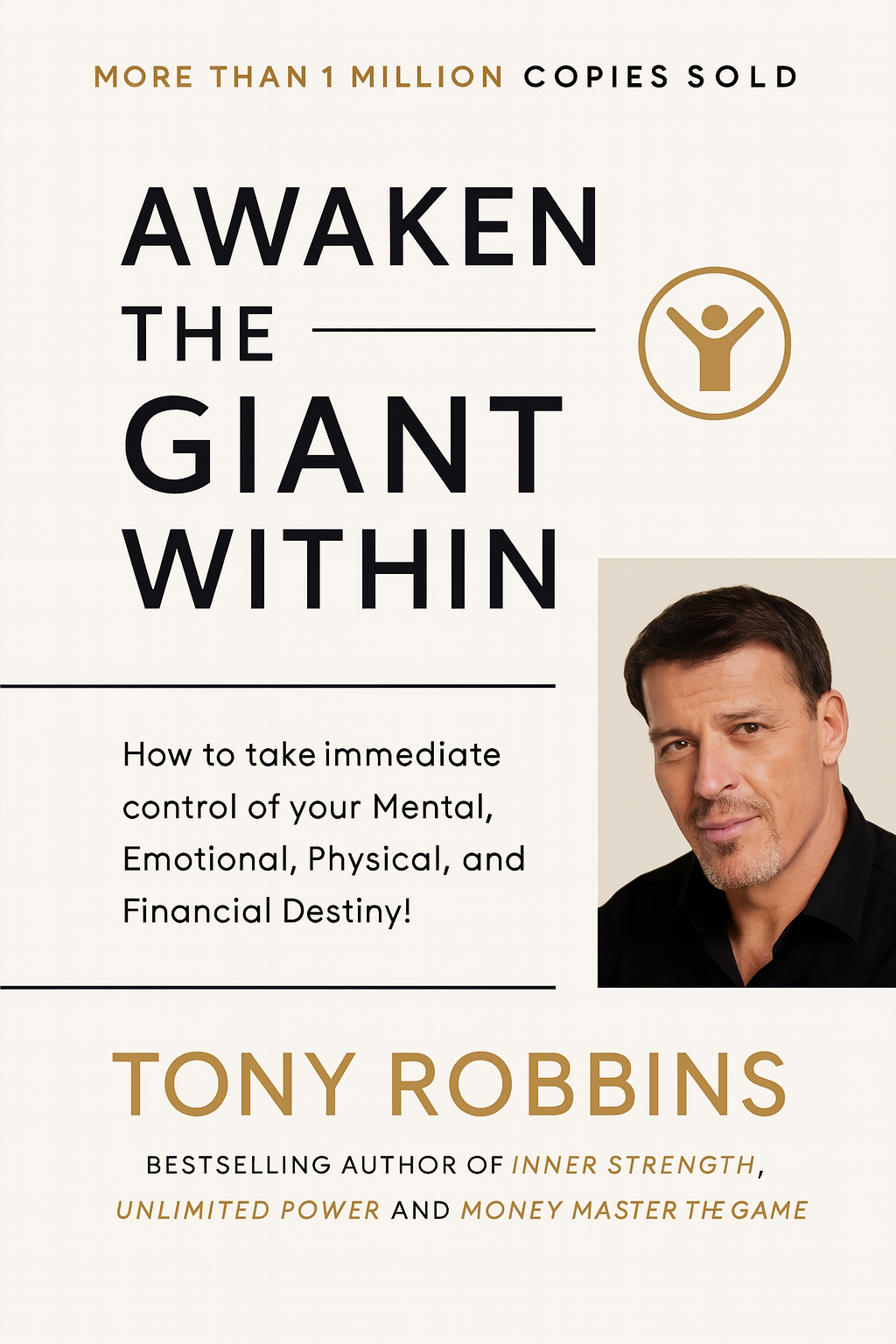
Awaken the Giant Within by Tony Robbins
This three-lecture audio course condenses all 87 sections of Awaken the Giant Within by Tony Robbins into a practical study of decision-making, mental conditioning, and life mastery. The first lecture covers the anatomy of decisions, showing why raising your standards, clarifying your values, and committing to a clear vision form the blueprint for every result you create. It explains the force that shapes your life and builds the foundation for the mastery system developed across the rest of the book. Listeners learn why decisions, not conditions, determine outcomes and how to use them as the primary lever for change. The second lecture presents the science of Neuro-Associative Conditioning, the method for rewiring the brain's pain-pleasure circuitry so that destructive patterns lose their grip and empowering behaviors take hold. It walks through the six-step Ultimate Success Formula and shows how the questions you ask yourself determine the quality of your life. It also covers how vivid metaphors and the ten emotions of power convert abstract goals into concrete, emotionally charged action. The final lecture applies the system to the five pillars of mastery: emotions, physical health, relationships, personal finances, and time. Each pillar follows the same decision-driven process, and the lecture includes the ten-day mental challenge plus the final Ultimate Challenge, which together turn the book's principles into measurable, real-world results across every major domain of life.
Igniting the Decision Engine: Foundations of Power and Purpose
Igniting the Decision Engine: Foundations of Power and Purpose
Welcome to Awaken the Giant Within by Tony Robbins, the book that answers one question most people never dare ask: who's really running your life — you, or your conditions? And here's the strange part — the answer might start with a stranger showing up at a doorstep on Thanksgiving, unannounced. Tony Robbins — born Anthony J. Mahavorick, no college degree, a man who once guided Oprah Winfrey across hot coals — built his entire system on that question.
Robbins opens with a hard claim: your destiny is shaped by decisions, not conditions. As a child, his family was saved by a stranger delivering food on Thanksgiving, an event he first read as pity and later reframed as proof of generosity — same event, different meaning, different life. He argues that three decisions control everything: what to focus on, what things mean, and what to do about them.
In his view, decision comes from the Latin 'decidere' — to cut off — so a true decision triggers immediate action. It's a muscle, he says, strengthened by repetition, not talent. He points to Soichiro Honda, F.W. Woolworth, and Fred Smith as men who decided, failed, and adjusted — because a wrong decision can be corrected, but indecision, that, that just guarantees stagnation. People, he contends, overestimate a year and wildly underestimate a decade.
Then comes the mechanism: Neuro-Associative Conditioning, or NAC, extending the work of Pavlov and Skinner. Every action, Robbins argues, is driven by the links your brain has built between pain and pleasure — links mostly installed randomly by environment and culture, never chosen by you. He describes killing his own Häagen-Dazs habit, not with willpower, but by linking massive pain to the habit and pleasure to breaking it. Change can happen in a single moment.
The same logic applies to the global frames he calls life metaphors. Call life a 'war' and every conversation becomes combat; call marriage a 'prison' versus a 'partnership' and watch the entire relationship change — same facts, transformed feelings. The author holds that these inherited metaphors were absorbed unconsciously, and that replacing them deliberately is one of the fastest levers for changing the quality of your life.
Next, emotional mastery. Robbins treats ten negative emotions — fear, anger, guilt, frustration, overwhelm — as action signals, messages rather than enemies, each carrying a prescription. Anger means a rule was violated; frustration means change your approach. Overwhelm, in his system, demands chunking tasks by priority, and these signals pair with ten power emotions — gratitude, curiosity, passion, determination — cultivated daily like physical training.
Deeper still sits the compass: your values. Everyone, he argues, runs on an unconscious hierarchy of moving-toward values like success and freedom, and moving-away-from values like rejection and humiliation. Conflicting hierarchies create what he calls internal warfare — two departments of the same mind fighting over every choice. His fix: consciously reorder the list, putting growth and contribution at the top, because growth can be satisfied in any moment, unlike values that depend on outside circumstances.
Finally, the daily practice. Robbins reframes time management as emotional discipline: everyone gets the same twenty-four hours, so 'not enough time' really means unclear outcomes and reactive living. His prescription — plan or plan to fail, prioritize by consequence using the Pareto principle, and block similar tasks together. And since thinking is just asking and answering questions, the brain works like a search engine: ask it why this always happens to you, and it will find helpless answers. Redesign your primary question, he says, and the mind starts finding resources instead.
Rewiring the Mind: Neuro‑Associative Conditioning and Life Metaphors
Where we left off, the author had handed you a decision engine, but here's the catch, knowledge alone changes nothing. Tony Robbins, the, the janitor who became a giant of personal development, closes Awaken the Giant Within by demanding action, and he does it with a single, a single uncomfortable truth. Potential power is all you have, he argues, until the day you convert what you know into what you do.
Remember the core insight from before: destiny is shaped by decisions, not conditions. The author restates his doctrine that every moment you make three choices, what to focus on, what things mean, and what to do, and that mastering these gives you control regardless of circumstances. He reassembles his full toolkit here, NAC's six steps, the pain and pleasure principle, the triad of physiology, focus, and language. The distinction between success and stagnation, he argues, is rarely resources. It's resourcefulness, plus the standards you hold and the decisions you make consistently. Two people with identical means, one thrives, one, one just survives, and the difference is what each decided daily.
Then the book turns verbal, and this is where it gets fascinating. Robbins argues that words aren't labels but filters, active construction sites for emotional experience. Facing a violent gang member, he described himself as 'a bit frustrated' rather than 'enraged,' and the, the whole confrontation defused. The words you attach to experience become the experience. So trade 'depressed' for 'a bit down on my luck,' and dial up 'invincible,' 'passionate,' 'exquisite.' He even cites cultures lacking words for certain emotional states, making those states less accessible to them.
Identity, the author contends, outlasts motivation every time. Willpower fades, but 'I am the kind of person who...' rewrites who you are, and raising standards means turning 'shoulds' into 'musts.' He compares life to a pilot's constant course corrections, consistent progress, never perfection. Anecdotes pile up, clients beating phobias in single sessions, a wheelchair-bound man shifting his state through physiology and focus alone, all proving that emotional mastery survives any external condition. His own arc, overweight, broke janitor to, well, this, is exhibit A.
The ending lands like a door slamming open. Invoking Robert Frost's 'The Road Not Taken,' Robbins puts you at a fork: old patterns behind you, application ahead. He asks for public commitment to specific actions within twenty-four hours, because decisions grow powerful only through immediate, repeated follow-through. Contribution, he says, is the secret to living, giving, and CANI, Constant and Never-ending Improvement, becomes a lifelong practice, not a completed project. Gratitude flows to mentors like Jim Rohn and John Grinder, and daily rituals, morning questions, incantations, goal reviews, extend the system into real life. The giant wakes through action taken today. Not someday, today.
Where we left off, the author had handed you a decision engine, but here's the catch, knowledge alone changes nothing. Tony Robbins, the, the janitor who became a giant of personal development, closes Awaken the Giant Within by demanding action, and he does it with a single, a single uncomfortable truth. Potential power is all you have, he argues, until the day you convert what you know into what you do.
Remember the core insight from before: destiny is shaped by decisions, not conditions. The author restates his doctrine that every moment you make three choices, what to focus on, what things mean, and what to do, and that mastering these gives you control regardless of circumstances. He reassembles his full toolkit here, NAC's six steps, the pain and pleasure principle, the triad of physiology, focus, and language. The distinction between success and stagnation, he argues, is rarely resources. It's resourcefulness, plus the standards you hold and the decisions you make consistently. Two people with identical means, one thrives, one, one just survives, and the difference is what each decided daily.
Then the book turns verbal, and this is where it gets fascinating. Robbins argues that words aren't labels but filters, active construction sites for emotional experience.
Facing a violent gang member, he described himself as 'a bit frustrated' rather than 'enraged,' and the, the whole confrontation defused. The words you attach to experience become the experience. So trade 'depressed' for 'a bit down on my luck,' and dial up 'invincible,' 'passionate,' 'exquisite.' He even cites cultures lacking words for certain emotional states, making those states less accessible to them.
Identity, the author contends, outlasts motivation every time. Willpower fades, but 'I am the kind of person who...' rewrites who you are, and raising standards means turning 'shoulds' into 'musts.' He compares life to a pilot's constant course corrections, consistent progress, never perfection. Anecdotes pile up, clients beating phobias in single sessions, a wheelchair-bound man shifting his state through physiology and focus alone, all proving that emotional mastery survives any external condition. His own arc, overweight, broke janitor to, well, this, is exhibit A.
The ending lands like a door slamming open. Invoking Robert Frost's 'The Road Not Taken,' Robbins puts you at a fork: old patterns behind you, application ahead. He asks for public commitment to specific actions within twenty-four hours, because decisions grow powerful only through immediate, repeated follow-through. Contribution, he says, is the secret to living, giving, and CANI, Constant and Never-ending Improvement, becomes a lifelong practice, not a completed project.
Gratitude flows to mentors like Jim Rohn and John Grinder, and daily rituals, morning questions, incantations, goal reviews, extend the system into real life. The giant wakes through action taken today. Not someday, today.
Mastering the Five Pillars: Emotions, Health, Relationships, Wealth & Time
Last time, the author demanded you convert knowledge into action, and today he hands you the workbook that makes that demand permanent. These closing pages of Awaken the Giant Within are back-of-book material, supplementary exercises meant to be revisited, not read once and shelved. The author's unifying thesis returns with force: destiny is shaped by decisions, not conditions, and lasting change comes from conditioning new patterns until they become your identity, never from luck or willpower.
The foundation, the author argues, remains the pain and pleasure principle, the idea that all human behavior drives toward avoiding pain and gaining pleasure. Resting on that base is Neuro-Associative Conditioning, his six-step process for changing any behavior pattern, and it deserves a slow walk. Decide what you want, then link pain to the old pattern and pleasure to the new one.
The remaining steps, as the author lays them out, are interrupting the limiting pattern, creating an empowering alternative, and conditioning that alternative until it becomes consistent. He pairs this with the Ultimate Success Formula, know your outcome, take action, notice what's working, change your approach, and the emotional triad of physiology, focus, and language. Two people, identical circumstances, one thrives, one, one just survives, and the difference is what each conditioned daily.
The toolkit then turns to words and beliefs, the levers the author believes shape everything. Transformational Vocabulary changes the words you use for emotional states, so 'depressed' becomes 'a bit down,' lowering the feeling instantly, while global metaphors frame whole domains of life as war, game, or gift. Beliefs, in his view, are feelings of certainty built on references, and his Interrogating Beliefs process asks whether a belief is true, where it came from, and what it costs you.
Values hierarchies and rules come next, the moving-toward and moving-away-from values, plus the rules governing what must happen before you permit yourself to feel success. The author treats these as levers that either empower or sabotage your entire experience, and the exercises ask you to rank your values and rewrite disempowering rules. Then come the ten Action Signals, fear, anger, guilt, overwhelm, each reframed as a call to action rather than something to suppress.
Alongside them sits the Ten-Day Mental Challenge, a stretch of refusing to indulge any negative pattern, which, spoiler, is harder than it sounds. The material also covers goal-setting across life categories, body, mind, emotions, finances, relationships, time, and contribution, plus morning priming questions built to cultivate gratitude, anticipation, and personal responsibility. And here the author draws a line between affirmations and incantations, words spoken with emotional conviction until your body believes them.
The strongest thread running through all of this, the author insists, is that self-mastery is a maintenance practice, not a single event. He urges readers to treat the appendix exercises as an ongoing workbook, revisiting ranked values, rewritten rules, and daily rituals whenever old habits resurface. Anecdotes pile up, people beating depression, financial ruin, health crises, relationship breakdowns, by changing the meaning they assigned to events, and, well, each one proves his point.
We are never victims of our conditions, only of our conditioning. The closing argument connects personal achievement to contribution, claiming fulfillment comes not from accomplishment alone but from improving the lives of others. The author points toward his seminars, audio programs, and coaching as accelerated pathways, but the final message is unmistakable: intellectual understanding is insufficient, knowledge must be applied immediately, consistently, and at identity level, so small daily decisions compound into an extraordinary quality of life.