
Why Galaxies Don't Fly Apart: The Hidden Universe
This 30-minute beginner course traces the full arc of cosmic history, from the universe's explosive beginnings to its possible endings. The opening lecture covers the Big Bang 13.8 billion years ago, cosmic inflation, the dark ages, and how the first Population III stars and early galaxies—now observed by the James Webb Space Telescope—ignited the cosmos. From there, the course tackles the dark matter mystery: why galaxy rotation curves, gravitational lensing, and the Bullet Cluster demand an invisible mass making up roughly 85% of all matter, building on Vera Rubin's pioneering work. A dedicated lecture resolves the common confusion between expanding space and moving galaxies, explaining Hubble's law, redshift, and peculiar velocities to show that galaxies are carried along by stretching space rather than flying through it. The second half turns to how galaxies build their stars. You will follow a giant molecular cloud as it collapses under gravity, encountering the Jeans instability, protostar formation, stellar feedback, and the initial mass function through a practical kitchen-recipe analogy. The course then dismantles the old myth of a static universe, using Einstein's cosmological constant, Hubble's observations, the cosmic microwave background, and Type Ia supernova measurements as evidence for a dynamic, evolving cosmos. The final lecture stages a debate between two cosmologists arguing the Big Freeze versus the Big Rip, examining dark energy, the equation of state parameter w, and observational constraints from Planck and supernova surveys to weigh the universe's ultimate fate. Along the way, you will meet the core ideas of modern cosmology in clear, question-driven format designed for listeners with no prior background.
A Cosmic Dawn: From Nothing to the First Galaxies
A Cosmic Dawn: From Nothing to the First Galaxies
You're standing at the kitchen window last night, tea going cold, and the sky finally clears after three days of rain. Just a handful of stars, the usual ones, faint through the city glow. Nothing dramatic. And yet every single photon landing on your retina has been traveling for hundreds, sometimes thousands of years to end its journey on the surface of your eye. That, Damodar, is where this whole story lives, in that quiet gap between what you saw and what was actually happening. Because if we rewind far enough, those pinpricks trace back to a beginning, a universe that started hot, dense, and completely dark. No stars at all. Scientists call that stretch the cosmic dark ages, a time before any stellar light existed anywhere. Which raises the obvious question. How did we get from that, to the view outside your window?
So, start at the beginning. The early universe was a hot, dense state, and as it expanded it cooled. Think of it like a room filling with steam: while the steam is thick, you can't see anything, light just scatters. In those first epochs, the whole cosmos was like that, an opaque soup of plasma. Then it cooled enough for protons and electrons to pair up into neutral hydrogen, and suddenly light could travel freely. That moment of transparency left behind a glow we still detect today, stretched across the whole sky. Astronomers treat that glow, the cosmic microwave background, like a baby picture of the universe, because it shows us the cosmos as it was when it first became visible. What gets me is that this wasn't some fleeting instant. After transparency came the dark ages, a long stretch with matter spread thin and no stars burning. The universe had the ingredients but no fire yet.
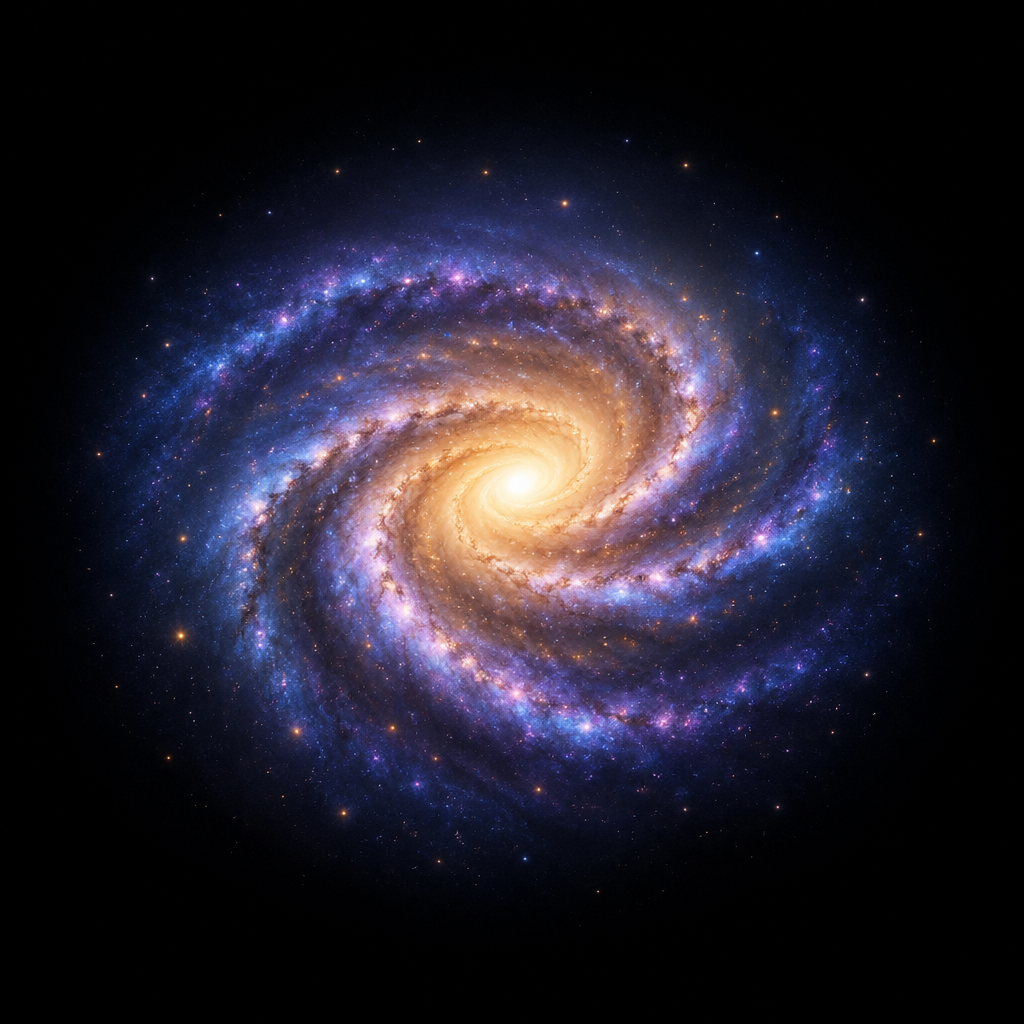
Now, the fire needed a match, and the match was gravity. Gravity slowly gathered matter into growing structures, and gas fell into halos of dark matter, which gave the first galaxies somewhere to form. For example, picture water collecting in dips on a tent after rain: the dips are the dark matter halos, the water is the gas. Inside those pockets, the earliest stars ignited from primordial gas, almost pure hydrogen and helium, with few or none of the heavier elements stars forge later. These first star cities appeared during what researchers call cosmic dawn, within the first few hundred million years after the Big Bang. And they were scrappy. Early galaxies were generally more compact and messier than the grand spirals we see nearby today, and they grew over time largely through collisions and mergers with one another. That means the Milky Way of your night sky is, in a sense, a late, polished edition of something that began as a rough draft.
Those early stars did something that still amazes me: they changed the universe itself. They pumped out ultraviolet light energetic enough to strip electrons off hydrogen atoms, kicking off an extended era called reionization. Not a single moment, but a long transformation, running from the end of the dark ages until the universe was roughly a billion years old. One of the most striking findings is that small, faint galaxies were everywhere in that era. Deep observations, including the Hubble eXtreme Deep Field, assembled from a decade of Hubble images of one tiny patch of sky, revealed thousands of galaxies, many of them faint dwarfs rather than big, fully formed ones. NASA notes those faintest galaxies shine at about one ten-billionth of what the human eye can detect. So the universe wasn't built by giants. It was, apparently, lit up gradually, by crowds of tiny, dim things, which is, I'll admit, not the story I expected.
And this is where the record holder comes back, because one galaxy in particular keeps the whole timeline honest. In observations made in October 2023 and January 2024, an international team using the James Webb Space Telescope, built by NASA, ESA, and the Canadian Space Agency, studied a galaxy with the unglamorous name JADES-GS-z14-0. Using an instrument called NIRSpec to read its spectrum, they measured a redshift of about 14.3, meaning we're seeing it as it was less than 300 million years after the Big Bang. The expansion of the universe had stretched its light all the way into the infrared, which is exactly what Webb was designed to catch. And here's my favorite part: that galaxy was already producing substantial oxygen. Stars had formed, lived, died, and enriched it with heavier elements, astonishingly early. Which brings us back to your window, Damodar. Every glance at the night sky is a look backward in time. You are not an observer standing outside this story. You are one of its later chapters, watching the earlier pages arrive, still traveling, one photon at a time.