
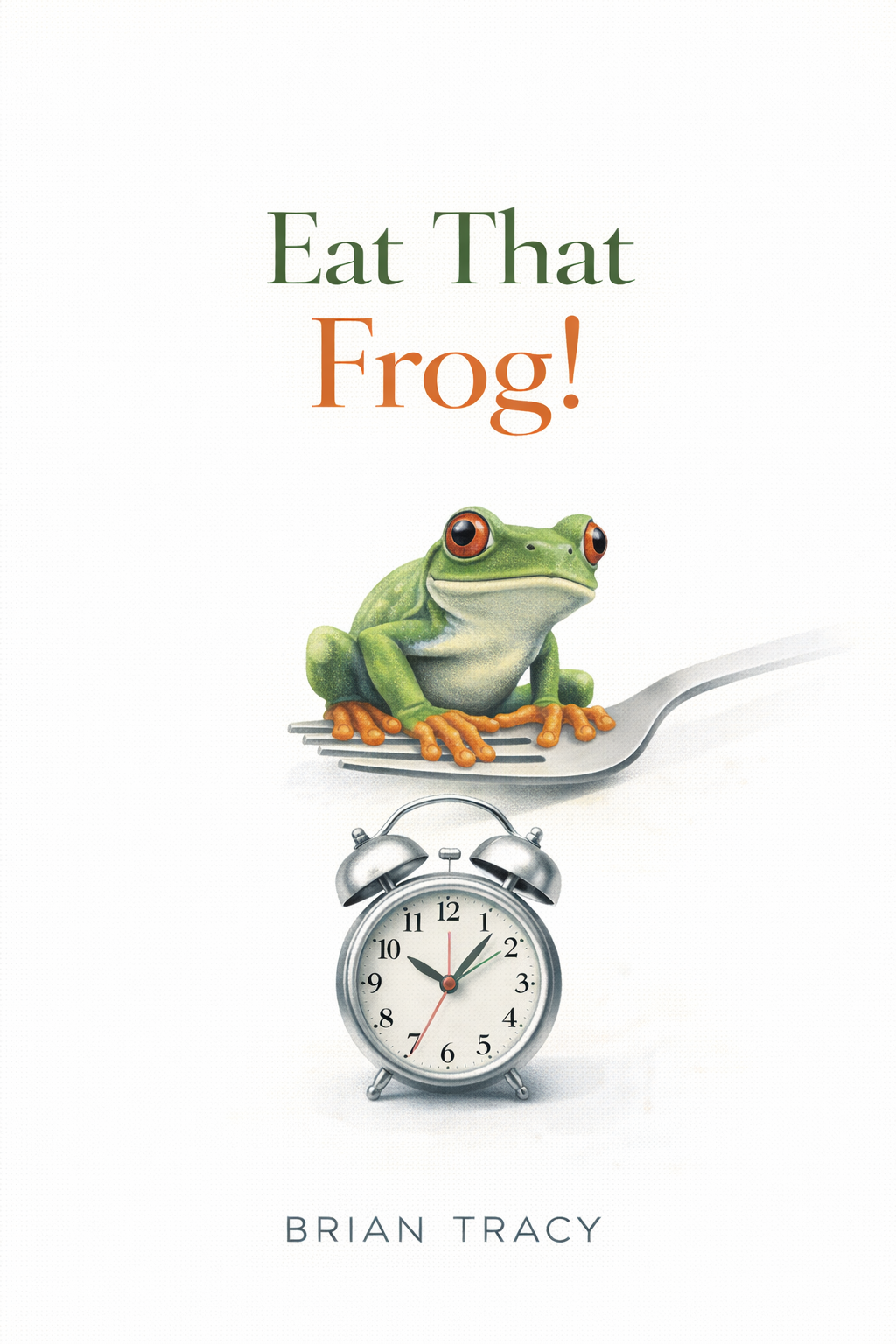
Eat That Frog! : 21 Great Ways to Stop Procrastinating and Get More Done in Less Time by Brian Tracy
This audio course presents the complete framework of Eat That Frog! by Brian Tracy, covering all 21 strategies for overcoming procrastination and accomplishing more in less time. The course begins with the core mindset shift behind the title: tackling your most important, most demanding task first thing each day, before anything else. From there, it builds a practical system for daily work. You will learn how to plan every day in advance, apply the 80/20 rule to identify the tasks that generate the majority of your results, and use the ABCDE method to rank priorities with precision. The course explains the Law of Three for identifying the tasks that matter most, how to define your key result areas, and how to upgrade the skills that most affect your output. Beyond prioritization, the course addresses the habits and conditions that make productivity sustainable. Topics include creative procrastination, which means deliberately putting off low-value tasks; identifying the constraints that limit your performance; applying self-pressure to stay disciplined; and building lasting motivation through clarity about your goals. You will also learn how to leverage technology rather than be distracted by it, how to slice large tasks into manageable pieces, how to create large blocks of focused time, and how to practice single-handling—starting a task and persisting until it is complete. The course closes with the four accelerators that turn these techniques into permanent habits, giving you a clear, step-by-step path from intention to consistent execution.
Why the Frog Matters
Why the Frog Matters
Eat That Frog! : 21 Great Ways to Stop Procrastinating and Get More Done in Less Time, by Brian Tracy, still matters because it attacks the one problem almost everyone shares: you know what's important, and you do everything else instead. Tracy, who went from washing dishes and digging wells to running a development company worth 265 million dollars, built this book on a saying attributed to Mark Twain. Eat a live frog first thing in the morning, and nothing worse will happen to you all day. The frog, of course, is your biggest, most important task, the one you're most likely to put off. Now, Tracy argues that everyone procrastinates in some form, and that the real difference between high performers and everyone else is which tasks they delay. The successful ones, he says, procrastinate on the trivial stuff and act decisively on the, the vital few tasks that matter. So the whole method comes down to this: start with the frog, and start immediately. Because if you have to eat the frog at all, staring at it doesn't help. Tackle that first, and Tracy says the worst part of your day is behind you, your stress drops, and momentum takes over. Procrastination, in his view, is the primary cause of underachievement, and focus is the cure. Now that we see the problem, let's discover how Tracy says we can set a clear target for success.
Set the Table – Defining Your Goals
So the first thing Tracy does is, is what he calls setting the table. Before you eat anything, you, you have to know exactly what's on the plate. Tracy argues that vagueness about goals is the single biggest barrier to productivity. One of the worst uses of time, he says, is doing something very well that didn't need to be done at all. Painful, right? His cure is a seven-step method from chapter one. Decide exactly what you want. Write it down. Set a deadline, with sub-deadlines if the goal is big. Then list every single action the goal requires, and organize that list by priority and sequence. Take action on your plan immediately. And finally, resolve to do something every single day that moves you forward. For example, he cites studies suggesting that people with written goals earn many times more than people without them. Now, Tracy also wants you to review those goals daily and ask of each task, why am I doing this? Because a clear target is what lets you pick the right tasks from the endless list.
Prioritize With the 80/20 Rule and the ABCDE Method
Having set clear goals, the next step is to filter the tasks that truly move you forward. Now, Tracy leans on a principle from the Italian economist Vilfredo Pareto, who observed way back in 1895 that eighty percent of the wealth in Italy was held by twenty percent of the population. Tracy argues the same lopsided pattern shows up in your work. Roughly twenty percent of your tasks produce eighty percent of your results. So most people stay busy on the trivial many while avoiding the vital few, and he says that busy-ness is, is itself a subtle form of procrastination. Before starting anything, ask: is this in the top twenty percent of my activities? For example, twenty percent of your customers often generate eighty percent of your revenue. The math matters less than the imbalance. But how do you sort the list each morning? That's where Tracy's ABCDE method comes in. Label each task by its consequences. An A task is something you must do, with serious consequences if it's left undone. A B task is something you should do, with mild consequences. A C task is, is nice to do, like phoning a friend or having coffee with coworkers, with no real consequences at all. D tasks you can delegate, freeing you for the A tasks only you can perform. And E tasks you eliminate entirely. The rule is simple: never work on a B while an A is still undone. Then number your A tasks, A one, A two, A three, and start on A one, your biggest frog. Armed with a prioritized list, it's time to act on the biggest frog first.
Eat the Frog – Taking Action
Now that you have a prioritized list, let's put the frog on your plate. So each morning, Tracy says, ask one question: what is my, my A-one task today? The single most important thing, the one with real consequences attached. Then start it immediately, and stay with it until it's done. Because if you have to eat a live frog at all, staring at it doesn't help. And here's the freeing part. Tracy argues everyone procrastinates anyway, so you might as well procrastinate on purpose. He calls this creative procrastination, deliberately putting off the trivial many. One tool he offers is zero-based thinking. Look at any commitment and ask, if I wasn't doing this already, would I start it today? If not, cut it. Before choosing anything, weigh the long-term consequences, since thinking ahead, he says, separates high performers from the rest. Eat the frog first, and the worst of your day is over. That's the complete framework—use it daily to turn procrastination into progress.