
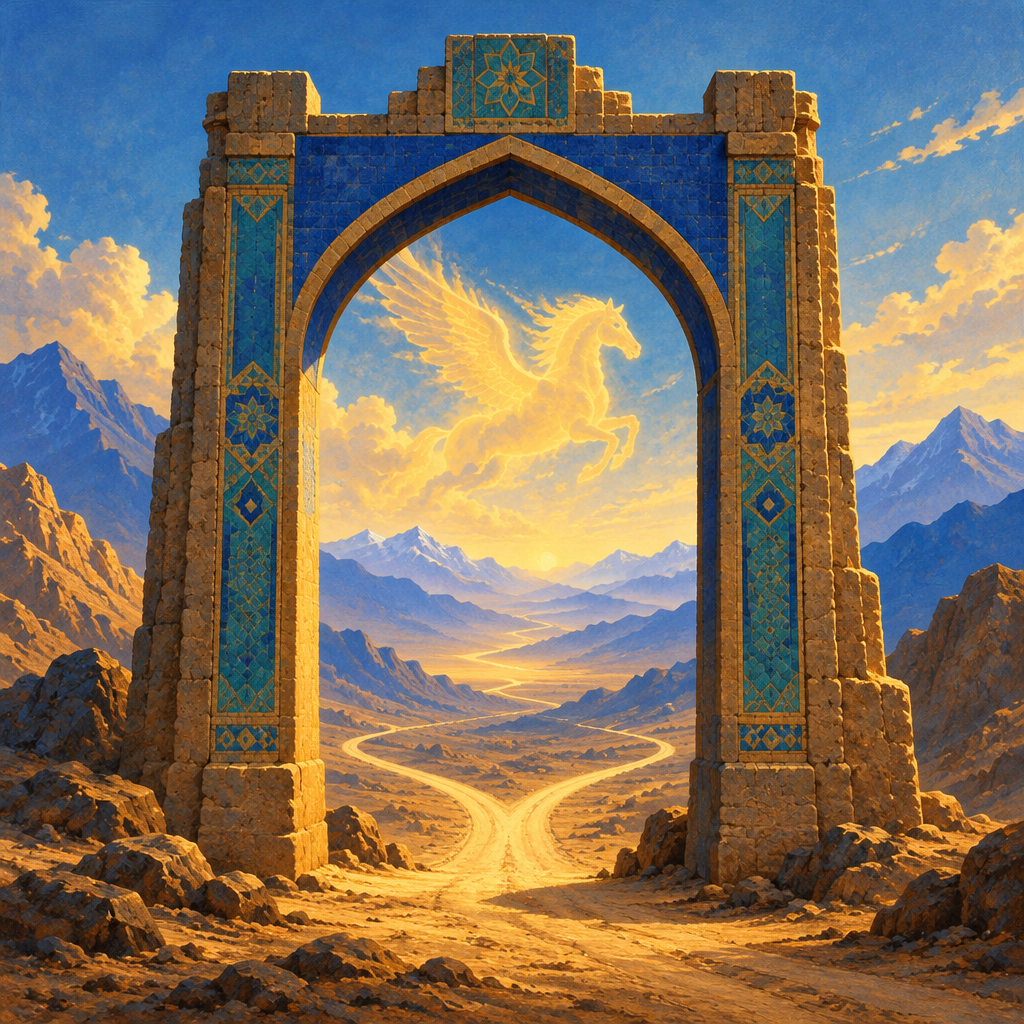
Afghanistan: Crossroads of Empires and Myths
This three-lecture course traces Afghanistan's history from antiquity to the present, showing why its geography made it a recurring arena for empires and how its culture endured beyond the wars. The first lecture covers two thousand years of foundations: the Achaemenid Empire around 550 BC, Alexander the Great's invasion in 330 BC and the Hellenistic influence that followed, the Kushan Kingdom of the first to third centuries AD, the spread of Buddhism along Silk Road trade routes, and the early Islamic conquests of the seventh century. Together these layers explain how trade, religion, and empire converged to shape Afghan identity and earned the land its 'Graveyard of Empires' reputation. The second lecture shifts to a single day in 1839, reconstructing the First Anglo-Afghan War through the arrival of Sir John Keane's British-Indian force at Kabul, the standoff with Dost Mohammad Khan, and skirmishes near the Khyber Pass. It examines the strategic missteps of the British East India Company and shows how terrain and tribal allegiance turned a planned conquest into a costly failure during the Great Game. The final lecture challenges the assumption that Afghanistan is defined only by endless conflict. It tests that myth against concrete evidence: Greco-Bactrian coinage that carried Hellenistic art across Central Asia, the Bamiyan Buddhas that stood for over a millennium, the poet Rumi's Balkh heritage, and the women's education reforms of the 1960s that produced doctors, engineers, and artists. The result is a fuller portrait: a country of creativity, scholarship, and resilience rather than merely a battlefield. Roughly fifteen minutes long, the course balances narrative history, a moment-by-moment war scene, and myth-busting analysis to give listeners a grounded understanding of Afghanistan's past and its persistent cultural legacy.
From the Silk Road to the Great Game: Afghanistan’s First Millennia
From the Silk Road to the Great Game: Afghanistan’s First Millennia
Picture a glass cup, delicate and blue-green, sitting in a storeroom in ancient Begram, in what is now Afghanistan. That cup came from the Roman world, thousands of kilometers away, and it sat beside ivories carved in India. Now, Sharam, ask yourself a simple question. How does a Roman cup end up here, in the mountains between Persia, India, and China? The answer is geography. This land sits at a crossroads, and in 1937 the French archaeologist Joseph Hackin's team dug up that very treasure at Begram, proof of connections stretching far beyond Afghanistan's borders. That single cup is the story of this country's first millennia. Everything flows through here.
Start with the ground itself. Between the Hindu Kush mountains and the Amu Darya river lay a region called Bactria, centered on the ancient city of Bactra, which you know today as Balkh. In the sixth century BCE, Cyrus II brought this land under Achaemenid Persian rule, and Darius I organized it into provinces, including Bactria, Arachosia, and Aria. So it was already a prize. Then came Alexander the Great in the fourth century BCE, and Balkh fell around 330 BCE, becoming the center of the Greek satrapy of Bactria. And this is what amazes me. The Greeks didn't just pass through. Their political and artistic influences took root, deeply. Around 250 BCE, a local Greco-Bactrian governor named Diodotus declared independence from the Seleucid Empire, and the kingdom grew until it stretched south past the Hindu Kush toward Kabul and parts of the Punjab. French archaeologists found the proof in 1964, unearthing Ai Khanum, an entire Greek-style city, right there in northern Afghanistan. A Greek city. In Central Asia.
Now, why does any of this matter, beyond the, the surprise of it? Because Bactria became wealthy, and wealth came from the Silk Road. A major branch of the Silk Road crossed Afghanistan, linking China, India, and lands farther west. Balkh served as a trading and transshipment center, the place where goods changed hands. Think of it like a, a great airport hub, except with camels and caravans instead of planes. But trade wasn't the only cargo. Bactria became a meeting place for religious and artistic ideas moving across Central and South Asia. Around 135 BCE, the Yuezhi, a confederation of Central Asian peoples, took Bactria from the Greco-Bactrians, and one Yuezhi group became known as the Kushans. Under King Kanishka in the second century CE, Kushan power reached its high point, an empire running from Bactria toward northern India and the frontiers of China. That was the golden age. Gandharan Buddhist art flourished, blending styles across cultures, and Buddhist pilgrims traveling these networks carried Buddhism from India toward China. I didn't expect that direction of flow, honestly, religion moving east from here, not just goods moving west.
But nothing in this story stays still, which is why layering is the right way to understand this place. The Hephthalites, also called the White Huns, ruled parts of the region until the western Turks defeated them in 565 CE. Then, in the seventh and eighth centuries, Arab forces arrived, and Balkh was taken in the eighth century, bringing the region into the expanding Islamic world. That was a cultural transformation, layer by layer, not a single stroke. And here's where I have to, no, wait, where I want to push back on something you've probably heard. People call Afghanistan the graveyard of empires. For the ancient era, that nickname gets it partly wrong. Empires didn't just die here. Many of them thrived here for centuries. The Greco-Bactrians, the Kushans, the Persians before them. What's truer is this: the land was ruled by changing dynasties and powers, never by a single, continuous Afghan state, until much later. In 1220, Genghis Khan's Mongol armies destroyed Balkh, a city whose history had already spanned successive empires. And much later, in 1747, Ahmad Shah Durrani founded the Durrani Empire, a genuine milestone in forming the Afghan state.
Let me come back to that blue-green glass cup, because it holds the whole argument. In the 1960s, the Soviet archaeologist Viktor Sarianidi discovered the Tillya Tepe burial site in northern Afghanistan, and the excavations yielded more than twenty thousand objects, including gold artifacts. The burial held a warrior and five women, and researchers have suggested some of the women may have died following the warrior's death. Gold, glass, ivory, Greek inscriptions, Buddhist art, Persian provinces, Islamic mosques. Same ground, different layers, one after another. One more thing worth knowing. The Silk Road wasn't one uninterrupted road, Sharam. The routes through Afghanistan were traveled intermittently over centuries, a shifting network, not a highway. Which means the wealth came and went, and whoever controlled the passes controlled the game. In the nineteenth century, that geography pulled Afghanistan into the Great Game, the rivalry between the British and Russian empires for influence in Central Asia. The cup, you see, was never just a cup. It was a receipt, from a land every empire wanted, and few could hold.
The Kabul Gambit: A Day in the First Anglo‑Afghan War, 1839
Speaker 1
Spring, 1839. A British officer is filling his pipe somewhere below the Bolan Pass, watching camels founder in the heat. Why am I looking at him?
Speaker 2
Because he's marching into the most instructive disaster of the century. The Army of the Indus, entering Afghanistan to unseat a king.
Speaker 1
Wait — unseat which king? I thought the British were, what, defending India?
Speaker 2
That was the sales pitch. In October 1838, Governor‑General Lord Auckland issued the Simla Manifesto, the public case for intervention. The target: Dost Mohammad Khan, ruler of Kabul.
Speaker 1
What had he actually done?
Speaker 2
Almost nothing. British officials feared he might turn toward Russia or Persia, so they decided a pliant former ruler, Shah Shuja, would guard India's northwest better.
Speaker 1
So fear of a rumor, basically. Did nobody inside the British camp push back?
Speaker 2
One did. Alexander Burnes, the political officer on the ground, advised Auckland to keep Dost Mohammad on the throne. Auckland followed Macnaghten instead, who wanted Shah Shuja restored.
Speaker 1
Of course he did.
Speaker 2
And here's the thing about Shah Shuja — he wasn't a nobody. He'd ruled Afghanistan from 1803 to 1809 before being deposed. He'd even received a British envoy, Mountstuart Elphinstone, back in 1809.
Speaker 1
Hold on. So the British were reinstalling a legitimate former king. That doesn't sound insane on paper.
Speaker 2
On paper, no. I'd wager, honestly — if I had to bet — even odds it looked like a bargain to Auckland. A friendly dynasty on the frontier, cheap, quick.
Speaker 1
And on the ground?
Speaker 2
General Sir John Keane led a British‑Indian force through the Bolan and Khojak passes toward Kandahar, entering Afghanistan in spring 1839 by way of Sind.
Speaker 1
How did the terrain actually treat them? I keep hearing 'logistics' as an abstraction—
Speaker 2
Stop. Concrete case, then. Ghazni, July 1839. A fortress with walls about sixty feet high, and the British had no heavy artillery to batter through. That's not abstract. That's a wall and no gun.
Speaker 1
Sixty feet? Then how—
Speaker 2
Intelligence. Mohan Lal, a Kashmiri interpreter and spy working with Burnes, found that one gate was lightly defended. On July 23, 1839, they stormed it.
Speaker 1
A spy decided the battle.
Speaker 2
An interpreter‑spied gate, yes. The British lost about 200 killed or wounded; the defenders nearly 500, with some 1,600 captured. And the captured provisions fed the advance on Kabul.
Speaker 1
So it's going, well, shockingly well?
Speaker 2
Kandahar had already fallen in April — Shah Shuja was crowned there on April 25. After Ghazni, Dost Mohammad left Kabul, and Shah Shuja was installed in August.
Speaker 1
So in, what, six months they'd taken everything. Victory, done, home soon?
Speaker 2
That's exactly the trap of the story. The restoration re‑established the Sadozai dynasty, but Macnaghten as envoy exercised substantial real power behind the throne. The Afghans could see who was governing.
Speaker 1
So a legitimate king, but a puppet—
Speaker 2
Exactly. And Barakzay resistance continued — the faction they'd deposed didn't melt away. The Sikhs under Ranjit Singh backed the British; the Barakzay rulers of Kabul and Kandahar opposed Shah Shuja's return.
Speaker 1
Mm. But the crowds didn't rise immediately. Why not?
Speaker 2
Because conquest is loud and occupation is slow. The early victories were real.
Speaker 1
So the seeds were there from day one.
Speaker 2
Dost Mohammad surrendered in November 1840, and the British shipped him off. How they treated a respected enemy shaped Afghan perceptions of British intentions.
Speaker 1
Meaning kindness to a rival could have bought goodwill, and they wasted it?
Speaker 2
That's a fair reading. And the occupation compounded it — money that had kept tribal chiefs content got trimmed, and the British settled into Kabul as if staying forever.
Speaker 1
Which brings me back to that officer with his pipe. He'd taken Kandahar, Ghazni, Kabul, for almost nothing.
Speaker 2
Right. Which is why I still can't fully agree when you frame it as inevitable disaster. If the strategy after 1839 had been lighter, cheaper, smarter — I think the outcome was genuinely open.
Speaker 1
And I think occupation itself was the flaw — you can't rule a pass, you can merely rent it. We're not settling this one.
Speaker 2
No. The war ended in 1842 with a disastrous British withdrawal from Kabul, and Dost Mohammad returned to power. But whether the empire lost in 1839 or in 1841 — that argument's still open.
Myth‑Busting: Afghanistan Is Not Just a Land of Endless War
Speaker 1
If someone believes Afghanistan has been nothing but war, what exactly do they lose?
Speaker 2
They lose the poetry of the mountains. Seriously — they lose the ability to see most of the record. The fighting is real, but it's a thin chapter stretched over a very long book.
Speaker 1
Okay, but that's your claim. Who says so? I'm not moving on a vibe.
Speaker 2
Fair. The Metropolitan Museum, for one — they identify Bronze Age Bactrian objects and finds from Aï Khanum, Begram, and Tillya Tepe as central chapters of this history. Art, not armies.
Speaker 1
So give me the strongest version of the war story first. I want it at its best, not a straw man.
Speaker 2
empires bled there for centuries, and the land broke them all. That's why people call it the graveyard of empires. It's a catchy label, and it's not entirely empty.
Speaker 1
And where does it crack first?
Speaker 2
With the Achaemenids, in the sixth century BCE. Persian provinces ran this region for generations. Empires didn't just die here — many administered it successfully for a very long time.
Speaker 1
Huh. So the nickname distorts the record.
Speaker 2
It flattens it. And there's a bigger crack: in 1747, Ahmad Shah Durrani was crowned near Kandahar and built a state that became the foundation of modern Afghanistan. An empire based here, not dying here.
Speaker 1
So Kandahar was a capital, not a battlefield.
Speaker 2
An early capital of the modern state, yes. The war story can't even account for the country's birthday.
Speaker 1
All right, I'll grant the politics. But culture — art, science — isn't that stretching it?
Speaker 2
Then let's test it. Bamiyan, roughly the sixth century CE. Two monumental Buddha figures carved into a cliff, with monasteries and caves developing over centuries.
Speaker 1
Buddhism in Afghanistan? Buddhism reached that far?
Speaker 2
Inscriptions and texts show Buddhism present by at least the mid-third century BCE. Bamiyan sat on a route connecting India and China, and its art linked Gandhara, Bactria, Sogdia, and Chinese Central Asia.
Speaker 1
So it was a junction of styles, not a frontier outpost.
Speaker 2
Exactly. And think of what the murals mean — those caves contain frescoes made with mineral pigments, a studio tradition sustained over centuries. That requires peace and patronage, not chaos.
Speaker 1
Okay, but one site doesn't prove a pattern.
Speaker 2
the Minaret of Jam. Sixty-five meters tall, Ghurid period, extraordinary brickwork. The Ghurids ruled Afghanistan and parts of northern India in the twelfth and thirteenth centuries.
Speaker 1
Sixty-five meters — that's, what, a twenty-story building of decorated brick?
Speaker 2
That's the picture. An inscription on it gives the year 1194, and it's thought to mark Firuzkuh, the Ghurid capital. UNESCO made it Afghanistan's first World Heritage site, in 2002 — and put it on the danger list the same year.
Speaker 1
On the danger list the same year it's honored. That's the tension in one sentence.
Speaker 2
It is. And the polite version of this conversation leaves out something — that the wars are recent. The country gained independence over its foreign affairs from Britain in 1919, then had a monarchy from the 1930s until it was overthrown in the 1970s. Decades of relative stability.
Speaker 1
So when did the endless-war image actually start?
Speaker 2
With the conflict that began in 1978, after the overthrow of President Mohammad Daud Khan. Soviet forces invaded in December 1979 and withdrew in February 1989. One lifetime, not eternity.
Speaker 1
Wait. You're saying the whole national image comes from about forty years?
Speaker 2
Roughly, yes. And even inside those years, culture survived. In November 1978, a worker at Tillya Tepe noticed a small gold disk. Viktor Sarianidi and his Afghan and Soviet team excavated and uncovered the Bactrian Gold.
Speaker 1
While the war was starting? They were digging up gold in 1978?
Speaker 2
While the war was starting. And here's the part that gets me — that gold was hidden in a vault of the central bank through all the upheaval, and the government revealed it was safe in 2003.
Speaker 1
Someone guarded art instead of— sorry, that's the thing I can't get over.
Speaker 2
People risked everything to keep it. That's not a war story. That's a custodian's story. And the diversity point matters too — Pashtuns, Tajiks, Hazaras, Uzbeks; Dari and Pashto official, Uzbek and Turkmen spoken. One people at war? It was not a single people at any time.
Speaker 1
So the Silk Road framing was right after all — a network, not a road, and a meeting place, not a—
Speaker 2
Not a graveyard. The routes ran through it, and Muslim conquerors in the mid-eighth century found flourishing Buddhist communities along trading routes. Exchange, layer on layer.
Speaker 1
I came in expecting to lose this argument, and I did. Fully.
Speaker 2
You held the myth to evidence, which is all I wanted. Afghanistan's monuments are older than its wars — the wars are the footnote, not the book.
Speaker 1
So next time I see the word Afghanistan in a headline, what should I actually see?
Speaker 2
A sixty-five-meter minaret standing at a river confluence, waiting for someone to look past the headline. Even the flood risk hasn't taken it down.