
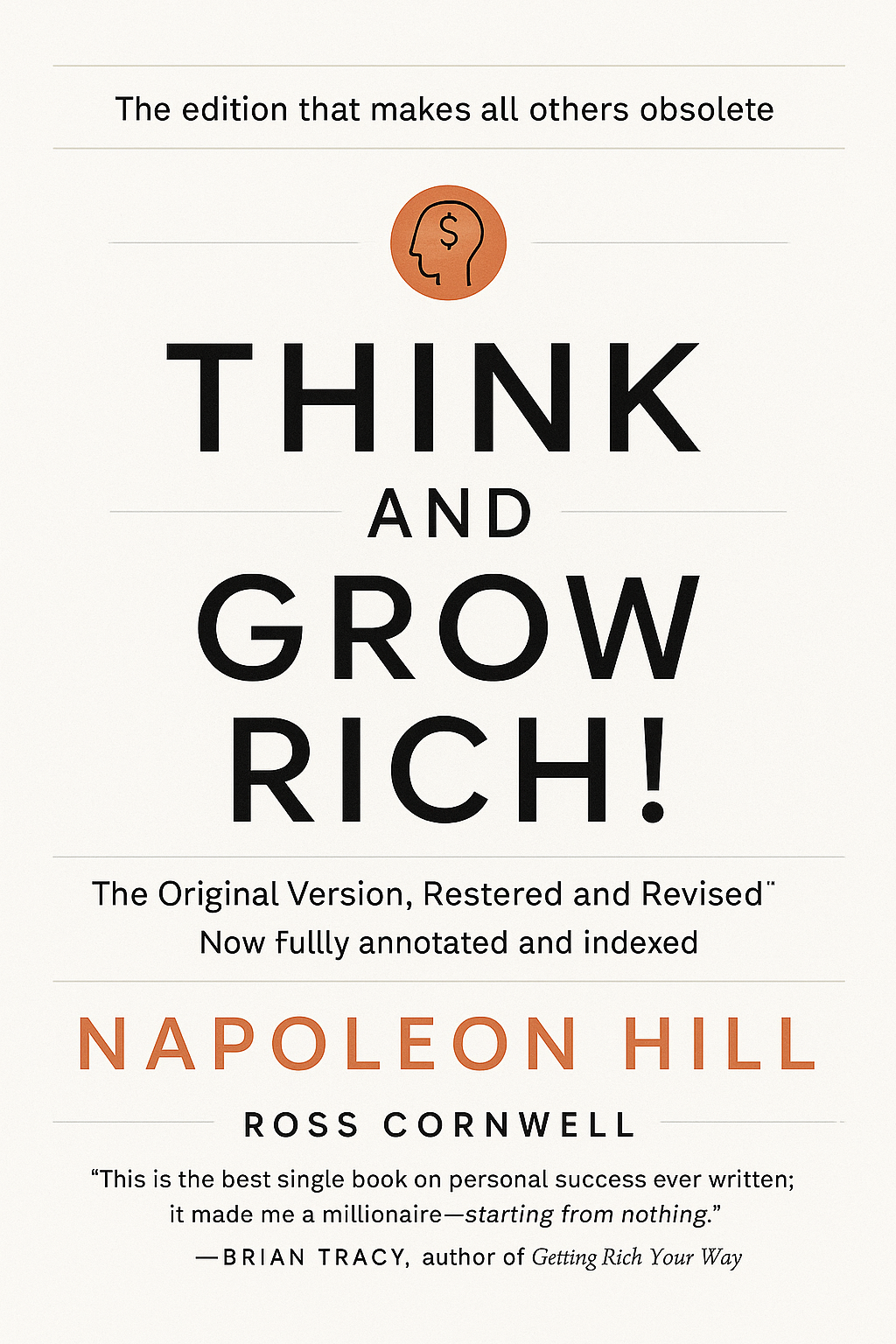
Think and Grow Rich! By Napoleon Hill
This six-lecture audio course walks through Napoleon Hill's Think and Grow Rich! from cover to cover, including the forewords, preface, appendices, endnotes, and index. The first lecture covers the book's purpose, the special forewords, the author's preface, and the opening parts of the Desire chapter, showing how a burning, definite purpose is born from the principle that whatever the mind can conceive and believe, it can achieve. The second lecture examines the three parts of Faith, the Autosuggestion step, and the opening of Specialized Knowledge, demonstrating how belief and deliberate self-talk shape the subconscious and convert desire into a plan. The third lecture covers both parts of Imagination and the six-part Organized Planning sequence, showing how to turn visionary ideas into concrete, actionable strategies. The fourth lecture addresses Decision and Persistence in full, the Mastermind principle, and the opening of Sex Transmutation, offering tools to defeat procrastination and sustain effort over time. The fifth lecture takes on the book's most advanced material: the remaining parts of Sex Transmutation, the Subconscious Mind, The Brain, The Sixth Sense, and the five-part epilogue on outwitting the six basic fears. The final lecture reviews the Appendix, Acknowledgements, all nine parts of the Endnotes, and the three-part Index, showing how to use these reference materials to reinforce the thirteen principles and apply them in daily life. Together, the lectures deliver a complete, structured study of Hill's classic on mindset, desire, faith, planning, and advanced mental techniques.
Foundations: From the Cover to the First Sparks of Desire
Foundations: From the Cover to the First Sparks of Desire
Welcome to Think and Grow Rich! By Napoleon Hill — the 1937 book that promises wealth begins in your mind long before it appears in your bank account. Before you dismiss that, hold on, because this book claims a hidden secret that made fortunes for Edison, Ford, and Rockefeller. Napoleon Hill, a man who was filing newspaper stories as a mountain reporter at thirteen, spent twenty-five years hunting that secret down.
Hill argues this is not motivational guessing — it is a research project, commissioned by steel magnate Andrew Carnegie himself. He studied hundreds of successful figures, and, this is the part people forget, he also analyzed over 25,000 people who failed. Both forewords in the book insist it is a manual to study repeatedly, not a story to read once — Bob Proctor credits it with lifting him from a modest Toronto fire department job to real wealth.
The author's preface adds his famous hook: a secret responsible for the fortunes he studied, never named outright. It reveals itself, he says, only to readers prepared to receive it through their own effort. In the book's view, success and struggle differ not by luck but by the, the discipline and quality of your thinking.
Then comes the first principle: desire, told through Edwin C. Barnes, who, honestly, looked like a tramp when he arrived in West Orange, New Jersey. He had no money, no connections, no education — but a burning, definite desire to become Thomas Edison's partner, not his employee. Edison later said he saw that determination in Barnes's face, gave him a modest job, and Barnes held it for five years while staying mentally fixed on his goal. When the Ediphone dictating machine arrived, other salesmen dismissed it as unsellable, so Barnes seized the opportunity disguised as misfortune. He sold it so successfully he won national distribution rights — and the partnership he had staked everything on. Wanted it, not wished it.
Hill pairs this with R. U. Darby and his uncle, who quit drilling for gold just three feet from a rich vein. Darby later applied that lesson and became one of the few men selling a million dollars of insurance annually.
According to the author, every failure carries the seed of an equivalent advantage.
The author then turns desire into a six-step method, distilled from Carnegie himself. Fix the exact amount of money you want, decide what you will give in return, set a definite date, create a plan and start at once, write it all down, and read it aloud twice daily with feeling. See yourself already in possession of the goal. Wishing is not enough, Hill contends — only a burning desire backed by faith and persistence, like his son Blair overcoming a prognosis of lifelong deafness, translates into riches. From here, every later principle — faith, autosuggestion, planning, persistence — draws its power from this starting point.
So as we close, notice how carefully the author built this foundation. He started with credibility, twenty-five years of research and Carnegie's commission, before asking anything of you. Then he handed you the engine that drives everything else: desire, not as a wish but as a, a settled, burning decision.
Remember Barnes, who looked like a tramp yet became Edison's partner through five patient years. Remember Darby, who stopped drilling three feet from gold, and, this is the hard part, learned from it. Every failure carries the seed of an equivalent advantage.
If you take one thing from Hill tonight, take the six steps — they are, they're the whole engine in miniature. An exact amount, a price you'll pay, a date, a plan started immediately, and that written statement read aloud twice a day. The goal is to see yourself already there.
And notice what the author does not promise — he never says wishing works. He watched 25,000 people fail, remember, and most of them, in his view, quit under temporary defeat. That's the, the real difference he keeps pointing at.
So keep Barnes and Darby in mind as we move forward. Next comes faith, the principle Hill says turns desire into something your mind will actually act on.
Deepening the Vision: Faith, Autosuggestion, and Early Knowledge
Last time we watched Edwin Barnes arrive in West Orange looking like a tramp, yet become Edison's partner through five patient years. Tonight the author deepens that story and hands us two more principles: faith and autosuggestion. And he insists, this is the striking part, that both are trainable skills, not gifts.
Recall that Barnes wanted partnership, not employment, and months passed with no apparent progress at all. The author argues Barnes burned his bridges, leaving no retreat, which forced his mind to develop genuine burning desire. Wishing, as Hill sees it, is not being ready to receive; when the dictating machine flopped, Barnes saw opportunity where salesmen saw failure.
The six steps codify this: fix an exact amount, decide what you'll give, set a date, start a plan immediately, write it down, and read it aloud twice daily. The author claims Edison, Ford, Carnegie, and Schwab followed these steps literally, and most people stay poor by ignoring them. See and feel yourself already in possession of the money.
Then comes Blair, Hill's own son, born without ears, pronounced deaf and mute by doctors. The author refused the verdict, planted burning desire in the boy, and reframed the affliction as an asset rather than a identity. Blair gained partial hearing, found a device, and entered the hearing-aid industry, proof, in Hill's framing, that every adversity carries seed.
Faith, the author contends, is a state of mind you can generate at will, because autosuggestion treats negative and positive thoughts with perfect indifference. Fear and poverty thoughts, emotionally repeated, produce failure just as surely, so courage and fear cannot share one mind. The alibis of Old Man IF show the, the cure: self-honesty, since nature cannot be fooled and we get exactly what we earn.
Now the author turns to autosuggestion, the third principle, calling it the connecting link between your conscious and subconscious minds. It covers every suggestion and self-administered stimulus reaching the mind through the five senses. His image is a fertile garden: plant no desirable seeds, and weeds of negative, indifferent thought grow automatically.
But here is the qualification people miss: the subconscious ignores unemotional, passive thoughts entirely. It requires ideas mixed with feeling, and, and that's why most people fail to translate desire into reality. Their negative thoughts, often intensely emotionalized, simply dominate their mental patterns day after day.
The method extends the six steps directly, so nothing new is required. Read your written statement aloud twice daily, morning and night, visualizing and feeling the money already in your possession. Repeat until the subconscious accepts it as a command. When practical plans arrive as hunches or flashes of insight, Hill insists you act on them immediately.
Still, the author names the central obstacle honestly: your conscious mind acts as a gatekeeper. It rejects or modifies instructions heading to the subconscious, which is why, and this stings, passive reading of these principles accomplishes nothing. Application is everything, and in his view, no exceptions.
Look at the causal chain now, and it's, it's genuinely elegant. Desire provides the starting point and the definite goal, while faith is the emotionalized belief giving thought its dynamic power. Autosuggestion then carries that mixture to the subconscious, which translates it into its physical equivalent.
Blair's story threads through all three principles as living evidence, remember. The planted desire, the nightly creed Hill read aloud until his subconscious absorbed it, the reframed affliction turned into a career. And the alibi self-analysis clears away the excuse habit that quietly blocks all three.
So take this away: in Hill's view, success is a trainable, systematic mental discipline, never a matter of circumstance. Old Man IF is the child of inertia and the parent of failure. Drop the alibi, and you've taken the first step.
Cultivating Imagination and Planning the Path to Riches
Last time the author handed us autosuggestion, the, the bridge that carries emotionalized desire down to the subconscious. Tonight he insists that desire, by itself, is only potential power. In the book's view, it becomes money only when crystallized into definite, practical plans executed with persistence.
Here is his uncomfortable claim: no individual has enough knowledge or ability to accumulate great wealth alone. So plans must be built through a Master Mind alliance, a group of minds working in perfect harmony toward one definite goal, even, and this surprises people, formalized in a written contract modeled on one drafted for Andrew Carnegie. When plans fail, the author contends, replace them with new plans, never abandon the goal, because temporary defeat is not failure unless you accept it as final.
Edison, as Hill tells it, failed ten thousand times before perfecting the incandescent bulb, and Ford endured early business defeats too. Defeat, in his framing, is merely a signal that your plans are faulty, not that the goal is out of reach. A quitter never wins, and a winner never quits.
Putting plans into action requires cooperation, which is why leadership forms the operational core of organized planning. The author lists eleven attributes of successful leaders, including unwavering courage, self-control, definiteness of decision, mastery of detail, and the habit of doing more than paid for. He contrasts leadership by consent, which is earned and durable, with leadership by force, which, in his reading of history, is always destroyed by its own excesses.
He also names causes of leadership failure, like fear of competition from subordinates and emphasizing title over substance. Egotism, selfishness, inability to organize details, they're all on the list. And he calls for new leaders in business, government, education, and public relations.
Then comes the mechanics of selling personal services, and here the author offers his QQS formula. Quality means service rendered with constant improvement, quantity means anticipating needs in advance, and spirit means harmonious cooperation backed by a positive mental attitude. Negative traits like jealousy and pessimism, he argues, cannot be concealed, they reveal themselves in your voice and manner.
For honest self-assessment, the author provides his famous list of thirty major causes of failure, from lack of a definite purpose to procrastination and wrong selection of vocation. He urges you to inventory your weaknesses with the ruthlessness of a merchant auditing stock, because, and this is the hard part, most people would rather stay ignorant of their faults than confront them. Self-honesty is the entry fee here.
Finally, decision, which the author calls the mastery of procrastination. After analyzing over 25,000 people who failed, he found lack of decision near the top of the causes every single time. His sharpest warning is that failures are easily influenced by the opinions of others, permitting gossiping neighbors and newspapers to do their thinking for them.
Opinions, as the author sees it, are the cheapest commodity on earth. Those who cannot keep their own counsel will never convert desire into money. So talk less and act more, show the world what you've done rather than announcing what you plan to do, for deeds, not words, are what count. Next comes persistence, the sustained effort Hill says gives plans their teeth.
So how do you actually apply the QQS formula in your own work? The author argues that reputation and goodwill compound like interest, built daily by a pleasing personality and the, the habit of doing more than paid for. Nobody, in his view, escapes that arithmetic.
His self-analysis questions go further than the failure list. He asks whether you procrastinate, whether you tolerate negative influences, and whether you chose your vocation or merely drifted into it. Know thyself, he says, in effect, with a ledger in hand.
The author also pairs this audit with a warning about ego. Intolerance, egotism, inability to cooperate, these, these are the faults that quietly sink careers that looked promising. And no, he adds, you cannot hide them.
On decision, the author's counsel is blunt. Reach your own conclusions, then keep your own counsel, because close friends and family, however well-meaning, will hand you opinions you never asked for. Your mind, he insists, is yours to direct.
So tonight's thread is clear, and it's, it's a single chain really. Desire needed plans, plans needed a Master Mind and leadership, service needed quality, quantity, and spirit, and execution needed decision. Deeds, not words, are what count. Next comes persistence, the sustained effort that gives every plan its teeth.
Decision, Persistence, and the Power of the Mastermind
Last time the author gave us decision, the mastery of procrastination, and urged us to keep our own counsel and let deeds speak. Tonight he hands us the machinery that keeps a decision alive: persistence, the Master Mind, and his strangest claim yet, that your brain is a receiver of thought.
Before any of it works, though, he demands a self-diagnostic inventory, a, an honest audit exposing the exact enemies of persistence: procrastination, indecision, fear of criticism, weak desire, and the habit of accepting compromises instead of demanding what you truly want.
The reward for that audit, the author insists, is self-knowledge, and persistence itself, he argues, is the direct pathway to faith. To build it he prescribes four steps: a definite purpose backed by burning desire, a definite plan expressed in continuous action, a mind closed against negative influences, and, and this is the one people skip, a friendly alliance with others who encourage follow-through.
He proves the point with Edwin Markham, who wrote in obscurity for years before 'Lincoln, Man of the People,' and Fannie Hurst, who collected thirty-six rejections, thirty-six, before becoming one of America's most successful writers. Weak desire settles; burning desire demands.
Those alliances lead straight into the Master Mind, where the author defines power as organized, harmonized effort, the coordination of knowledge and effort between two or more people working toward one definite purpose. He distinguishes the anatomic form, simple material cooperation, from the psychic form, in which minds attuned in harmony create a third, invisible force greater than any individual mind.
Every fortune of magnitude, in his telling, was built this way, from Andrew Carnegie's fifty-man staff to Henry Ford's alliances with Edison and Firestone. Plans are useless, the author contends, without the power to act on them.
Then comes his most controversial teaching: sex transmutation. Sexual desire, he argues, is the most powerful human urge, and its energy can be redirected, not suppressed, into creative and professional achievement. He ranks ten mind stimuli by intensity, with sexual expression first, followed by love, burning desire for fame or money, music, friendship, master mind alliances, mutual suffering, autosuggestion, fear, and narcotics.
Analyzing thousands of lives, the author claims great achievement rarely arrives before forty or fifty, because most people, in his view, dissipate this energy physically in youth. Blend love, romance, and sex, and you approach genius. Uncontrolled expression, he warns, simply drains the fuel.
The subconscious then completes the inner architecture, presented as the connecting link between your finite mind and Infinite Intelligence. It records every thought impulse and, here's the catch, acts on negative ideas as readily as positive ones, which is why the author insists you program it deliberately through autosuggestion and habit.
His method is emotional arithmetic: the seven positive emotions, desire, faith, love, sex, enthusiasm, romance, and hope, must crowd out the seven negatives, fear, jealousy, hatred, revenge, greed, superstition, and anger. Even prayer follows this rule, since prayers offered in fear and doubt bring, he says, exactly what is feared. Finally the brain itself becomes a broadcasting and receiving station for thought, with the creative imagination as the receiving set, backed by Dr. J.B. Rhine's telepathy research at Duke University. Desire, persistence, allied minds, and a programmed subconscious, one energy system.
So let's pull tonight apart, because the author has, in effect, handed you a single machine. A decision gives you a definite purpose, persistence keeps that purpose breathing, and the Master Mind supplies the organized power no individual possesses alone. One system, not five separate tricks.
Start with the audit, since the author puts it first for a reason. Procrastination, indecision, fear of criticism, weak desire, accepting compromises, these, these are the enemies he names, and he wants them confronted honestly. The reward is self-knowledge, because, in his view, life's battles are fought inside your own mind.
Then the four steps turn that knowledge into structure. A definite purpose backed by burning desire, a definite plan in continuous action, a mind closed against negative influences, and a friendly alliance with people who encourage follow-through. Notice the last step quietly becomes the Master Mind.
Markham and Hurst prove the pattern with their years of obscurity and those thirty-six rejections. And, according to the author, persistence leads straight to faith, because poverty consciousness and riches consciousness cannot occupy the same mind. One must be starved out.
The transmutation teaching, whatever you make of it, fits the same energy model. Redirected desire fuels achievement, allied minds amplify it, and the subconscious, programmed through the seven positive emotions, translates it into action. Even prayer follows the rule, he argues, since faith-driven prayer brings desires, while fearful prayer brings fears.
So here's your work before next time. Take the inventory honestly, name your two worst enemies of persistence, and find one ally who will push you to follow through. Battles are won in the mind first. Next we move to the sixth sense, the door to the temple of wisdom.
Advanced Principles: Sex Transmutation, Subconscious Mind, and the Sixth Sense
Last time the author built one machine: desire feeding persistence, allied minds amplifying it, and a deliberately programmed subconscious translating it into action. Tonight we reach the book's epilogue, where he finishes the six ghosts of fear and hands you the final instruments of self-mastery. The stakes here are the highest yet, because, in his view, everything collapses if fear and negative influence are left standing.
The author argues the fear of death is really a fear of its causes, illness, accidents, and the unknown, worsened by religious teachings that paint death in frightening terms. His antidote is a burning desire for achievement in some great work, since a mind absorbed in definite purpose leaves no room for such fear. On old age, he rejects the belief that capacity declines after forty or fifty, noting many accomplish their greatest work later in life, and warning that expecting old age prematurely brings on the very conditions feared.
His overriding solution is mastery of self, because nature grants humans absolute control over one thing only, thought, and a mind occupied with courage and faith has no vacancy for fear. He then adds a seventh evil, susceptibility to negative influences, the habit of letting others do your thinking for you, which he treats as more destructive than the six fears themselves. His thought experiment stings: if the world were ending and you had one hour to plan your escape, you would quickly discover how much of your supposed poverty was, was self-imposed.
The mind, the author insists, is the one inheritance that cannot be bought, borrowed, or stolen, yet most people never claim it. So he provides self-analysis questionnaires, over fifty probing questions covering habits, grudges, envy, decisiveness, and definiteness of purpose, to be answered honestly and repeated every six months or annually. And he closes the epilogue with the famous Fifty-Seven Famous Alibis by Old Man IF, excuses like IF I had money or IF times were better, calling alibi-building a deeply rooted, fatal habit. I am the master of my fate.
Then comes the origin story: in 1908, Andrew Carnegie offered the author twenty-nine seconds, twenty-nine, to decide on an unpaid, twenty-year task of organizing a philosophy of success from interviews with over five hundred accomplished Americans. That moment of decisive commitment, he argues, illustrates the very principles the book teaches, and his subjects, Edison with three months of schooling, Ford born into poverty, prove achievement follows discoverable laws. The testimonials spanning decades show the most successful readers treated the book as a working manual, studying it repeatedly and passing it along in documented chains of influence. Thoughts are things, and when mixed with definiteness of purpose, persistence, and burning desire, they transmute into riches. That is the thesis, offered only to those who apply rather than alibi.
So let's step back, because the author has now assembled the entire architecture, and the epilogue is where he hands you the keys. The self-analysis questionnaires are not, not an afterthought; they are the operating instructions for everything that came before. In the book's view, principles you never audit are principles you never apply.
The author also presents his Self-Analysis Test for Salespeople, roughly sixty questions applying a merchant's scrutiny to your personal services. He insists it applies to everyone, since, as he sees it, all people sell themselves, whether they admit it or not. More than fourteen marked weaknesses, he warns, signals the need for a complete overhaul.
Notice the symmetry in his method, because it's, it's genuinely deliberate. Fear is starved by occupying the mind with purpose, negative influence is starved by thinking for yourself, and alibis are starved by honest self-inventory. One discipline, three enemies defeated.
The origin story closes the loop with the author's own proof: Carnegie's twenty-nine-second deadline demanded instant decision, the very habit he later taught. Edison with three months of schooling, Ford in poverty, these men began with disadvantages, and achievement still followed discoverable laws. The philosophy, he contends, is a synthesis of patterns, never speculation.
So here is your final assignment, and it's the one the author would insist on. Take the questionnaire honestly this week, list your weaknesses, and schedule the same audit six months from now. Declare it plainly: I am the master of my fate. Thoughts are things, the author says, but only, only for those who apply. That closes our journey through the book, and the rest, as he'd tell you, is your work.
Beyond the Core: Epilogue Insights, Appendices, and Reference Materials
Last time we closed the epilogue with the author's final instruments of self-mastery, the questionnaires and Old Man IF's alibis, and now the book changes character entirely. Beyond the thirteen principles lies territory most readers never open: the endnotes, the appendices, and the beginning of the index, hundreds of pages of scholarly apparatus that most editions quietly tuck away.
These sections serve a dual function, clarifying the author's inspirational framework while supplying the historical and critical context modern readers need to evaluate it, and together they form the, the evidentiary backbone of the entire book.
Recall that the author demanded honest self-inventory, insisting that only those who apply the principles, rather than alibi, ever profit from them. The endnotes pick up exactly there, preserving the framework while supplying the early twentieth-century world the author wrote about, the context modern readers need to judge it fairly.
The annotations trace the biographies of the industrial titans whose achievements illustrated the principles, and they situate the work intellectually within the New Thought movement, William James's writings on the subconscious, and earlier American success literature, while documenting how sixteen lessons from The Law of Success became the thirteen steps to riches.
The Master Mind receives the deepest retrospective commentary of all, and the author defines it as the coordination of knowledge and effort between two or more people, in perfect harmony, toward one definite purpose. That alliance produces a third, invisible force greater than the sum of its parts, and harmony, he insists, is the, the non-negotiable condition, since minds attuned in conflict generate nothing.
The notes reinforce the emotional foundations too, explaining that thoughts charged with strong feeling become magnetic and attract corresponding circumstances through the deliberately programmed subconscious. They also reiterate that the six-step method must be followed literally, that the thirteen principles form an integrated system rather than a menu of techniques, and that specialized knowledge, assembled through alliances, builds wealth where general knowledge does not.
Persistence, the notes contend, is a cultivable state of mind built from definiteness of purpose, desire, self-reliance, accurate knowledge, cooperation, willpower, and habit, so weakness there is correctable rather than permanent. Then the endnotes turn documentary: Andrew Carnegie, born in 1835 to a Dunfermline weaver, rose from bobbin boy to telegraph operator under Thomas Scott's mentorship, and sold Carnegie Steel to J.P. Morgan for roughly $400 million.
His philanthropy, the libraries, the Endowment for International Peace, the Carnegie Corporation, is documented alongside Ford's path from Dearborn farm boy to the Model T, the five-dollar day, and the moving assembly line, and Edison's Menlo Park laboratory, the first industrial research facility, whose thousands of storage-battery experiments the author cites as proof of persistence.
Perhaps most valuable, the annotations perform a critical function throughout, distinguishing claims grounded in the author's firsthand interviews from published accounts or his own synthesis, and flagging factual inaccuracies and unverifiable stories, the Edwin C. Barnes narrative, the exact circumstances of the Carnegie meeting itself.
They note textual variations between editions, connect the principles to later developments in cognitive science, goal-setting theory, and organizational behavior, and the index then catalogues the central terminology alphabetically, Desire, Faith, Auto-suggestion, with their many sub-entries. Weigh the anecdote against the record. So the takeaway is simple: the thesis that success follows discoverable, teachable principles comes with its own evidence file, and the final judgment, as the author would insist, remains entirely yours. That may be the most intellectually honest thing a success book ever did.
So what do you actually do with an evidence file like this? The author would say you use it the way he used his twenty-five years of research, testing claims against lives, and, and this matters, against your own experience.
Consider how the annotations handle the Barnes story, which we met back at the very beginning. They flag it as unverifiable in parts, yet the pattern it illustrates, five patient years of definiteness of purpose, still stands as the author's core teaching.
The same holds for the Carnegie meeting itself, where the notes admit the exact circumstances resist confirmation. In the book's view, that honesty strengthens rather than weakens the philosophy, because principles you can test survive scrutiny better than stories you must simply trust.
The genealogies reward the patient reader too. Carnegie's rise from bobbin boy, Ford's assembly line, Edison's thousands of battery experiments, each biography becomes a case study in persistence and organized planning.
And the index, dry as it looks, is really a map of the whole system. Look up Desire and you find it linked to Faith, Auto-suggestion, and the Master Mind, because the author built one machine, not thirteen separate tricks.
So here is your final assignment for the entire course. Take one principle, one, and audit it against the historical record the notes provide, then against your own results. Weigh the anecdote, then decide for yourself. That, the author would say, is thinking for yourself, and it is the whole point.