
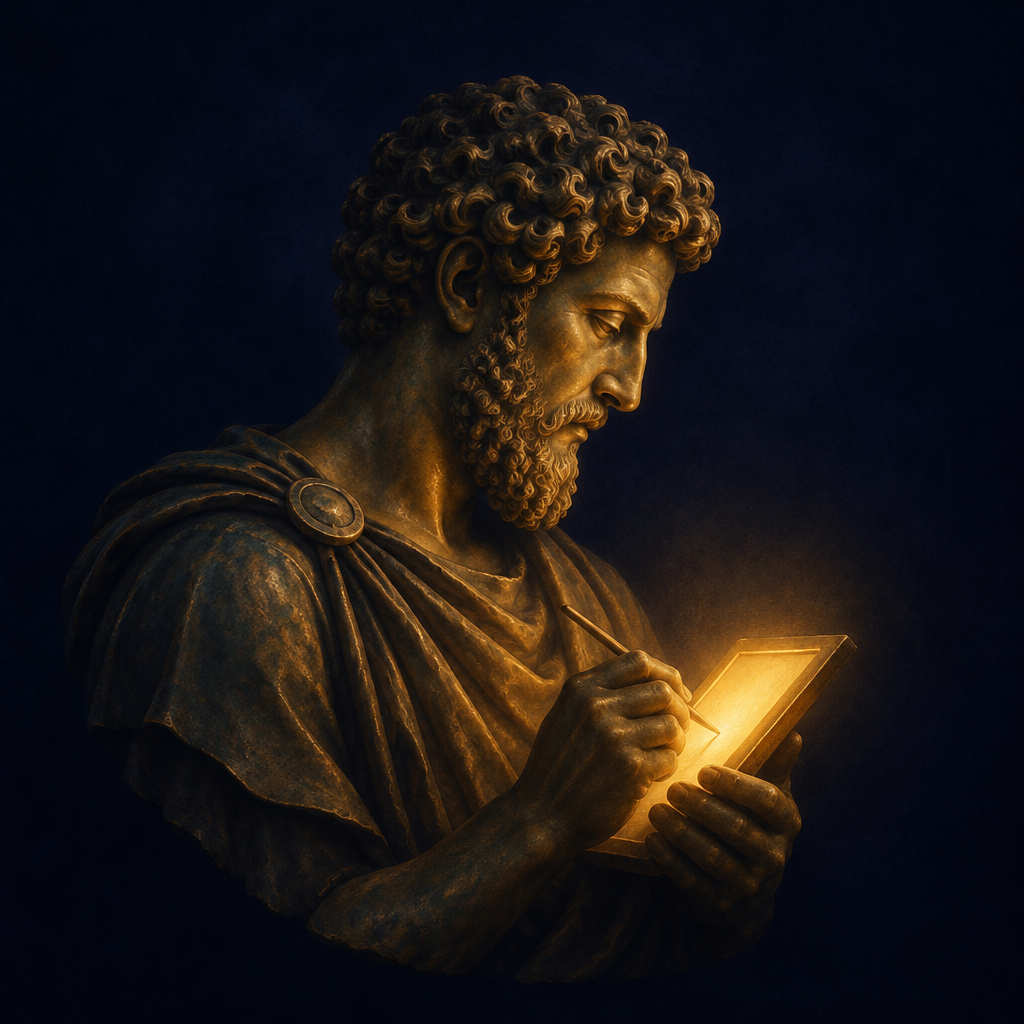
Marcus Aurelius: The Emperor Who Wrote to Himself
Marcus Aurelius and the Art of Calm is a 15-minute, three-lecture audio course on Stoicism as Marcus Aurelius actually lived it—first as a student, then as an emperor, and finally as a writer whose private notes became one of philosophy's most enduring works. The first lecture traces his early formation: born in 121 CE into a noble Roman family, adopted by Emperor Antoninus Pius at seventeen, and mentored by the Stoic tutor Junius Rusticus. Here the course establishes the foundational Stoic principle that inner peace comes from our own judgments rather than external circumstances—the idea captured in his line, "You have power over your mind—not outside events." The second lecture moves from theory to practice, examining how Marcus applied Stoic discipline to the demands of ruling an empire: his co-emperorship with Lucius Verus (161–169 CE), the Antonine Plague of 165 CE, and the Marcomanni campaigns of 166–180 CE. The guiding idea is that obstacles become the way forward—every impediment is material to work with, not a reason to blame. The final lecture covers the Meditations themselves: written in Greek in campaign tents between 170 and 180 CE, spanning twelve books on discipline, mortality, and daily conduct, and later fueling the modern Stoic revival and today's mindfulness apps. The course closes with one concrete habit listeners can apply in their own work sessions, turning Marcus's private notes into a repeatable daily practice.
The Dawn of the Philosopher‑King: Marcus’s Early Quest for Calm
The Dawn of the Philosopher‑King: Marcus’s Early Quest for Calm
A boy on the Caelian Hill. Rome, 121 CE. He would inherit the most chaotic job in the ancient world, and he spent his whole life training for one thing: staying calm. The ancient biographers tell us this child, Marcus Annius Verus, was solemn. Serious beyond his years. Now, that's an anecdote, not a psychology report, so hold it loosely. But here's what I respect about him. He looked at the world, saw the noise, and decided the product of his life would be his own mind. Britannica confirms the basics: born in Rome, 121 CE, to a wealthy and influential family through his mother, Domitia Lucilla. His father died young. His grandfather raised him. Loss showed up early. And Marcus, he didn't run from that. He went looking for a system.
Here's what strikes me about his education. It wasn't narrow. The Historia Augusta lists teacher after teacher — literature, drama, music, geometry, grammar, oratory. That's a, that's a lot of committees, frankly, and normally I'd cut half of them. But look at what he kept. Two rhetoric teachers matter here: Herodes Atticus for Greek, Marcus Cornelius Fronto for Latin. Their letters survive. Real correspondence, a real relationship. And Marcus studied both languages — he wrote his private notes, later, in Greek. But the moment that changed everything wasn't a lecture. It was a loan. His Stoic teacher, Junius Rusticus, handed him the writings of Epictetus. One book, from one teacher, redirected an entire life. That's focus. That's the essential feature. Everything else in his education supported it.
Now, the key idea. Stoicism holds that virtue is the genuine good, and vice the genuine evil. Everything else — status, comfort, applause — is circumstance. Think of it like this. You're shipping a product. You control the design, the craft, the decisions. You don't control the market's mood. The Stoics said the same about your mind. You control your judgments. You don't control events. So Marcus practiced governing his own responses while the world did whatever it wanted. And I mean practiced — the Meditations is a stack of private notes, not a textbook. The Stanford Encyclopedia makes this point clearly: it's evidence of ongoing effort, not mastery. He was debugging himself. Daily. That means the calm he wanted wasn't a gift. It was a discipline, built note by note.
Then fate walked in. In 138 CE, emperor Hadrian arranged the succession, and Antoninus Pius adopted Marcus. He was about seventeen. His name changed to Marcus Aelius Aurelius Verus, and his quiet study life was over. Antoninus became emperor that same year, and Marcus spent years learning government at his side before becoming emperor himself in 161 CE, sharing power with Lucius Verus. Remember this, Michael, because it's the whole architecture of his story. Philosophy wasn't his escape from responsibility. It was his preparation for it. A boy who loved books and quiet got handed the loudest job in the Roman world, and Stoicism is what made that survivable. The Historia Augusta even reports he wore a philosopher's cloak as a youth — an anecdote, yes, treat it cautiously, but the image works. He wore the, the idea on his shoulders before anyone asked him to.
So what do you do with this? The takeaway is simple and it's demanding: Stoic discipline begins with recognizing that inner peace is a product of your own judgments, not your circumstances. Product, Michael. Built, tested, shipped by you. Marcus left us the methods in Book 1 of the Meditations — his list of lessons from family, teachers, friends. He examined his own conduct. He reflected. He paid attention to the present moment. Here's your demonstration, one small thing to try today. Tonight, write down one judgment you made about your day. Then ask a single question. Was it the event, or was it me? When I think about the products that last, it's never the feature list. It's the one clear idea underneath. Marcus had his: master the judgment, and nothing else owns you. Start with one note. Tonight. That's how he began. That's how you begin.
The Emperor's Workshop: Applying Stoic Design to Governance
Rome, 161 CE. Antoninus Pius is dead, and the quiet student from our last lecture inherits the loudest job in the world. The empire's engine is roaring, and now Marcus has to drive it.
Last time we built the core feature: calm comes from governing your own judgments, not from controlling events. Now we ship it into production. And production, for Marcus, meant co-emperor. He insisted Lucius Verus share the office as an equal, the first time two co-augusti held equal authority, though Rome had seen shared power in other forms before. Verus took the eastern wars; Marcus kept the center, the law courts, the administration. Britannica is clear on what this means: his rule was no philosopher's retreat. Government ran on, amid military and administrative demands. And here's what I respect. He went to the courts. He worked on civil law, and Britannica notes his measures improved the position of less-favored groups, slaves, widows, minors. Not a radical rebuild, refinements. He was a conscientious ruler, not an innovative legislator. Good. Focus on the essential experience, not the feature list.
Then the bug reports started arriving. Warfare on the northern frontier. Rebellions. And plague. The Stanford Encyclopedia lists exactly these circumstances as the test of his Stoic ideal: acting well amid events outside your control. The Antonine Plague hit around 165 CE. Now, historians most commonly point to smallpox as the cause, but hold that loosely, the ancient evidence doesn't settle it. What matters is the response. Marcus didn't rage at the plague. He examined what was his to govern: the empire's decisions, his own conduct. The Internet Encyclopedia of Philosophy calls this the exercise of distinguishing what's within your control from what isn't, focusing a ruler's attention on judgments and actions rather than outcomes alone. Think of it like a product review. You can't control the market. You control the roadmap.
Now the Marcomanni. Germanic peoples pressing hard at the Danube frontier, a threat serious enough that Marcus spent roughly fourteen of his nineteen years as emperor on campaign. And here's the apparent contradiction. Stoicism teaches acceptance of fate. So why did he personally lead armies for years instead of delegating? Because Stoic acceptance was never passivity. The Meditations frame philosophy as a way of life, a practice to be applied, not abstract theory. Marcus treats justice and care for the human community as practical duties, people acting communally, contributing to the welfare of humanity, conceived as a shared cosmic city. So the resolution is clean. Accept what you can't command, the invasion, the plague, fortune itself. Then act, fully, on everything you can. He accepted fate's script and played his role without excuse.
Here's the line people love. What stands in the way becomes the way. And Marcus made it concrete. Facing the war's costs, he sold off imperial possessions in the forum rather than debase the currency or squeeze the provinces with taxes. The obstacle, empty treasury, became the material he worked with. Every impediment was a feature to prototype, not a bug to blame. Suppose a crisis hits your work. The blame meeting asks: whose fault? The Stoic design review asks: what does this make possible? Marcus chose the second question, every time.
One more test. 175 CE. Avidius Cassius, his own general, rebelled in the east. The revolt collapsed, Cassius died, and when the conspiracy's papers surfaced, Marcus reportedly burned them rather than hunt everyone named. He refused vengeance against Cassius's family. Why? Because the Meditations present other people as fellow members of a common human community, a premise that supports patience and cooperation in public life. That's not softness. That's a governance system with one unifying idea: treat authority as an occasion for duty and just action, not as proof of superiority or a guarantee of happiness.
And through all of it, he kept writing. At the Danube, in campaign tents, he composed the Meditations in Greek, not Latin, despite being a Roman emperor. Why Greek? Because it was private, philosophical, addressed to himself, its intended circulation uncertain even today. Twelve books of reflections, not a conventional treatise, not a political system. Personal exercises for his own moral improvement. The Meditations don't offer a systematic blueprint for modern government. They offer practical principles for conduct, leadership, and society.
So here's your takeaway, Michael. Every obstacle is a feature to prototype, not a bug to blame. The dichotomy of control was his daily workflow: sort what you govern, your judgments, decisions, responses, from what you don't, plague, invasion, betrayal. Then pour everything into the first pile. Next time, the final blueprint: how those private Greek notes became a legacy that outlived the empire itself.
Echoes in the Stars: The Enduring Blueprint of the Meditations
A tent on the Danube frontier. Roughly 170 to 180 CE. The most powerful man in Rome is writing notes nobody was ever meant to read. Michael, we've seen the design. We've seen the testing. Now, the release notes. Last time we watched Marcus run the Stoic product under load, plague and war and, and a co-emperor's death. The insight was: obstacles are material. Today we ask the question that matters to any product person. Why did this thing survive? Here's what gets me. The Meditations is a private notebook. No audience. No named reader. Marcus wrote it to and for himself, and scholars are clear on this point. It's rehearsal, not publication. He repeated Stoic teachings to himself as a practical effort at moral improvement. The scholar A. A. Long called Books Two through Twelve a kind of spiritual diary, written in leisure moments, apparently for his own use. And here's the counterintuitive part.
The most famous Stoic text in history came from a man who never called himself a philosopher and never taught a single student. He wasn't building a legacy. He was debugging himself. And that, that is exactly why it works. Legacy-building adds noise. Self-address keeps it honest.
So what's actually in the box? Twelve books. But hold on, don't picture a systematic treatise. Scholars caution that the twelve-book division alone doesn't establish a treatise structure, and Books Two through Twelve don't follow an obvious sequence. Book One is different, and it's widely believed to have been written first. It's the list of debts. Family, teachers, friends, the specific virtue he learned from each. We covered that in lecture one. Even there, Long observed, it's an intimate document, despite its distinctive focus on acknowledging the people who shaped him. The rest is self-address. The core Stoic distinction runs through everything: virtue is good, vice is bad, and external things don't by themselves make a life happy or unhappy. Happiness is grounded in virtue, and virtue lies within your power. He urges himself to meet people without anger, to regard them as kin, sharing a common origin. He links good judgment to examining impressions rather than accepting them uncritically. Accept what happens. Direct your conduct toward justice.
And justice isn't private self-control. Acting justly means acting for the community. He calls humans citizens of a cosmic city, obligated to contribute to the welfare of humanity. Stoicism isn't just inner discipline. It's a guide to social action.
Now, the stars. Marcus keeps telling himself to look up. Contemplate the vastness of the cosmos. People read that as poetry. It's not. It's a practical exercise. Think of it like this. When you zoom out far enough, the thing that's blocking you shrinks to its actual size. The world, in his framing, is governed by Providence, and he uses that premise when reflecting on what happens to him. The cosmic view isn't decoration. It's a, a calibration tool for judgment. And here's the survival story, because a private notebook should have died in that tent. It didn't. The text reached us through medieval manuscript witnesses, not through any authorial manuscript by Marcus. The title commonly rendered as To Himself comes from that manuscript tradition, and scholars have cautioned its origin and authorial status are uncertain. Long even noted the title on the lost manuscript behind an early printed edition may have reflected a reader's impression, not an author-given title.
The work reached print in the sixteenth century through an edition based on a manuscript that is now lost. The product outlived the maker with no roadmap, no support, no version two.
Then the revival. In the twentieth century, Stoicism came back through therapy rooms, not just seminar halls. The psychotherapist Albert Ellis explicitly credited Marcus Aurelius and Epictetus as foundational to Rational Emotive Behavior Therapy. One clinician, reading a dead emperor's private notes, and building a whole therapeutic method on the core insight: examine the impression before you accept it. That's the, the modern Stoic revival's engine, twentieth into the twenty-first century. And look at today's mindfulness apps. Daily prompts. Morning reflection. Evening review. That structure traces directly to the Meditations' own pattern of self-address and pre-dawn preparation. Marcus rehearsed his principles before the day hit him. The apps industrialized the rehearsal. Same essential experience, new packaging. I have complicated feelings about apps, but the, the honest product read is this: they kept the core loop and shipped it to millions. That's not a betrayal of the text. That's the text doing what it always did, which is run in the background of a working mind.
So why do I call the Meditations a minimal viable product for the soul? Because it's the smallest coherent thing that demonstrates the idea end to end. No treatise. No audience. No updates for eighteen hundred years, and it still runs. It works because it never tried to be complete. It tried to be used. Daily prompts that keep you aligned with the essential experience: calm. Now your demonstration. One habit. You work in fifteen-minute blocks, so use them. Before your next block, one sentence, written down: what's the one judgment I'm carrying into this session? Then run the block. After, one more sentence: was it the event, or was it me? That's it. That's the whole feature set. It mirrors Marcus's morning premeditation because you do it before the work, not after the damage. Take this habit into your next work session. Let the Stoic product run in the background of your mind. One man in a tent proved it never needs an update. Start tonight.
One note. That's how everything ships.