
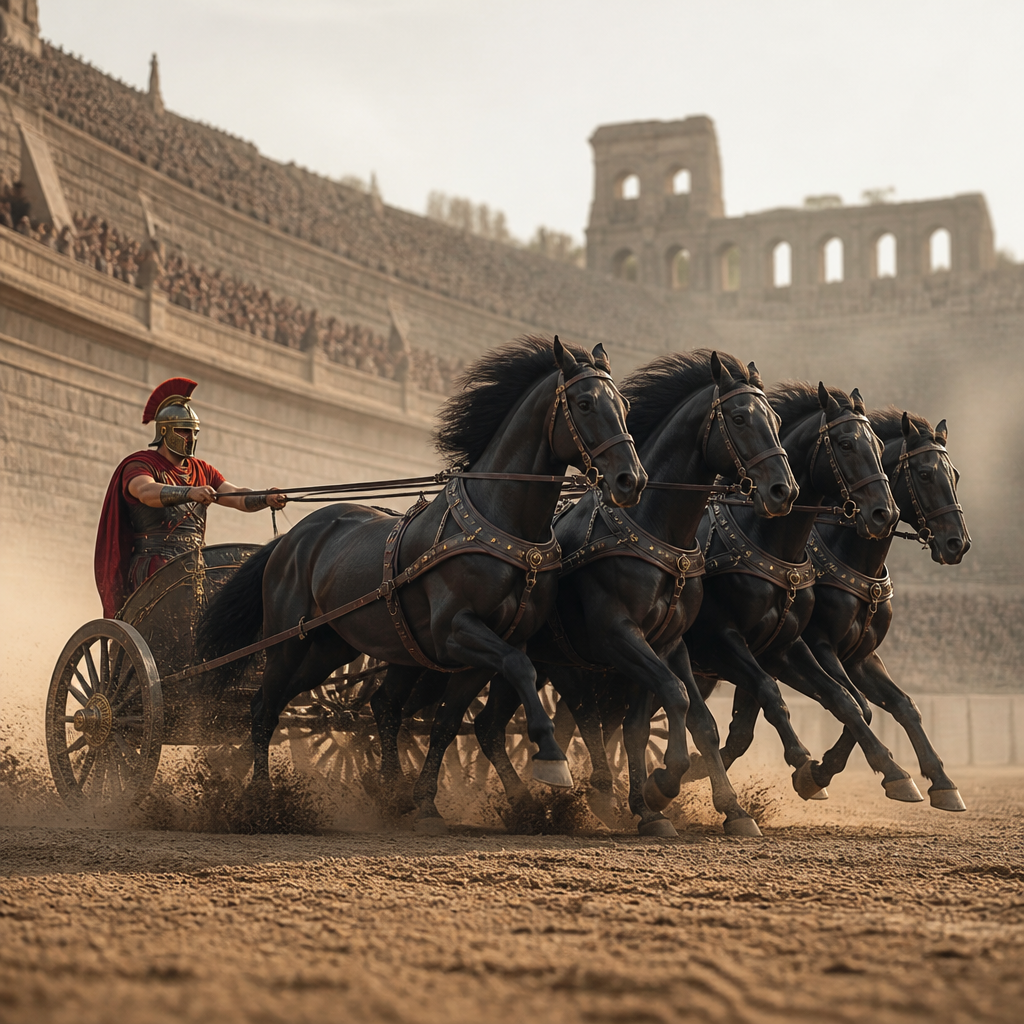
Speed and Spectacle: The Rise of Chariot Racing in Ancient Rome
This course examines Roman chariot racing as a social, political, and engineering phenomenon that shaped urban life for centuries. It begins with the Circus Maximus, a venue holding roughly 250,000 spectators, and explains why races functioned as civic rituals rather than mere entertainment. You will learn about the aurigae—the drivers, who ranged from slaves to aristocrats—and the four factions that organized them: the Reds, Whites, Blues, and Greens, which operated like modern sports clubs with fan bases, sponsorships, and rivalries. The course also covers the mechanics of the races themselves: fields of up to twelve chariots, speeds approaching 40 miles per hour, and the frequent crashes the Romans called naufragia, which audiences bet on heavily. The second lecture turns to the engineering behind the spectacle, detailing the Circus Maximus's dimensions of roughly 600 by 150 meters, the central spina with its metae turning posts, and the surveying tools—groma and dioptra—that ensured each lap covered equal distance. You will study the drainage systems that kept the sand track dry, the carceres starting gates with their rope-pulley release mechanism, the harness systems that kept horse teams in sync, and the vomitoria passages that allowed crowds to enter and exit safely. The final lecture focuses on the people who powered the sport and its political consequences. It covers the celebrity status of successful charioteers, including Gaius Appuleius Diocles, who earned an estimated 35 million sesterces—more than many senators—and could receive public statues and citizenship. You will learn how patrons funded teams and converted victories into political capital, how the four factions functioned like political parties whose colors appeared on banners and coins, and how emperors aligned with popular factions to reinforce their public image. The lecture also explains the betting economy, from the tabularii bookmakers who kept detailed ledgers to the taxes the state collected on gambling profits. By the end, you will understand chariot racing as a microcosm of Roman society, where wealth, ambition, and politics collided at high speed.
The Fast Track: Introducing Roman Chariot Racing
The Fast Track: Introducing Roman Chariot Racing
Picture a single piece of fired clay, smaller than a laptop. On it, a four-horse chariot screams around a turning post, and crouched at the base of that post is a fallen driver. That's a Roman terracotta relief, and the British Museum holds it today. One object. Two fates. The winner and the wrecked, frozen in the same second. Yevgeni, that little relief is your doorway into the most popular spectator sport the Roman world ever knew — and it was so much more than a sport.
Now, the key idea: chariot racing was a major form of public spectacle woven into Roman religious and civic life. Races ran as part of public festivals — the ludi Romani, the ludi Apollinares, the ludi Ceriales. So this wasn't a weekend entertainment you bought a ticket for. It was, it was the state itself throwing the party. And the main stage? The Circus Maximus, a principal venue for racing in Rome, a structure built to hold a staggering share of the city's population at once. Emperors understood exactly what that crowd meant. In the later Empire, the circus even served as a public setting where spectators could address the emperor directly and voice grievances. Think of it as a stadium, a temple, and a town hall fused into one.
The sport ran on color. Racing teams — the factiones — were organized around four colors: Red, White, Blue, and Green. And these weren't just jerseys. The factions operated as contractors, organizing racing teams and their services, complete with staff who supported both the racers and their horses. A charioteer's success depended on more than driving. The Blues and the Greens grew into the most popular factions and enjoyed imperial favor too. Loyalty ran deep — deep enough to turn violent. In 532, in Constantinople, a crisis involving the Blues and Greens erupted during scheduled races, and the resulting Nika riot became a major political upheaval. A riot, from, from fandom. Let that sink in. Domitian later introduced Purple and Gold factions, but they were short-lived. Four colors endured.
And the men on the chariots? They were called aurigae. Some were slaves or freedmen who could rise to become famous and wealthy figures — the name Flavius Scorpus survives in ancient literary testimony about racing. Their names and images turn up on honorific and funerary inscriptions, on lamps, on drinking cups, even in domestic mosaics. Celebrities, in other words, with merchandise. But the British Museum relief shows the price. That driver wears a cap, leggings, a short tunic, and protective leather straps — and the reins are passed around his waist, not just held in his hands. Why? Because if you fell, you, well, the, the logic was grim. Racing was hazardous, and some drivers' careers ended in fatal accidents while they were still young. The relief even shows a jubilator, an additional rider whose role was to encourage the racers. A hype man, on horseback, two thousand years ago.
The factions began as independent organizations in the Republic and early Empire, then came under imperial control in the later Empire. That trajectory tells you everything. Rome's rulers didn't leave something this powerful in private hands. And this is where it gets interesting for you, Yevgeni — this wasn't just spectacle, it was a political and economic engine, with emperors, magistrates, and betting crowds all staked on the outcome. The takeaway you should carry with you: chariot racing was more than a sport — it was a social, political, and economic engine that shaped Roman urban life. Everything else we cover in this course — the factions, the drivers, the crashes, the riots — flows from that one truth.
Engineering the Spectacle: How Rome Built the Ultimate Race Track
Speaker 1
Alright, so last time we established chariot racing was this social and political engine, not just a sport. But here's what's been bugging me since.
Speaker 2
Go on. You've got that look.
Speaker 1
The Circus Maximus held a huge share of the city at once, and races were fast and dangerous. Those two things can't both be easy. A massive crowd and a high‑speed track, on the same patch of ground.
Speaker 2
And you're right to hold both, because they pull in opposite directions. That tension is the whole story of this venue.
Speaker 1
So where do we start? The valley?
Speaker 2
Exactly. The Circus sat in the Murcia Valley, between the Palatine and Aventine hills. Rome's builders used a natural valley as the setting. They didn't fight the landscape, they borrowed it.
Speaker 1
Wait. So it wasn't one grand design from day one?
Speaker 2
Not at all. The monumental imperial structure came from centuries of repeated rebuilding. And it was damaged repeatedly by fire, then almost completely rebuilt under Trajan. Much of what's visible today dates to his reign.
Speaker 1
Okay, so give me the numbers. How big was this thing?
Speaker 2
The imperial‑era Circus was about six hundred metres long and one hundred forty metres wide, according to the Stanford Forma Urbis Romae Project.
Speaker 1
Six hundred by one forty. So think of it as, what, a dozen city blocks of racetrack?
Speaker 2
picture a straight walk of six hundred metres, that's roughly seven or eight minutes at a stroll, and the whole way you're flanked by seating on both sides.
Speaker 1
And here's a detail I didn't expect. The long sides weren't even parallel, right?
Speaker 2
Correct. The side facing the Aventine was slightly inclined. And that's not sloppiness, that layout shows up in other Roman circuses too.
Speaker 1
Why would they do that? It sounds like a, a mistake you'd correct.
Speaker 2
Remember the starting gates stood at the Forum Boarium end, arranged in a curved line set at an angle to the central axis. The curve helped place the teams at comparable distances from the starting line. The geometry was doing quiet work.
Speaker 1
Oh. So the wonky walls and the curved gates are the same problem being solved.
Speaker 2
Exactly. Fairness, baked into the architecture.
Speaker 1
Now, the key idea I want to nail down, the spina. That's the central spine the chariots raced around?
Speaker 2
Yes, sources call it the spina or euripus, the median feature marking the central axis. The turning posts, the metae, marked its ends, and the chariots raced around those.
Speaker 1
And those metae weren't decorative, were they.
Speaker 2
Not remotely. Each lap's distance depended on their exact placement. [steelman-then-break] Now, I could argue they were just monuments, altars and statues on show. But that argument dies the moment you ask how a race stays fair.
Speaker 1
If one turning post sits a metre off, each lap on that side is a different race.
Speaker 2
Precisely. And the Oxford reference account notes the carceres and metae were restored in 174 BCE. They maintained these installations, they didn't just admire them.
Speaker 1
When do the carceres themselves show up?
Speaker 2
The same Oxford account identifies 329 BCE for the earliest permanent starting gates. And in the imperial period there were twelve gates plus a larger central gate, the porta pompae.
Speaker 1
Twelve gates. So how did they launch everyone at once? I keep imagining twelve guys pulling twelve ropes and someone being half a beat late.
Speaker 2
That's the beautiful part. The gates formed a curved line, angled to the axis, so the teams sat at comparable distances from the start. The layout itself did the synchronizing.
Speaker 1
So the geometry is the mechanism. Okay, and the lap counting, was there anything for that?
Speaker 2
In 174 BCE, seven eggs were installed or restored as lap counters, lowered to mark completed circuits. The crowd could read the race's progress at a glance.
Speaker 1
Eggs? That's, that's wonderfully practical.
Speaker 2
It is. And there's a stranger twist with the spina itself. Research describes an early open drainage canal between posts as a possible forerunner of the later spina.
Speaker 1
Stop. The spine started as a drain?
Speaker 2
A possible forerunner, yes. And a 2016 geoarchaeological study used electrical‑resistivity tomography with sediment cores to look at the buried valley. It concluded builders made use of the flood plain's natural channels and depositional bars in managing water.
Speaker 1
So water management wasn't an afterthought, it was the foundation. What about the big drain, the Cloaca Circi Maximi?
Speaker 2
It's documented as carrying water from the Circus and Forum Boarium area toward the Tiber. But its precise route through the Circus itself remains hypothetical, not archaeologically confirmed.
Speaker 1
Fair. So we hold that one loosely. Now the crowd, how many people are we talking?
Speaker 2
Dionysius of Halicarnassus, writing in 7 BCE, described it as three and a half stades long, four plethra wide, and reported seating for 150,000. Ancient reported figures, mind, not modern capacity measurements.
Speaker 1
150,000 people in one structure. How do you even get them in and out without a stampede?
Speaker 2
That's where the façade comes in. Three levels, the lower one about as tall as the two upper levels combined. Arches at the bottom opened onto a covered passageway encircling the building.
Speaker 1
A ring corridor. And behind it?
Speaker 2
Radial walls divided the structure into rooms. Different rooms gave access to lower seating, stairs to upper seating, or shops. The seating itself, the cavea, had three sections: the ima, media, and summa cavea.
Speaker 1
So people flowed in through the arches, split through the ring, and sorted themselves by level. How do we even know all this? The site's so built over.
Speaker 2
Archaeological evidence, written sources, coins, and surviving remains, all combined to reconstruct the imperial‑period architecture. And recent restoration work has included plans for new lighting and drainage systems to expose and interpret the buried structures.
Speaker 1
a walk around the outer ring, arches overhead, food stalls in the radial rooms, and 150,000 people moving without gridlock.
Speaker 2
That's the achievement. Roman engineers combined architecture, hydraulics, and logistics so massive, high‑speed events could run safely and repeatedly.
Speaker 1
The venue wasn't a container for the spectacle. The venue was the engineering.
Speaker 2
And here's my honest test. If someone showed me a confirmed course for the Cloaca Circi Maximi running clean beneath the track, I would happily revise the drainage story. While that dig is pending, the natural‑channel evidence is what I stand on.
Speaker 1
Which sets up where we go next, doesn't it. The drivers, the patrons, the fans.
Speaker 2
Right. The engineering foundations are laid. Now we turn to the human element, the people who brought the races to life.
Heroes, Patrons, and Politics: The People Who Powered the Races
A slave dies at twenty‑seven, and a poet writes his epitaph. An emperor dines in a horse stable, by choice. And a driver amasses a fortune the Senate itself couldn't hand out. Previously we saw how the Circus Maximus was engineering made visible, the venue as the machine. But a machine needs people. And the people are where this story gets strange. Because here's the contradiction I want you to hold: the drivers were often the lowest of the low, slaves and freedmen. Yet some of them, some of them became richer and more famous than the aristocrats who owned the seats. Both things are true. And we're going to hold both until they make sense together. Quick recap. The engineering, the gates, the spina, the drains, that was the skeleton. Now the muscle. Remember, the races were run by four professional companies, the factiones: Red, White, Blue, and Green. Think of them as contractors. They supplied the horses, the equipment, the drivers, and the specialist staff. And I do mean staff. A manager, the dominus factionis, supervised coaches, grooms, even veterinarians. A full operation, not a loose club. Now, here's a correction worth making. The factions didn't come from the Republic. Initially semi‑independent. From the third century onward, they came under increasing imperial patronage. The state saw value. The state moved in. Now, the key idea: a driver's success depended on more than personal skill. The faction gave you the horses, the training, the organization. Which brings us to the case study. Gaius Appuleius Diocles. His career is documented by a detailed Roman inscription, and it reads like a stat sheet. Twenty‑four years of racing. He drove for three factions: the Whites, the Greens, then the Reds. Four thousand two hundred fifty‑seven races. One thousand four hundred sixty‑two wins. Let that record sink in. Over a third of his starts ended in victory, across nearly a quarter century of the most dangerous sport Rome had. And he wasn't alone at the top. The poet Martial wrote about the charioteer Scorpus, including poems responding to his death. Martial's epitaph presents Scorpus as a favorite of the circus audience. He died in his twenty‑seventh year. Fame, cut short. The inscription for Diocles, though, records the money too. Successful charioteers could become wealthy and famous, and some earned enough to purchase their own freedom. So who paid for all this, and why? Patrons funded teams because victories converted into political capital. And at the top of the patron pyramid sat the emperor himself. Imperial favor was not subtle. Suetonius reports that Caligula was devoted to the Greens. Devoted how? He regularly dined and spent nights in the Green faction's stable. The emperor of Rome, sleeping with the horses. And for special games, Suetonius says Caligula had the Circus decorated in red and green, and arranged for the charioteers on that occasion to be senators. The hierarchy flipped upside down for a day. One caution, though. Cassius Dio, not Suetonius, is the source for the gift of two million sesterces to the Green driver Eutychus. I, no wait, let me be careful there, because sources matter. And Domitian? The Oxford Classical Dictionary says he introduced a Purple, an imperial faction. A Gold faction? No reliable evidence. Short‑lived at best, if it existed at all. The Blues and Greens eventually outgrew the Reds and Whites, and drew particular imperial favor. But here's where it stops being a sports story. In the later Empire, the Blues and Greens became more than performers' organizations. Their supporters took part in organizing public acclamations for emperors and their representatives. Think of it like when a modern party machine turns out a crowd, except the crowd is chanting for the emperor, and the party is a racing team. The late‑antique factions had a formal role in producing acclamations in the emperor's honor. Organized spectatorship, welded to imperial ceremony. And imperial policy expanded the factions' role beyond chariot racing, pulling audience groups into larger organizations around those two colors. The circus was also a venue where spectators could express public opinion and petition the emperor, including for relief from taxation. Emperors used races to stage public rituals and bring together enormous audiences. So, Yevgeni, what do we take from this? The races ran on an intertwined network: drivers, patrons, emperors, and crowds, each staked to the others. A slave could buy his freedom with winnings. An emperor could court public opinion through a color. A poet could mourn a dead driver like a fallen hero. And if someone showed me evidence that any of these pieces moved alone, that the drivers succeeded without the factions, or that the factions thrived without imperial money, I'd revise the whole picture. But the inscription of Diocles, the stable of Caligula, the acclamations of the Blues and Greens, they all point one way. The takeaway: chariot racing wasn't a pastime that politics occasionally touched. It was a vehicle for social mobility and political influence, powered by people across many levels of Roman society. Next time, the crowd itself, and what happened when that crowd turned.