
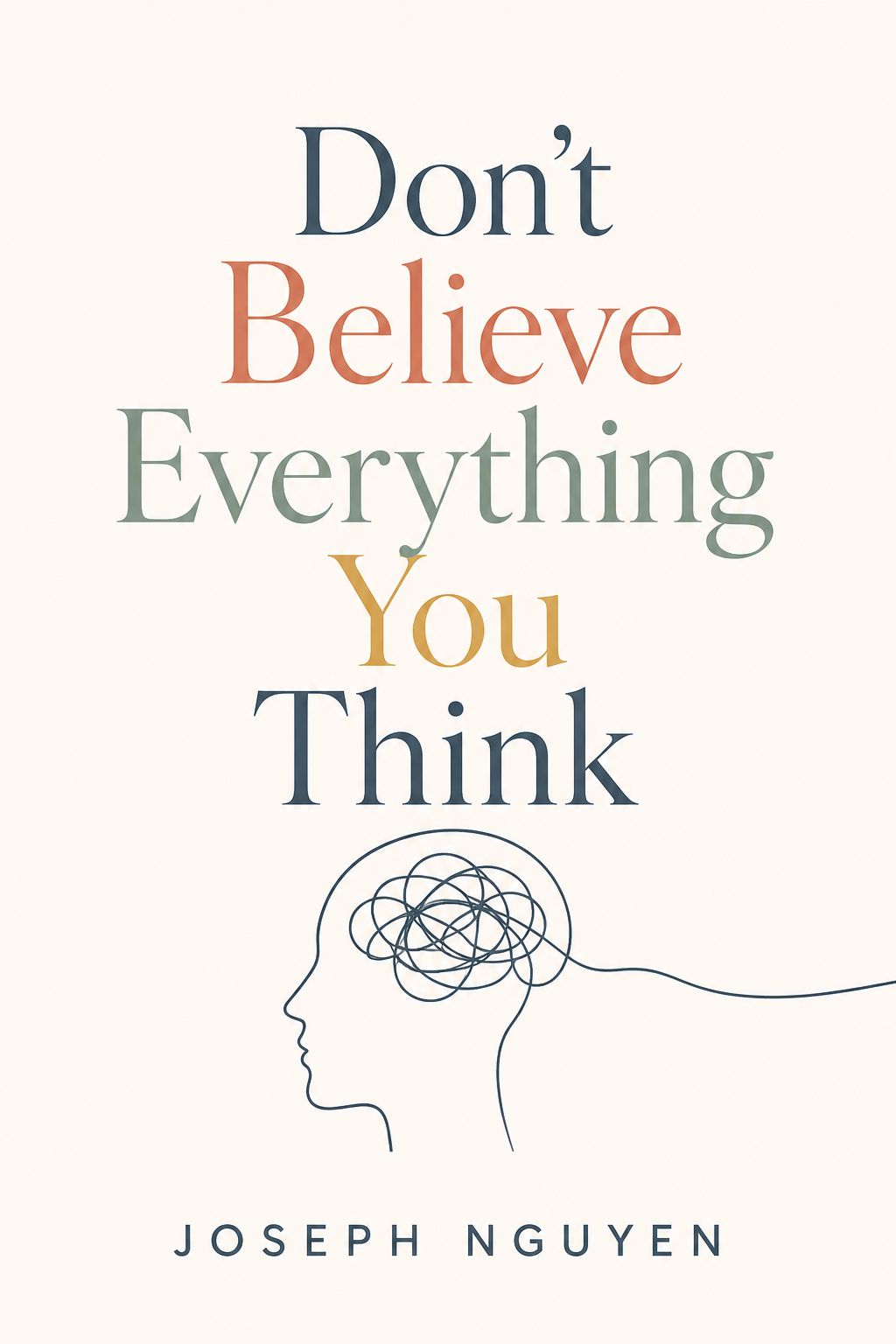
Don’t Believe Everything You Think by Joseph Nguyen
This 12-lecture audio course unpacks Joseph Nguyen's "Don't Believe Everything You Think," a guide to non-thinking and freedom from suffering. It opens by framing the book's intent and how to use the material, then traces the search for the root cause of suffering, arriving at the core insight that suffering comes not from events themselves but from how we think about them. The course distinguishes fleeting thoughts from the ongoing process of thinking, and introduces the Three Principles—Mind, Consciousness, and Thought—as the mechanism by which experience is generated from within. From there, it addresses a common objection: what happens to goals, dreams, and ambition if we stop thinking? The answer shows that purposeful action and a quiet mind can coexist. Further lectures examine how unconditional love and peace arise naturally when thinking quiets, why nothing is inherently good or bad—labels being mental constructs—and how intuition becomes a reliable compass for making decisions from stillness rather than analysis. The later lectures turn insight into practice. You will learn how to create the mental space where effortless, even miraculous, possibilities appear, and how to anticipate the real obstacles of a non-thinking life: fear, habit, and social pressure, along with strategies for working through them. A dedicated lecture covers the post-awakening phase, offering daily habits and practical steps to sustain the shift rather than treat it as a one-time event. The final lecture brings the entire framework together, reinforcing that truth cannot be intellectualized, only experienced, and inviting listeners to embody non-thinking as a lived state of peace, love, and joy. Throughout, the course stays conversational and concrete, moving from diagnosis to principle to practice, so that by the end you have both the understanding and the tools to quiet the mind without abandoning your responsibilities or ambitions.
Opening the Journey: From Cover to Vision
Opening the Journey: From Cover to Vision
Welcome to Don't Believe Everything You Think by Joseph Nguyen, a book that asks one huge question: what if your suffering has never actually come from your life, but from something much closer to home? Most people assume that fixing their circumstances, their thoughts, or their habits is the path to peace, but Nguyen claims the real answer is hiding somewhere nobody thinks to look. And the man making this bold promise? He has no psychology degree, never finished college, ran a marketing agency instead, and, wait for it, keeps three cats despite being allergic to them.
The book's core thesis lands fast, and it lands hard: according to the author, psychological suffering is not caused by our circumstances but by our thinking about them. Stress, anxiety, self-doubt, regret, and unhappiness, he argues, all arise from one single mistake — believing our thoughts as if they were facts. And here's the twist, the, the counterintuitive part: the mind is not the solution to your problems; in Nguyen's view, it is the source of them.
He calls this an inside-out understanding, meaning our experience of reality is generated from within, through thought, rather than fixed by external events. The world doesn't cause your feelings; your thinking about the world does. When you see that clearly, the author contends, you stop taking thoughts at face value, and suffering naturally starts to fade. No forced positivity, no new techniques, just recognition.
So why do most of us live backwards? Nguyen says people live from the outside-in, believing that changing external conditions — the job, the relationship, the, the whole life setup — will finally produce internal peace. But transformation, as he sees it, actually happens in the reverse direction, from the inside-out, and that's the entire roadmap of the book. The first half builds a conceptual understanding of mind, thought, and consciousness, while the second half turns practical: goals without stress, better relationships, finding purpose, unlocking creativity and performance.
Now, the author's credibility here isn't academic, and honestly, that's the point. He spent years battling depression, anxiety, and self-doubt, trying therapy, self-help methods, and relentless hard work, and nothing gave lasting relief. Then he encountered an understanding of the mind that, in his words, changed everything. This book is the fruit of that transformation, not theory.
Here's where Nguyen gets delightfully bossy about how you should read him. No hour-long meditation sessions, no religious beliefs, no life overhaul required — the book promises accessibility over austerity. Don't take obsessive notes, don't try too hard, don't force insights; read it like a novel, relaxed and open. Why? Because, in the author's view, insight arises naturally when the mind is quiet, and straining blocks exactly what you're seeking. And that word matters: insight. The author insists this is not an intellectual exercise, not something to memorize or cram like an exam. It's a deeper seeing, an awakening to how the mind creates experience moment to moment. Effort, he contends, is precisely what gets in the way of that seeing. One more instruction, and it's the most refreshing one: don't believe anything he says. I mean it — Nguyen explicitly asks readers not to take his word for anything, but to test every idea against their own direct experience. Verify, don't trust.
He also counsels patience, because even a small glimpse of these principles, he says, can begin dissolving chronic overthinking. And beneath that turbulence? Innate wellbeing, always already there, waiting to be noticed — unconditional peace found not through effort, but through recognition.
Uncovering Suffering: The Quest and Its Root
Before Joseph Nguyen wrote a single page about the mind, he spent years wanting to disappear. Starting in early adulthood, he says, he lived with depression, anxiety, and suicidal thoughts, all while functioning as a pharmacy student and later a finance professional. And he was, he was good at hiding it.
The author calls his skill at masking the pain a curse in disguise, because nobody, just nobody, knew how much help he actually needed. His negative thinking fed itself, he recalls, each gloomy thought triggering the next, until his whole experience of life was filtered through a lens of misery. It wasn't one bad season. It was a loop that ran for years.
Last time we saw the book's central promise: suffering comes not from our circumstances but from our thinking about them. Now you get to see where that idea came from, and honestly, the search behind it is remarkable mostly because of how badly it went.
Think of the, the scale of it. The author pursued conventional psychotherapy with multiple therapists, which he says left him feeling worse, like re-opening wounds without ever healing them. He took years of antidepressant and anti-anxiety medications, which blunted symptoms but brought side effects. When he stopped, the depression simply came back. That's, that's the pattern to hold onto. Then came the alternatives: meditation, yoga, journaling, affirmations, visualization, breathwork, exercise, tai chi, qigong, hypnotherapy, acupuncture, herbal remedies, neuro-linguistic programming, the law of attraction, and dozens of self-help books and seminars.
Each one, he says, offered temporary improvement at best, and the underlying suffering always resurfaced. Every single door led back to the same dark room. And out of that relentless failure comes the insight that changed everything.
Because here's what struck him. If so many completely different treatments all failed, the problem could not lie in the techniques themselves. Something deeper had been missed, by him and by everyone trying to help him.
He and his helpers had been treating symptoms rather than the root cause. It's like taking painkillers for headaches caused by dehydration while never drinking water. That realization reframed his entire search, and this matters, so, so stay with it. He stopped trying to manage or cope with suffering, and committed instead to finding its single underlying source. It was that willingness to challenge his own assumptions, rather than trying harder with existing methods, that opened the door to everything the book goes on to say.
So what is the root? According to the author, the root cause of all psychological suffering is not our circumstances, but our thinking about them. Building on principles of mind, consciousness, and thought, ideas that echo Sydney Banks's Three Principles psychology, he argues that every negative experience arises from the thoughts we generate about events, not from the events themselves.
Stress, anxiety, anger, sadness, depression, all of it, he contends, is created from the inside out, not imposed from the outside in. Two people can face identical situations and have entirely different emotional experiences, because their thinking differs. We feel bad, in this view, not because of what happens to us, but because of what we think about what happens to us.
The everyday examples make it land. Picture one driver stuck in traffic, furious about being late, about how unfair the delay is. Now picture another driver in that same traffic, lost in pleasant daydreams, feeling nothing negative at all. Same jam, different head. Same, sorry, same traffic, different thoughts, different experience.
Or take a painful event from the past. It causes no suffering in the present moment, the author says, until we recreate it through thought. He compares thoughts to clouds passing through the sky of consciousness. We suffer when we grab onto them, believe them, and treat them as reality rather than transient mental events. Which, when you hear it that way, sounds so obvious you wonder why nobody said it sooner.
And the practical implication is striking. We don't need to change the external world, and we don't need to fight or control our thoughts. We only need to see that thought is the mechanism creating our experience. When we see that a low mood or an insecure feeling is just thought in the moment, we naturally stop acting on it, and we wait for clearer thinking to emerge.
This ties the whole arc together. All those years of failed remedies failed precisely because they addressed circumstances and symptoms rather than thought itself. And once thought is recognized for what it is, temporary, illusory mental fabrications rather than accurate reports of reality, suffering becomes, in the author's words, optional, and it begins to dissolve. Not managed. Dissolved. That's the promise, and next time we'll look at how the mind actually builds this illusion.
The Mechanics of Thought: Distinguishing Thoughts From Thinking
Last time we landed on the book's root claim, that suffering comes from our thinking about circumstances rather than the circumstances themselves, and now the author takes us one level deeper. He draws a distinction he treats as absolutely foundational to everything that follows, and honestly, once you see it, you can't unsee it. It is the difference between having thoughts and doing thinking, and, and trust me, those are not the same thing at all.
Thoughts, in the author's definition, are involuntary and automatic mental events that simply arise in consciousness on their own, whether we want them or not. We do not choose them, we do not generate them deliberately, and we have no control over when they arrive or what they contain. The author compares them to breathing or blinking, natural processes that occur thousands of times a day without any effort on our part.
Thinking, by contrast, is a voluntary and deliberate act of engagement, something we do rather than something that happens to us. When we take a thought and start analyzing it, elaborating on it, believing it, or following its storyline down the rabbit hole, that is thinking. The thought appears on its own, but the engagement is our choice.
This explains, according to the author, why two people can have the exact same intrusive or negative thought, yet only one of them suffers. One lets the thought pass through like a cloud, while the other grabs hold of it and thinks about it, giving it life and power it never had on its own. The author uses two vivid metaphors here, thoughts as uninvited guests and thoughts as spam emails, and, and the spam one is my favorite. We cannot stop them from showing up in the inbox, but we are under absolutely no obligation to open them, read them, or respond. The mere presence of a thought, in this view, is completely harmless; the problem only begins when we engage.
A key insight follows from the involuntary nature of thoughts, and it is genuinely liberating. Because thoughts arise on their own, we should not feel guilty or responsible for having them, even the dark, strange, or disturbing ones that pass through everyone's mind. Having a thought says nothing about your character. What matters, the author contends, is only whether we engage with it. And this same insight explains why trying to control, suppress, or fight thoughts always backfires so badly. The act of pushing a thought away is itself a form of thinking about it, which reinforces the very thing we are trying to eliminate. It's the classic pink elephant problem, right, don't think of a pink elephant and now, now that's all you can think about.
The practical takeaway is a shift in orientation, from managing or monitoring our thoughts to recognizing that we are the awareness within which thoughts appear. When we understand that we are the observer of thoughts rather than their author, we naturally stop taking them so seriously, and they lose their grip on us. You are not the thinker; you are what notices the thinking. This distinction also sets up the book's larger thesis, the one we saw in the first lecture. Insight, not effort. It is seeing the nature of thought clearly, rather than applying techniques or willpower, that dissolves anxiety and suffering. Next time, we'll look more closely at the machinery itself, how mind, consciousness, and thought interact to construct every experience we have.
Let this distinction settle for a moment, because the author treats it as the hinge of the entire book. It is not the presence of thoughts that creates suffering, but our voluntary engagement with them. That single shift, he contends, changes everything about how we relate to our own minds.
Return to that spam inbox metaphor, since it, it really does hold up under pressure. Thousands of messages arrive daily, uninvited, and most of them are irrelevant or absurd. Arrival is not the same as engagement. The author's point is that we confuse the two constantly, treating every thought as urgent mail demanding a reply.
This confusion also manufactures guilt that, in the author's view, we never deserved. Because thoughts arise involuntarily, having a dark or strange one proves nothing about your character. And fighting such thoughts only feeds them, since suppression is itself thinking, which is why the pink elephant refuses to leave.
So the invitation here is not another technique, not a practice, not a discipline. It is a recognition, that you are the awareness in which thoughts appear, not their author. See that clearly, and thoughts loosen their grip on their own.
Notice, too, how this builds directly on our second lecture. We located the root of suffering in thinking, and now we see precisely where the fork in the road lies. Next time we open the machinery itself, how mind, consciousness, and thought interact to construct every experience you have ever had. Same insight, deeper ground.
The Three Principles and the Path to Quiet the Mind
Here's the question almost everyone asks once they hear this book's premise, and, and honestly, it's a fair one: if our feelings come from our thoughts, doesn't it logically follow that we should deliberately generate positive, uplifting thoughts in order to feel positive emotions? It sounds reasonable, and a whole self-help industry is built on exactly that logic.
The author's answer is a firm, unhesitating no, because in his view positive thinking, as conventional self-help promotes it, misdiagnoses the problem entirely — the issue was never the negative content of our thoughts, but the fact that we're entangled in thinking at all. Monitoring our minds, catching negative thoughts, and substituting cheerful ones every single day, he contends, requires constant vigilance, and that vigilance keeps us engaged in the very mental churn that produces the bad feelings we're trying to escape, so the discipline meant to help us quietly guarantees the noise it promises to cure.
Last time we separated involuntary thoughts from voluntary thinking, and the author's critique of positive thinking follows straight from that same line, the one about engagement being optional. Affirmations like repeating 'I am confident' while feeling insecure, he says, often collide with felt experience and manufacture internal resistance, like a cheap paint job slapped over rust, or like dumping more chemicals into a cloudy pool instead of stopping and letting the sediment settle.
Our psychology, like the body's other self-regulating systems, self-corrects when we stop interfering; negative feelings become a signal that we're caught up in thinking, not orders to act on, and once we simply notice them and let the mind settle, healthy feelings and wiser thinking emerge as our default state.
Which raises the deeper question of how human experience actually gets created, and, and this is where the book gets cosmic, because the author turns to the Three Principles, articulated by a Scottish welder named Sydney Banks in the 1970s.
Mind, in this framework, is the formless energy behind all of life, the, the universal intelligence that keeps hearts beating and planets in orbit; Thought is the creative principle through which we generate our moment-to-moment experience of reality. Consciousness, meanwhile, brings thoughts to life, making them feel real and giving us sensory experience, and the author likens the trio to a projector and screen: Thought creates the content, Consciousness projects it into vivid experience, and Mind supplies the power.
From that machinery comes the book's central thesis: we do not live in the world as it is; rather, we live in the feeling of our thinking about the world.
This, the author argues, explains why two people can experience the same event completely differently, and why the same person can feel anxious about a situation in the morning yet calm about it by afternoon even though nothing external changed, not one thing. Circumstances have no inherent power to make us feel anything, because experience is generated from the inside out, not the outside in; his snow globe image captures it, since a mind busy with repetitive thinking is a shaken globe, but when thinking settles, clarity emerges on its own, no stirring, no technique required.
Now watch the two halves of this lecture click together, and, and once you see it, you can't unsee it: the Three Principles explain exactly why positive thinking fails and why quieting the mind works. Once you see deeply that your experience is made of thought, the author says, you stop taking negative thinking so seriously, and it loses its grip; thoughts are designed to flow and change on their own, like clouds passing through the sky, and we suffer only when we grab onto them and treat them as real.
Trying to manage thoughts is unnecessary and counterproductive, because insight and fresh thinking arise naturally when the mind quiets, which means psychological well-being is our natural default state, obscured only by insecure, personal thinking — and that, the author contends, is the foundation for freedom from anxiety, stress, and suffering, without changing a single thing about your circumstances.
Living Beyond Thought: Thriving and Pursuing Dreams
Last time we saw that insight, not effort, is what quiets the mind, and now the author faces the two questions everyone asks next. First, if thinking causes suffering, how do we actually stop? And second, without thinking, how could we possibly function, work, or dream? His answers, and trust me, they're not what you expect.
Here's the trap, and it's, it's a beautiful paradox: trying to stop thinking is itself an act of thinking. The author compares it to forcing yourself to fall asleep, where the harder you try, the more elusive it becomes. He also pictures murky water that you, you keep stirring; the agitation holds the sediment up, while leaving it alone lets clarity return on its own.
So a quiet mind, in the author's view, cannot be achieved through effort, technique, or willpower. The effort to control thought is generated by thought itself, which only amplifies the noise. Peace of mind is our default state, waiting beneath the noise. It emerges when we stop interfering, through insight rather than intervention.
Thoughts, the author insists, are not the enemy, and that distinction matters enormously. The problem is believing their content, especially in low moods, when negative thinking appears most convincing. That's precisely when we should neither trust nor act on our thoughts, and that is worth writing down. He warns of a subtle trap, too: using intellectual understanding as another form of thinking, applying non-thinking like a technique, which defeats the purpose entirely.
The practical guidance follows directly: recognize when you're in a low mood, and defer important decisions until your state of mind improves. Negative thinking dissolves on its own, like clouds crossing the sky, when we stop clinging. Analyzing, fighting, or processing insecure thinking just feeds it, so, so we simply let it pass.
Now the second question, the big objection: without thinking, how do we thrive? The author says the question rests on a misunderstanding. He's not advocating eliminating thought but recognizing an intelligence deeper than analytical, verbal thinking. Thinking is a tool, excellent for solving practical problems, planning, learning skills, and communicating, but wildly destructive when applied to psychological problems like insecurity and anxiety.
Remember the hammer metaphor, right, the, the classic one? A hammer drives nails beautifully but becomes disastrous when applied to everything, including people. Suffering arises, the author contends, precisely when we try to think our way out of feelings, generating more judgment and more resistance to the present moment. And the evidence for deeper intelligence is everywhere, once you look. Flow states in athletes and musicians show our best moments occur when we're not thinking, like a pianist mid-performance who cannot pause to consider each finger. Your body breathes, circulates blood, and digests without any input from the thinking mind. And breakthrough insights arrive in the shower, on a walk, exactly when the analytical mind stops grinding. The author's core framework is a division of labor: use thinking for technical, logistical matters, and rely on innate wisdom for psychological and existential ones. When we stop managing our inner life with thought, fresh thinking arises from a quieter mind, more creative, more insightful, less recycled.
Thriving without thinking means acting from clarity, not from fear. Not passivity, but wisdom, and that, the author contends, is the source of our best functioning and flourishing.
Notice how these two questions, and, and this is the elegant part, answer each other. We stop trying to quiet the mind, and the mind quiets. We stop thinking our way through psychological problems, and a deeper intelligence takes over.
The progression matters, so, so hold onto it. First we learn why effort cannot still the mind and how thoughts settle on their own, like sediment in undisturbed water. Then we discover that what remains is not emptiness but the source of our best functioning.
This also reframes pursuing dreams, and, and here's the liberating part. Goals pursued from clarity feel entirely different from goals pursued from anxiety. The author contends that stress was never the price of ambition; it was the price of insecure thinking about ambition.
So the practical test is simple, not easy, but simple. Before any big decision, check your state of mind first, because that, according to the author, determines the quality of everything downstream. A quiet mind produces better choices than a clever strategy ever will.
Stop managing your inner life, and wisdom manages it for you. That is thriving beyond thought. Next time, we'll see what this means for the people closest to us, because relationships, the author says, transform completely when we stop taking our thoughts about others so seriously.
Embracing Unconditional Love and the Next Steps of Presence
Last time we left off with the author's division of labor, thinking as a tool for practical problems, and innate wisdom for everything psychological, and now he faces the objection that, that refuses to go away. If we're supposed to quiet the mind, what happens to our goals, our dreams, our ambitions? Do we just drift into some passive, ambition-free existence? His answer is reassuring and, honestly, clarifying beyond measure. Giving up compulsive thinking, he says, does not mean giving up achievement, and this lecture is where that distinction gets, gets fully worked out.
The reframing starts with a diagnosis. According to the author, a mind cluttered with anxious, repetitive thinking obscures our innate intelligence and creativity, much like, like clouds blocking the sun. The capacity was always there, shining underneath, but the weather never lets it through. Goals pursued from that state of mental noise tend to feel forced and stressful, driven, he contends, by insecurity or a need to prove oneself. When the mind settles, clarity emerges on its own. And from that clarity, the author argues, we act from inspiration rather than fear or desperation, which changes the entire texture of the pursuit. A central distinction runs through the whole teaching here, and, and it's the one to hold onto: pursuing goals to fill an inner void versus pursuing them as an expression of wellbeing. Many people chase achievements believing happiness lies on the other side, the promotion, the house, the relationship.
But in the book's view, that belief keeps them in a perpetual state of lack, always reaching for the next thing that will finally complete them. When we feel whole first, goals arise instead from curiosity, passion, and genuine interest. The journey itself becomes enjoyable, and, this is the surprising part, performance tends to improve under exactly those conditions.
The evidence, the author says, is hiding in plain sight. Athletes, artists, and entrepreneurs commonly describe their best work as happening when they were in the zone, a state characterized by, and here's the kicker, an absence of self-conscious thinking. The pianist mid-performance cannot pause to consider each finger, and the striker cannot analyze the ball's trajectory before striking it. These flow states in high performers illustrate that peak achievement actually coincides with reduced thinking, not more of it. The mind gets out of the way, and excellence comes through. Which suggests, in the author's framing, that we've had the engine backwards this whole time. So the practical takeaway, and the author is explicit about this: you need not abandon your ambitions. You simply need to stop using thinking as the engine for pursuing them. Insight, fresh ideas, and wisdom arise spontaneously when the mind is quiet, and right action follows naturally from that clarity. Not willpower. Not grinding mental effort.
No forced visualization, no white-knuckling your way to success. The author encourages trusting this deeper intelligence, sometimes described as innate wellbeing or wisdom, as something that already knows how to move your life forward. Goals will still be set and achieved, he says, but the compulsive, anxious quality drops away, leaving accomplishment that feels lighter and more fulfilling. And so the chapter closes with reassurance, and, and this is the note worth ending on. By understanding how the mind works, we lose nothing of our drive. We gain the peace that makes pursuing our dreams sustainable and, more than that, genuinely enjoyable. Stress was never the price of ambition. It was the price of insecure thinking about ambition, and that, the author contends, was never actually required of us. The unconditional wellbeing we've been circling for six lectures now, the love that asks nothing of your circumstances, turns out to be the, the ground you build everything from. Whole first, then the building.
Not the other way around, not ever the other way around.
Beyond Duality: Recognizing That Nothing Is Inherently Good or Bad
Last time we left off with whole first, then the building, goals pursued from wellbeing rather than lack, and now the author takes us to the question underneath all of it. If peace is already here, what do we, what do we even do next? And his answer, honestly, dismantles the last big framework standing: the whole idea that anything is inherently good or bad.
The book's move here is surprising, because the author doesn't treat unconditional love as just an emotion or a moral virtue we should cultivate. In his view, love is the fundamental creative force behind all human experience and achievement, the source energy of everything we bring into being. Every act of creation comes from either love or fear. Nothing else, no third option, and that distinction, he contends, quietly determines the fate of everything we make.
Fear-based creations, according to the author, are all the things we build for status, validation, or security, work done to prove we're enough. They're corrupted, he argues, by the very insecurity that drives them, limited and shaky at the foundation from day one. Love-based creations, by contrast, done for their own sake from genuine inspiration, tend to feel effortless, abundant, and, this is the beautiful part, naturally beneficial to everyone around them.
The mechanism behind this is the one we've been circling for six lectures now: thought is the creative medium through which we experience reality. So the quality of our thinking determines the quality of what we bring forth, since insecure thinking produces insecure outcomes and loving thought produces outcomes imbued with love. The author's examples land hard, creators whose best work arrived when they weren't trying, in moments of inspiration and connection rather than striving, which, when you check your own memory, is, is usually true of your best moments too.
Now here's where the author draws a line most people have never considered, the distinction between conditional and unconditional love. Unconditional love, he says, places no conditions and no expectations on its objects; it is given freely, full stop. Conditional love, in the book's framing, is really a transaction rooted in insecurity, a, an exchange, I'll love you if, which means it was never quite love to begin with.
This matters most, the author argues, in parenting, where conditional approval quietly transmits insecure thinking to children, generation after generation. Seeing a child's innate well-being rather than judging their behavior, he contends, allows love to flow unimpeded, and the child feels it. And the practical relief is this: we need not manufacture or practice love at all, because, in the author's view, love is our natural state once fear-based thinking simply quiets down.
Which brings us to the natural question that follows: once you've tasted peace, joy, and fulfillment right here in the present moment, what comes next? The author reframes the question entirely, because nothing external needs to come next, not one thing. The fulfillment people chase through achievements was available within all along. The default human approach, pursuing goals in order to feel whole, is, the author says, exactly backwards.
Wholeness comes first, from a quiet mind, and only then does your relationship to goals and action transform. Ambition doesn't disappear in this view, but it changes nature, arising from inspiration, curiosity, and love rather than from lack or the need to prove your worth. You move toward goals because you enjoy the process and want to contribute, not because you're chasing a fix for a perceived deficiency.
And this is where the duality itself finally dissolves, because when your sense of self no longer depends on results, failure stops being threatening. Outcomes, in the author's framing, are no longer judged as inherently good or bad; they're just information, just experience, arising from the inside out. The shift is one of orientation, so rather than constantly strategizing future happiness, you remain present, let the mind settle, and act on the natural wisdom that arises when thinking gets quiet.
Life, lived this way, begins to feel less like a problem to solve and more like something that unfolds when we stop fighting it. The author closes with an affirmation I want you to keep: there is no final destination to reach, because deep peace and connection are the foundation to live from, not a reward to earn. Love expressed cannot help but uplift everyone it touches. Everything you do next becomes an expression of abundance rather than an attempt to escape emptiness, and that, that is living beyond duality.
Guided by Inner Knowing: Acting Without Thought
Last time we ended with whole first, then the building — love as the source energy behind everything we create — and today the author takes that insight somewhere that, honestly, feels dangerous at first. Because his next claim is that nothing which ever happens to you carries any built-in label of good or bad, not the promotion, not the diagnosis, nothing. And before you object, sit with the setback you're still tender about, because that's exactly where he wants you to look.
The foundation is Shakespeare's line from Hamlet — 'there is nothing either good or bad, but thinking makes it so' — which the author treats as literal psychology rather than poetry. Events, he argues, carry no inherent quality at all; thinking stamps every one of them with a verdict, and since experience is filtered through thought, our judgments are arbitrary constructions, not descriptions of reality.
Here's the mechanism, and it, it follows straight from everything we've built: a single event — losing a job, a breakup, an unexpected setback — can feel devastating or liberating depending entirely on the thoughts you happen to hold about it in the moment. Two people face identical circumstances and live in two different worlds, because each is living in the feeling of their thinking, not in the circumstance itself.
The author illustrates this with the parable of the farmer whose horse runs away, where neighbors cry misfortune and the farmer only says 'maybe good, maybe bad,' and each apparent disaster — the lost horse, the son's broken leg — opens an unexpected benefit. When the mind is cluttered with anxious thinking, circumstances look threatening; when thinking settles, the same circumstances can appear neutral, even full of possibility. The quality of your experience tracks the quality of your thinking.
The practical posture, then, is open-mindedness, and it's simpler than it sounds. Rather than immediately categorizing every outcome as victory or defeat, you hold it lightly, notice the labeling thought as an optional overlay, and trust that you cannot know its ultimate significance. Much of our suffering, the author contends, comes not from events but from our judgments about them — release the judgment, and equanimity and lightness arrive on their own.
But this immediately raises the objection that, that refuses to go away: if we stop overthinking everything, how will we possibly know what to do? The author's answer is the hinge of today's teaching — a deeper, wiser intelligence already operates within us, intuition, gut feeling, wisdom, and it works independently of analytical thought. Analytical thinking is learned, effortful, rooted in the conditioned personal mind; wisdom arises spontaneously when the mind is quiet, showing up as fresh insight or a felt sense of knowing that needs no list of pros and cons.
And the evidence, in the author's telling, is hiding in plain sight. Einstein described the theory of relativity arriving in an intuitive flash while he was resting, not while grinding through equations; we routinely solve problems only after sleeping on them; everyday speech is full of 'the answer just came to me.' Athletes and performers call it being in the zone, where self-conscious thinking drops away and fluid, intelligent action takes over. Our best performance comes when thought gets out of the way.
That's not mysticism, the author insists — it's the default operating system of human beings, obscured only by the noise of compulsive thought. When thinking is contaminated by insecurity and limiting beliefs, our actions suffer; when the mind quiets, wisdom naturally guides appropriate behavior, and knowing arrives outside conscious processing entirely. Intuition isn't a gift reserved for a chosen few; it's what's left when the noise stops.
So put the two halves together and you see the progression of the entire book: we stop taking thoughts as literal truth, we stop labeling events as good or bad, the mind settles — and in that settled state, a natural intelligence emerges to guide action. Nothing needs to be added, manufactured, or practiced; the guidance was operating underneath the noise the whole time, waiting.
Which leaves the core reassurance, and it's the one I want you to keep: you already know what to do without thinking. You simply need to get out of your own way. The knowing comes when the noise stops. Hold that lightly, and next time we'll see where this understanding carries us from here.
Intuition and the Space for Miracles
Last time we ended with the claim that you already know what to do without thinking, that the knowing comes when the noise stops. Today the author takes that idea out of theory and into daily life, because a knowing you never act on is, is barely a knowing at all. His subject is how to actually follow your intuition, and his first move is to dismantle the pedestal it usually sits on.
Intuition, in the author's view, is not a mystical gift reserved for a chosen few. It is a natural faculty available to everyone, operating constantly beneath the surface of awareness. The reason most people cannot access it, he contends, is embarrassingly simple: their thinking minds drown it out. Analytical thought is loud and demanding, insisting on attention moment after moment, while intuition communicates quietly, through feelings, gut senses, and sudden knowing.
So the primary method for following intuition is not learning some new technique. It is reducing the noise of compulsive thinking, which, as we've seen across this whole book, happens naturally as your overall state of mind improves. The less cluttered the mind, the louder intuition becomes. In the book's framing, intuitive signals come through with increasing clarity as psychological wellbeing rises, which means the work was never about hearing harder.
But here the author draws a distinction that, honestly, deserves your full attention, because not every inner voice deserves your trust. Fear, he says, impersonates intuition constantly, and learning to tell them apart is the practical heart of this teaching. The two speak in completely different registers, and once you know what to listen for, the difference is, is hard to miss.
Fear speaks in urgent, anxious, pressured tones, often accompanied by racing thoughts and a sense of scarcity or lack. Fear-driven decisions feel heavy, forced, and urgent in the body. Intuition, by contrast, feels calm, quiet, and certain, arriving as a simple knowing without argument or justification. Intuitive decisions feel light, peaceful, and obvious in retrospect. Fear argues; intuition just knows.
The author illustrates both sides with stories, and they land with a certain sting. There are people who ignored their intuitive bad feeling about a business deal, a relationship, or a hire, overriding it with logic, and later regretted it deeply. Then there are the opposite cases, individuals who acted on a quiet inner knowing and found things worked out beautifully despite having no logical support at the time. Which, when you check your own memory, is, is usually true of your best decisions too.
Now, the author is honest about the awkward part: intuition often makes no rational sense in the moment. It may tell you to turn down an opportunity that looks perfect on paper, or pursue something completely impractical. Following it, he admits, requires trust, and trust is not something you can simply decide to have. It has to be built, and the author prescribes a method that strikes me as genuinely wise.
Start with low-stakes experiments, he says, small decisions like which restaurant to visit or which route to take home. Notice the quality of the outcomes and, just as importantly, how you feel along the way. Gradually, confidence accumulates, until applying intuition to larger life choices no longer feels like a leap. Small trust first, then the big decisions. You earn your own confidence.
But the author adds a caveat, and, and this matters, because this teaching gets misused constantly. Intuition, he insists, should never become a substitute for practical judgment or a way to bypass necessary thinking. I mean, you still balance the checkbook; you still read the contract. In his experience, once the mind is settled, intuitive insights tend to align with common sense anyway, so the conflict people fear rarely materializes.
And the chapter closes with reassurance, the same note this book keeps returning to. Everyone already has intuition and already uses it, the author contends, more often than they realize. The task is simply to quiet the mind enough to hear it clearly, and then to act on it with increasing trust. The knowing was there all along. Make space, and the miracles get room to work.
Facing the Challenges of a Non‑Thinking Life
Last time we ended with the knowing coming when the noise stops, and today the author finally cashes that promise in, because his subject is miracles. Not the supernatural kind, not lightning bolts reserved for the lucky few, but, as he sees it, the natural byproduct of a quiet mind. Sudden healings, improbable opportunities, resolutions to problems that seemed intractable, he argues, occur when habitual anxious thinking subsides enough for deeper intelligence and innate wellbeing to surface.
A mind cluttered with worry and effortful problem-solving crowds out the space where insight arises, so miracles simply look like what happens when the thought-noise clears. Which means the whole thing flips on its head, and, and this is the line to keep: peace of mind is the precondition for miracles, not the result of them.
Now here's the part everyone gets wrong, because creating this space requires no technique, no ritual, no discipline whatsoever.
The author is blunt about the trap: striving for a quiet mind is itself a form of thinking, and that striving blocks exactly what you're chasing. Instead he counsels gentle letting go, recognizing stressful thoughts as transient mental events rather than reality, and allowing them to settle on their own, like, like sediment we've met before. He draws on spontaneous remission cases and the mind-body literature, arguing the body and psyche possess self-correcting capacities that operate whenever mental interference diminishes.
And then the counterintuitive kicker: not knowing how to fix a problem is often an advantage. Uncertainty, in the book's view, opens the mind to fresh thought instead of recycling old, ineffective solutions. So the guidance is to stop chasing solutions and trust innate health.
But the author is honest that living from a quieter mind is rarely smooth, and he maps three predictable obstacles, starting with the quiet itself.
After a lifetime of nonstop thinking, he says, a quiet mind can feel unfamiliar, empty, even, even boring. He reframes that emptiness as the natural spaciousness from which clarity, creativity, and peace emerge, so what feels like boredom is often just the ego resisting the loss of its habitual activity. The second obstacle is relational, and this one stings. As you become calmer and less reactive, friends, family, and colleagues accustomed to old patterns, the commiserating, the worrying, the drama, may respond with confusion or hostility, unconsciously pulling you back into familiar roles.
Don't take it personally, he advises, since their resistance usually reflects their own insecurity. Compassion over judgment, and never, ever evangelizing. Trying to force others to change, he contends, contradicts the principles of non-thinking itself, and the most powerful influence is simply being an example of peace.
The final obstacles are internal, and they're the sneakiest ones. Old thought patterns return under stress, doubt creeps in about whether the process is working, and, and here's the trap, there's the temptation to turn non-thinking into a new belief system or an intellectual achievement.
The author warns against making the principles into another set of rules the ego can grasp and perform, because that reintroduces the thinking mind through the back door. He's equally reassuring about slipping back into old habits, insisting it's normal and erases nothing. Each time you notice you've drifted back into thinking, he contends, that noticing itself is the practice. There is no failing at this, only noticing sooner than you did before.
So the arc of these closing chapters, the, the whole final movement of the book, comes together cleanly. A quiet mind creates the conditions for the extraordinary, and while the transition brings understandable discomfort, social friction, and internal doubt, patience and gentle, consistent awareness let the benefits unfold. Ease, flow, better decision-making, improved relationships, deepening wellbeing, none of it forced, all of it surfacing on its own schedule.
The author's counsel, one last time, is to stop controlling and start trusting, to notice when thinking turns tense or repetitive and simply let it settle. You've watched this build across ten lectures now, from suffering's root in thought all the way to miracles in the quiet. Stop managing your inner life, and wisdom manages it for you. That is the non-thinking life, challenges and all.
Charting the Way Forward After the Shift
Last time we ended with the non-thinking life and its challenges, and now we arrive at the question every reader eventually asks after closing the book. You understand that thoughts create your experience, you've seen the principles at work, and you look up and think, okay, so, so now what? It's the question this final lecture exists to answer, and the author's reply, honestly, is the last surprise in the whole book.
Because according to the author, the answer is, there is nothing to do, not in the conventional self-improvement sense anyway. Transformation, he contends, does not come from effortful practice, rigorous techniques, or the disciplined application of methods, but from a deepening understanding. Nothing to do, and, and yes, coming from a self-help book, that lands like a small thunderclap.
By this point, the author assumes readers grasp the core principles intellectually. Thoughts create our experience of reality, we live in the feeling of our thinking rather than in direct contact with circumstances, and innate wellbeing stays available beneath the noise of compulsive thought. But intellectual comprehension, he insists, is only the first step toward lived realization, and the gap between the two closes on its own schedule.
Now here is the trap the author warns against most strongly, and it's the, the sneaky one. Turning these teachings into yet another self-help project, he argues, is precisely how their power gets destroyed. Because the very effort to use the principles as tools for fixing yourself reinforces the belief that something is wrong with you, keeping you trapped in your head, searching for answers in more thinking.
And that's the perfect inversion, isn't it, using the medicine to, to feed the disease. Insights, the author says, cannot be forced, scheduled, or manufactured on demand. They arrive on their own timetable, which means the striving mind that wants them is the very thing standing in their way.
So his guidance is disarmingly simple: relax, trust your own wisdom, and let understanding mature organically through ordinary experiences. Not through retreats, not through rigorous daily practice, but through everyday life. Understanding deepens by itself when you stop rushing it. Which, when you think about it, is the whole book's logic applied to itself one final time.
Now what about sharing this with others, because that's the natural next impulse, right? The author's advice follows the same logic exactly: live the understanding rather than preach it. People learn best from example and from their own insights, he contends, never from being told what to think, which is why evangelizing, as we saw last time, always backfires.
And here the author makes a move that, honestly, commands respect. He invites readers to revisit the book or explore the recommended resources, but he's clear that no external authority is required, not the books, not the teachers, not even him. The answers you seek arise from within, he says, as thinking settles and quiets.
That's a self-help author pointing away from himself, and, and how often do you see that? It fits, though, because if wisdom is innate, then depending on an authority would contradict the entire teaching. Stop looking outside, and the inside starts speaking.
The closing brings reassurance for every kind of reader, whether you're confused, skeptical, or excited, and I love this part. The principles, the author says, are already operating in your life regardless of whether you believe in them. Belief was never a requirement, only recognition, and recognition can come at any moment.
Simply continuing to look toward understanding, he contends, will gradually yield greater peace, clarity, and freedom. Relationships improve, creativity deepens, performance rises, not through effort but as side effects of a quieter mind. And so the book ends on a note of hope and gentleness that I want you to carry with you.
Wellbeing is your default state, and as you stop interfering with it through excessive thinking, life naturally becomes lighter and more effortless. The way forward after the shift, then, is not a path of striving but one of allowing. Not doing, but seeing. Eleven lectures ago we opened with the question of where suffering really comes from, and here is the answer the whole journey leaves us with: nothing to fix, nothing to force, nowhere to get to. Just a quieter mind, and everything it was hiding all along.
Bringing It All Together: The Essence of Non‑Thinking
Last time we ended with nothing to fix, nothing to force, nowhere to get to, and now, twelve lectures in, we, we arrive at the final destination of this whole journey. Except, and here's the twist that fits everything we've learned, the author insists there is no destination, only a return. This concluding talk distills the entire book into one accessible reference point, and the tone, honestly, is the gentlest yet, because what remains to say is simply what was always true.
The core thesis gets restated one final time, and the author wants it heard plainly: psychological suffering is not caused by our circumstances but by our thinking about them. When we feel stress, anxiety, anger, or sadness, those emotions serve as signals that we are caught in thought, not that something is wrong with our lives. That reframe alone, he contends, changes everything, because it moves the problem from the world out there to the weather in here.
And as thinking naturally settles, the author says, our innate mental health, clarity, wisdom, and wellbeing resurface on their own, like the sun behind clouds or a pond clearing when left undisturbed. No effort, no technique, no willpower is required, because peace of mind is our default state, something we uncover rather than create. You don't manufacture calm; you stop blocking it.
The lecture then reviews the key contrasts we've traced together, thinking versus the realm beyond thought, intellectual analysis versus innate wisdom, and solving problems at the level of circumstance versus at the level of mind. And here comes the reminder that, that trips up everyone, including me honestly: trying to control or eliminate thoughts is itself more thinking. What actually loosens thought's grip, the author contends, is simply recognizing thoughts as transient mental events rather than accurate reports on reality.
That recognition, this seeing rather than doing, is the heart of the entire approach, and it's why the book never handed us a practice to master. Notice how every contrast collapses into the same single shift, from fighting the noise to seeing the noise for what it is. One insight, applied everywhere.
Practical guidance gets condensed into a simple three-step process, and, and this is worth keeping close. First, notice when you feel bad; second, understand that a low-feeling state comes from heavy thinking in the moment; third, allow the mind to settle without interference before taking action or making decisions. Acting from a low state of mind, the author argues, tends to produce poor outcomes, while insights arriving from a quiet mind are reliable.
Notice what this gives you, a concrete way to apply the principles in everyday situations without turning them into another technique. Because that, of course, would be the classic trap, using the medicine to feed the disease one more time. Feel bad, know why, wait, then act.
The closing brings encouragement for ongoing practice rather than perfection, and this part lands soft. Be patient with yourself, the author urges, and treat setbacks and low moods as ordinary experiences of being human, nothing more. The principles, he says, operate whether or not you remember them in the moment, which means you cannot fail at this.
And the final message is hopeful in a way I want you to carry out of here. Because wellbeing is intrinsic and always available, we are, in the author's words, never more than one quiet mind away from peace, and life continuously provides fresh opportunities to see this for ourselves. Peace is one quiet mind away.
So non-thinking, in the end, is not another task to accomplish but a return to what we already are beneath the noise of compulsive thought. Twelve lectures ago we opened with the question of where suffering really comes from, and here is the answer the whole journey leaves us with, gentle and liberating and, and almost embarrassingly simple. The peace was never missing. It was only ever covered, and it is always, always there when the clouds pass.