
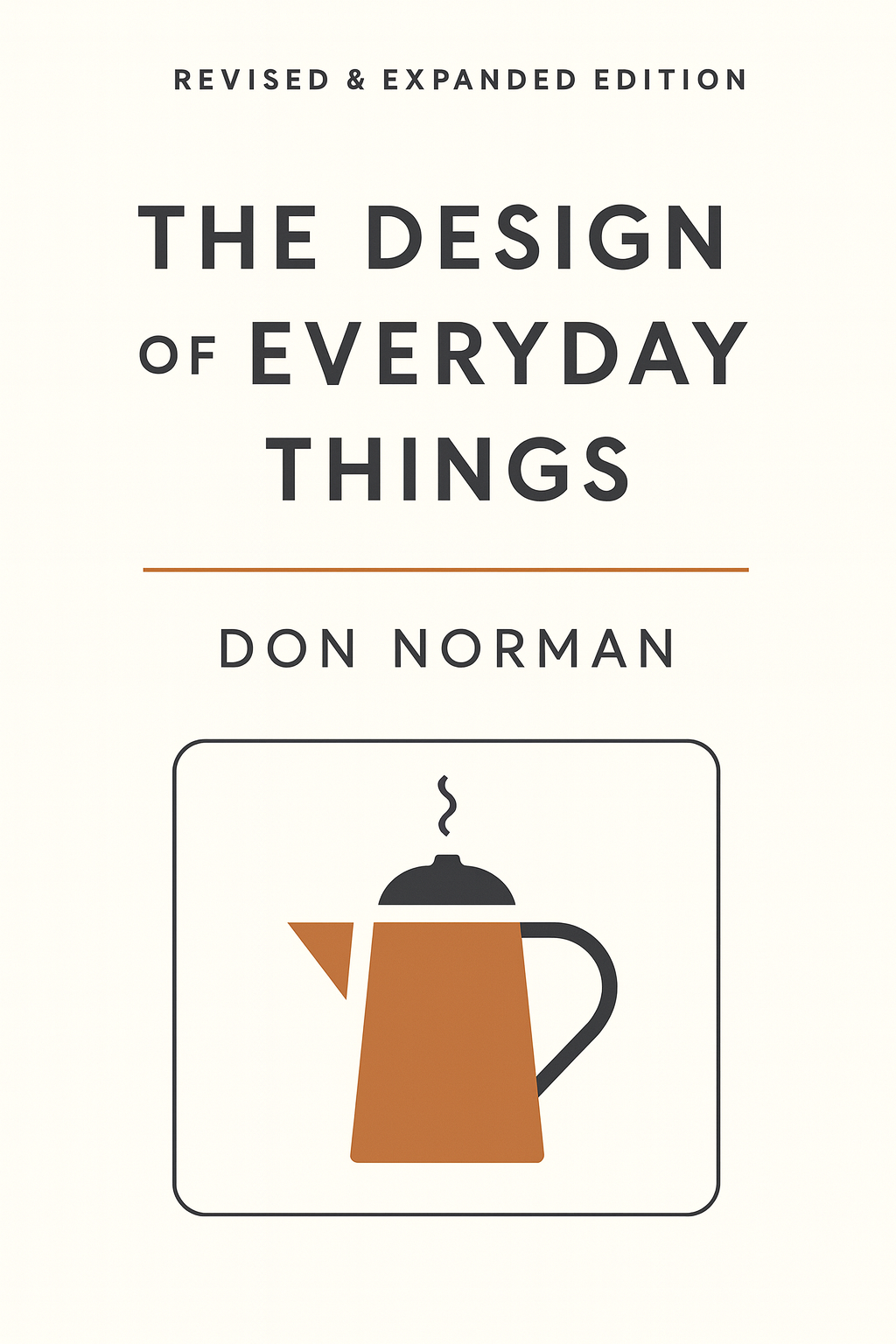
The Design of Everyday Things by Don Norman
This six-lecture audio course walks listeners through Don Norman's The Design of Everyday Things from cover to index, translating the full book into structured, conversational lessons. The series opens with the psychopathology of everyday things, showing why doors, switches, and simple objects frustrate users when discoverability and signifiers are ignored. It then builds a framework for understanding interaction: the seven-stage action model, the gulfs of execution and evaluation, the three-level processing hierarchy, and the mental models people construct to make sense of technology. Along the way, the course examines the trade-off between knowledge stored in the head versus knowledge in the world, and how constraints, affordances, and feedback form a system image that either prevents or invites human error. The second half turns diagnosis into design practice. Listeners learn to distinguish slips from mistakes, apply error analysis and forcing functions, and understand resilience engineering—designing systems that remain safe even when people fail. The course then introduces design thinking, including the double-diamond model, before connecting these methods to business realities: budget and schedule pressure, competition, the difference between incremental and radical innovation, and the dangers of "featuritis." A round-table discussion among a product manager, designer, and business strategist shows how human-centered design survives inside corporate constraints. The final lecture revisits the book's overarching messages, guides listeners through the acknowledgments, notes, and references, and explains how to use the index for continued study. The result is a complete, practical grounding in Norman's principles of usable, human-centered design.
From Cover to Early Missteps: Understanding Everyday Design Challenges
From Cover to Early Missteps: Understanding Everyday Design Challenges
Welcome to The Design of Everyday Things by Don Norman, the book that answers a question you've probably asked in frustration a hundred times — why do doors, phones, and stoves keep defeating perfectly smart people? Norman's answer is genuinely surprising, and it will, no exaggeration, change how you blame yourself forever. Your guide is a cognitive scientist with a Ph.D. in psychology who became a vice president at Apple — a man who's retired five times and keeps coming back to fight bad design.
So, the, the first thing to understand is a word Norman borrowed from ecological psychology: affordance. In the revised edition, he argues affordances are the possible actions between a person and an object — but affordances alone don't tell you anything. That job belongs to signifiers: visible marks and signals that show where and how to act.
A door handle isn't the affordance, it, it's the signifier of where to pull. That distinction matters, because when signifiers are missing or misleading, we guess. The author also admits his first edition ignored something huge — emotion. He now insists emotion and cognition are inseparable: positive affect makes us more forgiving and more exploratory. Which means, and this is the, the counterintuitive part, attractive products can actually work better.
Now for the stories, because Norman's examples are unforgettable. A friend of his got trapped between glass doors at a post office — identical panels, identical hardware, no clue which side hinged. Doors that confuse people this way are now called Norman doors, and he's, he's oddly proud of that. His rule: a door that needs a sign saying PUSH has already failed.
The author dissects telephones with cryptic hold and transfer functions that defeat even expert users. Then there's the refrigerator with two dials suggesting two independent controls, when really there's, no, wait, there's one thermostat and an airflow damper doing all the work. And those stove knobs? Poorly mapped controls cause millions of errors every single day.
From these failures, the book builds its core vocabulary. Visibility means making relevant parts apparent so you know what actions are possible. Feedback gives immediate confirmation that your action registered, and mapping is the relationship between controls and their effects. Arrange stove knobs in the same layout as the burners and you get a natural mapping — no labels, no memory needed.
Norman also distinguishes knowledge in the world, the visible cues and cultural conventions that make devices self-explanatory, from knowledge in the head, which demands training. The best design puts knowledge in the world, not in your head. Behind everything sits the paradox of technology: added functionality brings complexity, and that complexity becomes a barrier. Designers, the author contends, prioritize aesthetics, cost, and engineering convenience over human needs.
Here's the framework that ties it all together. Every object involves three things: the designer's model, the user's model, and the system image — the physical appearance and behavior of the object itself. The system image is the only channel through which designer and user can communicate, which, yeah, is a strange kind of conversation.
When the system image is silent or misleading, users construct erroneous models of how things work. And then the failures come, and users blame themselves. That's the, the cruel part — the object lied, and the person holding it took the blame.
Norman pushes hard on this psychology of self-blame. People form causal explanations for failures, often wrong folk theories about why things went wrong. Repeated failures produce learned helplessness — the belief that you simply cannot succeed. But the author argues much of it is really taught helplessness, caused by poor design, not personal inadequacy. He points to mathematics instruction as a parallel: students conclude they're bad at math when the, the teaching method is what's failing them.
His agenda for the rest of the book is simple. When many people make the same mistake, the design is at fault. Human-centered design — visible affordances, effective signifiers, natural mapping, constraints, and informative feedback — can make errors rare.
Deeper Actions and Mental Models: How We Interact With Objects
Last time we left off with Norman's radical claim: when many people make the same mistake, the design is at fault, not the users. Today the author takes us inside the act itself, showing how a simple goal becomes a failed phone call or a defeated stove. And then he flips the question, asking how much knowledge you actually need in your head at all. The answer, he argues, is far less than you think.
The centerpiece is the seven-stage action cycle, and it's, it's simpler than it sounds. You form a goal, translate it into an intention, specify an action sequence, and execute it; then the world answers back. On the return trip, you perceive what happened, interpret it, and compare the outcome against the original goal. The author is careful here — this is a model of cognition, not a literal recording of moment-to-moment thought. Emotion interleaves with every stage, as frustration or satisfaction feeds back into the next goal you form.
Between your intentions and the physical system sit two gulfs. The Gulf of Execution is the gap between what you want to do and what the system makes possible and apparent. The Gulf of Evaluation runs the other way — the gap between what the system did and your ability to understand it. Good design bridges the first gulf with signifiers, affordances, constraints, and mappings, and bridges the second with feedback and clear conceptual models. Two gulfs, two toolkits.
Now the psychology of blame, which is where the book turns genuinely uncomfortable. People are driven to find causes, and because a prior event seems to explain a later one, we misattribute causality — usually to ourselves. Norman watched people apologize to doors, telephones, thermostats, faucets, and clocks, as if the machine had feelings. In his view, that apology is misplaced, because the fault lies with the design.
The author warns this self-blame creates destructive cycles. Learned helplessness sets in when repeated failures teach you that success is impossible, so you stop trying. Taught helplessness generalizes further — early struggles with math or technology snowball into a conviction of global incompetence. Attribution theory explains the bias: everyday things seem simple, so failing at them feels like a personal failing, while we excuse ourselves with complex technology. Human error is usually a symptom of design failure. The author's corrective is that designers must make correct actions visible and results understandable, rather than expecting perfect users.
The second half shifts from action to knowledge, and it opens with a liberating claim. Norman argues that precise, complete knowledge is rarely necessary for effective functioning, because so much information exists in the world itself. Knowledge in the head is precise but hard to acquire and retrieve; knowledge in the world is easily available but requires perception and interpretation. He also separates declarative knowledge — facts and rules — from procedural knowledge, the how-to of typing or shifting gears that your hands remember better than your head does. Then come memory's severe limits, and this is where, no, wait, this is where it gets humbling. Working memory holds only about five to seven items, while long-term memory is vast but slow, error-prone, and reconstructive. In the famous penny experiment, most Americans cannot accurately draw a coin they have handled thousands of times. The author's conclusion: we function on approximations, remembering just enough to distinguish an item from its alternatives.
Memory for gist replaces verbatim detail, and prospective memory — remembering future intentions — is the major everyday failure point that calendars and reminders exist to solve.
So the design implications tie both halves together, and the LEGO motorcycle experiment is the author's favorite demonstration. People reconstructed the motorcycle using four kinds of constraints — physical, semantic, cultural, and logical — which did the cognitive work by limiting possible actions. Users needed only partial knowledge, because the world supplied the rest. Natural mappings go further: stove controls arranged like the burners, or a seat adjuster shaped like the seat itself, eliminate labels and memorization entirely. Norman grades mappings as optimal, good, or arbitrary, and arbitrary ones are the villains. The ambiguous two-knob, four-burner stove pushes knowledge into the head and invites error, and so does the differing layout of phone versus calculator keypads. Cultural conventions can make an arbitrary arrangement feel natural, which is why crossing between devices stings. The mandate emerges clearly: designers should place knowledge in the world through visible labels, meaningful structure, constraints, natural mappings, and standardization.
Never demand that users memorize arbitrary information. Knowledge in the world makes devices learnable and forgiving, while knowledge in the head enables speed and expertise. Well-designed artifacts let people act competently with incomplete, approximate knowledge; poorly designed systems punish them for being human.
Knowledge, Constraints, and the Roots of Error
Why can you operate a coin machine, a phone, and a typewriter without ever memorizing their details? The author's answer, which we'll build on all lecture, is that precise behavior can emerge from imprecise knowledge, as long as information is properly distributed between the head and the world. Today we follow that principle through natural mappings, four kinds of constraints, and the feedback that tells you what happened.
Last time we ended on the liberating claim that we function on approximations, remembering just enough to distinguish an item from its alternatives. The author now draws the line sharply: knowledge in the head must be learned and rehearsed and is prone to forgetting, while knowledge in the world is available the moment you perceive it. But it doesn't appear by accident — designers must deliberately supply it through visible affordances, constraints, and mappings.
Reminders show the same split, and this is where it gets personal. Mental notes fail constantly, while a letter placed on the floor by the door works, because it combines an attention-attracting signal with a meaningful message. Good design converts recall tasks into recognition tasks. The visible structure of the world, the author contends, should carry the information you need at the exact moment of action.
Natural mapping is the mechanism that makes this conversion work. When controls mirror the things they control — stove knobs arranged in a square matching the burners, car window switches matching the window layout — you need no labels and no memorization at all. But when manufacturers line the knobs up in a row while the burners form a square, that arbitrary relationship demands exactly the memorization human memory handles badly.
The author grades mappings along a continuum, and the grades matter. There's full spatial analogy at the top, partial analogy using shared features in the middle, and purely arbitrary cultural conventions at the bottom — like clockwise rotation increasing a value. Even conventions count as knowledge in the world, though, since they're learned once and apply across countless devices. Memory failure is often really design failure — when you can't remember which knob controls which burner, the blame belongs to the arbitrary mapping, not to you.
Now the LEGO motorcycle, the experiment that anchors the whole framework. People who had never seen the assembled model reconstructed it almost perfectly, because four types of constraints dramatically narrowed the possibilities. Physical constraints meant pegs fit only certain holes and keys fit only one way; semantic constraints meant the rider sits facing forward and the windshield goes in front of him.
Cultural constraints put red lights on the rear and white on the front, because red means stop and green means go. Logical constraints handle the leftovers — the remaining screw goes in the remaining hole, and the switch adjacent to a light likely controls it. Constraints operate silently; users simply feel they're doing what makes sense. Good design, the author argues, exploits all four at once, so the correct action feels obvious and errors become difficult or even impossible.
Cultural conventions deserve special suspicion, though, because they're arbitrary in origin, they vary across cultures, and they change over time. That's why products designed for one market confuse users from another, and why standardization — the deliberate codification of convention — is often the best solution when no natural design principle applies. Forcing functions go further still: interlocks, lock-ins, and lockouts, like microwave doors that won't operate while open, prevent undesired actions at the point of action rather than correcting them afterward.
Then comes feedback, which answers a different question than discoverability does. Discoverability asks how you know what to do; feedback asks how you know what happened. Good feedback is immediate, informative, and prioritized so urgent signals stand out, while poor or delayed feedback leaves you uncertain whether a command registered — producing repeated button presses and errors.
The author laments modern technology's beeps, blinks, and vibrations, which convey noise rather than meaning. Contrast that with the satisfying click of a well-made switch or an informative progress indicator. The lecture closes with the Seven Fundamental Principles of Design — discoverability, feedback, conceptual model, affordances, signifiers, mappings, and constraints — working together to bridge the gulfs between intention and action, and between action and understanding. When these principles are applied, everyday objects need no manuals. And when they fail, even simple devices become frustrating — and the errors we call human error are, in the author's view, design failures for which designers must take responsibility.
Designing Out Mistakes: From Bad Design to Design Thinking Foundations
When a pilot flies a working airplane into a seawall, or a nurse grabs the wrong vial, we reach, instinctively, for the, the same two words — human error — and then we stop looking, satisfied. The author argues that label is usually a confession of ignorance, because what looks like a person failing is bad design in disguise, and his foundational distinction separates slips, where the intention is correct but the action goes wrong, from mistakes, where the plan itself was flawed from the start.
The same cognitive machinery that makes skilled behavior possible — narrow attention, fallible memory, automaticity — also produces error, which is why, in his view, error is the price of skill — you cannot have one without the other.
Last time we ended on constraints and feedback quietly doing the cognitive work for us; today the author asks what happens when that support fails, and the answer begins with slips. A capture slip is what happens when a familiar, well-practiced routine hijacks a newer intention — driving to work on a Saturday when you meant to go to the store — while a description-similarity slip applies the right action to the wrong object, like tossing a spoon into the trash sitting beside the dirty dishes.
Mode errors, acting as if a device is in one mode when it's, it's in another, plague avionics and medical equipment; memory lapses like loss-of-activation errors round out the family. And the invisible gorilla experiment shows just how narrow focused attention really is, which is why interruptions and multitasking make slips of every kind likelier.
Mistakes are a different beast entirely, and the author, drawing on Jens Rasmussen's framework of skill-based, rule-based, and knowledge-based behavior, traces them to faulty mental models and flawed planning — the kind of failure where you were doomed before you touched anything. They're harder to catch than slips because the person believes the plan itself is correct, so nothing at the execution level ever looks wrong — the error is upstream, invisible, confident.
Even deliberate violations get a sympathetic reading here, since rule-breaking, he contends, usually signals rules that are impractical or, no, wait, poorly matched to the actual realities of the work. Which, yeah, is not what safety manuals usually say.
Rather than blaming individuals, the author draws on James Reason to reframe accidents systemically, and the Swiss cheese model is the, the image to hold onto. Organizational defenses are layers of cheese, each riddled with holes, and disaster requires the holes to align across every layer, while Reason's distinction between active errors, felt immediately, and latent errors, dormant decisions surfacing later, explains why finding human error begins an investigation rather than ending it. No single failure should ever suffice.
Three Mile Island, anesthesia machine incidents, look-alike medication packaging, and the Asiana Flight 214 crash all show how misleading indicators and opaque automation convert minor slips into catastrophes. And then there's Bainbridge's irony of automation — the more reliable the machine, the less prepared the human supervisor is to intervene when it fails — which is why the author favors additive automation that keeps people engaged over full substitution.
The constructive core is a design toolkit, because the goal was never eliminating error — it's prevention, detection, and recovery — and forcing functions are the strongest constraints: interlocks keep a microwave from running with its door open, lock-ins prevent shutdown mid-save, lockouts block dangerous states, while undo, reversibility, and aviation-style checklists catch the rest.
Confirmation dialogs and warnings, he cautions, mostly fail, because people habituate and click right through them — training and added warnings are weak substitutes for redesign. The deeper shift is cultural: blame-oriented cultures drive error reporting underground, while non-punitive incident systems, as aviation pioneered and medicine struggles to adopt, surface the latent conditions behind accidents.
Resilience engineering, championed by Hollnagel, Woods, and Dekker, reframes the question from who caused the error to why it felt like the right thing to do. The enduring takeaway is that human error is usually system error mislabeled, and good design — not more training, not stricter discipline — is the strongest safety intervention we have.
Advanced Design Thinking and Business Contexts
We've spent four sessions believing that human error is really design failure in disguise, and today the author finally asks the, the bigger question behind it all: who actually does this work, and under what conditions? Design thinking is the term that swept through business schools and boardrooms, and Norman credits the Stanford d.school and firms like IDEO, along with David Kelley and Tim Brown, with making it famous. Their claim was genuinely bold: methods like empathy with users, rapid prototyping, and relentless iteration could tackle services, organizations, even social problems, not just products.
The author traces the deeper roots back to the 1980s, to researchers like Mike Cooley and projects at Xerox PARC, who argued that technology should adapt to people rather than the reverse. He endorses the core of design thinking while cautioning, and this matters, that it is no magic bullet, because real design demands deep domain knowledge, multidisciplinary teams, and iterative testing with actual users. The British Design Council's double-diamond model gives the whole thing shape: the first diamond diverges across many framings and converges on finding the right problem, while the second diverges across solutions and converges on the best one. Designers, he contends, most often err by solving the problem exactly as originally posed, never questioning whether it was the right problem at all.
The recurring danger is premature convergence, what he calls satisficing, jumping on the first workable idea and, no, wait, settling there, which yields mediocre results every time. His counter-prescription is to defer judgment, generate many alternatives because quantity eventually yields quality, and observe real people in real contexts, since people are, honestly, poor at articulating their own needs. Failures in early iterations are cheap; failures after deployment are expensive. Organizations, he argues, should reward exploration and sensible risk-taking, and design education itself must change, because designers now need to understand people, technology, and business, and no single person can master all three domains.
Design, in the author's view, is shifting from the romantic lone-genius model to collaborative, socio-technical, systems-oriented work, and healthcare, transportation, and education show why: the hardest problems involve redesigning institutions, not just products. He closes the design thinking discussion with ethics, because design shapes behavior, so designers must prioritize human well-being over commercial exploitation. Contrast a feedback display that encourages energy conservation with gambling machines engineered to exploit psychology, and you see the, the moral fork in the road. Then the lecture turns to business, where designers rarely enjoy ideal conditions: they face time-to-market pressure, cost constraints, engineering and marketing demands, and brand considerations, making design fundamentally an exercise in managing trade-offs among stakeholders. The author distinguishes technology-driven innovation, those radical leaps, from market-driven innovation, the incremental copying most companies actually do, and from human-centered, design-driven innovation, which he argues produces the most successful products.
History, he shows, rarely rewards the original inventors: the automobile, the television, and the typewriter keyboard all went to companies that patiently iterated, and QWERTY demonstrates how early choices get locked in by network effects even when superior alternatives like Dvorak exist. Radical innovation tends to come from inventors and startups unconstrained by existing customers, while established companies, structurally biased against disruption as the typewriter-to-word-processor and film-to-digital transitions proved, excel at incremental improvement, which builds reliability and loyalty. Feature creep arises because every feature has an internal advocate while nobody inside the company represents the user confronting accumulated complexity, and research shows buyers choose feature-rich products at purchase though users later prefer simpler ones. Products follow a lifecycle: early versions are technology-centered and hard to use, mature ones become human-centered, and commoditized markets differentiate through experience, branding, and emotional appeal.
His prescription is to elevate design from late-stage styling to a strategic activity, with cross-functional teams, tolerance for early failure, ethnographic observation, and leadership that values design throughout, because good design must balance human desirability, technical feasibility, and business viability. Design is too important to be left only to designers.
Beyond the Core: Acknowledgments, Further Reading, and Index Insights
We've followed the author through design thinking, error, and business, and now we arrive somewhere unexpected: the back of the book. Acknowledgments, reading lists, references, and an index rarely get attention, but in this book they tell their own story. Today, that closing stretch reveals where these ideas came from and where they can take you next.
The final pages of the business discussion tackle what the author calls featuritis, and it's a, a genuinely vicious cycle. Marketing departments, product reviewers, and sales teams pressure every revision to add features, while nothing is ever removed, because every feature has devoted users. The result is creeping complexity that confuses the very people the product is meant to serve.
His examples feel painfully familiar: watches and appliances with dozens of undocumented functions, and camera menus that bury the features people actually want. Last time we saw that feature creep happens because nobody inside the company represents the user; now he shows the spiral in full motion. The counterexample is Apple under Steve Jobs, where strong leadership and a clear design vision resisted the dynamic entirely.
But the author insists designers can't simply out-argue marketing with good intentions, because design is only one voice among engineering, finance, legal, and sales. His prescription is that designers must learn the language of business, quantifying usability in terms of support costs, returns, and brand loyalty. Good design, in his view, is a continuous negotiation across the entire product lifecycle, with simplicity defended as a competitive advantage. Simplicity is a selling point, not a sacrifice.
Then come the acknowledgments, and they quietly rewrite the book's origin story. Norman credits colleagues at UC San Diego across cognitive science, psychology, and computer science, whose research on memory, attention, and slips formed the psychological foundations. The book, he reveals, evolved from an earlier academic work on human error, and he frames this version as a translation effort.
That framing matters: rigorous cognitive science, rendered actionable for the people who design doors, faucets, and stoves. Students, reviewers, editors, and readers worldwide kept shaping it too, because their correspondence continuously supplied fresh design examples. What looks like one man's manifesto is, in truth, a collaboration with no, wait, a genuinely cumulative, interdisciplinary one.
That spirit carries straight into the three-part General Readings and Notes, an annotated guide to the foundational literature. The author surveys cognitive psychology, human factors, ergonomics, and interaction design, pointing to human-error research from aviation and industrial safety. That research, he emphasizes, shows so-called human error is usually a symptom of poor design.
Alongside scholarship on slips, memory limitations, and mental models, he offers pointed commentary on design education. He criticizes the habit of blaming users for design failures, a habit educators pass along unexamined. His urging is consistent with everything we've heard: observe real users, prototype iteratively, design for error recovery, and make system states visible.
The reference lists, in two parts, document the empirical foundations beneath those principles. They catalogue citations across cognitive psychology, human factors engineering, human-computer interaction, and design research. You'll find Rasmussen's skill-, rule-, and knowledge-based performance levels there, plus Reason's taxonomies of slips and mistakes, mixing 1988 sources with newer research added in 2013.
And then the index, which sounds like the least glamorous part, becomes something of a, a confession. Read its vocabulary and you see the book's entire thesis laid bare: affordances, signifiers, feedback, mapping, constraints, discoverability, conceptual models. It catalogs cognitive frameworks too, like the seven stages of action and the gulfs of execution and evaluation.
The indexed examples reinforce the argument, from Norman doors and confusing stovetops to airplane cockpits and automation-induced errors. Most human errors are design failures. Even the distinction between knowledge in the head and knowledge in the world gets its index entries, alongside the Swiss cheese model we met earlier.
Taken together, this closing material makes a final, quiet claim. The author's principles are not aesthetic preferences but distillations of decades of interdisciplinary research. For you, they form a resource map for deeper study, and one last affirmation that good design is both an ethical and a practical necessity.