
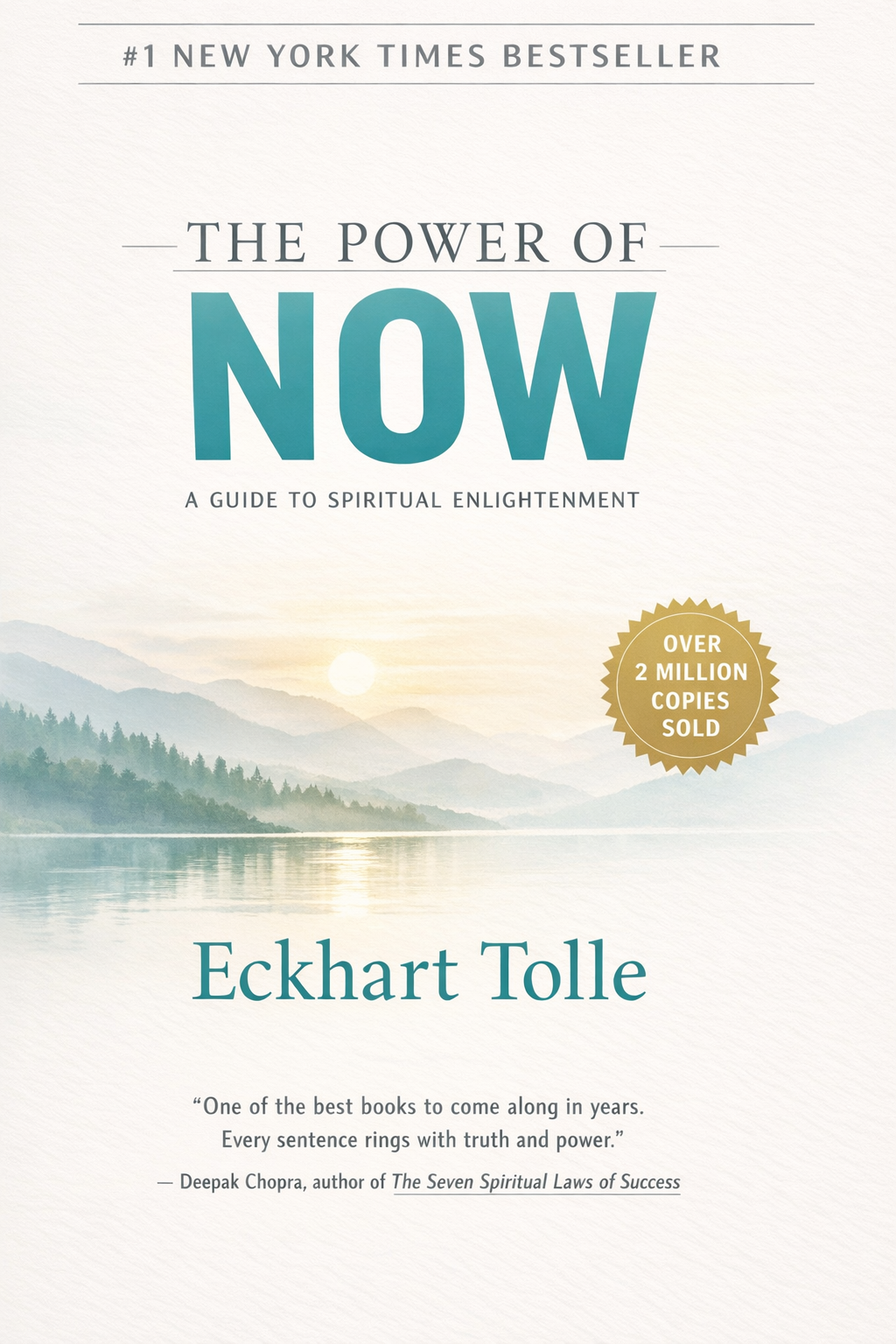
The Power of Now: A Guide to Spiritual Enlightenment by Eckhart Tolle
This six-lecture audio course guides listeners through Eckhart Tolle's The Power of Now, section by section, from the preface to the author's final reflections. The course begins with the book's opening pages, covering the author's background, the purpose of the work, and the central invitation to awaken to the present moment. From there, it examines the mind's role in suffering: listeners learn why identification with thought is the greatest obstacle to enlightenment, how to observe the thinker rather than be the thinker, and how this observation creates the space for genuine presence. The course then addresses psychological time, showing how past-future thinking fuels dissatisfaction and how releasing these mental time-traps reveals inner peace. The second half of the course turns to practice. Listeners explore the mind's strategies for avoiding the Now, the experiential state of presence, and inner-body awareness as a way to deepen consciousness. The course then covers portals into the unmanifested, including the inner body, breath, and silence, and applies presence to relationships, examining how love, addiction, and everyday interaction can become spiritual gateways. The final lectures move beyond duality, addressing the peace that exists beyond happiness and unhappiness, the meaning of surrender, and the letting go of dualistic judgment that leads to lasting freedom. Each lecture builds on the last, so listeners finish with both the concepts and the practical tools Tolle offers for living in the present moment.
Opening the Path: Preface, Introduction, and the First Steps Into Presence
Opening the Path: Preface, Introduction, and the First Steps Into Presence
Welcome to The Power of Now: A Guide to Spiritual Enlightenment by Eckhart Tolle — the book that answers the question haunting nearly every restless mind: why does happiness always feel one step away? Tolle claims the problem isn't your life at all — it's something far closer, something you're doing right now without noticing. Eckhart Tolle, a German-born spiritual teacher who studied at the Universities of London and Cambridge, arrived at his answer not through study but through a night of total despair that changed everything.
At twenty-nine, Tolle had lived for years with severe depression and suicidal despair. One night, a single thought tore his world open: the oppressive voice in his head was not who he truly was. He could not live with himself — so there had to be two selves. One could not be tolerated, and one could not tolerate it. That recognition, the author says, dissolved his egoic mind entirely. He woke the next morning to a world transformed — everything fresh, alive, and deeply peaceful. This direct experience of presence, not any conceptual understanding, became the foundation of everything he teaches.
Tolle presents his teaching as a rediscovery of ancient truths found across Christianity, Buddhism, Taoism, and Hinduism. But he translates them into language accessible to modern consciousness. The book is a bridge for people alienated by religious dogma who still hunger for spiritual truth. And he insists it must be lived, not merely read. He recommends slow, repeated reading with pauses, so the words function as pointers to inner transformation rather than accumulated knowledge. Not exactly a book you skim on the train, in other words.
So what is the core problem this book addresses? In Tolle's view, humanity is collectively identified with the thinking mind. Most people are trapped in compulsive thinking — an addiction to the ceaseless internal monologue of memories, interpretations, judgments, and worries. This identification creates a false self, the ego, which feeds on thinking and derives its sense of continuity from it. A significant portion of ordinary thought, he argues, is repetitive, useless, and even harmful. The mind treats the present moment as an obstacle or a means to an end. Yet nothing ever happens in the past or future — everything occurs in the Now.
Here Tolle makes an important distinction about terminology. When he speaks of the mind, he means not the physical brain but the mental-emotional state of consciousness dominating most human beings. The brain is physical; the mind is the energy of thought. Thinking becomes a disease when it is compulsive and continuous rather than purposeful and functional. The mind is a useful servant but a terrible master. Suffering arises, the author contends, when we derive our entire identity from it.
The practical entry point to freedom is what Tolle calls the watcher — the witnessing presence that observes thoughts without being consumed by them. Rather than trying to stop thinking, you begin by listening to the voice in your head as if it were another person speaking. Watch the thinker. That single act, he says, creates a shift in consciousness and opens access to a deeper dimension of awareness. Enlightenment means rising above thought, not falling below it. The mind is meant to be used consciously, then set aside when the task is done. True artists and creative thinkers already know this — genuine creativity comes from stillness, where the mind receives rather than generates.
Emotions, Tolle explains, are the body's reaction to the mind. Negative emotions signal a state of unconsciousness. Enlightenment itself is simply a felt oneness with Being — our natural state of connectedness with something immeasurable and indestructible. It cannot be attained as a future goal, because the present moment is all there ever is. That's the paradox sitting at the heart of this book.
Tolle frames humanity's collective dysfunction — personal anxiety, conflict, and large-scale violence — as originating in the mind's dominance. The shift into presence is therefore not merely a personal benefit but an evolutionary necessity. The book is designed as a transformational tool, using questions and answers drawn from his teaching sessions, addressing you directly as if speaking to your own presence. Each chapter contains the whole teaching in seed form. No pressure on any single page, then. The widespread hunger for its message is, for Tolle, evidence of a collective shift toward awakening. You are not the thinker. Hold that one — it's the foundation for everything that follows.
Unmasking the Mind: From Identification to Conscious Awareness
Last time we left off with a single, unsettling claim: you are not the thinker. Today the author takes that seed and shows you, practically, how to watch the mind that has been watching you. The question is no longer what's wrong with your life — it's where are you, exactly, when the thinking is happening? The author argues that compulsive thinking has become a disease, and most people are simply not present in their own lives. The mind-generated ego thrives on past and future while quietly resisting the present moment. You cannot fight the mind with the mind. Resistance, the author contends, only feeds what you resist — so a different move is required entirely. That move is witnessing: becoming the silent watcher of your thoughts. The author offers a concrete practice — close your eyes and listen to the voice in your head without judging or condemning it. Just listen. Pay particular attention to repetitive thought patterns, the loops that play on rotation.
When you listen impartially, something remarkable dawns: there is a voice, and, and 'I' am the one hearing it. That realization — the 'I am' behind the thinking — is, in the author's view, the most significant shift a person can make toward enlightenment. You are the awareness, not the noise. Brief gaps of stillness appear between thoughts, and within those gaps, the author says, lies intense peace. The author uses a metaphor here: the sun is a tiny part of the universe, and thinking is likewise a minute aspect of consciousness. All true creativity, he argues, emerges from the stillness between thoughts, not from mental noise. So no, you won't lose your edge by quieting down — quite the opposite. The body also serves as an anchor to presence: emotions are the body's reaction to the mind. Watching emotions at the body level, feeling the inner body, noticing the breath — these, the author says, are additional entry points to the Now. The breath only ever happens now.
But what about the deeper currents of pain that keep pulling us back into unconsciousness? Here the author introduces what he calls the pain-body — and this is where the lecture takes a darker turn. The pain-body, in the author's framing, is an accumulation of old emotional pain living in almost everyone. It combines residual pain from your own childhood with collective pain passed down through generations. This semi-autonomous energy entity periodically awakens and seeks to feed on more pain — through conflict, drama, grievance, and negative thinking. It can take over your thoughts and behavior entirely. Unhappiness is its food. The author distinguishes pain — what happens in the moment — from suffering, which is the mind's resistance to what is. This explains why intimate relationships can flip so quickly from harmony to destruction, and why many people are effectively addicted to unhappiness. The pain-body prefers negativity because negativity sustains it.
The author also addresses the women's collective pain-body, arguing that centuries of suppression have made it heavier — though women, he suggests, may sit closer to awakening through their stronger connection to the inner body and Being.
The method for dissolving the pain-body is the same witnessing practice applied to thought. When it activates, observe it with alert attention — feel the emotion directly in the body, without mental commentary. Allow it to be there. Presence starves the pain-body, because it can only feed on unconscious identification, never on conscious awareness. The vicious cycle — unconsciousness creates pain, and pain reactivates unconsciousness — can only be broken by presence. Presence transmutes pain into peace. So what does one actually do to move deeply into the Now? The author dismantles the assumption that presence requires complex techniques. The essential move is simply noticing when attention has drifted into past or future, and gently returning it to the present.
He distinguishes clock time — practical, functional planning — from psychological time, the compulsive replaying and projecting that serves no purpose and generates suffering. You can plan a trip without living in the future. Problems, in his view, are mental constructs: a problem is a situation plus time plus mental projection. In the Now, there are only situations to be dealt with or accepted. Most people cannot imagine a life without problems — the mind instantly generates future scenarios, revealing its addiction to problem-making. Moments of perceiving beauty — in nature, art, or another person — are spontaneous experiences of presence, because beauty can only be perceived when the mind is still. The unified thread is simple: enlightenment is feeling connected to Being, the unchanging essence beneath the noise. Liberation begins when you stop believing you are the thinker. Hold that — next time, we go deeper into what that connection actually feels like.
Breaking Free From Time: Moving Deeply Into the Now
Last time we ended on presence transmuting pain into peace. Today the author asks a harder question: what happens when the mind simply refuses to let you stay? Because it has strategies, and, and some of them are wearing very convincing disguises. The first disguise is waiting, and the author insists it comes in two sizes. Small-scale waiting is the line at the airport, the, the queue at the store, the traffic you're stuck in. Large-scale waiting is waiting to start living. Both, the author argues, do the same damage: they reduce the present to a means to an end, treating the Now as an obstacle to get past. Some people, he says, spend their entire lives waiting to begin, and that, in his view, is the unconscious state itself. His prescription is strikingly simple: when you catch yourself waiting, drop the mental projection of the future moment and enter the Now directly. The quality of your consciousness now determines the quality of your life.
No pressure, then. Waiting, reframed, becomes free practice time for presence. Which, honestly, airports could use. But the author then turns to something with real teeth: the pain-body, which we met last time as the accumulated field of old emotional pain. Here he shows how it operates up close, and it's not pretty. The pain-body, he contends, is a semi-autonomous energy entity that wakes up periodically and wants more pain to sustain itself. When it activates, it feeds on negative thinking and dramatic conflict, showing up as irritation, impatience, a hunger for drama, or deep sadness. Unhappiness is literally its food. And here's the part that stings: it especially seeks out your closest relationships. The author explains that intimate partners unconsciously attack each other's pain-bodies, provoking the very pain each one craves. That's why, in his framing, harmony in a partnership can flip into warfare so fast. The pain-body survives through identification, the moment you become the emotion completely.
The way out, the author says, is conscious observation: feel the raw sensation in the body, not the mental story about it. Allow it fully, without the narrative. Witnessing presence starves it, and its dense energy transmutes into awakened consciousness. You watch it, so it cannot be you. Building on this, the author returns to the watcher with a vivid image. He describes the attention required as a cat watching a mousehole: alert, relaxed, not anticipating, not judging. You don't suppress the thought, you, you just create a gap between the observer and the observed. In that gap, he says, presence arises on its own. Another doorway is the inner body: feeling the aliveness in your hands, your feet, your whole body shifts attention from mind to being. Presence is not something you do. It is something you are, gradually uncovered as identification with thought and pain weakens. Not a technique to master, the author insists, but a transformation of consciousness itself.
Which is either liberating or terrifying, depending on your to-do list. Finally, the author maps the mind's avoidance strategies with diagnostic precision. He distinguishes ordinary unconsciousness, the background static of subtle discontent, unease, boredom, and judgment, from deep unconsciousness, where the pain-body erupts into acute suffering. Ordinary unconsciousness is so pervasive it goes unnoticed. Negative emotions like irritation and resentment, he argues, are actually signals: the mind is resisting the present. Used as reminders to become present, they become allies rather than consuming you. The mind, in his view, treats the Now as an obstacle, an enemy, or a means to an end, never as an end in itself. And complaining gets special attention as nonacceptance that strengthens the ego. When you complain, the author contends, you make yourself right and the situation wrong, feeding the ego's need for superiority. Shared complaining, he notes, often becomes the glue holding relationships together, a false bonding through mutual negativity. The answer is not suppression or forced positivity.
It is awareness: observe the impulse to complain without acting on it, and a gap opens between stimulus and response. In that gap, presence emerges. The author also separates clock time, practical and useful for scheduling, from psychological time, the mind's habit of dwelling on grievances or anticipated fulfillment. Waiting, pain-body identification, unconsciousness, complaining, all of them, in his view, are variations of one thing: resistance to the Now. Recognizing them in yourself is the beginning of freedom. Next time, we'll see what happens when presence meets the body and the breath. Until then, catch yourself waiting, just once, and, and see what's actually here. It might surprise you.
Cultivating Presence: Strategies, the State of Being, and the Inner Body
Last time we ended with the mind's disguises, waiting, complaining, the pain-body, all variations of one thing: resistance to the Now. Today the author moves from diagnosis to method. Because knowing the mind's tricks is one thing, actually entering the present is, is something else entirely. He starts with waiting, that chronic state of projecting fulfillment into the future while treating the present as an obstacle. His prescription is direct: when you catch yourself waiting, shift full attention to the Now and watch what emerges. Usually, it's peace and aliveness. Beneath waiting sits a deeper pattern, background dissatisfaction, and the ego feeds on it. Negativity, complaint, and grievance reinforce the ego's sense of separateness, its story of being wronged or incomplete. But negativity, the author contends, cannot coexist with presence, because it needs psychological time, past and future, to survive. Ask yourself: is there a problem right now? Not in an hour, not tomorrow, now.
The answer is almost always no, because problems are mental projections that cannot exist in the Now. The mind hates that question, which is exactly why it works. And cutting the link with psychological time doesn't mean abandoning clock time. You can still meet deadlines and learn from the past without being dragged back into unconscious identification with them. You just stop living there. So what is this presence we keep pointing toward? Here the author gets blunt: it cannot be captured in words or understood through thought. Words and mind belong to the world of form, while presence is formless, pure consciousness beneath all thinking. Like pointing at the moon, teachings can only direct attention toward it. Presence can only be known through direct experience. Most people live identified with the stream of incessant thinking, which keeps them trapped in time. Yet even brief gaps in that stream, moments of witnessing thoughts without judgment, begin to dissolve the egoic mind.
The author points to natural portals: beauty, nature, stillness, and observing the thinker. When you listen to a thought, you become aware of yourself as its witness. That awareness, he says, is presence itself. He notes that Jesus and Buddha pointed to this same awakened state, though the mind often converted their teachings into mere belief systems. Belief is easier than being, apparently. But many people cannot find that stillness, feeling instead a constant background of restlessness and mental noise. The author's answer is the inner body, the felt sense of aliveness within the physical form. The deepest truth of who we are cannot be reached through thought, because the mind cannot know the formless and timeless. The body is a bridge. It is visible form condensed out of formless, timeless life. The core practice is to feel the body from within: close your eyes and direct attention to your hands, feet, chest, abdomen. Sense the subtle vibration there.
This is not visualization or thinking about the body, but a direct felt experience of inner aliveness. The author distinguishes the outer body, a dense physical shell, from the inner body, a subtler energy field connected to Being. He references the Biblical phrase 'Before Abraham was, I am' to indicate a deeper identity thought cannot access. Which, if you sit with it, is a fairly staggering claim. The real shift is treating inner-body awareness as a continuous way of living, not a formal meditation. Brief moments throughout the day, in line, in an elevator, in traffic, transform dead time into awakened time. Waiting, in other words, becomes free practice again. The inner body serves as an anchor, keeping attention grounded in the present and preventing the mind from pulling it into past and future narratives. The author also addresses aging, illness, and mortality directly. The outer body is impermanent, but the inner body connected to Being is timeless, and dwelling there changes your experience of physical decline.
Illness and limitation can even become opportunities for deeper presence, since suffering arises from resistance to what is, not from the condition itself. The resistance is the suffering. He connects the inner body to forgiveness, too, noting that grievances are held in the emotional body. Presence dissolves these accumulated pain patterns. And here lies the essential distinction: thinking is a tool of the mind, while awareness is the deeper consciousness that can observe thought. By inhabiting the inner body, you shift from identification with thought to identification with awareness itself. The author describes the inner body as the place where the unmanifested enters the manifested world, connecting this to God as immanent life energy within all forms. You are that awareness. Mastering this practice means remaining rooted in Being even while engaged in ordinary activities. That embodied presence, the author says, is the foundation for spiritual awakening and the end of psychological suffering.
Next time, we'll see what happens when presence meets the deeper portals of silence and surrender. Until then, feel your hands, just once, from the inside. You might be surprised what's been waiting there. It was there all along.
Portals and Relationships: Accessing the Unmanifested and Enlightened Connections
Last time we ended with the inner body, that felt aliveness anchoring you in Being. Today the author opens the door behind all his practices. He calls it the Unmanifested, and, and honestly, it changes how you hear everything else. The Unmanifested, in his framing, is the invisible, formless Source of all manifested life. It is pure Being, existing prior to and beyond every physical form. It cannot be grasped by the mind. And that's not a limitation the author apologizes for, it's the whole point. The mind itself is a product of manifestation, so it can never step outside form to see the formless. Asking thought to understand Being is, is like asking a wave to study the ocean by looking at itself. So how does anyone ever touch this dimension? The author's answer is portals, specific doorways that dissolve the barrier between form and the formless.
And here's the detail that matters most: the Unmanifested is not a place you travel to. It is always present, underlying all existence. The portals don't take you anywhere, they simply reveal what is already there. Going deeply into the present moment is itself the primary portal. Every other entry point, the author insists, ultimately leads into the Now. Which means all his practices, the inner body, watching the thinker, the breath, they're, they're all doors into one room. He names several portals, and some of them are not what you'd choose. Inner stillness is one, the deep silence beneath mental noise. But profound loss can also crack the shell of form, and so can a near-death experience. The author isn't romanticizing suffering here, he's observing that anything dissolving the world of form can reveal the formless. Even cessation of breathing, briefly, can open the door. Deliberate practice, meditation, conscious surrender, these are the gentler routes.
But they all do the same work: thinning the veil between you and Being. Why does any of this matter for awakening? Because, the author contends, reconnecting with the Unmanifested restores awareness of your identity beyond form, beyond thought, beyond the egoic self. If your true nature is formless Being, then the ego and its accumulated pain are not who you are. They are clouds, not the sky. And this is where the book pivots toward its most demanding test. The author turns to intimate relationships, the arena where this truth gets proven or lost. Presence is easy in a quiet room, alone, with your eyes closed. Relationships, he argues, are where the ego meets another ego, and where the pain-body finds its favorite food. If Being underlies everything, then even your partner is a portal, or a battlefield. It depends on your presence. So hold this framework as we move forward. The Unmanifested is here, now, beneath every form you see.
The practices don't create it, they, they just clear your view. Next time, we'll see what happens when two people meet from that stillness. Until then, notice one gap, one still moment, and, and see what's underneath. It was never absent.
Beyond Duality: Peace, Surrender, and the Journey to Lasting Freedom
Last time we ended with the Unmanifested, the formless source beneath every practice. Today the author completes the arc, moving past happiness and unhappiness entirely. Because both, he argues, are, are judgments, and there's a third thing underneath them. Happiness, in his framing, depends on the mind labeling conditions as positive. Unhappiness is the same mind labeling them negative. Peace needs no label at all. The egoic mind constantly evaluates, so most lives swing between these two poles. Peace, by contrast, is an inner state independent of how the mind scores external events. Nonjudgment is the key. Easier said than scored, of course. The author illustrates with the parable of a Chinese farmer. His horse runs away, and neighbors cry misfortune. Maybe, he says. The horse returns with more horses, and they call it luck. His son breaks a leg riding, and they call it tragedy. Maybe, again.
Then the army conscripts every young man except the injured son. Maybe, still. The point, the author contends, is that the mind cannot know whether any event is ultimately good or bad. Every event interconnects with countless future events the mind cannot foresee. All judgment is partial. Every event belongs to a larger wholeness the mind's verdicts can never capture. Peace is not arranging circumstances to your liking. It is resting in the awareness that precedes all verdicts of good and bad. The farmer, frankly, would make a terrible news commentator. The author then turns to suffering and its strange purpose. Pain may be unavoidable, but suffering is created by mental resistance. The story is the suffering. Suffering arises from identification with the mind and its denial of the present. Yet, paradoxically, intense suffering can crack the ego's shell and force a person into presence. Unconscious suffering deepens the pain-body, but, but suffering fully accepted and observed dissolves it.
The author also separates true compassion from sentimental pity. Real compassion arises from shared being beyond forms, a healing presence. Empathizing with someone's mind-made suffering actually reinforces it. Presence heals, pity spreads. As more individuals awaken, the author envisions a new earth emerging. Awakened beings catalyze transformation in others simply through their state. The dissolution of ego is not an achievement but a return to our natural state. You were, apparently, fine all along. Finally, the author defines surrender, and he defines it carefully. Surrender is yielding to the flow of the present moment, not resisting it. It is not resignation. A surrendered person can work vigorously to change a situation. The difference is that their action arises from acceptance rather than negativity. If a situation cannot be changed, he offers three options. Leave it, change it, or accept it fully. Anything else, the author says bluntly, is madness and suffering.
Action from surrender is focused, creative, aligned with the whole. Action from resistance is reactive, ego-driven, often destructive. Picture a car stuck in mud. You can rage at the mud, or accept it and calmly free the car. The energy wasted on rage becomes, becomes available for the towing. Surrender even transforms illness and death. A woman with severe disability, upon accepting her condition, found peace and freedom before dying. And if you cannot surrender, the author offers a fallback. Accept your non-surrender. Bring acceptance to your resistance itself. That secondary surrender is always available. Surrender is not weakness but the greatest strength, connecting you to the power of Being. The mud, notably, never asked for your opinion. The author closes with his own story, grounding everything in lived experience. Born in Germany, he studied philosophy and languages at the University of London. He later worked as a research supervisor at Cambridge.
Despite academic success, he fell into deep existential despair, severe depression by twenty-nine. One night, filled with dread and fear of annihilation, he thought he could not live with himself. A paradoxical thought, and, and it prompted an intense inward inquiry. Who was this self? His identification with mind and ego collapsed, shifting him into deep peace and presence. He woke to a world fresh and alive, spent months in stillness observing with heightened perception. He eventually left academia to become a spiritual teacher. Presence, ego's dissolution, lasting peace, these are not theoretical constructs. They are the fruit of his own journey. So here the arc completes. You are not the thinker, and the peace beneath judgment was never absent. Until next time, catch one verdict of good or bad, and, and see what rests underneath. It was there all along. Maybe.