
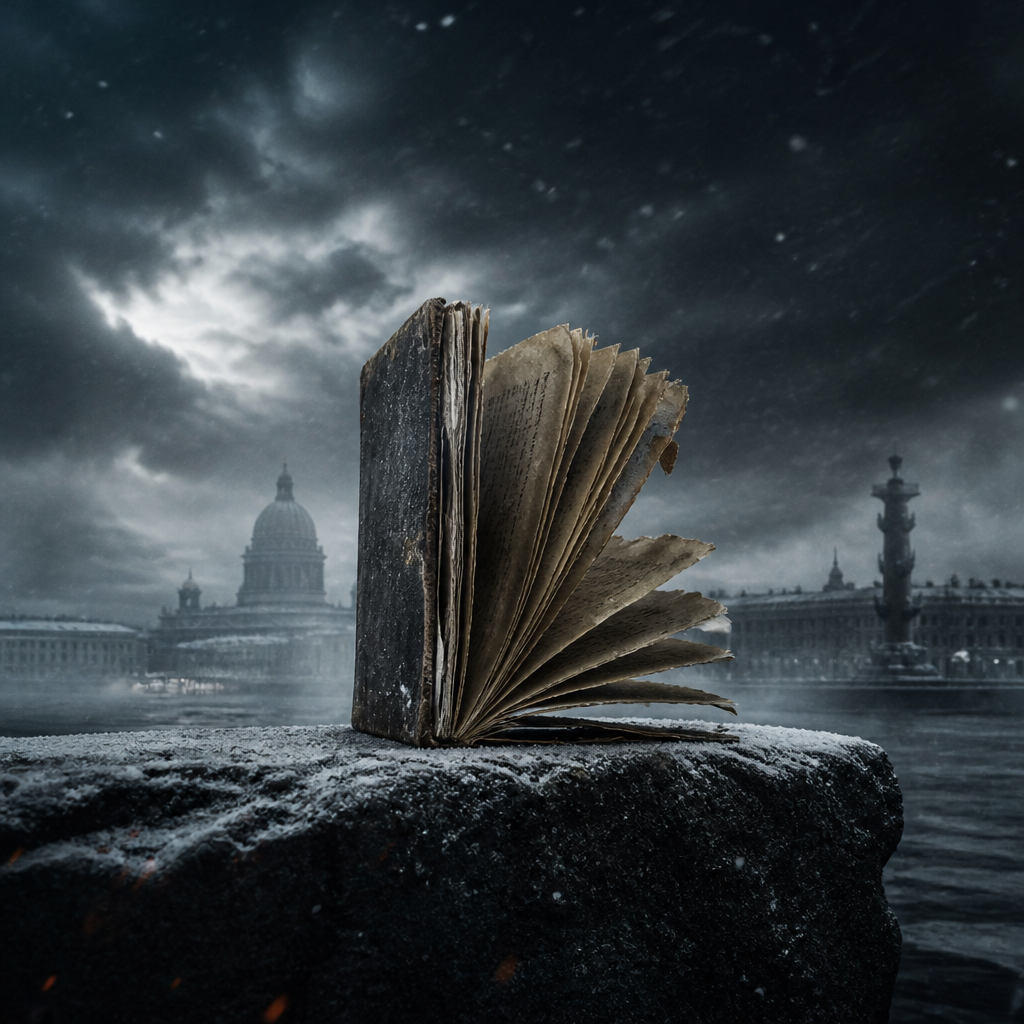
Dostoevsky Unveiled: From Formative Fires to Literary Immortality
This nine-lecture audio course, designed for a 45-minute listening experience, traces Fyodor Dostoevsky's life, major novels, and lasting global influence. It opens with his formative years in 19th-century St. Petersburg: his birth in Moscow in 1821, his mother's death in 1837, his university years, and his 1849 arrest with the radical Petrashevsky Circle. The second lecture tests the popular "tortured genius" myth against concrete evidence from his Siberian exile and Notes from the House of the Dead. Subsequent lectures examine his major works in detail: Raskolnikov's moral collapse and the limits of rationalism in Crime and Punishment; Prince Myshkin's innocence confronting a corrupt aristocracy in The Idiot; the clash of faith, free will, and doubt in The Brothers Karamazov, including the Grand Inquisitor chapter; the 26-day writing sprint and gambling debts behind The Gambler; and the political fury of Demons, inspired by the murder of Ivanov and the spread of nihilist ideology. Along the way, the course separates documented fact from legend, using prison records, letters, contracts, and publication history as evidence. The final lectures turn to reputation and legacy. One examines how Dostoevsky's posthumous fame actually developed—not instantly, but through shifting critical tides: early reviews, the first English translation in 1886, Soviet-era criticism, and the existentialist revival after World War II. The closing lecture highlights Constance Garnett, the Victorian translator whose English editions of Crime and Punishment and The Brothers Karamazov shaped how Western readers encountered Dostoevsky, even as critics faulted her for smoothing out Russian idiom. Throughout, varied presentation styles—narrated scenes, dialogues between opposing viewpoints, and step-by-step investigations—keep the analysis concrete and grounded in the texts, dates, and documents that made Dostoevsky a permanent figure in world literature.
Into the Dark: The Formative Fires That Forged Dostoevsky
Into the Dark: The Formative Fires That Forged Dostoevsky
December 22, 1849. Semyonovsky Square, St. Petersburg. A young man in a prison shirt stands bound against a post, waiting for a firing squad to end his life at twenty-eight. His name is Fyodor Dostoevsky, and in a few moments he will believe he has minutes left to live. Then, at the last possible second, an officer rides out and announces the sentences have been commuted. The whole thing was staged. And I keep asking myself, Ahmed, how does a man walk away from that and not simply survive it, but become the, the novelist who taught the world what suffering means on the page? That's the question underneath everything we're about to explore together. So let's rewind, because how he got to that post is the real story.
He was born in Moscow on October 30, 1821, by the Julian calendar Russia used then. His father, Mikhail, was a physician at the Mariinsky Hospital for the Poor, which means something unusual for a Russian writer of that era. Unlike most of his literary peers, Dostoevsky was not born into the landed gentry. Think of what that childhood actually looked like: his family's home sat on the hospital grounds, so illness and poverty weren't abstractions to him. They were the view from the window. His mother, Maria, came from a merchant family and was remembered as kinder and more indulgent than his stern father. Summers at a small estate brought him face to face with peasants, an experience he later folded into his story The Peasant Marey. And as a boy, he devoured Romantic and Gothic fiction. That mix — poverty up close, folklore, dark romance — became the raw material for everything he'd write.
Now, the losses. In 1837, his mother died while he was studying in St. Petersburg at a military engineering school, a career his father had chosen for him rather than a literary one. His father's death followed two years later. Two parents gone in the span of, of roughly two years, while still a student. And here's a detail I want you to hold onto, because it surprised me too. You may have heard the old story that peasants murdered his father. Oxford scholarship raises a real caveat there: that claim was a rumor, not an established fact. What we do know is that orphanhood hit him young, and grief became a language he spoke fluently. He graduated in 1843, resigned his commission soon after, and gambled everything on writing. The boy raised beside a charity hospital chose to write about people nobody else bothered to see.
Then came the launch, and the curse wrapped inside it. His first major success, Poor Folk, appeared in 1846, and it drew attention to the lives of impoverished people in St. Petersburg. The critic Belinsky famously praised him as a new Gogol, which sounds like a gift. It wasn't, not entirely. Imagine being told, at your first at-bat, that you're the next genius — every book after that gets measured against a crown you never asked to wear. The same year, he also published The Double, a short work of psychological strangeness that audiences found harder to love. So the young author was celebrated and trapped at once. Restless, he began attending meetings of the Petrashevsky Circle in 1847, where members discussed utopian socialism and political ideas. On April 23, 1849, the authorities arrested him. Months in prison, then that square, that post, that false execution. His sentence: four years of hard labor in Omsk, Siberia, followed by military service.
And that, Ahmed, is where the transformation happens. He later described his Siberian experience as a change in his convictions, including a rejection of intellectuals' condescension toward ordinary people. The prisoner who'd been praised as an aristocrat of letters sat in shackles beside the very peasants he'd only written about. He came out of Omsk with material no salon could supply, and those prison experiences became the basis for Notes from the House of the Dead, published in the early 1860s. Even his engineering training, his work as a draughtsman and his architectural studies, left fingerprints — scholars have connected it to the cityscapes in Crime and Punishment. Everything the dark years took from him, he turned into ink. What gets me is the economy of it. The mock execution didn't break him; it handed him his subject. The man who nearly died for his ideas spent the rest of his life arguing that no idea is worth a human soul. Everything he wrote after Siberia — and we'll walk through those books together — carries the pulse of that December morning.
The Myth of the ‘Tortured Genius’: Dostoevsky’s Prison Years Tested
Speaker 1
There's one book Dostoevsky was allowed to keep in the whole Omsk prison camp. A New Testament, given to him by women connected to the exiled Decembrists. That detail is where I want to start.
Speaker 2
And it's the right place. Because that little book is a, a test case for the whole myth — the tortured genius who suffered for his art.
Speaker 1
Right, because that's the image everybody has. He chose suffering, it purified him, out came the great novels.
Speaker 2
Give the myth its strongest version first. Say the suffering was the, the fuel for everything. Now we test it against what actually happened.
Speaker 1
Okay. So what did happen? He was arrested in—
Speaker 2
April. April 22, 1849, with members of the Petrashevsky Circle, that group for radical political discussion.
Speaker 1
And the charge? That's the part that is not often stated plainly.
Speaker 2
Political association and discussion. Not violence, not a crime anyone would call criminal. He talked about ideas in a drawing room, and the state answered with prison.
Speaker 1
So the suffering was imposed.
Speaker 2
Entirely. Months in the Peter-Paul Fortress, the staged execution on Semyonovsky Square in December 1849, the commuted sentence, then Siberian penal labor.
Speaker 1
How long was Omsk, actually?
Speaker 2
Four years of hard labor. He arrived in January 1850, then was sent to Semipalatinsk for military service, and didn't return to central Russia until 1859.
Speaker 1
So ten years, roughly, gone. And I keep hearing he described prison conditions in a letter right after release.
Speaker 2
He did — a letter to his brother, giving an account of the conditions. And scholars treat that letter as a separate source from the book he later wrote.
Speaker 1
Which is Notes from the House of the Dead, right? The famous prison memoir.
Speaker 2
Published serially in the journal Time between 1860 and 1862. But — and this is where I push back on the popular reading — it's not a diary.
Speaker 1
It's not?
Speaker 2
No. It uses a fictional framing device. A narrator presents the manuscript of Aleksandr Petrovich Goryanchikov, a fictional former prisoner.
Speaker 1
So the convicts in it — are they real people or composites?
Speaker 2
the inmates are portrayed as varied individuals, not one stereotype of criminality. But the arrangement of events is literary, not a day-by-day record. A scholarly study cautions the book compresses and rearranges incidents.
Speaker 1
Wait. So people quote it as documentary evidence and it's partly constructed?
Speaker 2
Partly, yes. That was my face too. The depiction can still inform us about conditions — but the shaping is craft.
Speaker 1
Which means the myth has a second problem. Even the account of his own martyrdom is, is curated.
Speaker 2
Exactly. Now the third problem — what prison actually did to his convictions. He called it a regeneration.
Speaker 1
Meaning what, concretely?
Speaker 2
Scholarly work on his Siberian letters describes a shift from interest in French theoretical socialism toward an Orthodoxy rooted in Russian life.
Speaker 1
So the radical of the 1840s reverses. But wait — was the New Testament in prison the cause, or the symptom?
Speaker 2
Honestly? We can't fully separate them. He kept the book, and the book became the man. But faith in tension with skepticism — that remained unresolved.
Speaker 1
And it shows up later as — this is what I keep circling — freedom. People can't have ideas imposed on them.
Speaker 2
That's the prison lesson he carried into the novels: the limits of imposing abstract political ideas on living people.
Speaker 1
Okay, but here's where I still resist. Didn't exile damage him? The epilepsy —
Speaker 2
He began experiencing epileptic attacks after Siberia. That's documented. So no, the suffering wasn't ennobling across the board.
Speaker 1
real suffering, real transformation, but imposed, not chosen.
Speaker 2
And even his letters from Semipalatinsk — about sixty-five of them, by one scholarly count — show a man corresponding, working, staying alive. Not a martyr glowing in the dark.
Speaker 1
was Omsk the making of him, or the wound he wrote his way out of?
Speaker 2
I genuinely think it's both, and I don't think the evidence lets us pick. The manuscripts are arranged; the epilepsy was real; the faith was fought for. He walked out of that camp carrying all three.
If You Miss *Crime and Punishment*, You Miss the Soul of Modern Angst
Speaker 1
So here's what breaks if someone reads Crime and Punishment as just a murder story with a detective.
Speaker 2
Everything, honestly. The novel tells you who did it on the page. Six parts and an epilogue, and the whole thing is about what happens inside Raskolnikov's head afterward.
Speaker 1
An impoverished ex-student murders a pawnbroker, we know it's him from the start — so what's the suspense?
Speaker 2
The suspense is whether his own mind survives his theory. He kills the pawnbroker and her stepsister, and the book becomes his mental and moral struggle.
Speaker 1
Wait — stepsister too?
Speaker 2
Lizaveta, yes. And that second death matters, because people who call it a simple robbery plot miss the entire design.
Speaker 1
But it started as something else entirely, didn't it? I read it went through drafts.
Speaker 2
It did. He conceived the idea in the summer of 1865, and the University of Toronto's exhibit traces how it changed. He described it in a September 1865 letter to the publisher Mikhail Katkov — a young man drawn to strange, unfinished ideas.
Speaker 1
Unfinished ideas. Meaning what, exactly?
Speaker 2
That's Raskolnikov's article — his theory dividing people into ordinary and exceptional types. The exceptional, he claims, are entitled to cross moral or legal boundaries for some consequential purpose.
Speaker 1
So the murder is —
Speaker 2
Partly a test. He wants to find out whether he himself belongs to that supposedly exceptional category. The axe is philosophy carried out.
Speaker 1
And an early draft wasn't even told this way?
Speaker 2
No. The exhibit notes an early first-person conception — a man on trial, reflecting on his crime — and connects it to Dostoevsky's own imprisonment in the Peter and Paul Fortress. Later it became a third-person narrator riding close inside Raskolnikov's perceptions.
Speaker 1
There was even a different working title, right?
Speaker 2
The Drunkards. The project's development included a focus on drunkenness and its social effects — that thread survives in the Marmeladov family.
Speaker 1
The Drunkards? That's a different book.
Speaker 2
Same book, different angle. And one more eerie detail — the Toronto exhibit reports that the January 1865 axe murders of two elderly women in Moscow may have shaped the final development.
Speaker 1
Okay, so where did it actually reach readers?
Speaker 2
Serialized in 1866 in the journal The Russian Messenger, then book form in 1867. Now — think of one ordinary day inside that serialization.
Speaker 1
Meaning, like, a reader in St. Petersburg waiting for the next installment?
Speaker 2
Exactly. That reader already knows the murderer. What they're waiting for is whether Porfiry Petrovich, the investigating magistrate, can break him with pure psychological pressure in their conversations.
Speaker 1
But doesn't Porfiry already suspect him?
Speaker 2
He does. And that's one of two routes toward confession in the book. Porfiry is investigative pressure. Sonya Marmeladova is the other — compassionate moral appeal.
Speaker 1
Sonya, who — remind me what she sacrifices.
Speaker 2
She sacrifices herself to support her impoverished family. She urges Raskolnikov toward confession and eventually accompanies him to Siberia. He confesses and gets eight years of hard labor.
Speaker 1
So the law wins? Case closed?
Speaker 2
No. That's the misreading I keep pushing back on. His inner turmoil begins before the law has convicted him. Guilt and conscience are the actual punishment engine — fear, isolation, psychological distress undermining his theory from the first hours.
Speaker 1
So punishment precedes the sentence. But why the epilogue, then? If the conscience work is done?
Speaker 2
Because the epilogue depicts the possibility of repentance and spiritual renewal — the legal sentence isn't the end of his moral story. A scholarly analysis describes the novel's structure as fragmented, with the epilogue moving toward unity and spiritual insight.
Speaker 1
I want to test something. You said the setting is Petersburg itself — not some abstract moral landscape?
Speaker 2
The cramped, poverty‑stricken city is integral. Think of his coffin‑like garret, the cramped stairways — the action unfolds in that physical city, and it presses on many decisions.
Speaker 1
And the other characters — are they just sounding boards for him?
Speaker 2
The novel's psychological force comes from clashes between Raskolnikov and the others, whose competing ideas challenge his self‑understanding. One scholarly interpretation argues the book locates moral authority in human community, not abstract rules or self‑interested calculation.
Speaker 1
So the theory —
Speaker 2
The plot places his private theory against the consequences of violence for actual people. The victims, and everyone around them. Whether moral obligations bind even when you believe you serve a greater good.
Speaker 1
That's the question I'd hand back to him, honestly. Does the novel answer it?
Speaker 2
It answers by demonstration. He gains nothing, and loses himself. The book endures because it joins philosophical doubt to the lived experience of guilt, alienation, and the desire for human connection.
Speaker 1
Which is why people still see themselves in him.
Speaker 2
And why Ahmed or anyone else rereading it notices something new — you walk past someone isolated, withdrawn, arguing with themselves on a tram, and you now read that scene like Dostoevsky wrote it: theory on fire, conscience already sentencing.
The Ordinary Week That Mirrors *The Idiot*’s Compassion
Somewhere in your week, Ahmed, there was a moment like this. Someone dropped a bag, or stood confused at a ticket machine, and you stopped. Two seconds. You helped, they nodded, you moved on. Nobody applauded. Nobody even remembered it an hour later. Now hold that small, unremarked act of kindness in your mind, because it's the exact raw material of the novel we're opening today, The Idiot. Same impulse, same compassion. But Dostoevsky does something almost cruel with it. He takes that impulse and drops it into the most glittering, status-hungry drawing rooms in Russia, and then he watches what breaks. [fact:none]
The book itself was born under pressure. Dostoevsky wrote it between 1868 and 1869, from Europe, where he and his family were effectively hiding from creditors after his gambling losses drained everything they had. From Geneva he wrote to his niece Sofia Ivanova about the problem eating at him. His central task, he told her, was to depict a perfectly beautiful man. And I, I keep pausing on that phrase, because it sounds simple until you try it. A good character, he knew, is the hardest thing in fiction. Villains are easy. Virtue on the page usually curdles into something saccharine. He was attempting the thing every novelist quietly avoids. [fact:none]
So into the world of Russian aristocrats he sends Prince Myshkin, a man returning from a Swiss sanatorium, gentle, open, unguarded. Think of him as your two-second kindness stretched into a whole personality. He has no armor. He says what he feels. And here's the mechanism, the, the thing that makes the novel run. Among strangers on a street, kindness costs nothing. Among people with reputations, fortunes, and jealousies, kindness becomes an intervention. It disrupts the game. The aristocracy around him treats openness as a defect, which is why they call him an idiot. His compassion doesn't just go unremarked there. It detonates. [fact:none]
Now the details that surprised me most. Myshkin has epilepsy, a condition Dostoevsky himself lived with, and the novel uses it twice at once. It's a plot device, yes, episodes strike at the worst moments. But he also gives Myshkin moments of heightened clarity around the attacks, a strange luminous intensity before the dark. The illness and the insight share one body. Then the tests. Nastasya Filippovna, the woman whose fatal beauty has made her a scandal, and Rogozhin, whose jealous obsession with her borders on worship. Dostoevsky had read about an 1867 student murder trial in the newspapers, and threads of it run into Rogozhin's crime. Myshkin's innocence gets squeezed between those two forces until something has to give. [fact:none]
There's a scene I want to hand you carefully, because it's the lecture's hinge. Myshkin asks Nastasya Filippovna, is it really true that you were a fallen woman? Society hears that as tactless, even cruel. But the question carries no judgment in his mouth at all. He's asking the way a child asks, wanting only the truth of her, not her shame. Which means the question inverts conventional morality. The people who never ask are the ones condemning her. The so-called idiot is the only one who sees a person instead of a reputation. That's the paradox, Ahmed. The label they use to dismiss him is actually the novel's highest moral distinction. [fact:none]
And still the novel ends in wreckage. Rogozhin's obsession turns to murder. Myshkin collapses completely, mind gone, returned to the Swiss sanatorium. The perfectly beautiful man fails, by every worldly measure. So grant the strongest objection its full force. You could say Dostoevsky proved goodness doesn't work, that innocence in a corrupt society is simply destroyed. I understand that reading. I've, I've felt its pull myself. But I choose the opposite conclusion, and here's why it survives that objection. The failure is society's, not Myshkin's. Everyone he touches sees, briefly, what a human being could be. The book doesn't tell us goodness wins. It tells us goodness witnesses. Your unremembered act of kindness this week mattered exactly the same way. [fact:none]
Freedom vs. Fate: The Duel of Voices in *The Brothers Karamazov*
Speaker 1
I'll just say it plainly. The Brothers Karamazov is a religious book. Dostoevsky found God in Siberia, wrote a sermon, and wrapped it in a murder plot. That's the whole thing.
Speaker 2
I held that view for years, and it deserves its strongest version. So let's take it seriously and test it.
Speaker 1
Fine. So it's his final novel, right? The last word of a believer?
Speaker 2
It was serialized between 1879 and 1880 in The Russian Messenger, and it's his last completed novel. But here's what breaks the sermon reading — the believer loses the arguments.
Speaker 1
Loses? In his own book?
Speaker 2
Ivan Karamazov, the atheist brother, gets the novel's most powerful lines. And Dostoevsky never fully answers them. He gives the rebuttal to lived example, not to logic.
Speaker 1
Wait. Which brother is which? I lose track.
Speaker 2
Think of it as four answers to one question — does God matter? The father, Fyodor Pavlovich, is a buffoon and sensualist. His sons each respond differently to him.
Speaker 1
So Dmitri is, what, the passionate one?
Speaker 2
Dmitri is passion, appetite, honor colliding. Ivan is intellect. Alyosha — also called Alexei — is faith, the young disciple of the elder Zosima. And there's a fourth, Smerdyakov, the resentful servant son.
Speaker 1
Four sons. And the father gets murdered.
Speaker 2
The murder of Fyodor Pavlovich is the structural spine. And the twist is the mechanism — Smerdyakov does the killing, but he claims he acted on Ivan's philosophy.
Speaker 1
So Ivan's ideas literally kill someone. Isn't that Dostoevsky rigging the case against him?
Speaker 2
That's the fair objection to my side, yes. But consider what Ivan actually argues. His famous formulation — if God does not exist, everything is permitted.
Speaker 1
Everything is permitted. So without God, morality collapses.
Speaker 2
Except Ivan isn't celebrating that. He's in agony. He even wrote an article on ecclesiastical courts arguing the state and the Church should reunite — positions a pure rebel wouldn't hold.
Speaker 1
So he's arguing with himself. Okay, the poem — the Grand Inquisitor. Why does everyone call it the heart of the book?
Speaker 2
It's Ivan's imagined poem. Christ returns to Seville during the Inquisition, and the old cardinal arrests him. The Inquisitor tells him, essentially — you gave humanity free will, and it's too heavy a gift.
Speaker 1
Too heavy how? Give me a concrete picture.
Speaker 2
Think of someone standing in a supermarket aisle, paralyzed by forty kinds of bread. Now multiply that to every moral choice in a life. The Inquisitor says people don't want freedom — they want bread, miracles, and someone to obey.
Speaker 1
And the Inquisitor's correction?
Speaker 2
He takes away the freedom and provides the care — authoritarian love, enforced happiness. Christ's answer to all of it is a kiss. Not an argument. A kiss.
Speaker 1
A kiss? That's the rebuttal? Sorry — that's, that's weaker than Ivan's whole case.
Speaker 2
That was my reaction too. But that's the design. Zosima's teaching — each is responsible for all — only works as demonstration. Alyosha lives it. Nobody out-debates Ivan.
Speaker 1
Now the courtroom. Doesn't Dmitri at least get justice?
Speaker 2
No. And this is where psychology becomes a double-edged sword. The circumstantial evidence convicts him — the 'scientific' psychological reads of his character damn him.
Speaker 1
So the same psychological insight that made the novels great convicts an innocent—
Speaker 2
Exactly. Everyone is sure they understand Dmitri's passions, and their certainty convicts him. It's Dostoevsky turning his own method into the trap.
Speaker 1
Okay. I came in calling it a sermon. I'll grant the strongest version — belief shapes everything. But you've shown Ivan gets the better lines, the verdict is unjust, and the answer to the Inquisitor is a kiss, not a proof.
Speaker 2
And I'll grant your side its due — the believer wrote it, and the faith wins the ending's tone. What's the polite version of this conversation that nobody says?
Speaker 1
Say it.
Speaker 2
That Dostoevsky stacked the deck by making his atheist so brilliant that readers suspect he was arguing with his own doubt the whole time. The book isn't faith defeating doubt. It's one man holding both.
Speaker 1
So the synthesis isn't an argument — it's a life lived beside the doubt.
Speaker 2
And what would move me off that reading? Go find the text. Read Ivan's Rebellion chapter, then the Inquisitor, and see whether the kiss lands as an answer — or as a concession.
Did Dostoevsky Write *The Gambler* to Pay His Debts? Unraveling the Myth
In October 1866, Dostoevsky dictated a whole novella in twenty-six days, racing a contract deadline that could have cost him nine years of income. And he called the book Igrok, The Gambler, about a man destroying himself at the roulette wheel. So hold these two things together, Ahmed, because they refuse to fit. The book was written to escape a debt trap, yes. And the man writing it was himself a roulette addict who had lost fortunes at the tables. Now, the familiar story says he wrote it to pay his gambling debts. I want to test that story like a detective tests an alibi, and I'll warn you now: one of our leads turns out to be wrong.
Start with the paper trail, because the paper is damning. Dostoevsky signed a contract with the publisher Fyodor Stellovsky, and the terms were, were brutal. He had to deliver a substantial new work by the first of November, 1866. Miss that date, and Stellovsky could publish his works for nine years without paying him a ruble in royalties. Think of it like a pawnshop loan against your entire future output. And Dostoevsky had already taken Stellovsky's advance money, so there was no walking away. Meanwhile, he was also busy with Crime and Punishment, which was appearing in installments in The Russian Messenger that same year. So the man was writing two books at once, one of them under a countdown clock. That's the situation, not a romantic debt paid at the casino door.
So let's interrogate the myth directly. If I had to wager, I'd say the pay-the-debts story is maybe twenty percent true, and I'd put real money on that. The immediate obligation was delivering a manuscript under contract; the gambling debts were part of a wider mess of financial trouble and dependence on advances. And then the case breaks open. A Cambridge article reports the gambling story idea had occurred to him years before the frantic 1866 sprint. Which means the deadline doesn't explain the subject, and the subject doesn't explain the deadline. The book isn't a confession dragged out of him by creditors. It's an old idea delivered under extreme pressure.
Now the clue that changes everything: a person. With the deadline bearing down, Dostoevsky hired a stenographer, Anna Grigorievna Snitkina, a young woman trained in shorthand under the noted instructor Ivan Paulson. Picture her ordinary day, because it's extraordinary. She arrives, he dictates, she takes shorthand, then goes home, transcribes it overnight, and brings back clean pages for his corrections. That cycle, day after day. From the fourth of October to the twenty-ninth, twenty-six days of it, and the manuscript was finished just before the deadline.
Then comes the detail I didn't expect. Stellovsky, the publisher, simply could not be found to receive the manuscript. Convenient, you might think, for a man holding a nine-year trap. But Snitkina suggested the manuscript be officially registered, and Dostoevsky used official delivery documentation to prove it was submitted on time. The trap did not spring. So what did the world get? A novella called Igrok, set in a German spa town, narrated by Alexei Ivanovich, a tutor in the household of a financially troubled Russian general. And a, a lovely surprise from the record: the manuscript was reportedly first titled Roulettenburg, a city of roulette, until the publisher wanted something more Russian-sounding.
So did the pressure produce the book's breathless first-person urgency? I think it fed it, though the deadline alone can't reduce the book to autobiography. His own roulette experience is widely recognized as a source, yes. But most scholars connect the book most directly to Anna Snitkina herself, whom he met while dictating it, and not to his earlier affair with Apollinaria Suslova. They married in 1867, after the work was done. And the book reaches past gambling into money, love, social status, and the hunger for freedom. One sobering note, though: his roulette addiction did not end when the manuscript did. A scholarly account describes it continuing in later years.
So the myth dies, but something better survives it. He didn't write The Gambler to pay his gambling debts; he wrote it to survive a contract, with an idea he'd carried for years, beside a woman who became his wife. Desperation didn't create his subject. The wheel kept spinning either way.
The Red Ink Pen: How a Simple Tool Shaped *Demons*' Political Fury
Speaker 1
So there's a detail I keep circling. Dostoevsky drafting Demons in red ink. Is that, is that actually documented, or is it one of those legends?
Speaker 2
It's real. Red ink in his drafts, and he was writing the novel between 1871 and 1872. Which means the man who nearly died over ideas in 1849 finally wrote the book about what ideas do when they're carried out.
Speaker 1
And the title — Demons, sometimes The Possessed, sometimes The Devils —
Speaker 2
Depends on the translation. And the red ink is almost too neat, blood and ideology in one pen. So treat it as a, a lens rather than a fact that explains everything.
Speaker 1
Okay, so where did the novel actually come from? Because it reads like prophecy.
Speaker 2
It came from a murder. In 1869, an underground revolutionary cell led by Sergei Nechaev killed a student named Ivanov at the Gerasimikhin farm.
Speaker 1
A student?
Speaker 2
A student they suspected of betraying them. And the motive, that's the part — Ivanov hadn't betrayed anyone. The cell killed him to bind the group together.
Speaker 1
So the killing was the glue. Not the goal, the glue.
Speaker 2
Exactly. And when Dostoevsky read about it, he recognized the future in it. That's what he wanted to understand.
Speaker 1
But wait — I thought the book was about the liberal generation, the fathers. Did he restructure it?
Speaker 2
He did, and that's the wrong turn worth telling. Early drafts centered on Stepan Trofimovich, the liberal father generation of the 1840s. Then the Nechaev case pulled the sons in, and the novel reorganized around the revolutionary cell.
Speaker 1
So the satire spreads both ways.
Speaker 2
Both ways, yes. The liberal establishment is ineffectual, talking, never acting — and the nihilist cell is pure action with no conscience. Neither generation comes off well.
Speaker 1
Okay, but that's my pushback. People call him reactionary, say the book just demonizes radicals—
Speaker 2
No. That reading can't survive the fathers. If he were only writing counter-propaganda, why spend chapters skewering his own side's complacency?
Speaker 1
Fair. So who's the Nechaev figure in the book?
Speaker 2
Pyotr Verkhovensky. He translates Nechaev's actual pamphlet, the Catechism of a Revolutionary, into the novel's conspiracy. And the binding mechanism — that's the Shatov murder.
Speaker 1
Shatov being the one who wants to leave the group?
Speaker 2
Yes. The cell makes every member complicit in killing him before he's killed. Think of it like a gang initiation written into politics — once your hands are dirty, you can't walk away.
Speaker 1
That's cold. And Stavrogin — where does he fit? Everyone calls him the center.
Speaker 2
Stavrogin is where the ideas come from. Ideas spread from him through Verkhovensky and Shigalyov like a contagion — he inspires them and feels almost nothing himself. Red ink flowing outward from one pen.
Speaker 1
So he's the source that's empty.
Speaker 2
That's the horror of it. The strongest soul in the book generates convictions he doesn't hold.
Speaker 1
And the censored chapter — At Tikhon's? I've heard it was cut.
Speaker 2
Katkov's journal, The Russian Messenger, refused to print it during serialization. It's Stavrogin's confession — including the violation of a young girl — and it was too much for the editors.
Speaker 1
Too much even for a journal already printing a murder novel.
Speaker 2
I know. The confession, sorry — the point of it is Stavrogin telling the truth and feeling no relief. Confession without repentance.
Speaker 1
Okay. So how did later readers see it? You said prophecy—
Speaker 2
Readers from Camus onward recognized that the Nechaev affair let Dostoevsky articulate revolutionary terror half a century before it arrived. The cell, the complicity murder, ideology justifying everything — the twentieth century kept supplying his examples.
Speaker 1
Sorry. So if I'm following, the book doesn't say ideas are dangerous—
Speaker 2
It says ideas detached from persons are dangerous. The demons enter the herd, and the herd drowns. That's the Gospel image under the whole title.
Speaker 1
You know what I keep thinking about? Ahmed sitting somewhere this week, drafting a message in anger—
Speaker 2
Typing fast, and the words leave the pen before the conscience catches up. Same mechanism, smaller scale.
Speaker 1
So the red ink pen — it's not decoration.
Speaker 2
It's the cost, written in the same unit the novel opens in. One pen, one murder, one generation of sons who believed the ink was the blood.
When the Crowd Silences the Voice: The Public’s Role in Dostoevsky’s Posthumous Reputation
February 1881, St. Petersburg. A procession winds through the winter streets toward the Tikhvin Cemetery at the Alexander Nevsky Monastery, and the crowd is enormous. Mourners came from many parts of Russian society—students, shopkeepers, officials—walking behind one coffin. The man inside it died at the top of his game. His Pushkin speech in Moscow the year before, at the unveiling of the poet's monument, had made him a major public voice. And this is where I want to hand you, Ahmed, the belief almost everyone carries: that from that day forward, his fame simply rose in a straight line. I believed it too. Then I read the reception history, and the line isn't straight at all. It bends, breaks, and doubles back.
So give the belief its strongest version first. He died famous, translations were already spreading beyond Russia, and the world simply kept reading. That part is genuinely true, and I won't take it from you. One study counts 146 translations into European languages during the last two decades of the nineteenth century. That number surprised me, honestly, because it sounds like unstoppable momentum. But here's the polite version of the conversation that nobody says out loud: momentum isn't the same as esteem. Books can circulate widely while critics rank their author third in his own country, behind Turgenev and Tolstoy. Translation counts measure availability, not admiration. And when you separate those two things, the straight line starts to wobble.
Now, the mechanism, and it has a name: Anna Dostoevskaya. His widow took charge of promoting and distributing his works, produced an early collected edition, and built what one scholarly introduction describes as Russia's first publishing enterprise run by a single woman. Imagine releasing a song you love; the distributor decides which version the world hears. Anna published editions for children, adaptations for general readers, affordable volumes, illustrated abridgments, popular readings, reader-friendly biographies. That machine carried him to the broader public through the 1890s and early 1900s. And the twist I didn't expect: wider circulation could undermine the official image. The Tsarist government wanted a conservative, patriotic Dostoevsky, and the books kept producing competing interpretations instead.
The same unevenness shows up abroad, and Greece is the case study I'd point to. From 1877 to 1918, Greek reception was cautious. Translations were rare, often just short works printed in newspapers, sometimes routed through French rather than straight from Russian. Greek readers became widely aware of him during the interwar period, decades after his death. France tells a parallel story: French literary criticism introduced him in the 1880s and 1890s, but those early accounts were selective, showing French readers a partial Dostoevsky. So when someone tells you his fame was instant, ask them which country, which decade, and which Dostoevsky. The honest answer is a patchwork of local timelines, each arriving late and arriving different.
Then comes the hardest test, the Soviet Union. His religious and political ideas clashed with Marxist interpretations, so his reputation stayed contested for decades. A scholarly study traces a shift after Stalin's death, especially around the 1956 anniversary of his death. A study of the Soviet Thaw reports he was reintroduced into the school curriculum in 1956. But the 1956 textbook did something almost comical, Ahmed. It criticized him and simultaneously celebrated him as proof of Russian literature's worldwide prestige. Condemned and boasted about in the, the same chapter. He returned to the curriculum fully in the 1960s, the sneering term Dostoevshchina fell out of use, and interpretation split into camps: a liberal strand around Yuri Karyakin, a Slavophile-conservative one around Vadim Kozhinov. The anniversaries sealed his canonical place.
So what actually survived the testing? Not the straight line. What survived is a repeating pattern: politics decides which Dostoevsky you're allowed to read, and readers keep overriding the decision. The 1960s brought renewed scholarship, including a second edition of Mikhail Bakhtin's study of his poetics. A thirty-volume complete works edition began in 1972 with the Russian Academy of Sciences in St. Petersburg, a research resource that still anchors the field. After the Soviet collapse, scholars turned at last to the political and religious dimensions that had been neglected. Return with me to that funeral procession in 1881, the crowd stretching toward the monastery gates. The mourner walking there believed the voice would speak forever, directly, unmediated. It speaks, but the crowd chooses the voice. Each generation renegotiates the contract.
The Unlikely Hero: How a Forgotten Translator Saved Dostoevsky’s Global Reach
A woman in Victorian England, sitting at a desk, quietly deciding how readers would hear Dostoevsky. Not a publisher, not a critic, not Russian. A translator named Constance Garnett. And for decades, Ahmed, most readers who fell in love with *Crime and Punishment* in English were, without knowing it, falling in love with her sentences. Now, the reasonable answer to the fame of Dostoevsky has seemed obvious. Great books travel on their own; genius crosses borders by itself. That's the story I'd have told you a week ago. Then I looked at the record, and the record says something else.
So who was she? A Cambridge graduate with first‑class honours, a scholar who did not begin studying Russian until her thirties. Think of it like picking up a language the way someone picks up a marathon, mid‑life, on purpose. During a difficult pregnancy, she began studying Russian after meeting a Russian exile, Feliks Volkhovsky, who gave her the first encouragement and instruction. One exiled voice, one determined student. That's the whole origin. And I, I love how unglamorous the start was. Her first published translation appeared in 1894, Ivan Goncharov's *A Common Story*. Not Dostoevsky. She could hardly have imagined what that first step would build.
Now the scale of what she built, because this is where it stops being a hobby. Garnett translated seventy‑one volumes of Russian literature. Tolstoy, Turgenev, Gogol, Chekhov, and Dostoevsky, one shelf of a library re‑created by one person. She rendered much of Dostoevsky’s fiction into English, along with works by the other major Russian authors. Which means the English versions arrived through one woman’s hands.
So what did that burst set off? A 2009 Cambridge University Press study examines the influence of Dostoevsky on English modernism between 1900 and 1930, and it identifies the translations by Garnett as a key part of his English‑language arrival. Her versions were praised by Joseph Conrad and D. H. Lawrence. Even Hemingway admired them, though the New Yorker notes the work he credited her with was *War and Peace*, Tolstoy, not Dostoevsky. Small footnote, big reader. And there's a wrinkle in the record worth flagging: one account says she made trips to Russia to meet the writers she translated, sometimes staying months, while another finds no evidence of extended stays during her career. The honest position is that the travel itself is disputed.
Now grant the other side its strongest case, because it's real. Some have described Garnett’s style as overly English, a polish that smooths the jagged registers into something more genteel. A Newnham College account frames that criticism as part of a broader debate about translation and national identity. George Pattison puts it carefully: her English can preserve a nineteenth‑century feel, and every translation is an interpretation, but he identifies real shortcomings in her rendering of a key phrase in *Crime and Punishment*. So the objection stands: she flattened some of what makes him him. And yet, I'd argue, it still fails to undo her. Because without her, that argument doesn't exist.
And that's where the disagreement is still live, Ahmed. A 2020 article in *The Russian Review* goes further than defending her; it argues her translations were acts of literary transmission, and that Dostoevsky's own texts somehow anticipate future translators, as if the books were written with their crossing in mind. I find that idea beautiful, and I can't fully prove it, and neither can anyone. The University of Chicago Press credits her translations with establishing Russian writers for English‑language readers. So the question stays open: did Dostoevsky conquer the English world, or did a Cambridge graduate lend him her voice and carry him across? Maybe the honest answer is that she is inside every English sentence of his we've ever read. And she did not sign the title page as an author.