
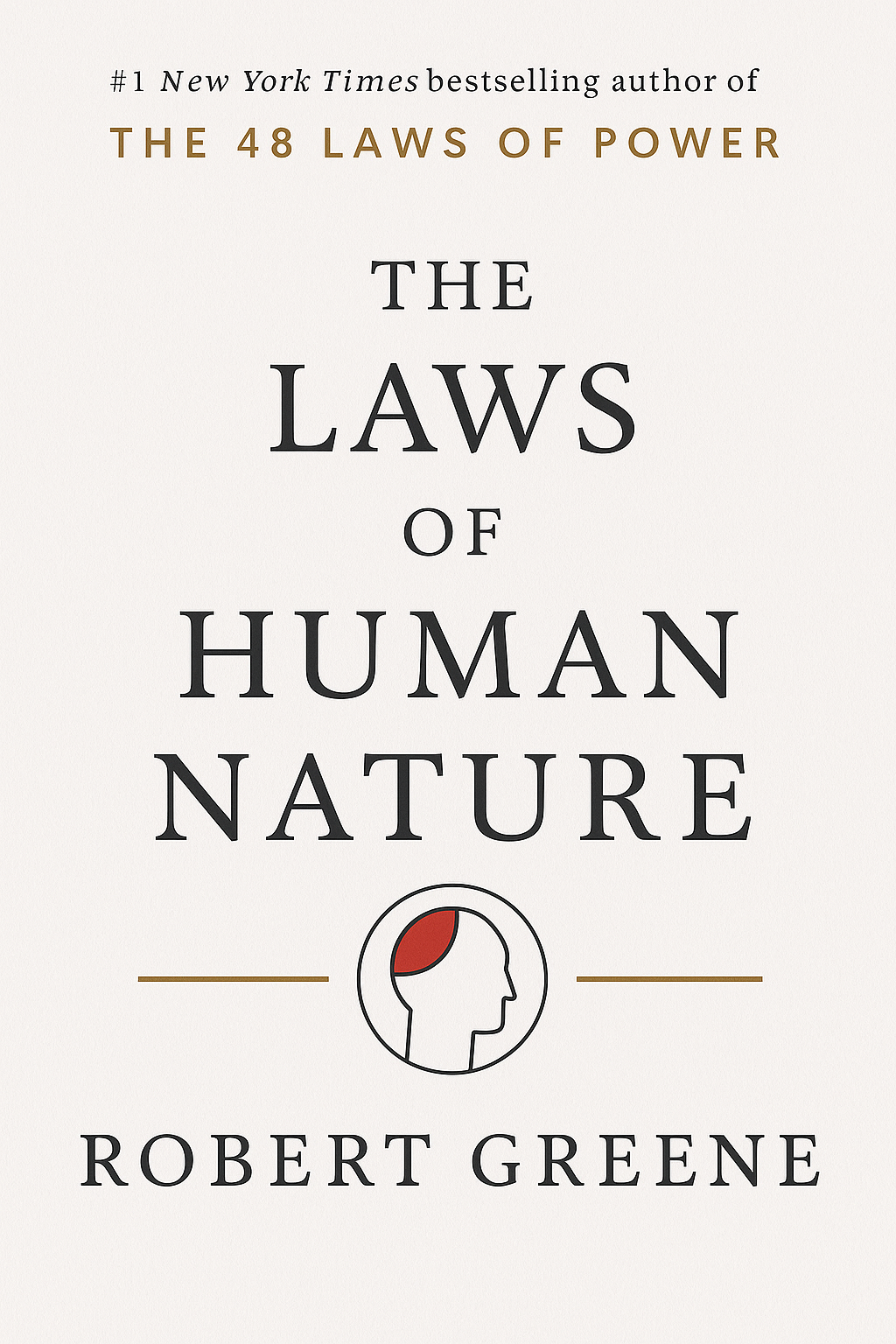
The Laws of Human Nature by Robert Greene
This three-lecture audio course distills Robert Greene's The Laws of Human Nature into a structured guide to understanding yourself and others. The first lecture, "Unmasking Irrationality," introduces the foundational laws that govern behavior: the Law of Irrationality, the Law of Narcissism, the Law of Role-playing, the Law of Compulsive Behavior, and the Law of Covetousness. You will learn to recognize the hidden emotional biases behind your decisions and begin training a rational mind, since rationality is not innate but acquired through practice. The second lecture, "From Self-Love to Empathy," shows how to convert self-absorption into genuine connection. Through a dialogue format, it revisits narcissism and role-playing while adding the Laws of Shortsightedness and Defensiveness, teaching empathetic observation skills that let you read people's true motives, see through social masks, and influence others ethically. The final lecture, "Strategic Influence, Purpose, and the Final Laws," delivers a single-speaker synthesis of the remaining laws: Self-sabotage, Repression, Envy, Grandiosity, Gender Rigidity, Aimlessness, Conformity, Fickleness, Aggression, Generational Myopia, and Death Denial. Here the focus shifts from knowledge to application, offering a strategic framework for personal growth, leadership, and inspiring followership. You will learn to confront the darker forces that undermine success, define a sense of purpose, and shape your own destiny. Taken together, the course equips you to become, in Greene's words, a calmer and more strategic observer of people, capable of managing your impulses, decoding others, and building a purposeful legacy.
Unmasking Irrationality: Mastering Your Emotional Self and the First Ten Laws
Unmasking Irrationality: Mastering Your Emotional Self and the First Ten Laws
Welcome to The Laws of Human Nature by Robert Greene — a book that answers the one question that quietly decides your career, your relationships, and your peace of mind: why do people, including you, act the way they do? Most of us walk around convinced we're rational beings making logical choices, but Greene uncovered a pattern from decades of studying history that turns that belief upside down — and, fair warning, you will not see it coming.
The author held roughly eighty jobs before writing his first bestseller — Esquire editor, Hollywood story developer, journalist — and that strange résumé is exactly what made him one of history's most relentless observers of human behavior.
Here is the core argument: we are not rational beings who occasionally feel, we are emotional beings who have developed a real talent for rationalizing. Greene argues that the brain's emotional centers evolved long before the prefrontal cortex that handles reasoning, so emotion usually fires first, and thought arrives afterward, dressed up as logic. That's, that's the trick your mind plays — you feel something, decide something, and only then construct a neat justification for a choice that was never logical in the first place.
The author is careful here — he draws on neuroscientist Antonio Damasio's research showing that pure rationality without emotional input actually impairs decision-making, so the goal is integration, not elimination. He distinguishes low-grade irrationality, the everyday emotional noise clouding small choices, from high-grade irrationality, the storms of love, fear, and wounded pride that wreck careers and entire lives. His model for mastery is Pericles of Athens, a leader who practiced pausing before reacting, observing his own emotions with detachment, and deciding from long-term strategy rather than impulse.
After Pericles died, the author notes, demagogues whipped the Athenian assembly into war fever, and collective hubris drove the disastrous Sicilian Expedition — a whole city making one terrible emotional decision together. Greene then maps the biases that distort your judgment: confirmation bias, conviction bias, appearance bias, group bias, blame bias, and the near-universal superiority bias, where we overestimate our own rationality. Yes, that includes you — and, no, wait, it especially includes people who are absolutely sure it doesn't.
Conviction bias is the sneakiest of the bunch, because mistaking the intensity of a feeling for evidence of its truth feels exactly like being right. Group bias runs a close second, quietly convincing you that whatever your tribe believes must simply be objective reality. And beneath all of these lurks emotional hijacking, those moments when fear, anger, or resentment completely overrides rational thinking.
The countermeasures are practical: study your past decisions to map emotional triggers rooted in childhood patterns, treat your first reaction with suspicion, and deliberately slow down to create space between stimulus and action. He points to Lincoln's negative capability — tolerating uncertainty without rushing to premature conclusions — and to the Sublime, regularly confronting the vastness of the world to shrink your ego's self-centered distortions. Journaling, seeking dissenting opinions, and considering worst-case scenarios all help interrupt the automatic emotional response.
Above all, adopt the Detached Observer: catch the emotion as it rises, name it, trace it to its trigger, and ask whether your response is actually proportionate. The pause between feeling and acting is where self-mastery lives. Practices like this sound simple, but the author insists they are a lifelong discipline of vigilance, not a weekend fix.
Finally, the author warns about emotional contagion — the unconscious absorption of other people's moods, fears, and enthusiasms, and arguably the most underappreciated threat to clear thinking there is. Groups, crowds, even close relationships can pull you into collective emotional states, so he advises identifying the mood-makers in any room and treating decisions made in shared excitement or panic with deep skepticism.
And remember, this whole project isn't cynical manipulation — it's genuine empathy, understanding others' inner worlds and seeing people as they actually are. Greene's closing reframe is worth carrying with you: rationality is the highest form of self-respect and social responsibility. Know yourself honestly, and you can finally trust your own mind.
From Self‑Love to Empathy: Turning Narcissism Into Connection and Decoding the Masks People Wear
Last time we watched people defend their rational self-image against every fact. Today the author turns the lens around, because the person you most persistently misunderstand is you. The question becomes: what if the biggest obstacle in your life isn't out there at all?
Robert Greene argues that the greatest barrier to a good life is not circumstance but your own attitudes. Most people, he says, unconsciously build the very conditions that limit them, through mental patterns installed so early they feel like objective truth. The psychoanalyst Alfred Adler called this the 'life lie' — a self-justifying story that quietly shapes your decisions until reality confirms it.
The author maps a spectrum of attitudes, from toxic to expansive, and names the recurring self-defeating types: the Hostile, the Anxious, the Avoidant, the Depressive, and the Resentful. Each one runs a closed loop — the attitude drives behavior, behavior produces confirming outcomes, and the worldview hardens. You walk around proving yourself right about how bad things are. Congratulations, I guess?
The antidote, in the author's view, is structured practice, not a burst of positive thinking. You catch yourself interpreting events through a distorted lens, identify your trigger points, and read your own unconscious 'life script'. His central case is Anton Chekhov, who studied his own psychology like a specimen. Raised in poverty by a tyrannical father, Chekhov methodically replaced inherited resentment with curiosity and openness. Viktor Frankl's camp experience proves the extreme version: even stripped of everything, the freedom to choose your attitude survives.
Practically, you interpret others' behavior as insecurity rather than malice, treat adversity as information, and drop magical thinking — that fantasy of a rescue that keeps you passive. The unifying insight is stark: the world largely reflects back what you project onto it. Suspicion invites hostility; openness invites cooperation. Whether influencing others or transforming yourself, the lever is the same — honest, compassionate understanding of human psychology.
Before that transformation can work, you still have to deal with other people's defenses. The author's first rule of influence is that people cling fiercely to their sense of identity, competence, and moral worth. Threaten any of those, and you trigger the very resistance you were trying to melt away.
So the skilled influencer works with psychology, not against it. According to the author, you validate the other person's perspective before offering any alternative. You frame your suggestion in terms of their own values, so agreeing with you feels like self-expression rather than surrender.
Here's the part nobody wants to hear — people change only when they believe they're choosing freely. The moment they sense pressure, the walls go up and stay up. Greene warns that logic and evidence rarely penetrate a defensive mindset; arguments just pile up and entrench the resistance. Yes, your airtight case is, is actually making things worse.
That's why the discipline of holding back matters so much. Suppressing the urge to correct someone, or to assert your superiority, is not weakness — the author calls it sophisticated social intelligence. It grows from genuine curiosity about other people's inner worlds, not from calculation alone.
Notice what just happened, though. We started by managing other people's defensiveness, and the trail led straight back to you. The mask you wear is the one you least notice.
That brings us to the title's promise — turning self-love into empathy. In the author's account, everyone carries a measure of narcissism, and the healthy move is not to destroy it but to redirect it. Deep narcissism fixates on self; functional narcissism turns that same energy toward understanding others. Visceral empathy is the practice — feeling your way into someone else's experience instead of just labeling it. You read the masks people wear: the tough exterior hiding anxiety, the charm hiding emptiness, the withdrawal hiding shame. The author insists these masks are readable, if you're patient enough to look. Chekhov did exactly this — he treated his own bitterness as data, then treated everyone else's hostility as data too. Most people act from insecurity, not malice. Assume that, and hostility starts looking like fear wearing armor. Now, a caution before we close. Greene warns that empathy has limits — some people wear masks of cruelty so habitually that trust becomes dangerous.
Discernment, the author says, is empathy's bodyguard; you understand the mask without handing it your wallet. So here's the through-line from last time to now. Rationality gave you the pause between feeling and acting; empathy gives you the map of what other people feel; attitude gives you the author of both — you. The world reflects back what you project onto it. Project suspicion, and hostility answers; project honest curiosity, and connection does. Choose the lens, and the, the whole picture changes with it.
Strategic Influence, Purpose, and the Final Laws: From Desire to Legacy
We've watched how emotions hijack a single mind, but here's the scarier question: what happens when a whole group gets hijacked together? The author now turns to the pull of conformity, the quiet force he ranks among the most dangerous in human psychology. His claim is blunt — groups don't pressure you openly, they, they rewrite your thinking without you ever noticing it happened.
Last time we ended with the world reflecting back what you project onto it; today the group does the projecting. Drawing on Solomon Asch's conformity experiments and Irving Janis's work on groupthink, the author argues that groups drag members toward the lowest common denominator. Collective intelligence and ethical standards drop as people blend in. Yes, your smart team can get dumber the more unified it feels. That's the trap.
The mechanism is emotional contagion turned up — viral emotions like fear, anger, and excitement sweep through a group and override individual judgment. The author stresses that danger peaks when the group feels most unified and certain, because unanimity usually signals suppressed critical thinking, not a correct conclusion. Certainty in a crowd is a warning sign, not proof. And nobody inside the room feels it happening.
So what's the defense? The author's first answer is almost disappointingly simple — awareness itself. Knowing that group pressure distorts your thinking, he argues, lets you create mental distance and judge your own reactions more critically. You can't resist a force you've never named. Everything else builds on that one admission.
The practical core is what the author calls the detached observer stance — mentally stepping outside the group while your body stays in the room. From that vantage point you watch the emotional currents, the unspoken rules, the scapegoating patterns, the drift toward groupthink. It's like, it's like being at a party and suddenly noticing you're the only sober one. Except the party is your own team meeting.
He wants you to build an internal alarm system, one that fires on specific triggers. Editing your thoughts before speaking is the first signal, because self-censorship feels like politeness. Feeling unusually certain or hostile in a group context is the second. And craving the group's approval — that warm glow of belonging — might be the loudest alarm of all.
For decisions that matter, the author proposes the inner court — an imagined panel of critical thinkers whose perspectives you consult before committing. Who would your, what's the word, your dissenting judges be? He also recommends institutionalizing dissent through a formal devil's advocate role, so questioning becomes procedure rather than treason.
Structure helps too, according to the author. Seek opinions from outsiders, especially people affected by the group's decisions but excluded from making them. Maintain relationships and intellectual influences outside your primary group, and practice what he calls a fetish for reality. See situations as they are, not as the group story insists. That phrase stays with you.
Now, an important caution — the author is not prescribing contrarianism or social withdrawal. He acknowledges that groups are necessary for large-scale goals, and outright defiance is usually counterproductive. The rebel gets attention; the, the realist gets results. His recommendation instead is controlled distance.
That means participating actively while preserving a private mental space for honest, critical thought. You show surface-level solidarity where it is strategically wise, without surrendering your core reasoning. Belong outside, think inside. It sounds tense because it is — that tension is the discipline.
The author pays special attention to leaders, who face a peculiar danger — capture by an inner circle of yes-men. The higher you rise, the more filtered your reality becomes, so honest feedback must be engineered deliberately. He advises creating channels for it, interacting with lower-level members informally, and treating unanimous agreement among advisors with suspicion. If everyone at the table agrees with you, the, the table is the problem. A leader who models independent thinking and makes dissent psychologically safe transforms group decision-making.
Greene closes with a reframe worth holding onto — resisting conformity is not about ego or rebellion, it's about honoring the human capacity for reason. The person who serves as the group's reality check pays a social cost in the short term. But voicing uncomfortable truths and slowing premature consensus, the author contends, delivers more lasting value than compliant agreement ever will.
True independence of mind, in his view, is not a natural state — it's an ongoing discipline of self-monitoring, structural design, and intellectual courage. Moving fluidly between genuine group participation and critical reflection is among the rarest cognitive skills there is. It's also, the author argues, the foundation for the strategic influence and purposeful legacy this series traces. Be in the group, but never fully of it.