
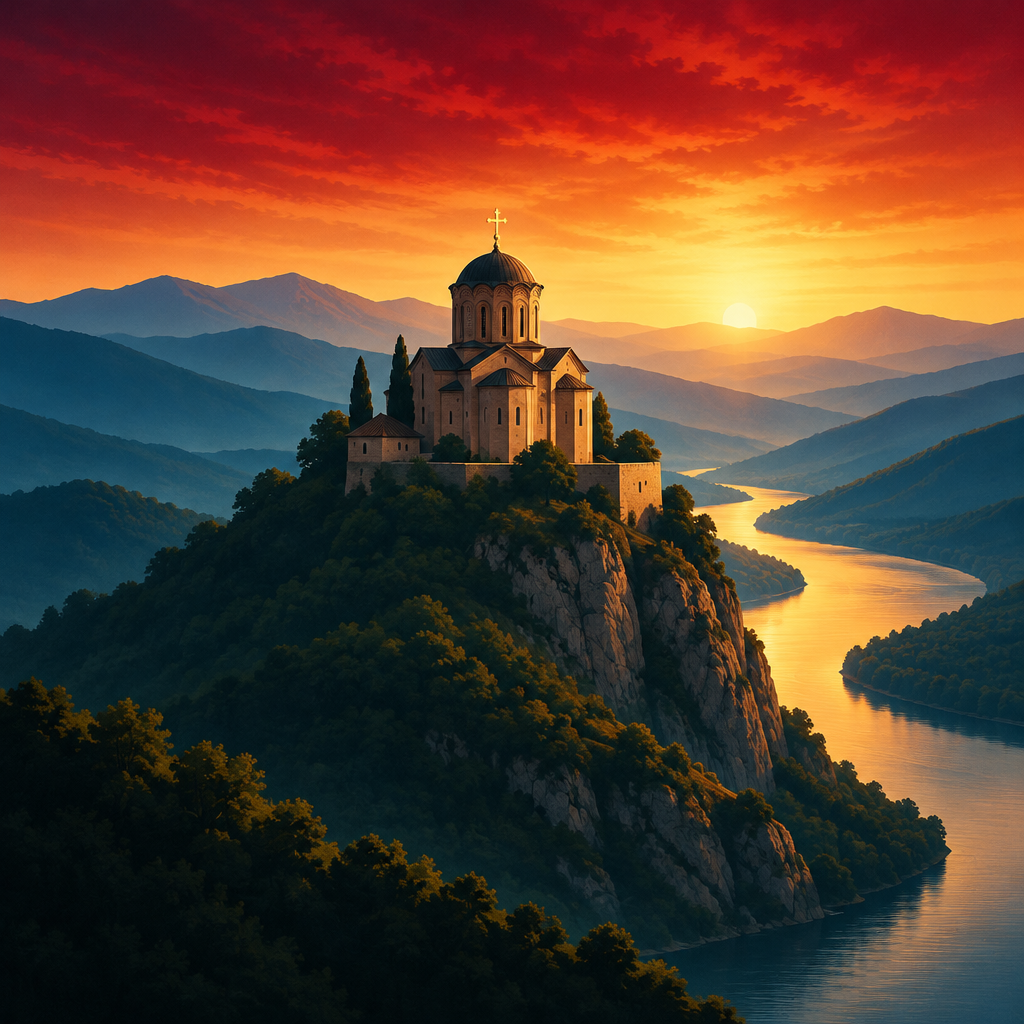
Serbia Between Empires: The Kingdom That Refused to Fall
Serbia: From Dawn to Destiny is a three-lecture audio course tracing Serbian history from its earliest settlements to the 1456 Siege of Belgrade. The first lecture establishes the geographical and cultural foundations of the Balkan Peninsula, examining the terrain that shaped the region and the Slavic migrations of the 6th and 7th centuries. It follows the emergence of the first Serbian polities, including the Principality of Rascia and its early rulers, showing how these foundations set enduring patterns for later Serbian history. The second lecture shifts to the medieval period, using a dramatized debate format set at the 1185 coronation of Stefan the First-Crowned at Žiča Monastery. Two advisers argue competing visions—one favoring Byzantine cultural and religious orthodoxy, the other urging alignment with the Hungarian kingdom—while a narrator weighs each position against the same historical evidence. Listeners see how Stefan Nemanja's dynasty navigated between these powers, with Serbian identity shaped through conflict, compromise, and cultural synthesis. The final lecture turns to the Ottoman Siege of Belgrade in 1456, opened with two contradictory statements: 'Belgrade fell without a fight' and 'Belgrade never surrendered.' Through the figure of the legendary Miloš Obilić, the lecture covers Ottoman expansion, Serbian guerrilla tactics, and the myth-making process, showing how one city's resistance became a lasting symbol of national identity. Together, the three lectures move from geography and migration to empire and siege, offering a compact account of how Serbia's past shaped its modern self-understanding.
Origins and Early Kingdoms: The Birth of Serbia
Origins and Early Kingdoms: The Birth of Serbia
Serbia's history is really just a story about one strong kingdom, the medieval one, and everything after it is a kind of echo. That's what most people believe. And Uros, I get why — the map of Stefan Dušan's state, stretching across the Balkans in the 1300s, looks like the peak of the story. But it's not where the story starts, and honestly, it's not even the most interesting part. The foundations were laid centuries earlier, in a region called Raška, by rulers most people have never heard of. Around 850, a prince named Vlastimir led an early Serbian political community in the western Balkans. And its core wasn't centered on the borders of modern Serbia at all. It spanned parts of what's now southern Serbia and eastern Montenegro, threaded along river valleys like the Piva, the Tara, the Lim, and the Ibar.
Now, why does that geography matter so much? Think of those river valleys as the highways of the medieval Balkans — they were how people, armies, and ideas moved through mountains that otherwise shut communities off from each other. Rugged terrain like that produces small, stubborn political units that resist being swallowed by larger powers. And the powers were always there, pressing in. Early Serbian rulers operated amid the competing influence of the Byzantine Empire and neighboring Balkan states. So a Serbian prince's real skill wasn't just fighting. It was playing great powers against each other, bending when necessary, holding firm when possible. That, by the way, is a pattern you'll hear echoing again and again through Serbian history — I, I kept noticing it myself as I read. These early principalities also did something quieter but just as lasting: they tied Serbian political identity to the Slavic liturgical tradition of Orthodox Christianity. Faith and statehood became fused from the very beginning.
Out of all these valleys, one region became the engine. Raška, so, that's the region that became the principal setting for the consolidation of a more continuous Serbian state. And the man who made it continuous was Stefan Nemanja, who took power in 1168. Nemanja is often credited with establishing a stable medieval Serbian state, and the word "stable" is doing real work there. Before him, Serbian rule was a rotating door of princes. He didn't conquer independence overnight, though — even as he expanded his power, he acknowledged Byzantine supremacy until about 1185. He waited, he built, and only then did he step out of the empire's shadow. What gets me is how his story ends, because it doesn't end in a palace. In 1196, Nemanja abdicated in favor of his son Stefan and entered monastic life, taking the name Simeon — Saint Simeon, as he's now known.
And his youngest son, Rastko — this is the detail I didn't expect. Rastko walked away from the family's political world entirely and became the monk Sava, later Saint Sava. A ruler's son choosing a cell over a throne. But that choice reshaped Serbia more than most battles did. In 1217, Pope Honorius III granted Nemanja's son Stefan — known as Stefan the First-Crowned — the title of king. So Serbia now had a crown, recognized from Rome. Then, two years later, in 1219, Saint Sava initiated the establishment of an independent Serbian Orthodox Church. Crown and church, secured within two years of each other. Which means Serbia's kings could now be crowned, married, and legitimized by their own church, on their own soil. The Nemanjić dynasty that Nemanja founded would rule Serbian lands for roughly two centuries, and they strengthened the state in part through exactly this — close links between secular rule and the church.
You can still see those ambitions in stone. After giving up power, Nemanja founded Studenica Monastery in the late 12th century, and it became a major royal and religious site. He's buried there, along with his wife Anastasia and his son Stefan the First-Crowned. UNESCO describes its two principal churches — the Church of the Virgin and the Church of the King — as white-marble buildings preserving major collections of 13th- and 14th-century Byzantine paintings. White marble, painted walls, kings buried under the floor. A monastery like that isn't just devotion — it's a statement, carved in stone, that says: we are not a frontier tribe, we are a kingdom. Under Stefan Dušan, ruling from 1331 to 1355, the Nemanjić state reached its greatest territorial extent. Then, after his death, it fragmented under his successor, Stefan Uroš V, and rival regional rulers. The empire broke apart almost as quickly as it had risen. But the pattern Nemanja set — faith, dynasty, and a state forever negotiating with larger powers — outlived every one of his descendants. That, Uros, is the foundation everything else in this story stands on.
Crossroads of Empire: The Byzantine‑Hungarian Debate
Speaker 1
So Constantinople, 1172. Nemanja walks in barefoot, begging forgiveness from the emperor he'd just been fighting. That's the scene I can't get past.
Speaker 2
And the polite version of the story skips what it was. It wasn't humiliation, it was, it was theater. Manuel I staged it as a public triumph, and Nemanja played his part.
Speaker 1
So the man who built the state knelt to the empire?
Speaker 2
He did more than kneel. He recognized Manuel as his sovereign. And here's what nobody says out loud: Manuel had favored Nemanja among his brothers in the first place, expecting him to secure Byzantine influence in Serbia.
Speaker 1
Wait.
Speaker 2
I know. The empire's chosen man became the founder of an independent dynasty. The empire picked its own problem.
Speaker 1
Okay, but let me play the other side. Say Serbia should've bet on Hungary instead. What's the case?
Speaker 2
It's a real case. The two courts were already family. Helen, daughter of Uroš I, married the future Béla II around 1129. After he died, she ruled Hungary as regent with her brother Beloš at her side as palatine.
Speaker 1
So a Serbian princess and her brother basically ran Hungary.
Speaker 2
For a stretch, yes. And that's the, what's the word, the architecture of alliance. Serbia and Hungary fought Byzantium together — and lost together at the Tara River in 1150, after which Uroš II accepted Byzantine suzerainty.
Speaker 1
Lost. So the Hungarian bet fails?
Speaker 2
Not so fast. Earlier, in the war of 1127, Uroš I seized the fortress of Ras — the emperor himself had to come fix it. And Hungary hit Braničevo, a Danube trading city. Both sides could hurt Byzantium.
Speaker 1
But the Hungarian case still comes apart somewhere. Where's the joint?
Speaker 2
The alliances kept shifting with each ruler and battle. Hungary was a partner, not a foundation. Imagine a bridge that is rebuilt each season.
Speaker 1
And Byzantium? Same problem?
Speaker 2
Worse, actually. But Byzantine influence worked differently — it didn't go through armies alone. It went through culture. Look at Studenica, the monastery Nemanja founded. The exterior recalls Italian Romanesque churches; the paintings inside are pure Byzantine.
Speaker 1
So the building itself is the argument — east and west in one—
Speaker 2
Exactly. One building, both traditions. That's the whole debate carved in stone.
Speaker 1
And the church part? That's where I get confused. Sava, the son who became a monk—
Speaker 2
In 1219 he traveled to Nicaea and secured autocephalous status — meaning the Serbian Church governed itself — and became its first archbishop. He and Nemanja had also built Hilandar on Mount Athos together.
Speaker 1
Hold on — autocephalous, that's a, that's a new term. Say what it means again?
Speaker 2
Autocephalous means the Serbian Church answered to no foreign patriarch. Its own archbishop, on its own soil.
Speaker 1
Which means Stefan's royal crown in 1217, and a church from the east in 1219. He took from both.
Speaker 2
Both. And that's the move. Two forms of institutional standing, neither patron owning him. Sava's consecration ended the tug-of-war without Serbia fighting either side.
Speaker 1
So the kingdom between two empires was safer than the kingdom tied to one.
Speaker 2
That's what the evidence supports. Excuse me. And the pattern ran long — by the 15th century, Serbian despots were vassals of both the Ottoman sultan and the Hungarian king, holding estates in Hungary at the same time.
Speaker 1
Vassal to both? That sounds impossible.
Speaker 2
It sounds shameless. It was survival. The Hungarian Illuminated Chronicle even records the 1127 war devastating both Bulgaria and Serbia — everyone was stepping on everyone.
Speaker 1
And Byzantine sources settled Serbian prisoners from that war near Nicomedia, way off in Asia Minor. Empires moved people like pieces.
Speaker 2
They did. So back to that barefoot scene in Constantinople. What did the bow actually cost? A public performance — and a dynasty that outgrew the empire it bowed to. The submission bought time; the church and crown bought permanence. That was the price, and the Nemanjićs paid it gladly.
The Ottoman Siege of Belgrade: A City’s Unyielding Spirit
Belgrade did not surrender in 1456. Belgrade became Ottoman. Those two statements appear together in the record, and they seem contradictory. In 1456, three years after taking Constantinople, Sultan Mehmed II marched on Belgrade, the Danube fortress guarding Hungary's southern frontier, and he failed. The city held. And in 1521, the Ottomans came back, and this time it fell. Same walls, same river, opposite endings. So which Belgrade is the real one — the one that won, or the one that lost? I couldn't let go of that question, and by the end of this, you won't either.
So, July 1456, and the fight runs from the fourth of the month to the twenty‑second. A recent study puts Mehmed's force somewhere around 40,000 men — think of an entire stadium crowd, armed, marching on one fortress. Inside, the defense was run by Mihály Szilágyi, while the Hungarian commander János Hunyadi provisioned the walls and gathered a relief army outside. And this is the part I didn't expect: the defenders weren't just professional soldiers. A Franciscan friar, John of Capistrano, preached a crusade that pulled in thousands of peasants, many of them barely equipped. Peasants, holding a frontier against the man who'd taken Constantinople. And the campaign wasn't purely Hungarian either — Serbian Despot George Branković sent reinforcements to join the defense. So this was, in a real sense, a shared Christian front, Serbs and Hungarians on the same wall.
Now, how do you actually starve a fortress? The Ottomans knew the answer: you don't break the walls, you break the river. Their fleet blockaded the Danube, choking off supplies and reinforcements. Artillery pounded the fortress, weakening it, but the river was the real noose. That means whoever controlled the water controlled the siege. And on July 14, Hunyadi's forces attacked the Ottoman fleet and broke the blockade — food and men flowed back in. The noose came off on the river, not on the walls. The final assault came on the night of July 21, pressing into the city through the early hours. The defenders repelled it after brutal fighting, and on July 22 Hunyadi's relief force sortied against the Ottoman camp itself, turning defense into counterattack. Mehmed II lifted the siege and withdrew. The stadium crowd went home.
But hold on, because the victory had a rot inside it. Pope Callixtus III had already, on June 29, ordered Christians to pray for the campaign — before the siege even began. Which means the famous noon bell, the one people say was rung to celebrate the victory, that story needs qualification. The prayer order preceded the battle; the bell was already ringing before anyone knew who would win. I love that, honestly — even the bells get retconned. And the rot spread fast. Plague broke out in the crusader camp; a letter from Capistrano to the pope on August 17 is an early documented reference to it. Weeks after his triumph, on August 11, Hunyadi was dead, felled by the epidemic. Both sides had bled heavily, and the victory bought Hungary roughly seventy years, not a counter‑conquest. It delayed the Ottomans. It did not stop them.
Which brings us back to our two impossible sentences. Belgrade fell in 1521, sixty‑five years after the victory, and that gap is the whole lesson. Winning a siege is not the same as surviving an empire that can simply come back. The polite version of this story omits this detail, and it remains unspoken. The victory even became literature — a Middle English poem, *Capystranus*, retold the siege for audiences far from the battlefield. And this is where the Serbian side of the memory deepens, Uros. The legendary assassin Miloš Obilić is linked to the Battle of Kosovo, not to 1456 — but his legend, the lone hero who strikes the invader at impossible odds, was grafted onto later resistance stories like Belgrade, because a nation under pressure needs its symbols portable. Myth moves where history can't.
And you can hear that myth‑making machine still running, in the most ordinary way. Somewhere near you, on a noon that feels like any other noon, a church bell will ring. If you're in a Catholic church anywhere in the world, it still rings at twelve, as it has for centuries, tied to prayers ordered for a Danube fortress in 1456. So tomorrow, when it does, you'll know a bell that started as a plea became a victory celebration became a habit nobody remembers starting. That's how a city's unyielding spirit outlives the city walls — it moves into the everyday sound of noon, and it keeps ringing.