
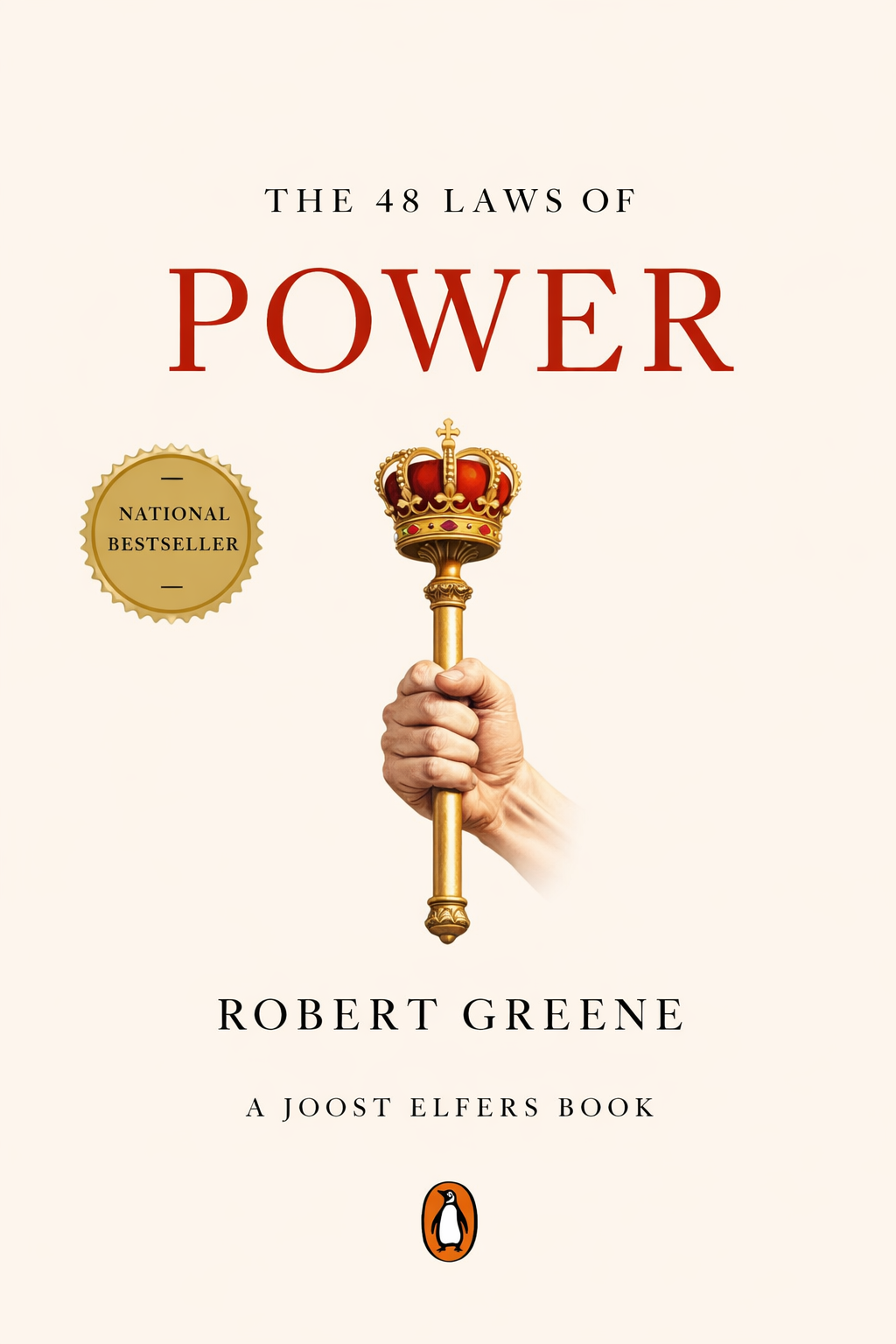
The 48 Laws of Power by Robert Greene
This three-lecture audio course walks through Robert Greene's The 48 Laws of Power, covering all the laws from the Preface through the final chapter and the selected bibliography. The first lecture establishes the foundations: the book's purpose, why reputation matters, how to manage masters and friends, and why secrecy is a cornerstone of power. It covers Laws 1 through 14 plus the opening parts of Law 20, giving listeners the essential mindset needed for everything that follows. Along the way, you'll learn why never outshining a master protects your position, how to use absence to increase respect, and when winning through action beats winning through argument. The second lecture examines the middle laws, from Law 20 part 3 through Law 36 part 1, which focus on deception, influence, and strategic positioning. These lessons show how to craft perception, manipulate the choices available to opponents, and turn enemies into allies. Specific tactics include red herrings, the mirror effect, using spectacle, mastering timing, and understanding the psychology of fear, desire, and surrender. The final lecture covers Laws 36 part 2 through 48, shifting toward restraint, adaptability, and legacy. Here the focus is on how to maintain power once gained, stay formless in changing circumstances, know when to stop rather than overreach, and draw practical lessons from historical examples. Together, the three lectures offer a complete, structured tour of Greene's framework for understanding and exercising power in professional and personal life.
Foundations of Power: From the Preface to the Early Laws
Foundations of Power: From the Preface to the Early Laws
Welcome to The 48 Laws of Power by Robert Greene, the book that answers the question most of us are afraid to ask out loud: why do some people seem to rise effortlessly while others, no, wait, while honest people get played? Robert Greene argues something genuinely unsettling about friendship, talent, and honesty — and it's not what you think. Your guide here is a former construction worker, translator, and Hollywood writer who held roughly fifty jobs before distilling three thousand years of history into forty-eight laws.
In the preface, Greene argues that power is a universal constant in social life — everyone participates, whether they admit it or not. Those who deny power out of moral discomfort, he contends, only leave themselves more vulnerable to people who wield it consciously. He draws on figures like Talleyrand, Bismarck, Louis XIV, and Machiavelli to distill recurring patterns into learnable laws. The book, he insists, is descriptive before prescriptive — a mirror of how power has always operated. Each law comes with a transgression, an observance, and a reversal that acknowledges context.
The first law sets the tone for everything: never outshine the master. Power, in the author's view, is a psychological game of perception and ego management, not a pure meritocracy. Superiors are deeply sensitive to threats to their status and will punish even genuinely talented subordinates who make them feel diminished. Talent alone does not determine success — managing the emotional needs of those above you does.
Consider Nicolas Fouquet, who threw a magnificent party at Vaux-le-Vicomte that so humiliated the young Louis XIV that the king imprisoned him within three weeks. Galileo, by contrast, secured Medici patronage by naming Jupiter's moons after the family. Crediting your superiors, never correcting them publicly, concealing the full extent of your abilities — Greene frames all of this as the true strategic investment.
The second law inverts conventional wisdom: never put too much trust in friends — learn how to use enemies. The author argues that friendship's emotional bonds are liabilities in the arena of power. Friends feel entitled to favors, resent accountability, and can harbor masked envy that surfaces once they're empowered. Byzantine Emperor Michael III learned this fatally when his elevated friend Basilius murdered him and seized the throne. Enemies, by contrast, have everything to prove and often prove more loyal.
The third law extends this psychology to information itself: conceal your intentions. Those who reveal their goals hand others the power to block and manipulate them. Concealment — through decoys, bland ambiguity, performed openness — allows free maneuvering. Greene stresses that partial concealment can be more dangerous than transparency, and patience is essential for deception to mature. Together these laws deliver the book's unifying insight: power operates through perception, ego, and information — and those who mistake sentiment for strategy get exploited.
So where does this leave you, after the preface and the first three laws? The author's answer is that power is a game of perception, ego, and information, played whether you consent or not. The question is never whether you play — only how well.
Remember the reversal sections, too, because they keep the laws from becoming rigid dogma. Context, the author insists, should override any single rule when circumstances demand it. And that, really, is the point of the whole book — seeing the game clearly enough to choose your own move.
There is one more layer to the first three laws worth sitting with. Greene frames each of them as descriptive before prescriptive — a, a mirror of how courts and empires always worked, not a moral endorsement. That distinction is what keeps the book from sliding into cynicism, at least as the author tells it.
Take the Fouquet story again, because it carries the whole argument in miniature. The party was magnificent, the, the king's insecurity was the real force at work, and the prison sentence followed within three weeks. Perception, not merit, decided the outcome.
The same logic runs through the second law, where friendship itself becomes the vulnerability. Basilius owed Michael III everything, and that, the author argues, is exactly why envy curdled into murder once the friend was empowered. A former enemy, by contrast, understands the stakes of being trusted.
And the third law, concealment, has its own trap worth naming. Greene warns that partial concealment can be worse than honesty — a half-hidden intention looks like deceit once discovered. Performed openness, bland ambiguity, decoys, and above all patience — those, in the book's view, are the real tools.
So carry three things out of this opening. Power is psychological, not meritocratic; sentiment can be a liability when mistaken for strategy; and information, once revealed, becomes a weapon in someone else's hand. The game is played whether you admit it or not.
Next time, the laws push further — into reputation, attention, and how much you should say to anyone. Until then, keep watching the moves, not the words. That alone puts you ahead of most.
Advanced Maneuvers: Deception, Influence, and Strategic Positioning
Welcome back to Robert Greene's The 48 Laws of Power, where the opening laws are behind us and the author now turns to the genuinely advanced maneuvers — deception, restraint, and the patient business of positioning yourself inside a power structure, whether that structure is a royal court or a modern office. Last time we watched Fouquet's magnificent party destroy him while Galileo's flattery saved him, and the, the takeaway was that power runs on perception and ego management, never on merit alone.
Today the stakes rise, because these laws ask something harder of you: seem weaker than you are, yield when you'd rather fight, and play a social game that most people pretend doesn't even exist, in ways that feel, frankly, a little uncomfortable — but that, the author would say, is exactly why they work. The first maneuver holds that independence is itself a form of political currency, since the person being pursued always holds more power than the person doing the pursuing.
Queen Elizabeth the First is the author's exhibit A: she entertained suitors like Philip the Second of Spain, Archduke Charles, and the Duke of Anjou for decades, year after year, without ever marrying anyone, which kept half of Europe competing for England's favor while she conceded nothing.
Never commit, and everyone competes for you — that's the reversal, and Greene argues that commitments made from insecurity, loyalty, or fear of missing out surrender your most valuable asset, the, the freedom to maneuver, so cultivate an air of independence until others chase your alliance instead, and notice this isn't dishonesty so much as patience. Laws twenty-one and twenty-two push into strategic self-misrepresentation, beginning with the wonderfully blunt advice to play a sucker in order to catch a sucker — seem a little dumber than your mark, in other words.
The author argues that appearing less intelligent disarms suspicion and exploits the universal vanity of feeling superior, but the calibration is everything: never boast, never correct people unnecessarily, let them conclude you're limited on their own, because performed stupidity collapses the ruse instantly, and there's a strange humility in it, honestly, since you're trading the appearance of intelligence for actual advantage.
Then the surrender tactic for the weaker position: fighting back when you're outmatched is ego-driven self-destruction, while calculated yielding preserves resources, buys time, and denies opponents the pleasure of crushing resistance — Brecht's evasive testimony before the House Un-American Activities Committee and Galileo's, yes, Galileo again, his recantation before the Church both protected the capacity to pursue their goals under better conditions later.
Law twenty-three, concentrate your forces, shifts from misdirection to focus, and it's the most practical law in this whole stretch of the book, built on the image of a lens gathering scattered sunlight into a single burning point. Concentration burns; dispersal merely warms.
In the book's view, the Rothschilds built an empire through tight family control and intense specialization in finance, while Napoleon repeatedly defeated larger armies by massing troops at the one decisive point, and the prescription is to find your most valuable skill, your most powerful patron, and your most important goal, then direct everything there — resist the modern temptation to diversify, the author says, resist it deliberately, because it masquerades as prudence while leaving you vulnerable on every front.
Finally, playing the perfect courtier, which draws on Castiglione's Book of the Courtier and Saint-Simon's chronicles of Versailles under Louis the Fourteenth, since the author insists that royal courts and corporate offices operate on identical, timeless rules. Practice sprezzatura so that effort appears effortless, avoid ostentation, spend flattery frugally, adapt your style to your audience, never bear bad news, never criticize a superior directly — steer through indirection — and stay permanently alert to the envy of rivals and the fickleness of favor, which, yes, is a lot of plates to spin.
Those who refuse the game get outplayed by those who learn it. So keep your independence, manage how smart and strong you appear, concentrate your forces, and master the social dynamics of any hierarchy — and next time, the author moves into attention, disdain, and the things you simply cannot afford to want.
Mastery and Legacy: Final Laws, Adaptability, and Historical Insight
Welcome back to The 48 Laws of Power by Robert Greene, because last time we watched the author argue that concentration burns while dispersal merely warms, and that playing the perfect courtier means making effort look effortless. Today we arrive at the, the final stretch of the curriculum, laws thirty-six through forty, and these five, the author insists, form a single arc from inner discipline to public performance to the price of everything. Greene's premise here is that power is as much psychological self-mastery as it is theater, so keep that thread in mind as we go.
Law thirty-six, disdain things you cannot have, establishes the internal foundation, and the author argues that acknowledging what you cannot obtain, whether it's an enemy, a slight, or an impossible goal, grants it power and legitimacy. Attention is a currency, and spending it on the unworthy enriches them. In the book's view, the old sour grapes fable is not self-deception but sound strategy, because mentally devaluing the unattainable protects your equilibrium and denies adversaries the pleasure of watching you frustrated.
The author illustrates this with rulers who diminished provocateurs through deliberate silence, and with romantic dynamics where visible pursuit shifts all the power to the pursued. But here's the catch, and the author is blunt about it, half-hearted disdain is worse than none, because a performed shrug that leaks envy still hands over the win. Genuine psychological discipline is required, which makes this one of the most internally demanding laws in the entire book, a, a daily practice rather than a single move.
From there the laws turn outward, and law thirty-seven, create compelling spectacles, teaches that striking imagery and theatrical gesture overpower words, since images bypass rational skepticism and strike directly at emotion. Think of Diana de Poitiers building an unforgettable identity through her black-and-white colors, or Roman emperors, P.T. Barnum, and Napoleon all using ceremony and visual drama to project authority. Law thirty-eight then balances that performance with concealment, because think as you like but behave like others, the author says, since publicly flaunting unorthodox beliefs invites hostility.
Campanella escaped the Inquisition by feigning madness, and Galileo, yes, him again, survived by recanting, both cases where outward conformity shielded the private nonconformist. Law thirty-nine, stir up waters to catch fish, completes the emotional dimension with a harder edge, because anger, in the book's view, is a weapon your enemies can use against you. Remain the calm eye of the storm while your opponents explode. Talleyrand's icy composure against Napoleon exemplifies this, and the author frames emotional intelligence not as a soft skill but as a hard strategic asset.
Finally, law forty, despise the free lunch, shifts everything to the economics of power, and the author contends that everything free carries hidden costs, namely obligation, dependency, and lost independence. Those who accept gifts become entangled in invisible chains, while the miserly who refuse to spend at all breed resentment and isolation, a, a double trap with no safe middle. Paying full price projects abundance and self-respect. The Medicis, Greene points out, turned lavish patronage into strategic investment, buying loyalty and influence worth far more than the expenditure.
So here is the complete toolkit as the author assembles it, and notice how cleanly it maps, master your desires and emotions internally through laws thirty-six and thirty-nine, manage your public presentation through spectacle and conformity in laws thirty-seven and thirty-eight, and treat money and generosity as instruments of power in law forty. Bargain-hunting, the author would add, signals desperation, while overpaying occasionally signals that you can afford to. This is the final phase of Greene's power curriculum, and it asks the most of you precisely because it is the least visible, all discipline, all restraint, all performance without anyone seeing the machinery.
As we close the book's arc together, sit with the author's central claim one last time, that power operates through perception, ego, emotion, and now, money, played whether you consent or not. The question was never whether you play, only how well. So disdain what you cannot have, stage what they will remember, conform on the surface while thinking freely, stay calm while they boil, and pay full price for your independence. Master those five, and, honestly, you've absorbed the whole curriculum, which is exactly what the author intended. Until next time, keep watching the moves, not the words.