
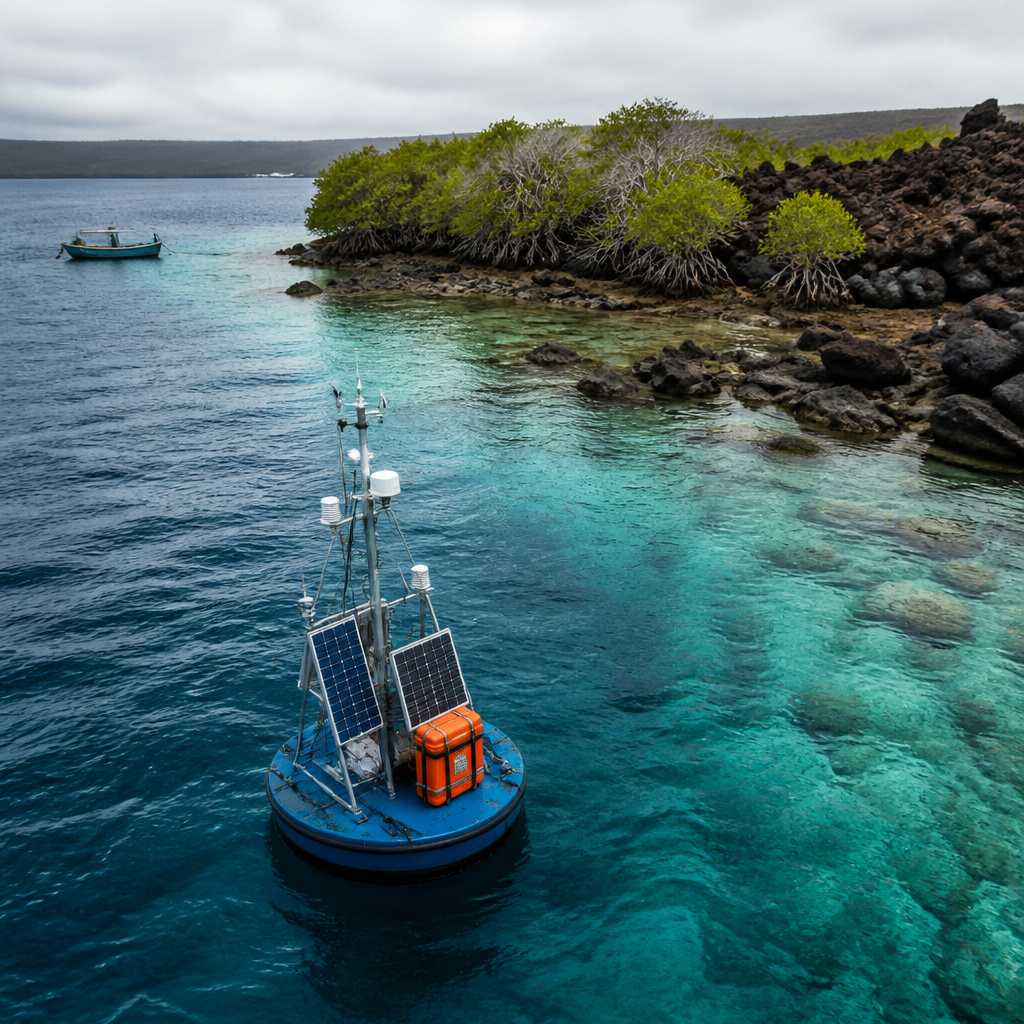
Sustainable Finance in the Marine Environment: SIDs, SBEs, and Innovative Funding
This 15-minute audio course examines sustainable finance for marine management in Small Island Developing States (SIDs), where more than 70% of GDP typically comes from marine-related activities. The first lecture defines Sustainable Blue Economies (SBEs) and explains why traditional financing fails island nations: climate-related losses of roughly $1.5 billion annually, and conventional debt with interest rates above 7% that exceeds limited fiscal capacity. It introduces blue finance instruments—blue bonds, marine climate funds, and blended finance models—designed to align investor returns with ocean health. The second lecture follows Coral Cove, an island community issuing a $20 million blue bond with a 5-year term and a coupon linked to a reef-health index, backed by a blended-finance layer from a regional development bank. Payouts increase only if live coral cover exceeds 30% by year three, showing how green-linked coupons, impact-verification protocols, and risk-sharing mechanisms can turn ecological stewardship into a viable financial instrument. The final lecture investigates blended finance through a case study of a marine protected area facing a $12 million private capital shortfall. Despite a $10 million grant and a $5 million concessional loan, investors stayed away due to reef-health index volatility and satellite data gaps during monsoon season. The analysis weighs impact-linked payouts against fixed-coupon structures, concluding that hybrid designs, guarantees, and real-time monitoring can bridge the capital gap for marine management in SIDs.
Blue Horizons: Why Small Islands Need a New Financial Tide
Blue Horizons: Why Small Islands Need a New Financial Tide
Picture a Tuesday morning in a fishing village, Andrew. A boat owner checks her engine, a tourism operator reads the weather, a finance minister, hundreds of miles away, reads a debt report. None of them says the words "blue economy" out loud. But all of them depend on the same thing, an ocean that stays healthy and an economy that can pay for keeping it that way. The World Bank defines a sustainable blue economy as ocean-related sectors plus the policies that decide whether marine resources are used sustainably. That second half is what makes it different from plain blue growth. It links economic activity to ocean health and pollution control, which means finance is part of the definition, not an afterthought.
So why do small island developing states struggle where bigger coastal nations don't? The World Bank and the UN Department of Economic and Social Affairs point to sustainable management of ocean resources as a particular challenge for SIDS, one requiring coordination across sectors, countries, and public and private actors. Think of it like running a small shop next to a supermarket. You have less fiscal space, thinner credit, and the same ocean risks as everyone else. UNCTAD reviewed climate plans from thirty-nine SIDS and counted six hundred and six ocean-focused measures, split between sustainable use of the ocean economy and ocean conservation. That means, Andrew, these governments have already done the homework. What's missing is the money to act on it.
Now, the scale of that gap surprised me. UNCTAD reported ocean-related aid of about two point four billion dollars in 2022, while calling for a proposed two point eight trillion dollar Blue Deal for ocean investment. Compare those two numbers and the shortfall becomes almost physical. Conventional borrowing doesn't close it either. Ordinary debt is expensive for small islands, and it's built for projects that generate fast, predictable revenue. Marine protected areas and mangrove restoration do the opposite. They pay back slowly, and much of the return arrives as avoided damage rather than cash.
That's where blue finance comes in, and this is where it gets interesting for you. UNCTAD describes blue finance as financial instruments dedicated to ocean-friendly or water-resource projects, things like blue bonds and blue loans. The Seychelles gives us the case study worth holding onto. In October 2018, it issued a fifteen million dollar sovereign blue bond, with World Bank support, to finance marine protection and fisheries management. And the structure is the real lesson. A five million dollar partial credit guarantee from the World Bank lowered borrowing costs. Another five million in concessional financing from the Global Environment Facility made the whole thing affordable. The money then flowed through two channels, a Blue Grants Fund managed by SeyCCAT and a Blue Investment Fund run by the Development Bank of Seychelles.
What did that buy? According to the World Bank case study, Seychelles expanded marine protection from five million hectares to about twenty-two million. The funds backed fisheries monitoring, small-scale aquaculture experiments like seaweed and oyster farming, pollution abatement, and research. I'll be honest, what gets me is that even this success had friction. A World Bank evaluation found the loan component struggled partly because local investors were scarce and borrowers faced heavy collateral and down-payment demands. So even a well-designed instrument doesn't fix everything. But the Seychelles proved the template works, and others are following, with Belize exploring debt-for-nature swaps and blue-carbon credits, and Cabo Verde planning a dedicated blue fund. The tide, Andrew, can be financed. It just needs instruments shaped like islands, not like continents.
Coral Cove’s Blue Bond: A Village’s Journey From Reef to Revenue
Speaker 1
There's a fisherman I can't stop thinking about. Amisai Arevalo, up in Chunox, northern Belize. His family fishes, and he calls the conservation project there personal.
Speaker 2
That's the right person to start with. Because the deal wrapped around his reef is one of the biggest marine finance transactions anywhere — Belize converted $364 million of sovereign debt in 2021.
Speaker 1
Three hundred sixty‑four million?
Speaker 2
And that's just the debt repurchased, at a discount. The U.S. International Development Finance Corporation backed it with political‑risk insurance valued at $610 million.
Speaker 1
Okay, so walk me through it, because debt conversion sounds like accounting, not conservation.
Speaker 2
Think of it as a trade. Belize couldn't afford its old loan payments. So a consortium bought the debt cheap, and in exchange the government committed real money to the ocean.
Speaker 1
Committed how? Words are cheap.
Speaker 2
The DFC estimated roughly $180 million generated over time — for marine protection, fisheries management, habitat restoration. And the government signed on to payments over twenty years, plus an endowment for the long haul.
Speaker 1
An endowment? So the money doesn't just stop when the deal matures.
Speaker 2
Right — it's built to outlive the paperwork. The Nature Conservancy's case study describes a two‑part structure: the debt conversion itself, and a separate conservation agreement that locks in the funds and the measures.
Speaker 1
Now, who actually built this? Because a small island state doesn't just, you know, ring Credit Suisse.
Speaker 2
No. The Nature Conservancy set up a subsidiary, the Belize Blue Investment Company, which extended a blue loan. Credit Suisse arranged and financed the blue bond behind it.
Speaker 1
So the charity became the bank.
Speaker 2
Effectively, yes. And the terms mattered as much as the money — the Green Finance Institute reports a nineteen‑year term with a five‑year grace period on principal.
Speaker 1
Grace period, meaning... breathing room?
Speaker 2
Exactly. Five years before principal payments start. Conservation pays back slowly, so the loan was shaped to match — the same logic the World Bank used tailoring Seychelles' bond maturity a few years earlier.
Speaker 1
Hold on, though. I want to push on this. Conservation commitments on paper — what makes Belize actually deliver?
Speaker 2
That's the right pressure point. There's a hard number: Belize committed to raising Biodiversity Protection Zones from 15.9 percent of its ocean to 30 percent.
Speaker 1
Fifteen point nine to thirty. That's, that's nearly doubling protected water.
Speaker 2
It is. And the planning isn't imposed from outside — fishing associations and tourism boards sit at the table designing the protected areas. That's the marine spatial planning piece.
Speaker 1
Which is presumably where Amisai comes in.
Speaker 2
That's his seat. The Nature Conservancy describes advocates like him making the project personal — fishers shaping the zones they'll live inside.
Speaker 1
So his ordinary day — checking nets, reading the water — is now connected to a bond somewhere in New York.
Speaker 2
The debt and the reef are the same document. That's the whole idea.
Speaker 1
Okay, but does it work? Genuinely?
Speaker 2
too early to say fully. A 2023 peer‑reviewed study flags transaction complexity, borrowing cost, and how conservation commitments get designed as the real headaches for small island states.
Speaker 1
So I shouldn't take Belize as proof, more as evidence.
Speaker 2
Evidence, yes. Though Belize did win bond awards for the structure, so the market noticed. The milestones include reef restoration for tourism and better fisheries management — things you can, in principle, count.
Speaker 1
And Seychelles already showed the counting could work — protection went from five million hectares to over twenty million.
Speaker 2
It did. And there's a lesson in the friction too — Seychelles' loan channel struggled when local borrowers couldn't meet collateral demands.
Speaker 1
So the money arrives but may not reach the village.
Speaker 2
Sometimes. That's the gap between a well‑designed instrument and the fisherman at the dock.
Speaker 1
Would you defend this deal, then? All of it?
Speaker 2
I defend the claim: that a country can rewrite its debt so that paying it down also protects the water its people live from. Whether it delivers all $180 million — ask me in a decade.
Speaker 1
A decade. That's about right for a reef.
Speaker 2
And about right for a bond.
Can Blended Finance Bridge the Gap? An Investigation
The spreadsheet was open on the finance officer's screen, and one column was completely empty. It was the private capital column in a regional climate fund's budget for the next fiscal year. Public money had been pledged. Philanthropic money had been pledged. The column that was supposed to multiply everything, the one that would actually close a projected shortfall in the millions, held nothing. So here's the question I want to chase down with you, Andrew. Why does private capital keep refusing to show up for the ocean, even when governments and charities have already put their own money on the table? Because there's a whole field built on the promise that this works. It's called blended finance, and the OECD defines it as using development finance strategically to mobilise additional money for sustainable development. In the ocean economy, it mixes public, philanthropic, and private capital. That's the theory. The empty column is the reality. Let's investigate.
Now, our case study. A marine protected area project in the Maldives set a thirty million dollar target, structured deliberately as a blend. A ten million dollar grant, sitting at the bottom of the stack, was meant to absorb the first losses. A five million dollar concessional loan, cheaper and more patient than any commercial bank would offer, came next. The idea, the whole idea, was that these two layers of softer money would de‑risk the deal enough that private equity would pile in on top. Think of it like a friend co‑signing your mortgage. Their promise makes the bank comfortable. The model isn't hypothetical, either. The Global Fund for Coral Reefs uses exactly this architecture, grants to prepare reef‑positive, revenue‑generating projects, plus concessional loans and guarantees to reduce risks in unfamiliar blue‑economy markets and pull private capital in. So the Maldives deal followed a proven playbook. And the private equity tranche still failed to fill.
Now, my first instinct, and I think the reasonable one, was to blame the money itself. Not enough of it, wrong investors, bad timing. That's the answer a sensible person lands on first. But it's wrong, and here's the correction. The deal died on the reef‑health index, the metric tying the coupon to conservation outcomes. Investors looked at it and couldn't price the risk. Satellite‑derived coral cover data had gaps during monsoon season, so the index swung around for reasons that had nothing to do with whether the reef was actually recovering. Would you buy a bond whose interest rate depended on a number you couldn't trust? Neither would they. And the OECD guidance backs this up from the other side. It says blended finance should demonstrate additionality, producing results that wouldn't otherwise occur, and should be tailored to local conditions rather than copied from a template. The Maldives structure was locally tailored in its ambitions but not in its data foundations. That mismatch, not the money, is what emptied the column.
Here's the twist that convinced me. A neighbouring island ran a similar marine financing effort around the same time, but with a fixed‑coupon bond instead of an impact‑linked one. No reef‑health index, no variable payments. Just a steady, predictable rate. A consortium of pension funds came in. And that, honestly, puzzled me. An impact‑linked coupon is supposed to be the sophisticated instrument, the one that rewards conservation outcomes. Why would the simpler design win? Because pension funds need to know what they'll be paid. The innovation that looked like a feature to conservationists looked like unmeasurable volatility to the people with the chequebooks. Scale matters here too. The OECD counted blended‑finance arrangements leveraging about two point nine six billion dollars in private finance for ocean projects over five years, roughly six hundred million a year. Across ocean initiatives, it amounts to a relatively modest flow. So the instrument that attracts conservative capital at scale is the one that behaves like capital expects.
So what came out of the post‑mortem? An analyst drafted a three‑part hybrid for the regional climate fund, and I want you to notice how each piece answers a specific failure we've just traced. First, a guarantee, provided by a development finance institution, to cover the private tranche against the risk of default. That addresses the trust problem directly. Second, a redesigned coupon, fixed enough to satisfy pension funds, with conservation incentives attached on top rather than baked into the payment itself. Third, a proper monitoring system for the reef‑health index, closing the monsoon data gaps, because OECD principles demand monitoring for transparency and results, with financial flows and development results tracked using clear metrics and made publicly available. Each element is unglamorous. But together they map onto the OECD's five blended‑finance principles, a development rationale, mobilising commercial finance, local adaptation, effective partnerships, and monitoring. The trade‑off, of course, is cost. Guarantees and monitoring aren't free, and somebody has to pay for the safety.
Let me put my own money where my mouth is, figuratively. If you asked me to wager on whether blended finance can bridge the marine funding gap for small island states, I think the odds are favorable within a decade, provided the structures resemble the three‑part hybrid. The strongest objection is the one we just lived through, that even well‑designed instruments fail when local investors are scarce, collateral demands are heavy, and the data wobbles. That objection is real, and I won't talk past it. But the choice survives it, and here's why. The alternative, conventional aid alone, is smaller still, and the World Bank and United Nations identify governance reform and ecosystem‑based management as foundational needs, with instruments like blue bonds layered on top. The Global Fund for Coral Reefs already funds the baseline studies, the monitoring, the impact assessment, the boring plumbing that makes an index trustworthy. The bridge gets built not by the boldest instrument, but by the best‑measured one.
That's what I would count on.