
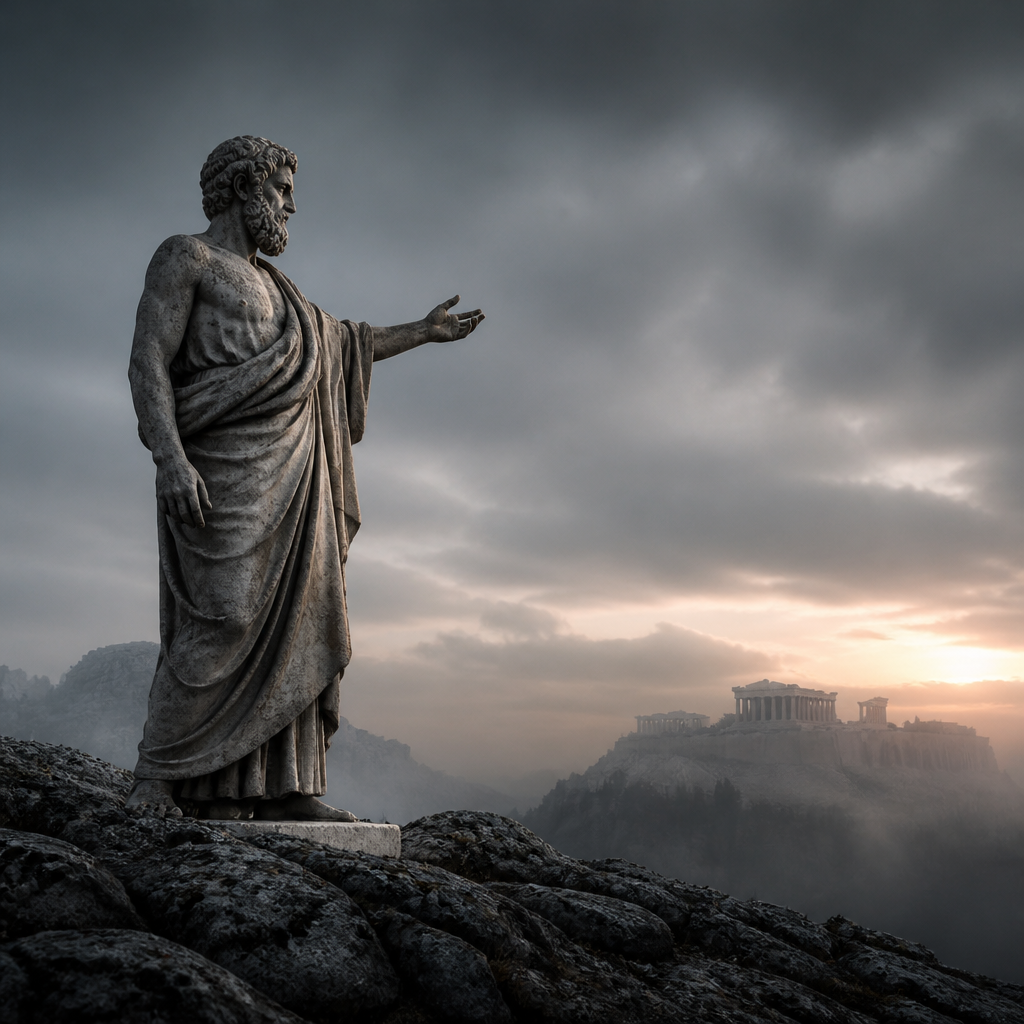
Aristotle’s Break From Plato’s Republic
This six-lecture audio course traces Aristotle's political thought from his origins in Stagira to his mature theory of the state in the Politics. The first lecture covers his birth in 384 BC, his father Nicomachus's role as court physician to Macedon, and his formative years at Plato's Academy, where early notebooks reveal the seeds of dissent from his teacher's idealism. The second lecture examines a bronze shield recovered from the Athenian Agora, showing how Aristotle used material culture to develop his argument about the balance between private property and public duty—a direct challenge to Plato's Republic. The third lecture confronts a core paradox: how a state can hold both equality and hierarchy without contradiction, illustrated through the Spartan krypteia and resolved through Aristotle's concepts of natural slavery, moderate democracy, and the mixed constitution. The fourth lecture stages a debate between Plato's abstract Form of Justice and Aristotle's virtue ethics, testing both against the historical record of the Helot revolts and their collective punishments. The fifth lecture follows a clay tablet naming a servant, Eudoxus, to show how the household (oikos) grounds Aristotle's claim that the polis exists to nurture collective virtue rather than individual ambition. The final lecture connects the Athenian ekklesia to modern neighborhood meetings, arguing that politics is not grand speeches but the routine practice of civic deliberation through which citizens achieve the good life. Together, the lectures show why Aristotle's practical, evidence-based approach to political theory still shapes how we think about constitutions, justice, and civic participation today.
The Young Aristotle: From Macedon to the Lyceum
The Young Aristotle: From Macedon to the Lyceum
Aristotle, people will tell you, was born a philosopher. He arrived in the world with the answers, plotted out the categories of everything, and simply wrote them down with that calm, systematic confidence we associate with his name. That's the common belief. And it's almost exactly backwards. Aristotle was born in 384 BCE in Stagira, a city in the Macedonian region of northeastern Greece, and his starting point wasn't abstract theory at all. It was medicine. His father, Nicomachus, served as a court physician to Amyntas the Third, the grandfather of Alexander the Great. Think of what that household meant: a boy watching his father diagnose patients by looking, touching, asking, observing. That's where the empirical instinct begins, Jashvendar, not in a seminar room but at a bedside where evidence decides.
So when Aristotle was about seventeen, he left the Macedonian periphery and traveled to Athens to study at Plato's Academy. That journey matters. The Academy was a leading place of learning in the Greek world, the intellectual capital of the age, and a seventeen-year-old Stagirite walking through its gates would have encountered something his homeland simply could not offer. Dialogues, structured debates, and above all, mathematical idealism, the conviction that truth lives in perfect, unchanging forms rather than in messy particulars. Stagira gave him the observation habit; the Academy gave him the argument habit. And Plato, who had himself studied with Socrates, became the most famous teacher Aristotle would ever have. What gets me is the duration of it. Aristotle remained associated with the Academy until Plato's death in 347 BCE, an association spanning roughly two decades. Twenty years sitting at the feet of a man whose ideas he would eventually, carefully, and quite brilliantly dismantle.
Because that's the tension, isn't it? Two decades studying under one master produces devotion, but it also produces, well, an unusually well-informed critic. Aristotle absorbed Plato's conviction that politics could be reasoned about from first principles. Then he began to push back. Plato's ideal city, the one sketched in the Republic, is built top down, designed like a geometric proof. Aristotle's instincts, remember, came from a physician's household. He wanted to start from what actually exists, from observed constitutions and living communities. The seed of his later critique of the ideal state was planted right there, inside the Academy itself, watered daily by the very teacher it would challenge. I, I find that quietly moving. The student who learned to ask "but is it so?" learned it from the man whose answers he came to doubt.
Now, Plato died in 347 BCE, and Aristotle left Athens for Assos, on the northwestern coast of Asia Minor. He stayed about three years, continuing philosophical work he had begun at the Academy. And during his time in Assos, he likely began expanding his investigations into marine biology. The philosopher of the ideal state, squatting at the tide line, cataloging sea creatures. Then, after the death of his host Hermias, he moved to the nearby island of Lesbos, and later spent roughly five years in Stagira or elsewhere in Macedon, where he eventually became tutor to the young Alexander of Macedon. So look at the arc, Jashvendar. Academy, coast, island, royal court. He kept collecting the raw material of the real world, and that material would reshape political theory.
In 335 BCE, Aristotle returned to Athens and established his own school. Not in a private academy building, in a public exercise area dedicated to Apollo Lykeios. That's where the name "Lyceum" comes from, and honestly, the setting is the argument. Plato's school was set apart; Aristotle's was out in the open, a gymnasium where anyone could linger and listen. The Lyceum's work ranged well beyond philosophy, embracing botany, biology, astronomy, medicine, political history, mathematics, music, government, and the arts. This was a school that studied everything, because reality itself was the syllabus. Aristotle would eventually die in 322 BCE at Chalcis, on the island of Euboea, but the Lyceum had already done its work. The physician's son from Stagira had built a place where the ideal and the observed finally met on equal terms. Which is exactly the conversation his political thought would carry forward.
The Bronze Shield: From Symbol to Theory
Speaker 1
So we're starting with an actual shield? Bronze, from the Agora, sitting in front of Aristotle?
Speaker 2
That's the image, yes. But I have to be careful with it, because it's an interpretive picture, not a documented artifact.
Speaker 1
Meaning there's no shield.
Speaker 2
Meaning no surviving text tells us Aristotle ever analyzed one. The shield is a, a way of talking about something real that we've lost.
Speaker 1
Lost how? What did we lose exactly?
Speaker 2
Aristotle wrote a dialogue called On Justice. It's gone. No complete text survives.
Speaker 1
Gone entirely? So how does anyone even know it existed?
Speaker 2
Ancient testimony. The biographer Diogenes Laërtius catalogued Aristotle's works, and he lists On Justice as a four‑book work.
Speaker 1
Four books on justice. And you're taking Diogenes's word for—
Speaker 2
Not just his. Cicero also refers to Aristotle's four substantial books on justice. Two independent ancient witnesses agreeing on the size.
Speaker 1
Okay, that's better sourcing than I expected. But hold on. People say "Aristotle's Republic." Is that this work?
Speaker 2
No, and that's the confusion worth untangling. Diogenes lists a separate item, Extracts from the Republic, in two books.
Speaker 1
Two books of excerpts, separate from the four‑book On Justice.
Speaker 2
Right. So the label sometimes applied to the work attributed to Aristotle shouldn't be taken as another name for the dialogue traditionally ascribed to Plato, and it isn't On Justice either. The catalogue keeps them distinct.
Speaker 1
And Plato's Republic, the one that survives—that's Socrates investigating justice.
Speaker 2
Through both the organization of a city and the organization of an individual soul. Which is probably what Aristotle's excerpts were digging into.
Speaker 1
So did the lost dialogue feed Cicero? His De re publica has an Aristotelian flavor, but there's no direct evidence his lost dialogues were Cicero's sources.
Speaker 2
Cicero's De re publica is a different work, and there is no direct evidence that Aristotle's lost dialogues served as sources for it. The shared title element, res publica, makes the two easy to conflate.
Speaker 1
So the conflation is baked into the Latin. But then what do we have of Aristotle on justice?
Speaker 2
The Nicomachean Ethics, Book V, survives intact. The Eudemian Ethics treats justice too, sharing themes though the texts aren't identical.
Speaker 1
Can we read those as a substitute for the lost dialogue? Reconstruct it from them?
Speaker 2
That's the tempting move, and it's the wrong one. The surviving works are essential evidence, but they can't stand in verbatim for On Justice.
Speaker 1
So we know he wrote on justice, and we have his later treatment. What's actually in that treatment?
Speaker 2
A distinction that still organizes the field. Justice in distribution versus justice in rectification.
Speaker 1
Give me something concrete, because those words blur.
Speaker 2
Think of dividing a prize. Distributive justice uses proportional equality, shares allocated by a relevant proportion, not identical amounts for everyone.
Speaker 1
And rectification?
Speaker 2
That's transaction justice. Someone's been shorted, and rectificatory justice restores an arithmetic equality between the parties. Balance the scale back.
Speaker 1
So one justice looks forward at worth, the other looks backward at the deal.
Speaker 2
That's a fair gloss. And he also uses justice broadly, for lawfulness, virtue in relation to other people, alongside those narrower particular forms.
Speaker 1
Wait, so justice isn't just courts and fair division there? It's, it's the whole virtue toward others?
Speaker 2
Exactly. Now, that connects to the Politics, where he asks who should hold authority in a city, and famously calls the human being a political animal.
Speaker 1
The line everyone quotes. But bring back the shield. Where does the bronze come from?
Speaker 2
From Plato, not Aristotle. The Republic's myth of metals assigns bronze and iron to the producers. The familiar bronze image belongs to that myth.
Speaker 1
So the shield we opened with—
Speaker 2
Stop. It's a modern teaching image. We have no evidence Aristotle's On Justice used a bronze shield as its own symbol.
Speaker 1
Part of me wants to hold onto the shield anyway. It's such a good picture.
Speaker 2
It's a good picture because it points somewhere true. Objects carrying communal meaning, a city's identity pressed into metal. That's the lost dialogue's neighborhood.
Speaker 1
Neighborhood, not address. I came in expecting a shield and leave with a catalogue entry.
Speaker 2
And that's the honest position. Four books on justice, two books of excerpts from the Republic, and a gap where the argument should be.
Speaker 1
So you'd say the shield stands and we just, we don't know what it stood on.
Speaker 2
I'd say it stands as a question. Whether Aristotle's justice work matched Book V of the Ethics or went somewhere else entirely, that stays open.
Speaker 1
I'm keeping the shield. You can keep the fragments.
Speaker 2
Deal. The fragments are enough to know the man was there.
The Paradox of Equality and Hierarchy
Aristotle believed all citizens are equal. Aristotle believed some citizens must rule the others. Both statements sit in his Politics, and he does not treat the pair as a contradiction. That's the polite version of this lecture, by the way, the tidy version. The impolite version is that his equality was conditional, built inside a hierarchy he defended on grounds most of us now find indefensible. So hold both claims in your head, because he did, and the resolution he offered still shapes how we argue about power today.
We begin where he begins, in his Politics. Picture a shouting match in an assembly. The democrats stand up and say we are free men, all of us, so we all deserve an equal share of rule. The oligarchs stand up and say we are wealthy, so our superior contribution deserves a greater share. His move is not to pick a side. It's to say both are making the same mistake from opposite directions. Each takes one difference, freedom or wealth, and treats it as if it settled every political question. He calls this a dispute about which differences matter. Equal in what respect? That question is the whole engine.
Now the machinery. Aristotle distinguishes two kinds of equality. Numerical equality gives everyone the same amount, full stop. Proportional equality gives shares according to a relevant ratio, so people judged equal in the relevant respect get equal shares, and people judged unequal get unequal ones. Think of it like splitting a prize, where the split tracks contribution rather than headcount. So a state can pursue equality and hierarchy at once without any contradiction, because the hierarchy is just proportional equality applied to whatever differences the community deems relevant. And the purpose matters too. The political community exists not merely to protect property or enable trade, but to enable living well, which shapes who he thinks deserves authority.
But then he does something that surprised me. In Book Three, he argues the many, when assembled, may judge better than a small number of individually excellent people, because each person contributes a share of virtue and practical wisdom. His analogy is a shared meal. Many contributors, each bringing a little, can collectively provide more than a few individuals, however fine, can manage alone. What gets me is how inclusive that sounds, given how limited his citizen body is. And yet he hedges. He considers this alongside arguments about competence and the common advantage, so it isn't a blank check for unchecked popular rule. He appears to wager that collective judgment beats elite judgment within a well-designed constitution, perhaps even at odds.
Now say the part the tidy version skips. His citizen body excluded resident foreigners, enslaved people, and others who lacked political participation. He defends natural slavery in Book One, arguing some people are naturally suited to be ruled, which is a historically influential claim and, to be plain, an ethically indefensible one. And on women, he concedes they possess a deliberative faculty, then characterizes it as lacking authority, a claim modern scholars find unsubstantiated. Acknowledged rational capacity that does not convert into equal standing. Citizenship itself, in his fullest sense, means participating in deliberative or judicial office, and political rule, where citizens take turns, is distinct from a master's rule over a slave. The equality was real, inside a fence.
So how does he build the fence into a constitution? He classifies regimes by how many rule and whether they rule for the common advantage or their own, with democracy meaning the poor majority and oligarchy the wealthy few. Then comes his most practical insight. A constitution ruled by a numerous middle class is the most attainable good arrangement for many cities, because a large middle class is less prone to faction than a city split sharply between very rich and very poor. And his preferred regime, polity, is a mixed constitution, blending democratic and oligarchic elements rather than handing unchecked power to either group. The paradox resolves not by choosing equality or hierarchy, but by mixing them so neither extreme can dominate.
After all this, what stays with me is how contemporary his fence still looks. He gave special weight to the middle as a source of stability, and he made political equality conditional rather than universal, with pronounced exclusions elsewhere. Equal in what respect, he asks, and the question does not close. Once you've heard it, you'll notice it in an ordinary day, in any committee, any vote, any argument about who deserves what. Someone claims a difference that matters, and everyone starts negotiating the respect. That negotiation is his republic, still running.
Justice Tested: The Trial of the Helots
Speaker 1
I keep messing this story up in my head, so help me. If I get the Spartan helots wrong, what actually breaks?
Speaker 2
Everything downstream. Get it wrong and you think a lawful city committed one atrocity. Get it right and you're facing a harder question, whether a whole legal system can be built on injustice.
Speaker 1
So give me the scene. Where does it start?
Speaker 2
Thucydides, book four, chapter eighty. Sparta is scared. Athens has just established a presence at Pylos during the Peloponnesian War.
Speaker 1
And fear of Athens translates into fear of the helots because...
Speaker 2
Because the helots might exploit the situation at Pylos to revolt. Thucydides is explicit about that link.
Speaker 1
Okay, so what do the Spartans actually do?
Speaker 2
They announce that helots distinguished in war can be selected for freedom. But it's a test. They fear the ones who most eagerly claim freedom are the most likely to rebel.
Speaker 1
So the bravest men volunteer themselves for a trap.
Speaker 2
Exactly. And about two thousand helots get selected. The account says they were chosen for the best service in war, not for any crime.
Speaker 1
No crime. That detail is doing a lot of work here.
Speaker 2
It is. The Spartans killed the selected helots not long afterward, and no one knew how each had died.
Speaker 1
No one knew how. That's chilling.
Speaker 2
And it's why the episode is often called mysterious. Thucydides gives no method, no location.
Speaker 1
Wait. Before the killing, there's something about temples?
Speaker 2
Yes. The selected helots crowned themselves and processed around the temples, apparently celebrating the freedom they expected to receive.
Speaker 1
Garlands, then disappearance. And Plutarch tells a version of this too?
Speaker 2
He does. In his account the helots selected for bravery wear wreaths and visit the temples before disappearing. It resembles Thucydides but isn't the same source.
Speaker 1
Hold on, though. Should I even believe the massacre happened?
Speaker 2
Good instinct, and no, you don't have to. Scholars have treated it both as a credible event and as a possible apocryphal story.
Speaker 1
Why would they doubt Thucydides?
Speaker 2
Partly practicality. Think of secretly killing and concealing the deaths of roughly two thousand people. One scholar argues that difficulty alone challenges the account.
Speaker 1
Two thousand bodies do not just vanish.
Speaker 2
Right. And there's the narrative proximity. Immediately after the killings, Thucydides says Sparta sent seven hundred helot hoplites with Brasidas on his expedition. That closeness has been used against the story's plausibility.
Speaker 1
So killing two thousand, then arming seven hundred of the same population? That is, that is genuinely odd.
Speaker 2
It's a tension in the text, yes. Some readings treat the whole episode as a story constructed around secrecy, suspicion, and fear, not a transparent report.
Speaker 1
Okay, so set the doubt aside for a second. Now bring in the philosophers. Plato.
Speaker 2
For Plato, justice is an abstract ideal, grounded in his philosophical ideas. The just city exists as a perfect pattern, and particulars approximate it.
Speaker 1
So if I applied Plato to the helot episode, what breaks?
Speaker 2
You would measure Sparta against a perfect ideal of justice it did not claim to instantiate. It tells you Sparta falls short, but it can't tell you much about the machinery of the shortfall.
Speaker 1
The philosopher's approach differs here—
Speaker 2
We'll come back to that point shortly. You've read the distinction between justice as lawfulness and justice toward others. Where does collective punishment land?
Speaker 1
Badly, I think. His justice is a virtue of the soul, a disposition in the person acting. Killing men selected for bravery isn't a virtuous disposition toward anyone.
Speaker 2
That's the answer I'd give. And notice what it reframes. If justice lives in the soul, the question of who can bear it opens up, master, citizen, or helot.
Speaker 1
Meaning the helot isn't just an object of policy but someone to whom justice is owed.
Speaker 2
Yes. And here's the strongest version of the other side. Sparta did nothing unlawful. Plutarch attributes to Aristotle a statement that the ephors formally declared war on the helots when taking office.
Speaker 1
Aristotle said that?
Speaker 2
Plutarch reports it as a later testimony. The point is the declaration legally sanctioned violence against the helots, so the machinery ran inside the law.
Speaker 1
So the legalist defense is, each step was legal. And it still fails?
Speaker 2
It fails on Aristotle's own terms. His standard is the common advantage and virtuous character, not formal compliance. A regime can be perfectly lawful and deeply unjust.
Speaker 1
That's the assumption I didn't know I was carrying, that law and justice coincide.
Speaker 2
The krypteia makes the same point. The Oxford Classical Dictionary notes it as another prominent example of targeted violence against helots, distinct from the massacre story. Institutional design, not a one-off crime.
Speaker 1
And Thucydides says Spartan institutions were shaped significantly by the need to guard against the helots.
Speaker 2
That's his characterization. So the consequences compound, a purely legalistic justice applied to the helots corrodes the whole constitution.
Speaker 1
So Sparta was lawful, and that's precisely the indictment.
Speaker 2
That's where I land. And now the garlands mean something different. Those men processed around the temples believing they were free, inside a system whose justice did not reach them.
Speaker 1
Yeah. The procession I started out finding beautiful is the cruelest detail in the story.
Speaker 2
It's the test case, isn't it. Two visions of justice, and one of them even asks the question the helots needed asked.
The Whisper of a Servant’s Name
A servant. That's where this segment starts. Not a king, not a constitution, a servant whose name we don't even know, passing through a shared courtyard day after day. Aristotle mentions servants almost in passing, and I nearly skipped past it. He says people can take offense at servants they encounter frequently in everyday life. Stop on that. The most influential critic of the ideal city pauses to complain about, about running into the same servant too often. Why would that detail sit at the center of a serious political argument? That's the question we're chasing, and the answer, it turns out, is an entire theory of what a city is.
Now, the reasonable reading, because a lot of smart people arrive here honestly. Plato's Republic proposes that the guardian class live communally, eating together, receiving necessities from other citizens rather than accumulating private wealth. The point is unity. Plato links the guardians' shared sense of mine and not mine to civic harmony, common joys and common sorrows meant to reduce division. So the reasonable conclusion goes like this: strife comes from private ownership and private family, so abolish both for the rulers, and you abolish the strife. And note the ban applies to the guardians, not straightforwardly to every inhabitant of the city. That's the argument on its best behavior. And Aristotle looks at it and says, no. You've diagnosed the wrong disease.
Because here's the mechanism, and it's not about property at all. Aristotle questions whether making the city maximally unified is even desirable. A city, he argues, is a plurality, different people in different roles. Make it too unified and it stops being a city, becoming more like a household, and eventually just an individual. Push unity far enough and you dissolve the very thing you were trying to perfect. Then the family. He argues communal wives and children don't produce the unity their proponents seek. If kinship becomes unknown, he warns, assaults, homicides, quarrels, and slanders lose the restraint kinship usually supplies. Injuries against close relatives are especially impious, so losing recognized kinship is morally costly, not liberating. And affection itself weakens. People tend to care more for what is distinctly their own, and shared arrangements blur the identification of parents and children. That, that surprised me. He's arguing abundance of connection dilutes it.
So the servant returns, and now he makes sense. Suppose you share everything, work, meals, the people who cook and clean. Aristotle compares communal living to travel partnerships, where ordinary friction over small matters produces quarrels. For example, when labor and benefits aren't shared equally, those who work more and receive less resent those who work less and receive more. The servant is the daily texture of that friction. Someone you can't avoid, whose small failures you catalog, whose face you're stuck with at dawn. Aristotle even asks, pointedly, how household work would be organized if women and property were both held in common. Nobody had an answer. The servant's anonymous name stands for everything the beautiful theory forgot to schedule.
Then Aristotle treats property separately from wives and children, and this is where his answer lands. His compromise is private ownership combined with common use. Private ownership encourages people to attend to their own responsibilities, while good laws and character can encourage them to share. He cites Sparta, where citizens made practical use of one another's slaves, horses, dogs, even provisions while traveling. Private hands, common benefits. And the correction to the wrong answer arrives plainly: some problems blamed on private property arise from human vice, not from ownership itself. Private property even permits a distinct pleasure, recognizing something as your own, while still allowing generosity. One honest complication, though. Scholars still debate whether Aristotle was justified asking whether Plato extended communal arrangements to the producer class, since the Republic specifies the guardians but stays vague about everyone else's daily lives. Aristotle thought stable families among producers prevent rebellion, not threaten it.
So the investigation closes, Jashvendar. The servant wasn't a footnote. He was the evidence that a city runs on ordinary, particular, unavoidable people, and any plan that dissolves the particular dissolves the city with it. A modern scholarly review breaks Aristotle's critique into objections to the aim of communal family life, its means, and its other disadvantages, which tells you how durable the argument proved. Now the choice. When weighing maximal unity against protected plurality, I side with him, and not because private life is comfortable. The strongest objection says common ownership would make everyone brothers, and brotherhood can't be bad. His answer is that brotherhood, spread too thin, becomes a word. Among friends there's a natural tendency to share possessions anyway, so common use doesn't require abolishing ownership. The city that protects what is mine is the one where sharing stays a gift.
The Daily Assembly: When Politics Becomes Routine
Speaker 1
So there I was at my building's association meeting, arguing about a leaking roof, and someone sighed and said, I don't do politics.
Speaker 2
And something about that bothered you.
Speaker 1
Because if a roof vote isn't politics, what is? But everyone means the same thing by it, elections, speeches, drama.
Speaker 2
That belief deserves its strongest version, so let's grant it fully. Politics is high-stakes statecraft, done by specialists. Ordinary people just live their lives and occasionally choose the specialists.
Speaker 1
Okay, and what's wrong with that?
Speaker 2
Recall from Lecture 3 that Aristotle defines a citizen (Politics III) as anyone who participates in deliberative or judicial office—not by residence or passport. Here we’ll see how that participation is organized in practice.
Speaker 1
Participation? So residence counts for nothing?
Speaker 2
For citizenship, no. He distinguishes citizens from resident foreigners and enslaved people, but the core criterion remains participation in civic duties.
Speaker 1
Wait, that flips the modern picture. I'm a citizen by just... existing somewhere.
Speaker 2
Right, and his definition makes a city a community of citizens, which means you can't define the city without asking who actually decides things.
Speaker 1
So how did deciding things actually work? Give me a concrete case.
Speaker 2
Athens. The Ecclesia, the assembly. It met about every ten days, roughly thirty-five times a year.
Speaker 1
Every ten days.
Speaker 2
Which turns participation into routine practice, not an occasional ceremony. Decisions usually went by simple majority after debate open to members.
Speaker 1
And anyone could stand up and propose anything?
Speaker 2
No. That's the joint where the romantic version comes apart. The agenda was set by the prytaneis, a committee of the Boule, and motions had to originate there.
Speaker 1
So the assembly debated and voted, but couldn't initiate new business itself.
Speaker 2
Exactly. And Aristotle doesn't treat every assembly as identical either. In Politics Four he lays out different ways to allocate deliberative authority, to all citizens, to some, or to different bodies for different matters.
Speaker 1
What kinds of decisions count as deliberative for him?
Speaker 2
War and peace, alliances, laws, elections of magistrates, audits of officials. He's describing the machinery, not just law‑passing. The whole constitution, the politeia, is an arrangement of offices, especially the sovereign one.
Speaker 1
Hold on. Audits of officials. That's the boring stuff, isn't it? Scrutiny, elections, review.
Speaker 2
That's the point. His assembly work is mostly what anyone would call administration. Politics as paperwork, done in public, by ordinary people.
Speaker 1
But why would he trust ordinary people with judgment at all?
Speaker 2
Politics III, chapter 11 notes that a multitude can collectively judge better than a few elites—a ‘feast’ where many contribute may surpass one organized by a single patron.
Speaker 1
So each person brings a share of virtue and practical wisdom.
Speaker 2
Yes. And his stranger image, the assembled multitude is like one human being with many feet, hands, and senses. Contributions combining into collective judgment.
Speaker 1
That's, that's a genuinely weird picture.
Speaker 2
But it's doing real work. It explains why a thousand mediocre judges can outperform a few excellent ones.
Speaker 1
You said earlier he hedges this, though. Where?
Speaker 2
Two hedges. The multitude must not be so corrupted it becomes despotic. And this does not mean every citizen should individually hold the highest offices.
Speaker 1
So what's his actual arrangement?
Speaker 2
A mixed one. The many elect officials and hold them accountable, while important offices go to qualified officeholders.
Speaker 1
Okay, but my roof meeting. How does arguing about contractors cultivate virtue in anyone?
Speaker 2
By practice. Deliberating forces you to hear other residents, weigh claims, accept a majority verdict you disliked. That repeated drill is how practical wisdom grows, on his account.
Speaker 1
Hmm. I want to push back. Most people at those meetings are just annoyed.
Speaker 2
Fair, and he'd grant the friction. But the annoyance is the practice. Citizenship was registered through local demes at eighteen, on citizen parentage, and then exercised in the assembly, council, and courts.
Speaker 1
Bodies like the Boule itself, not just the big assembly.
Speaker 2
Right, and those bodies, the council, the courts, were where citizens exercised direct participation daily.
Speaker 1
So if I had to wager, I'd bet even odds that a modern council meeting embodies his ideal.
Speaker 2
I'd take the other side of that bet. Modern councils mirror the structure, elected members, agenda control, public sessions. But they betray the defining criterion.
Speaker 1
Because residents attend but don't deliberate.
Speaker 2
Attendance isn't the standard. The standard is the right to share in judgment and office, and most modern arrangements delegate that away entirely.
Speaker 1
So the roof meeting is closer to him than the council is.
Speaker 2
Oddly, yes. Ordinary people arguing, deciding, living with the result.
Speaker 1
And that's his bigger claim, isn't it, that politics isn't a distraction from the good life?
Speaker 2
It's constitutive of it. The city exists to enable living well, not just to protect property or enable trade.
Speaker 1
So politics as necessary evil gets it backwards entirely.
Speaker 2
It inverts the whole picture. The routine, unglamorous deliberation is the point.
Speaker 1
What would actually move you on any of this? Evidence‑wise.
Speaker 2
Go find a local council or association where ordinary members genuinely hold agenda power, not just voice.
Speaker 1
And if I found one where they do?
Speaker 2
I'd happily pay off my half of the wager. Show me the minutes.
Speaker 1
Minutes. The most boring document in the world, suddenly carrying an entire theory of the good life.
Speaker 2
That's Aristotle for you. The philosophy was hiding in the paperwork all along.