
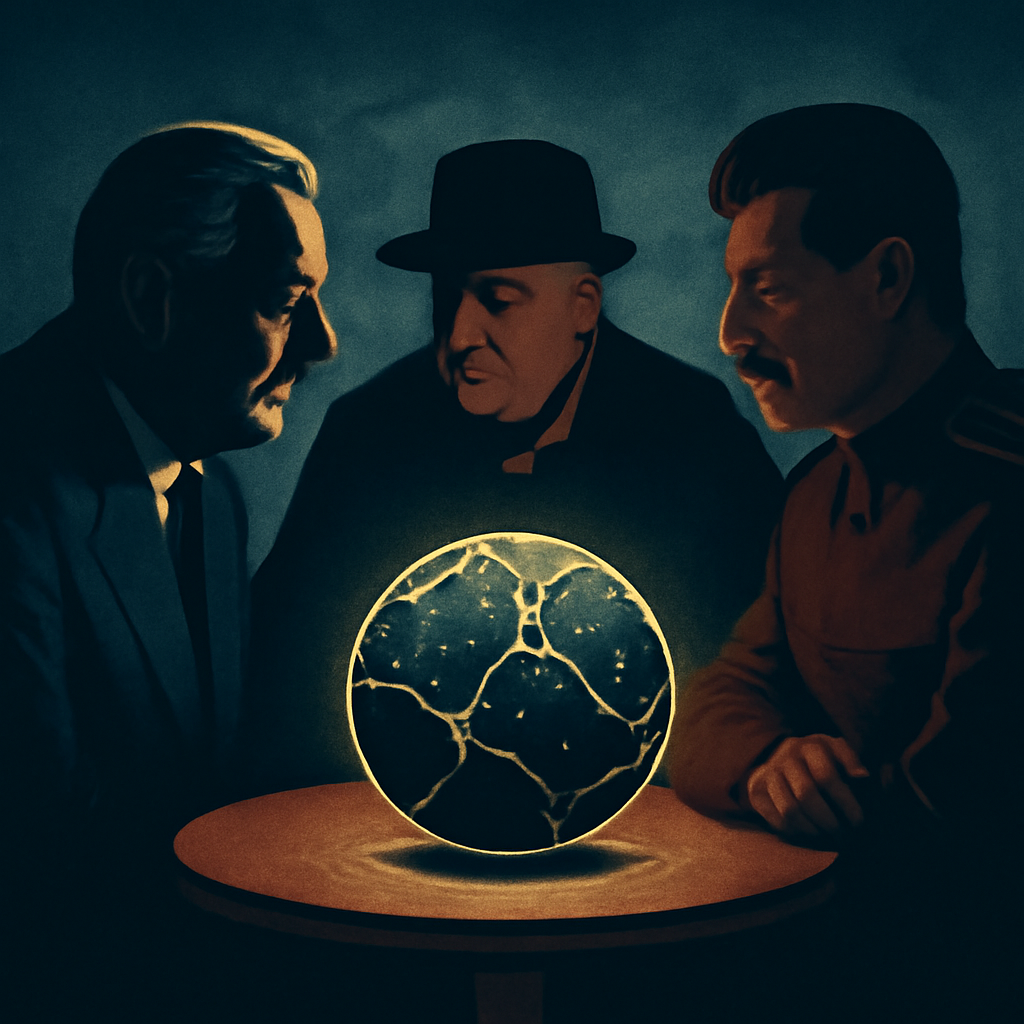
Allies of Necessity: The Roosevelt‑Churchill‑Stalin Partnership
Allies of Necessity: The Roosevelt-Churchill-Stalin Partnership is a six-lecture audio series that traces how three very different leaders were pushed together by war and how their alliance shaped the modern world. The course opens with each man's pre-war position: Roosevelt's Four Freedoms speech, Churchill's Finest Hour broadcast, and Stalin's Molotov-Ribbentrop Pact with Nazi Germany. It then moves to the Tehran Conference of 1943, where the three met face-to-face for the first time and argued over Operation Overlord, Stalin's demand for a second front, and Churchill's preferred Mediterranean campaign. From there, the series examines the Yalta Conference of 1945, where the trio bargained over Polish borders, the founding of the United Nations, and Soviet entry into the war against Japan. The final lectures cover the unraveling of the partnership. At Potsdam in 1945, with Truman replacing the late Roosevelt, disagreements over Germany's occupation zones, the Potsdam Declaration on Japan, and the first public reveal of the atomic bomb exposed the cracks in the alliance. The course then follows the rapid slide into the Cold War through the Truman Doctrine, the Marshall Plan, and the Berlin Airlift of 1948-49. A closing lecture draws out lasting lessons on realpolitik, coalition-building, and the balance of power, connecting the wartime summits to modern diplomacy, from NATO's formation to contemporary climate accords. Each lecture uses a different delivery style, including multi-voice re-enactments of the summit negotiations.
The Unlikely Trio: How Three Leaders Converged on the World Stage
The Unlikely Trio: How Three Leaders Converged on the World Stage
Picture three men in a room. One was born rich on the Hudson River. One was born in an English palace. One was born to poverty in a Georgian town, and his own birth date was so obscure that records later revealed it was wrong by nearly a year. Franklin Roosevelt, Winston Churchill, and Joseph Stalin. A democrat. An imperialist. A dictator. Yet between 1941 and 1945, they fought the same enemy, and together they reshaped the world. Sidd, this course is about how that happened. And I'll tell you now, the key idea of this first lecture is simple. This alliance was never friendship. It was necessity.
Let's start with who these men actually were. Because their backgrounds, honestly, could not have been more different. Roosevelt was born in Hyde Park, New York, in 1882. Aristocrat. Privileged. He became the 32nd U.S. president in 1933, after serving as New York governor, a role he won in 1928. Before that? In 1920 he ran for vice president on a losing ticket. Then, in 1921, polio struck him at age 39. Most men would have, would have stopped there. He came back. He came back. Churchill, born at Blenheim Palace in 1874, was elected to Parliament in 1900 as a Conservative, crossed to the Liberals, then returned to the Conservatives in 1924. A party wanderer. Nobody fully trusted him. And Stalin? Born Ioseb Dzhugashvili, in Gori, Georgia. He joined the Bolshevik movement, made the Central Committee in 1912, and became party general secretary in 1922. After Lenin's death in 1924, he consolidated power and ruled as a dictator for roughly a quarter-century. Remember that. A democracy, a parliamentary state, a one-party dictatorship. Three systems. One table, eventually.
Now here's where the story turns. By 1940, France had fallen and Britain stood under siege. Churchill, who had become prime minister in May 1940 after serving as First Lord of the Admiralty when war broke out in 1939, needed help. Desperately. Roosevelt wanted America out of the fighting but not out of the game. So he sent Britain aid short of direct military involvement. Think of it as arming a neighbor's house while your own door stays locked. Then, in 1941, Germany attacked the Soviet Union. And this is the twist, Sidd, the one nobody saw coming. Churchill, who had spent years condemning the Soviet system, immediately embraced Stalin as an ally. Not because he changed his mind about communism. He changed his mind about Hitler. Britain simply could not survive a Germany that swallowed the Soviet Union. Then came Pearl Harbor. December 7, 1941. The Japanese attack brought the United States into the war, and Roosevelt directed the full mobilization of the nation's resources. Suddenly, all three men were in. Same side. Same immediate goal, defeating Germany, even though their interests and systems were, were completely different.
But hold on. Before you think this was a smooth partnership, look at the cracks already forming. Roosevelt's America talked about freedom and self-determination. Stalin's Soviet Union was a dictatorship with vast territorial interests. Churchill's Britain was an empire, and empires and self-determination, well. You can see the problem. Roosevelt also had a bigger dream. He kept pushing for a new international organization, a body that could settle disputes after the war. That vision, the record shows, contributed to the founding of the United Nations. But each man was playing a different long game. The shared goal was defeating Germany. Everything after that was, was contested ground. That means the alliance was always running on a timer. Defeat Hitler, and what then? Nobody had agreed.
So what's the takeaway from where we've landed? Three men with nothing in common except a common enemy, converging from utterly different worlds onto one stage. A Hudson Valley aristocrat who beat polio and the Depression with the New Deal. A palace-born maverick who'd been written off and became prime minister in his country's darkest hour. A Georgian revolutionary who turned a marginal party post into absolute rule. For example, consider how strange Tehran would later look, when they finally did meet, in Iran, from November 28 to December 1, 1943, coordinating the invasion of northern France, Operation Overlord. We'll get there in the next lecture. Because the, the thing to hold onto is this. The alliance worked exactly as long as the enemy did. When Hitler's Germany fell, the glue dissolved, and the world these three built together began cracking apart. Next time, Tehran, where the partnership peaked, and where the seeds of the Cold War were quietly planted. You'll want to hear how it played out.
Desert Diplomacy: The Tehran Conference (1943)
Speaker 1
So last time we left off with three men who had nothing in common except Hitler. And now, suddenly, they're all in the same building.
Speaker 2
Right. Tehran, November 28 to December 1, 1943. The code name was Eureka. First time all three sat in one room.
Speaker 1
And here's the detail I can't get past. Roosevelt, the American president, stayed in the Soviet Embassy. Why would he do that?
Speaker 2
Stalin raised security concerns about travel through Tehran's streets. So Roosevelt moved in as a guest, a separate building inside the compound. The presidential record is clear on that.
Speaker 1
So the man who preached freedom against dictatorship was staying within the Soviet Embassy compound.
Speaker 2
And it gets better. On November 28, before the first joint meeting, Roosevelt and Stalin met privately. Just the two of them. In Roosevelt's quarters.
Speaker 1
Before Churchill?
Speaker 2
Before Churchill. And that's not an accident. That's a message.
Speaker 1
Okay, so what was actually on the table? Because I remember from last time, the big fight was the second front.
Speaker 2
That's the key idea of this whole conference. Stalin had been demanding a direct attack on Germany from the west for two years. His country was bleeding on the Eastern Front.
Speaker 1
And Churchill continued to focus on the southern European theater.
Speaker 2
He was looking toward southern Europe.
Operations in southern Europe, pressure in the region, and the possibility of Turkey entering the war. The leaders did consider it desirable for Turkey to join the Allied side before the end of 1943.
Speaker 1
So from Stalin's chair, what did that look?
Speaker 2
It seemed like a delay, perhaps hoping the two sides would weaken each other. Whether that was fair or not, that's how it landed.
Speaker 1
Which, honestly, given how little trust existed, makes sense.
Speaker 2
And here's the counterintuitive part. Roosevelt, the capitalist democrat, sided with the Soviet dictator on this one. He wanted Overlord, the cross‑Channel invasion, committed and dated.
Speaker 1
Wait, why would Roosevelt align with Stalin over Churchill?
Speaker 2
Because Roosevelt read the postwar map. He figured the Soviet Union would be the dominant power in Europe after Germany fell. It might have seemed wiser to deal with Stalin directly rather than through Britain.
Speaker 1
So the teasing of Churchill at Tehran, that was strategy too?
Speaker 2
Partly. Roosevelt needled Churchill in front of Stalin, and accounts from the conference show Churchill bristling. It was personal, but it was also positioning.
Speaker 1
Okay, so what actually got agreed? Give me the concrete commitments.
Speaker 2
The Western Allies committed to launching Operation Overlord, the invasion of northern France, by May 1944. That was the headline.
Speaker 1
And Stalin gave something back?
Speaker 2
He did. Soviet forces would launch a major offensive around the time of Overlord, to prevent German forces moving from the Eastern to the Western Front. Coordinated timing.
Speaker 1
So the two fronts would squeeze Germany simultaneously.
Speaker 2
Exactly. And the military conclusions paired Overlord with an operation against southern France, its scale depending on available landing craft. Plus support for the Yugoslav Partisans, supplies and commando operations.
Speaker 1
Now, what about Japan? Because America was fighting a two‑ocean war.
Speaker 2
Stalin agreed in principle that the Soviet Union would enter the war against Japan after Germany's defeat. Huge for the United States strategically.
Speaker 1
Though I'm guessing the fine print came later.
Speaker 2
That was typical. The precise terms of Soviet territorial gains weren't finalized at Tehran. Details came at Yalta in 1945.
Speaker 1
Same with Poland, right? Because I've read the borders were basically sketched at Tehran.
Speaker 2
Sketched is the right word. The Soviet‑Polish border would follow the Curzon Line, with Poland compensated by shifting its western border toward the Oder and Neisse rivers.
Speaker 1
But not formally settled there.
Speaker 2
No. The German‑Polish boundary wasn't ratified until Potsdam in 1945. Tehran drew the outline. And remember, Poland was a democracy‑in‑exile watching its borders get redrawn without a seat at the table.
Speaker 1
That seems like an early source of later tensions, doesn't it.
Speaker 2
One of them. They also agreed the European Advisory Commission should study Germany's dismemberment before any final decision. Occupation zones were on the table too.
Speaker 1
And Roosevelt's United Nations idea, did that come up?
Speaker 2
He discussed it with Stalin directly. His concept was the Four Policemen, the United States, Britain, the Soviet Union, and China keeping order after the war.
Speaker 1
Four Policemen. It reflects a particular vision of postwar order.
Speaker 2
It is. And then there's the December 1 declaration on Iran, their host. Independence, sovereignty, territorial integrity, plus thanks for Iran's wartime assistance and promises of economic help.
Speaker 1
Interesting, the Iranian government actually wanted that declaration, didn't they?
Speaker 2
A U.S. diplomatic account says Tehran itself requested it, addressing their contribution and needs. The declaration also stated the three nations would work together in the war and in the peace after.
Speaker 1
So for our listener, what's the takeaway from these four days?
Speaker 2
Tehran was the peak. The alliance worked because each man got something he needed. Overlord for Stalin, a dated promise. Japan for Roosevelt. A role for Churchill, even a diminished one.
Speaker 1
And Churchill's 69th birthday fell right in the middle of it, November 30.
Speaker 2
It did. There's a famous dinner. But the toasts couldn't hide the hierarchy forming. Roosevelt and Stalin had found each other.
Speaker 1
So the glue held at Tehran. Yet the map already showed emerging divisions, such as future border discussions and occupation zones.
Speaker 2
Which sets up the next gathering perfectly. Because the war would end, and the questions Tehran postponed, those would all come due in the Soviet capital.
Yalta: The Blueprint of Post‑War Europe
A map of Europe, drawn in pencil, with an eraser lying next to it. That eraser matters more than the pencil. In 1945, three leaders met at Livadia Palace in Crimea to reshape Europe’s postwar map. Franklin Roosevelt. Winston Churchill. Joseph Stalin. The place was Livadia Palace, about two miles southwest of Yalta, where the American delegation was housed. The dates were February 4 to 11, 1945. Eight days. And Sidd, here's the thing to hold onto from the start. Yalta didn't just end a war. It priced one.
Quick callback, because it matters. At Tehran, remember, the trio settled military questions. Overlord got its date. Stalin got his second front. Now, with Allied forces approaching victory in Europe, the agenda shifted from how to win, to who gets what once Germany falls. That's the pivot. Tehran coordinated armies. Yalta divided the spoils. And the man driving hardest for a deal was Roosevelt, who wanted one thing above all: Soviet participation in a future United Nations.
Now, the mechanism of the whole conference. Think of it as three currencies being exchanged at one table. Germany was addressed. Yalta affirmed that Germany would be occupied by Allied forces, in separate zones for the United States, the United Kingdom, and the Soviet Union. France got invited too, with a zone carved from the American and British areas, plus a seat on the control commission. A central control commission would run things from Berlin. Germany would be disarmed. Industries that could feed military production, eliminated or controlled. Major Nazi war criminals would face trial. And a commission in Moscow would work out the detailed reparations plan, with German assets, deliveries from current production, and even German labor on the table as possible forms.
Then Poland. The hardest currency of all. The leaders accepted the Curzon Line as the basis for Poland's eastern border, with adjustments discussed. In the west, Poland got territorial compensation from Germany, but here's the detail people miss. The final western frontier was not settled. The agreement described the compensation and left the boundary to be fixed later. On paper, Poland's provisional government would be reorganized on a broader basis, democratic leaders from inside Poland, Poles from abroad. The new Provisional Government of National Unity was pledged to hold free and unfettered elections, universal suffrage, secret ballot, as soon as possible. Sounds clean, right? It wasn't.
This is where the critics' strongest point is presented. People said Roosevelt gave away Eastern Europe at Yalta. And the promise on paper really did fail. The Declaration on Liberated Europe pledged joint Allied assistance to liberated countries and former Axis satellite states in addressing political and economic problems. That part is true, and it's the strongest thing the critics have said. It also doesn't survive contact with what actually happened. Within months, Soviet‑backed communist governments took power in several countries. The promised elections were not held as intended.
But the counter matters just as much. The Red Army was already sitting in Poland and much of Eastern Europe. Western troops were not. No document signed at Yalta could move an army that was already there. So what did Roosevelt actually buy? His United Nations. The compromise included a Security Council voting formula: substantive decisions required an affirmative vote of seven members, including the concurring votes of the permanent members. That's the veto, born right there in the bargaining. Stalin got his price for joining.
And the Japan deal. Stalin reaffirmed the commitment that the Soviet Union would enter the war against Japan two or three months after Germany's surrender. The price this time was written down. Southern Sakhalin and adjacent islands returned to the Soviet Union. The Kuril Islands transferred over. Outer Mongolia, Dairen, Port Arthur, the Chinese Eastern and South Manchurian railways, all addressed, with some provisions requiring the concurrence of Chiang Kai‑shek. China would retain full sovereignty in Manchuria even as Soviet interests in ports and railways were safeguarded.
The takeaway. Yalta was a receipt, not a gift. Many of the promises were paid for with assets already in place. The key idea is that the blueprint for post‑war Europe wasn't drawn by ideals. It was drawn by armies, then signed in a palace. Which leaves the question hanging over everything. Germany was about to fall. So who would actually enforce these signatures, once the common enemy was gone? The question the next gathering at Potsdam would have to answer.
Potsdam: The Last Summit and the Cracks Appear
Speaker 1
So last time we ended at the previous summit, with the map of Europe sketched in pencil and an eraser lying next to it. And I keep thinking, the war was ending, but the peace was just beginning.
Speaker 2
That's the perfect way into Potsdam. Because this conference, July 17 to August 2, 1945, is where the pencil meets the paper. Cecilienhof Palace, near Berlin.
Speaker 1
And here's the detail that gets me. They held it inside the sector of Germany that was under Soviet control. Why would the Western leaders do that?
Speaker 2
It was a statement. The war was fought on Soviet terms, on ground the Red Army took. Stalin was the host. And remember, the cast had changed.
Speaker 1
Right, because Roosevelt died on April 12, 1945. So Truman walks in, and Churchill, and Stalin.
Speaker 2
Exactly. Truman, Stalin, Churchill. Potsdam was an early summit between Truman and Stalin. It was one of the first times they had sat together.
Speaker 1
Wait.
Speaker 2
And it gets stranger. Mid-conference, the British election results came in. Labour won. Churchill left, and Attlee replaced him as prime minister on July 28.
Speaker 1
So the man who embodied the wartime order just... walked out of his own summit?
Speaker 2
He did. And that's the first crack. The personal chemistry that had held the earlier wartime conferences together was gone.
Speaker 1
So what was actually on the table? Give me the agenda.
Speaker 2
The administration of defeated Germany, reparations, Poland's borders and government, and the continuing war against Japan. That's the whole conference in one breath.
Speaker 1
Okay, Germany first. At Yalta they sketched zones. What did Potsdam confirm?
Speaker 2
Four zones. United States, Britain, France, and the Soviet Union. And an Allied Control Council to coordinate policy across all four.
Speaker 1
But no central German government?
Speaker 2
Correct. They did not agree to restore one. The occupation authorities would govern during the interim. Disarmament, demilitarization, eliminating the armed forces, stopping military hardware production.
Speaker 1
And the Nazi stuff?
Speaker 2
Nazi laws and institutions removed, democratic political activity encouraged, war criminals arrested and tried. On paper, a clean sweep.
Speaker 1
Now, the key idea I want to nail down. Reparations. Because I've read this was where the economy split before the politics did.
Speaker 2
That's the takeaway here. Each occupying power would take reparations primarily from its own zone. That compromise killed the earlier idea of treating Germany's economy as a whole.
Speaker 1
So if each power strips its own zone...
Speaker 2
Then Germany's economy partitions itself, zone by zone, before anyone draws a political border. The Soviet Union would get a share of industrial equipment from the western zones, the exact amount to be set by the Control Council.
Speaker 1
Not a fixed percentage?
Speaker 2
Not fixed. And the Soviet Union undertook to meet Poland's reparation claims from its own share. Stalin was carrying Poland's bill.
Speaker 1
Which brings us to Poland. The borders again?
Speaker 2
German territories east of the Oder and Western Neisse rivers went under Polish administration, pending a final peace settlement. Not a final treaty border. And Königsberg in East Prussia would transfer to the Soviet Union, subject to later formal determination.
Speaker 1
And the Germans living in Poland, Czechoslovakia, Hungary?
Speaker 2
The leaders agreed those populations would be transferred to Germany. The agreement said orderly and humane. The estimates of displaced run to around twelve million people.
Speaker 1
Twelve million. That's, that's hard to even picture.
Speaker 2
Think of it as one identifiable person. A grandmother in Danzig packing one suitcase, told her city isn't hers anymore. Now multiply that day twelve million times. That's the number.
Speaker 1
Okay. Now the bomb. Because this is the part everyone thinks they know. Trinity happened July 16, the day before the conference opened.
Speaker 2
The United States tested its first atomic bomb at Trinity on July 16. On July 24, Truman told Stalin that the United States possessed a powerful new weapon.
Speaker 1
And Stalin's reaction?
Speaker 2
Truman's account said Stalin showed little apparent interest. Almost a shrug.
Speaker 1
A shrug? To the atomic bomb?
Speaker 2
Witnesses suggest it was a carefully calibrated performance. It is unclear whether Stalin already knew through his intelligence networks; the record here shows just the surface. But the indifference was strategic, not naive.
Speaker 1
Now, the Potsdam Declaration on Japan. July 26. Who signed it?
Speaker 2
The United States, Britain, and China. Calling on Japan to surrender, warning of prompt and utter destruction.
Speaker 1
Not Stalin?
Speaker 2
Not Stalin. The Soviet Union wasn't yet at war with Japan. He had promised to enter two or three months after the German surrender. That clock was still running.
Speaker 1
And here's the twist people miss. The Declaration demanded unconditional surrender and did not mention atomic weapons.
Speaker 2
Correct. It did not explicitly mention atomic weapons. And it did not specifically demand the abolition of the emperor system. The Japanese leadership viewed those omissions as significant.
Speaker 1
So what did the conference actually produce, on paper?
Speaker 2
The Protocol of the Proceedings, dated August 1, and the leaders' final report issued August 2. Plus a Council of Foreign Ministers, the US, Britain, the Soviet Union, China, and France, to prepare peace settlements.
Speaker 1
And Poland's government? Did they settle that fight from Yalta?
Speaker 2
The Allies recognized the Provisional Government of National Unity and called for free elections. But disagreements over how representative that government actually was, those remained.
Speaker 1
I see a pattern.
Speaker 2
Each agreement at Potsdam has a crack built into it. Reparations from separate zones. Borders pending settlement. Elections promised but contested.
That's the honest read. I'll grant the strongest version of the other side: the Allies did achieve real things. Four-zone administration, a Control Council, a foreign ministers' council, war criminals facing trial. But the compromise on reparations, each power stripping its own zone while Germany was also supposed to retain an economy meeting approved peacetime needs, that left room for sharp disagreements over implementation.
Speaker 1
So the cracks weren't accidents. They were the price of getting any signature at all.
Speaker 2
Exactly. Potsdam didn't fail. It deferred. And deferral works when trust exists to pay the bill later.
Speaker 1
Which was running out. Because the common enemy was weeks from defeat.
Speaker 2
And that's the question hanging over everything. The Potsdam outcomes would echo through the Cold War decades. For our listener, the takeaway is this: divergent visions for Germany, a new weapon changing the math, and personal fatigue, together they turned allies into rivals.
Speaker 1
So the next question, the one that has to be answered, is what happens when the signatures can't be enforced. Who blinks first over Berlin?
Speaker 2
And that, Sidd, is exactly where the story goes next.
From Alliance to Antagonism: The Early Cold War (1946‑1949)
A telegram. Five thousand words long, tapped out from the American embassy in Moscow in February 1946, by a diplomat named George F. Kennan. He was sick, exhausted, working alone. And in that one document, he handed Washington a new way to see its former ally. Soviet policy, he argued, was shaped by insecurity. The right answer wasn't war. It was long-term containment. One telegram. A whole doctrine. Last time we examined the big questions, we saw how they were set aside. Now the bill comes due.
Recall the key takeaway? The alliance didn't fail, it deferred. Deferral works when trust exists to pay later. The trust was gone within months. On March 5, 1946, Churchill spoke at Westminster College in Fulton, Missouri. His speech was called the Sinews of Peace, but history remembers one phrase. An iron curtain had descended across Europe. And here's the detail people miss. Truman was there. He accompanied Churchill to Fulton and introduced him. The sitting president endorsed the message.
Now, the mechanism of the break. Think of it like a chain of falling dominoes. Britain went first. London told Washington it could no longer afford to aid Greece and Turkey. That announcement was the immediate catalyst. Truman went to Congress, asking for military and economic assistance. His framing became doctrine. Supporting threatened free peoples was now U.S. policy.
Then came the economic move, and this is the counterintuitive part. On June 5, 1947, Secretary of State George C. Marshall proposed a European recovery program in a speech at Harvard. It was framed as an offer to all of Europe, including the Soviet Union. Stalin's foreign minister, Vyacheslav Molotov, actually walked out of the Paris discussions and rejected the plan. Moscow then blocked the Eastern European states from joining. An aid program did what armies hadn't. It hardened the divide. Congress later authorized it, and $13.3 billion in U.S. funds ultimately flowed to Europe.
Stalin answered with organization. In September 1947 he created the Cominform, to promote ideological unity among communist parties. And, this is the surprising bit, it included the communist parties of France and Italy, not just Soviet‑bloc states. Yugoslavia was there too, until Tito and Stalin fell out and Yugoslavia was expelled. Then, a communist coup brought Czechoslovakia under communist rule. That one hit Western capitals hard, and it accelerated many plans for a military alliance.
But the confrontation that defined the period came over Berlin. In June 1948, the Western occupation authorities introduced a new currency in their German zones, deepening the division between the Western zones and the Soviet zone. Stalin answered on June 24. Soviet forces blockaded all land and water access to the Western sectors of Berlin. The U.S. and Britain chose air. For example, picture a plane landing several minutes apart, day and night, carrying coal, flour, milk. U.S. and British aircraft made 277,569 flights. America delivered over 1.7 million tons. The blockade failed. Stalin lifted it. The airlift ran until September 30.
The map then froze into place. The Federal Republic of Germany was established in the Western zones. The German Democratic Republic followed in October, in the Soviet zone. And on April 4, 1949, the North Atlantic Treaty was signed in Washington, establishing NATO with twelve founding members from Europe and North America, committed to collective defense. Then the final shock. On August 29, 1949, the Soviet Union tested its first nuclear bomb at Semipalatinsk. Truman announced it publicly on September 23.
So, Sidd, the takeaway. In under four years, the wartime partnership inverted completely. Containment replaced cooperation. Aid became a weapon. Berlin became a test of nerve. And the alliance of necessity, the one we've tracked since Tehran, had fully turned into rivalry. The glue dissolved exactly on schedule. Which leaves the question the next lecture has to sit with. If these three men built the postwar world together, then tore it apart, what, honestly, is their legacy worth?
Legacy of the Big Three: Lessons for Modern Diplomacy
Speaker 1
So last time we watched the alliance invert into rivalry in under four years. And I keep circling one question. What did these three actually leave behind?
Speaker 2
That's the right final question. And I want to answer it with an object. Imagine a gavel on a horseshoe‑shaped table. The UN Security Council chamber.
Speaker 1
The gavel. Okay, why the gavel?
Speaker 2
That chamber is the most enduring legacy of the wartime alliance. Five permanent members, each with a veto. The United States, Britain, the Soviet Union, China, France. That structure was agreed at Yalta.
Speaker 1
So the 1945 bargaining is still, still running the room today?
Speaker 2
Whenever a permanent member blocks a resolution, it echoes the decisions made at Yalta. The UN came into existence on October 24, 1945, after ratifications including all five permanent members. The veto was the price of their joining.
Speaker 1
But wait. The charter wasn't just three men in a palace, right?
Speaker 2
Correct, and that's the honest caveat. Representatives of 50 countries met in San Francisco in 1945. The Big Three shaped it, but many nations negotiated the charter. It was adopted June 25, signed the next day.
Speaker 1
So the legacy is institutional, not just personal.
Speaker 2
Both. And the personal part has a number attached. The documented Roosevelt‑Churchill correspondence alone runs to 1,949 messages. 1,161 from Churchill, 788 from Roosevelt.
Speaker 1
Nineteen hundred.
Speaker 2
And a Naval War College Review study counts 682 exchanged messages among all three leaders between June 1941 and Roosevelt's death. They talked constantly.
Speaker 1
Okay, but here's my pushback. If they talked that much, why did it all fall apart so fast?
Speaker 2
Because personal diplomacy can manage distrust, but it can't erase diverging interests. Their agreements depended on strategy and the military situation, not warmth.
Speaker 1
So the letters bought time, not trust.
Speaker 2
Exactly. And here's the counterintuitive part. The most successful wartime coalition in history produced the most dangerous peacetime rivalry within eighteen months of victory.
Speaker 1
Which sounds like failure. But is that fair?
Speaker 2
I'll grant the strongest version of the critics. Yalta's Declaration on Liberated Europe promised free elections, and implementation became contested. That failure is real. It also doesn't erase what the partnership built.
Speaker 1
Because without the coalition, there's no victory at all.
Speaker 2
And no UN, no Atlantic Charter lineage. The Atlantic Charter set out shared principles and envisaged collective security. On January 1, 1942, 26 states signed the Declaration by United Nations adopting those principles.
Speaker 1
So the institutions grew out of the, the wartime habit of meeting. Is that the real export? The summit itself?
Speaker 2
That's a big part of it. Leader‑to‑leader summits became standard practice. Even the ones that failed, like the Dumbarton Oaks talks of 1944 producing the General Assembly and Security Council proposals, taught the mechanics.
Speaker 1
Now, the key idea I want our listener to carry out of this whole course. Is there one lesson that survives?
Speaker 2
Coalitions of necessity survive shared threats, but they need shared visions to outlast victory. That's the pattern from Tehran to the blockade.
Speaker 1
And does that pattern still show up? For example, in anything recent?
Speaker 2
Think of modern coalition‑building, like when democracies coordinate sanctions or climate accords with states they otherwise distrust. They faced coordination problems reminiscent of the challenges the wartime leaders dealt with in their own summits.
Speaker 1
Shared threat, different visions. So the wartime lesson is a warning label.
Speaker 2
It's also a warning about vague agreements. The wartime conferences show leaders agreeing on broad principles while leaving enforcement and political outcomes unresolved. Later Western negotiators drew the verification lesson from that.
Speaker 1
Which is why a formal collective defense arrangement mattered so much. April 4, 1949. Collective defense answered what Potsdam left open.
Speaker 2
Right. Instead of trusting signatures, the treaty locked in mutual obligation. The failed Big Three trust got institutionalized into Article 5.
Speaker 1
Okay, one more thing. The reputations. Did history judge the three of them evenly?
Speaker 2
Not even close. Yalta became a political controversy in American politics for decades after 1945. Roosevelt's critics made the word itself an accusation.
Speaker 1
For decades?
Speaker 2
Yes. Even though the Red Army was already sitting in Eastern Europe, and no signature at Yalta could move it. The blame outlived the facts by a generation.
Speaker 1
The gavel, the treaty, and the summit habit everywhere. That's the inheritance.
Speaker 2
Cooperation and its limits, both. The Big Three built the postwar order and proved how far shared interests can stretch, and where they snap.
Speaker 1
And for Sidd, listening to all six of these, the practical takeaway?
Speaker 2
When evaluating any international partnership today, ask two questions. What threat holds it together, and what vision would keep it together after the threat is gone.
Speaker 1
The threat question everyone asks. The vision question, almost nobody does.
Speaker 2
And that second question is one the Big Three did not answer. That's the legacy, and the warning.