
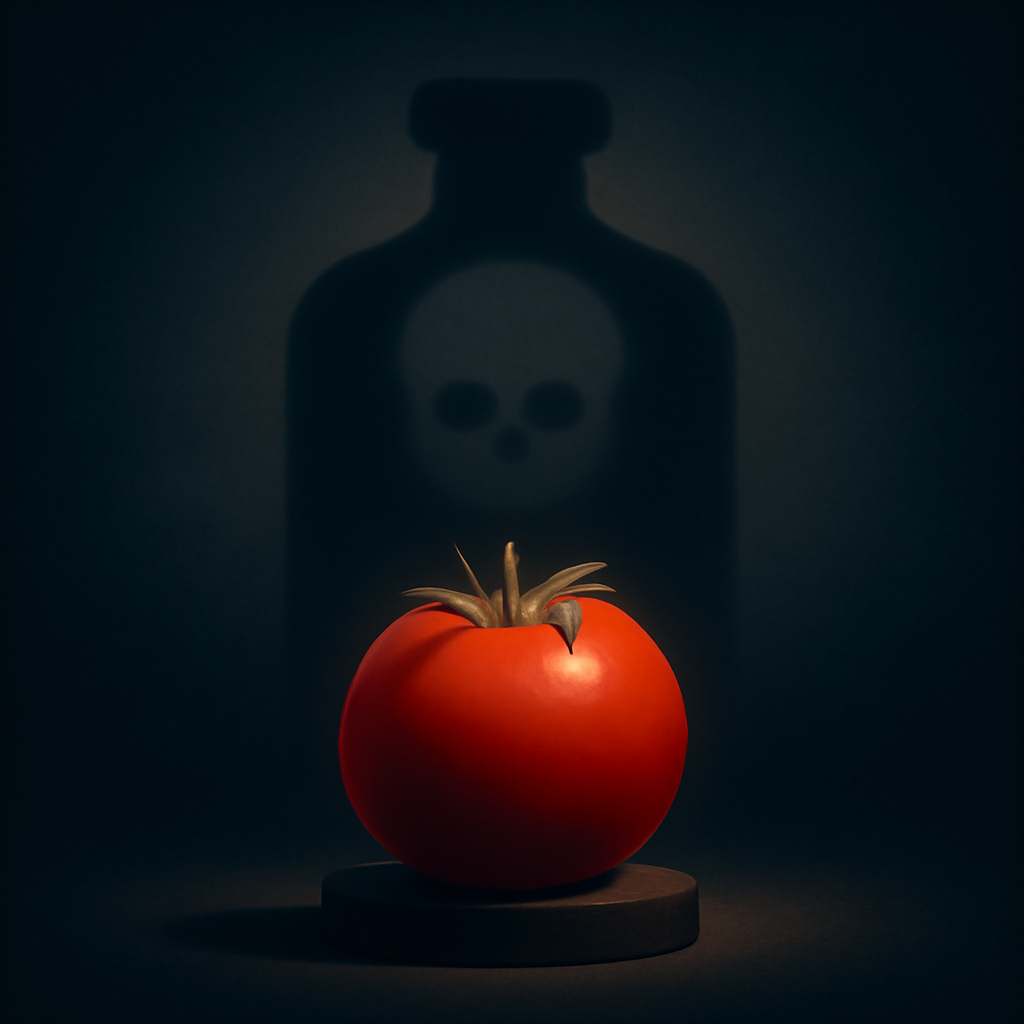
The Juicy Origins: Tales of Tomatoes & Avocados
The Juicy Origins: Tales of Tomatoes & Avocados is a three-episode audio series tracing how two of today's most popular foods overcame fear, misinformation, and market manipulation to become kitchen staples. The first episode covers the 19th-century tomato panic, when an 1820 London newspaper headline warned that eating a tomato would kill you. The series explains how superstition, class bias, and confusion about the fruit's acidity on pewter plates fueled decades of fear, and how Dr. John H. B. Smith's 1845 chemical analyses proved tomatoes contained no toxins. The episode closes with the 1893 Chicago World's Columbian Exposition, where the first commercial ketchup factory helped turn the tomato into an everyday food. The second episode shifts to the avocado's crisis in 1920s California, where a mysterious wilt in 1924 orchards became the basis for a poison scare amplified by the Pacific Fruit Corp consortium. Listeners learn how plant pathologist Dr. Eleanor V. Hart's 1926 study identified Phytophthora cinnamomi as the true cause, and how the Avocado Growers Association's 1929 public tasting event restored consumer confidence. The final episode examines the modern avocado boom: the Instagram-driven avocado toast trend, Mexico's Michoacán region producing over 45% of global supply, and the environmental, labor, and market consequences that followed, including the 2018 Avocado War. The series closes with a practical rule for aligning food trends with transparent sustainability metrics.
The Red Scandal: How the Tomato Survived the ‘Poisoned Fruit’ Panic
The Red Scandal: How the Tomato Survived the ‘Poisoned Fruit’ Panic
Speaker 1
—because that is not what the sources say, and you know it. The tomato was never some forbidden fruit nobody touched.
Speaker 2
And we're off. No, look, you're right. The popular version is a man bites a tomato on courthouse steps, crowd screams, history changes.
Speaker 1
Exactly, and that story is, the story is basically a legend. But the fear itself was real. That's the part I want to unpack.
Speaker 2
Then let's start there. The tomato came out of the Americas. Spanish and Portuguese colonists carried it to Europe in the sixteenth century.
Speaker 1
So it's an import. A stranger showing up in a continent that already had opinions about plants.
Speaker 2
And that's the key idea. Europeans already had a category for plants like this. Nightshades. That family includes genuinely poisonous species.
Speaker 1
So the tomato walks in looking like a cousin of belladonna.
Speaker 2
Right, and that resemblance is one proposed explanation for the suspicion. It also, botanically, actually belongs to that family. So the fear wasn't random.
Speaker 1
Wait, so it's not pure superstition? The family link is real?
Speaker 2
The family link is real. The deadly conclusion is false. That's a, that's a nice distinction for our listener. Guilt by association, plant edition.
Speaker 1
Okay, so who wrote this down? Somebody had to put the tomato in the poison column in print.
Speaker 2
One of the earliest European references is a 1544 herbal by the Italian herbalist Pietro Andrea Mattioli. And he doesn't just say nightshade.
Speaker 1
He says—
Speaker 2
Mandrake. He groups the tomato with mandrake, a plant tied in contemporary lore to aphrodisiac effects.
Speaker 1
So it's poisonous AND scandalous. That's, that's a brutal first impression for a fruit.
Speaker 2
And Mattioli described it as green at first, golden when ripe. Which is where the old name comes from. Golden apple.
Speaker 1
Pomo d'oro. Which, funnily enough, is hiding inside the word tomato itself.
Speaker 2
Mm. Now the English entry in this story is John Gerard, 1597. His herbal calls tomatoes corrupt and of rank and stinking savor.
Speaker 1
Rank and stinking savor. That's a food review that ends a career.
Speaker 2
And it stuck. By the eighteenth century many Europeans feared eating tomatoes. They were sometimes called poison apples.
Speaker 1
Okay, but here's where I push back. People repeat the pewter plate story. Acidic tomato, pewter plate, lead leaches out, aristocrats get sick, tomato gets blamed.
Speaker 2
That's the popular explanation, yes. Lead leached from pewter tableware by the acidic fruit.
Speaker 1
And is it true?
Speaker 2
Here's the honest answer. It's disputed. McGill science communicator Joe Schwarcz has said that explanation is not plausible.
Speaker 1
So we shouldn't teach it as the cause.
Speaker 2
No. It should be presented as a proposed explanation, not an established cause of tomato-related deaths. Smithsonian's own account makes that point.
Speaker 1
Yeah. So the poison apple label may really reflect confusion with poisonous nightshade relatives, rather than a documented pattern of people dying.
Speaker 2
Exactly. Which is almost scarier. A reputation built on resemblance and rumor, not bodies.
Speaker 1
Now, the courthouse story. Robert Gibbon Johnson, Salem, 1820. He eats a tomato in public, everyone expects him to die, he doesn't, tomato wins.
Speaker 2
The classic. And food historian Andrew F. Smith went looking for it. His investigation found no primary-source evidence for the supposed incident.
Speaker 1
None? Like, not a single—
Speaker 2
Not for that 1820 event as described. And the accounts people tell differ in their details. That's usually the tell.
Speaker 1
Huh. So why does the story survive? It's not like people invented it for fun.
Speaker 2
Because the structure is irresistible. A feared food, a public test, a conversion. It's a, it's basically a myth shaped like a story.
Speaker 1
So the legend is doing the work the real history did slowly.
Speaker 2
Right. And the real history is messier. In the United States, the broad claim that tomatoes were considered poisonous can obscure differences in time and place.
Speaker 1
Meaning some regions feared it while others were already eating it.
Speaker 2
Yes. Acceptance wasn't one switch that flipped at a courthouse. It spread unevenly, over decades.
Speaker 1
Okay, so let me do the listener-translation move here. Think of someone today avoiding a food because of one viral story they half-remember.
Speaker 2
That's exactly the parallel. The tomato's case is the old version of that. No verified event, just a durable origin myth.
Speaker 1
And the tomato survived it anyway. That's the part that gets me. How does a fruit outlive a two-century reputation?
Speaker 2
Slowly, then commercially. Remember, the fear faded as people simply ate the fruit, region by region, and kept not dying.
Speaker 1
So the evidence was, what, just... dinner?
Speaker 2
Basically. Ordinary plates doing what the courthouse legend only claims to have done.
Speaker 1
The most boring possible rebuttal. No drama, just survival.
Speaker 2
And that's the takeaway for our listener. Public perception can turn a nutritious food into a feared poison. But evidence, ordinary repeated evidence, can reverse the narrative.
Speaker 1
So the tomato's redemption wasn't a single heroic moment. It was thousands of unremarkable meals.
Speaker 2
Yes. And the myth got the credit. Which is, honestly, the most human part of this whole story.
Speaker 1
Okay, but that raises the next question. If fear and folklore can do this to a tomato...
Speaker 2
...what happens when the threat to a crop is real? Because next time, it's the avocado. Corporate intrigue, a mysterious blight, a market crash.
Speaker 1
A buttery green fruit staring down the twentieth century. I'll bring the guacamole.
Speaker 2
Deal. Until then, everyone, keep questioning what your food has been accused of.
The Green Gambit: Avocado's Fight Against the 'Mysterious Blight' Scandal
Speaker 1
Okay, so last time we left the tomato redeemed, and I promised guacamole. I've been thinking about that handoff all week.
Speaker 2
And here we are. The tomato's lesson was that a reputation built on rumor can be undone by ordinary evidence. Now the avocado gets its crisis.
Speaker 1
Right, and I want to start with something physical. Picture a grower walking his grove in Southern California, maybe 1914, and finding fruit with these odd sunken patches.
Speaker 2
That's sunblotch. Observed in Southern California as early as 1914, though nobody understood what caused it at the time.
Speaker 1
So the scars came, and the explanation came... later?
Speaker 2
Late. An early official U.S. report didn't appear until 1928, and even then the disorder was blamed on sun exposure or a genetic problem.
Speaker 1
Sun exposure. Because it looked like sunburn.
Speaker 2
Exactly. The name stuck because the symptoms looked like sunburn, and here's the kicker, the name stuck even after experiments showed the disease was infectious.
Speaker 1
Wait. They proved it was infectious and still called it sunblotch?
Speaker 2
Names outlive the science. In 1931, W. T. Horne and E. R. Parker demonstrated the infectious nature and showed it could be transmitted by grafting.
Speaker 1
Grafting. So the very tool growers used to propagate their orchards was also the delivery system for the disease.
Speaker 2
That's the trap. In orchards, the most important route of spread is often propagation with infected material, especially budwood or rootstock used in grafting.
Speaker 1
Okay, hold on. Before we go further, what was the infectious agent? Because I remember hearing virus.
Speaker 2
Early researchers did call it a virus. But they failed to find virus particles in affected tissue, and that failure was a clue the assumed explanation was wrong.
Speaker 1
So the wrong label persisted for decades. When did it finally get corrected?
Speaker 2
In 1979, researchers characterized a viroid associated with sunblotch. That shifted the explanation from a conventional virus to a much smaller infectious RNA.
Speaker 1
A viroid. And that was confirmed how?
Speaker 2
In 1980. The purified avocado sunblotch viroid, ASBVd, was confirmed as the cause when inoculated healthy avocado seedlings developed disease symptoms.
Speaker 1
Hold on. A seedling, deliberately inoculated, gets sick. That's the proof.
Speaker 2
That's the classic demonstration. And what makes ASBVd strange is its size. It's a circular, single-stranded RNA molecule of about 247 nucleotides, with no protein-coding capacity.
Speaker 1
Two hundred forty‑seven nucleotides. Help me feel that number, because nucleotides mean nothing to most people listening.
Speaker 2
Think of it this way. It's roughly 247 RNA building blocks, and that tiny loop carries all the information needed for replication and disease. No protein, no shell, just RNA.
Speaker 1
So small, yet it carries everything it needs to replicate and cause disease.
Speaker 2
Right. And it's so distinctive that ASBVd is the type species of the viroid family Avsunviroidae, literally named for this pathogen.
Speaker 1
The avocado got a whole viroid family named after it. That's a dubious honor.
Speaker 2
It did. And it behaves oddly too. Unlike viroids that replicate in a cell nucleus, ASBVd replicates and accumulates in avocado chloroplasts.
Speaker 1
In the chloroplasts. The photosynthesis factories. So it sets up shop in the plant's kitchen.
Speaker 2
And its RNA contains hammerhead ribozymes that enable self‑cleavage during replication. The RNA can do that catalytic work without encoding a protein.
Speaker 1
It cuts itself. The molecule is the machinery.
Speaker 2
Exactly. Now, back to the grove. What does the grower actually see? Typical fruit symptoms are irregular sunken areas or scars that may appear white, yellow, red, or necrotic.
Speaker 1
And on the tree itself, not just the fruit?
Speaker 2
Infected trees may show streaks on green twigs, leaf discoloration or distortion, stunting, and a spreading or drooping growth habit. And symptoms vary among trees.
Speaker 1
Vary. So two infected trees side by side could look completely different.
Speaker 2
They could. And here's the part that makes this genuinely hard to manage. Some infected trees show no visible symptoms at all, so visual inspection alone is unreliable for finding infected trees.
Speaker 1
Symptomless carriers. The healthy‑looking tree is the dangerous one.
Speaker 2
That's the key idea. Symptomless carrier trees matter because they can still transmit ASBVd, and they may also have reduced yields.
Speaker 1
So a grower could be losing fruit and might not see a single scar. How else does it move through a grove?
Speaker 2
Natural root‑to‑root grafts can transmit the viroid between neighboring avocado trees. Roots touching underground, and the disease crosses.
Speaker 1
Underground. And what about seed? If a tree is infected, is the next generation infected?
Speaker 2
ASBVd can pass from an infected tree through seed. Pollen can also infect the seed, but here's the twist, pollen transmission does not infect the pollen‑receiving mother tree.
Speaker 1
So the pollen carries it into the seed, but the tree that received the pollen stays clean?
Speaker 2
Yes. The infected seed, not the receiving tree, is the consequential carrier in that route. The mother tree escapes; her offspring doesn't.
Speaker 1
That's, that's a strange inheritance. What about the grower's own hands? Tools, pruning shears?
Speaker 2
ASBVd can be transmitted mechanically when contaminated tools create wounds. So pruning and harvest equipment can be a risk in infected groves.
Speaker 1
So grafting, roots, seed, pollen, tools. Coming in from many directions. Can an infected tree be saved?
Speaker 2
No cure is available for infected trees. Control relies on preventing spread: clean propagation material, diagnosis, and removal or management of infected trees.
Speaker 1
Prevention is the main strategy. That's brutal for a grower who's invested years in an orchard.
Speaker 2
It is. And the seed transmission numbers are sobering. Studies report rates that can be high, up to seventy or eighty percent.
Speaker 1
Seventy to eighty. But you said something about symptomless carriers there, that they transmit at higher rates?
Speaker 2
That's the nuance. The studies do not consistently show symptomless carriers transmitting at higher rates than symptomatic trees. The relationship varies with cultivar and environmental conditions.
Speaker 1
So the intuitive story, the invisible tree being the worst spreader, isn't actually settled.
Speaker 2
Not settled. Which matters, because growers making removal decisions need to know what the evidence actually supports.
Speaker 1
Okay, one more wrinkle. Is this limited to avocado, or does it jump species?
Speaker 2
In addition to avocado, experimental transmission has been reported in a small number of other laurel‑family plants, including camphor and the related avocado species *Persea schiedeana*.
Speaker 1
So it stays mostly in the laurel family. Now, let me pull back to the big picture, because I keep seeing the parallel with the tomato.
Speaker 2
Say it.
Speaker 1
The tomato got a reputation from a name and a resemblance. The avocado's disease got a name, sunblotch, from a resemblance to sunburn. Both names outlived the evidence.
Speaker 2
Same wooden board, different valley. The tomato's poison apple label and the avocado's sunblotch label both did work the facts were not authorized by.
Speaker 1
And the practical lesson for anyone listening?
Speaker 2
The takeaway is that a misleading name can steer management for decades. Growers spent years treating sun exposure or genetics while an infectious agent moved through their budwood.
Speaker 1
So the fix was diagnosis, not blame. Test the material, not the sunshine.
Speaker 2
Right. And next time, the avocado's story turns from disease to boom, the explosive global rise and the new risks of over‑production.
Speaker 1
From blight to glut. I'll bring the toast this time.
Speaker 2
Deal. Until then, everyone, keep asking what your food's name is hiding.
The Gold Rush: How the Avocado Became the World's Most Valuable Green Commodity
Speaker 1
Okay, so last time we left the avocado rescued from sunblotch, and I promised toast. I've been thinking about that handoff all week.
Speaker 2
And here we are. The sunblotch lesson was that a misleading name can steer management for decades. Now the avocado gets its boom.
Speaker 1
Right, and I want to start with something physical. Picture a seedling avocado tree arriving in Santa Barbara in 1871, carried up from Mexico by Judge R. B. Ord.
Speaker 2
This is documented as an origin point for the state's avocado industry, per UC Agriculture and Natural Resources. One tree, one judge, one port town.
Speaker 1
So the object in hand is a single seedling. And from that, what, an orchard?
Speaker 2
Eventually. An early commercial orchard of budded trees went in around 1908, planted by William Hertrich for Henry E. Huntington on the San Marino estate.
Speaker 1
Huntington, the railroad man, growing avocados. That's a real flex.
Speaker 2
It was a rich man's curiosity crop. The seedling that matters most came later, at the farm in La Habra where the Hass cultivar was selected in the 1920s.
Speaker 1
The Hass. The one in many kitchens now. So Hass finds this seedling, patents it in 1935, works with grower Harold H. Brokaw to promote it.
Speaker 2
That's the Smithsonian account, yes. And here's the part most people miss. Hass didn't conquer overnight.
Speaker 1
How slow are we talking?
Speaker 2
By 1957, Hass was just fifteen percent of California's crop. It didn't pass Fuerte in marketed volume until 1972.
Speaker 1
Fifteen percent in the fifties. So the world's most famous avocado spent decades as an underdog.
Speaker 2
Then it took over. By 1990, Hass was eighty-three percent of California production, and Fuerte was down to two percent.
Speaker 1
From underdog to near‑total dominance in eighteen years. What flipped it?
Speaker 2
Trade policy. From 1993 to 2007, a U.S.–Mexico phytosanitary workplan progressively opened more of the United States to Hass avocados from designated municipalities in Michoacán, until imports were allowed nationwide.
Speaker 1
So the fruit didn't just win on taste. It won on a paperwork agreement about pest risk.
Speaker 2
Right. And the supply shift was dramatic. Imports supplied about ninety percent of U.S. avocado availability by the last decade covered in a 2024 University of Florida overview.
Speaker 1
Ninety percent imported. And in 2023, USDA reported a record 2.78 billion pounds of fresh avocado imports, with Mexico supplying eighty‑nine percent of the volume.
Speaker 2
2.78 billion pounds in one year. That's the scale‑anchor for our listener. A billion pounds is an enormous amount; imagine nearly three times that.
Speaker 1
Billion with a B.
Speaker 2
Billion with a B. And nearly all of it Hass or Hass‑like varieties, more than ninety percent of those imports originating in Mexico.
Speaker 1
So one cultivar, one country. That's, that's a monoculture story with a passport.
Speaker 2
It is. And the Hass itself is a Mexican–Guatemalan hybrid, not a pure example of either type. One seedling's genetics, replicated across two continents.
Speaker 1
Which raises the question I keep circling. How did we get here? How does a fruit go from a rich man's estate to billions of pounds?
Speaker 2
Slowly, then suddenly. And the deep history is longer than anyone expects. Archaeological evidence from Tehuacán, Mexico, indicates people were consuming avocados by roughly 8,000 to 7,000 BCE.
Speaker 1
Eight thousand BCE. Before, before most of the crops we think of as ancient.
Speaker 2
And a 2025 study of remains from El Gigante rockshelter in western Honduras pushed it further, tracing avocado use and management across roughly 11,000 years.
Speaker 1
Eleven thousand years of management. So the boom isn't new appetite. It's old appetite with new logistics.
Speaker 2
That's the frame. The El Gigante researchers found people managing wild avocado trees as early as about 11,000 years ago, and selecting for larger, more robust fruit by about 7,500 years ago.
Speaker 1
Selecting. So ancient people were already doing what Hass did, just slower.
Speaker 2
Same wooden board, different valley. The researchers concluded avocado cultivation at El Gigante even preceded maize's arrival in that region.
Speaker 1
Avocados before corn. That, that rewrites the whole picture of Mesoamerican agriculture in my head.
Speaker 2
And the ancient selection of larger fruit and thicker rinds made avocados more productive and easier to transport, per the researchers. That's early supply‑chain thinking.
Speaker 1
Thicker rinds as transport tech. Okay, so how did it reach the plate? Because guacamole has its own lineage.
Speaker 2
The Nahuatl word ahuacamolli, meaning avocado sauce, is the source of the Spanish‑derived word guacamole. By the Spanish conquest in the sixteenth century, it was an established part of Aztec cuisine.
Speaker 1
So when the fruit entered English usage in the eighteenth and nineteenth centuries, it also carried the nickname alligator pear.
Speaker 2
It did. And pre‑conquest, avocados were cultivated across tropical America, but historical accounts describe individual seedling trees rather than a uniform modern orchard crop.
Speaker 1
Individual trees, not orchards. So the industrial scale we just described, the billions of pounds, that's genuinely new.
Speaker 2
New, and concentrated. The avocado tree, Persea americana, is native to the Western Hemisphere, from Mexico south toward the Andes, with domestication closely associated with Mesoamerica.
Speaker 1
So one region's ancient crop became a global commodity. And the El Gigante study described domestication as a prolonged process over thousands of years, not a single instant.
Speaker 2
Which is the honest read. The researchers analyzed desiccated and carbonized avocado remains, using seed and rind measurements to track long‑term management and selection.
Speaker 1
Seed and rind measurements. They literally measured the fruit to read the history.
Speaker 2
Botanical accounting. And here's a fun one for the road. Avocado is botanically a type of berry.
Speaker 1
A berry. The world's most expensive berry.
Speaker 2
So let's pull the threads together, because the pattern across all three episodes is the same. The tomato got a reputation from a name. Sunblotch got a name from a resemblance. And the Hass got its empire from patience and paperwork.
Speaker 1
And the takeaway for our listener?
Speaker 2
Rapid consumer trends can turn a niche fruit into a global commodity, but unchecked demand creates supply chain, environmental, and equity pitfalls. The Hass went from fifteen percent of one state's crop to billions of pounds of imports.
Speaker 1
So the rule is, popularity needs the same scrutiny the panic got.
Speaker 2
Exactly. A meaningful drop below eighty‑nine percent in Mexico's import share, combined with diversification of the Hass share, would be a reason to relax. Until then, one seedling's descendants are carrying the whole boom.
Speaker 1
One seedling, eleven thousand years of selection, and a 1935 patent. That's the whole story in three objects.
Speaker 2
And the toast is earned this time. Until next time, everyone, keep asking where your food's popularity came from.