
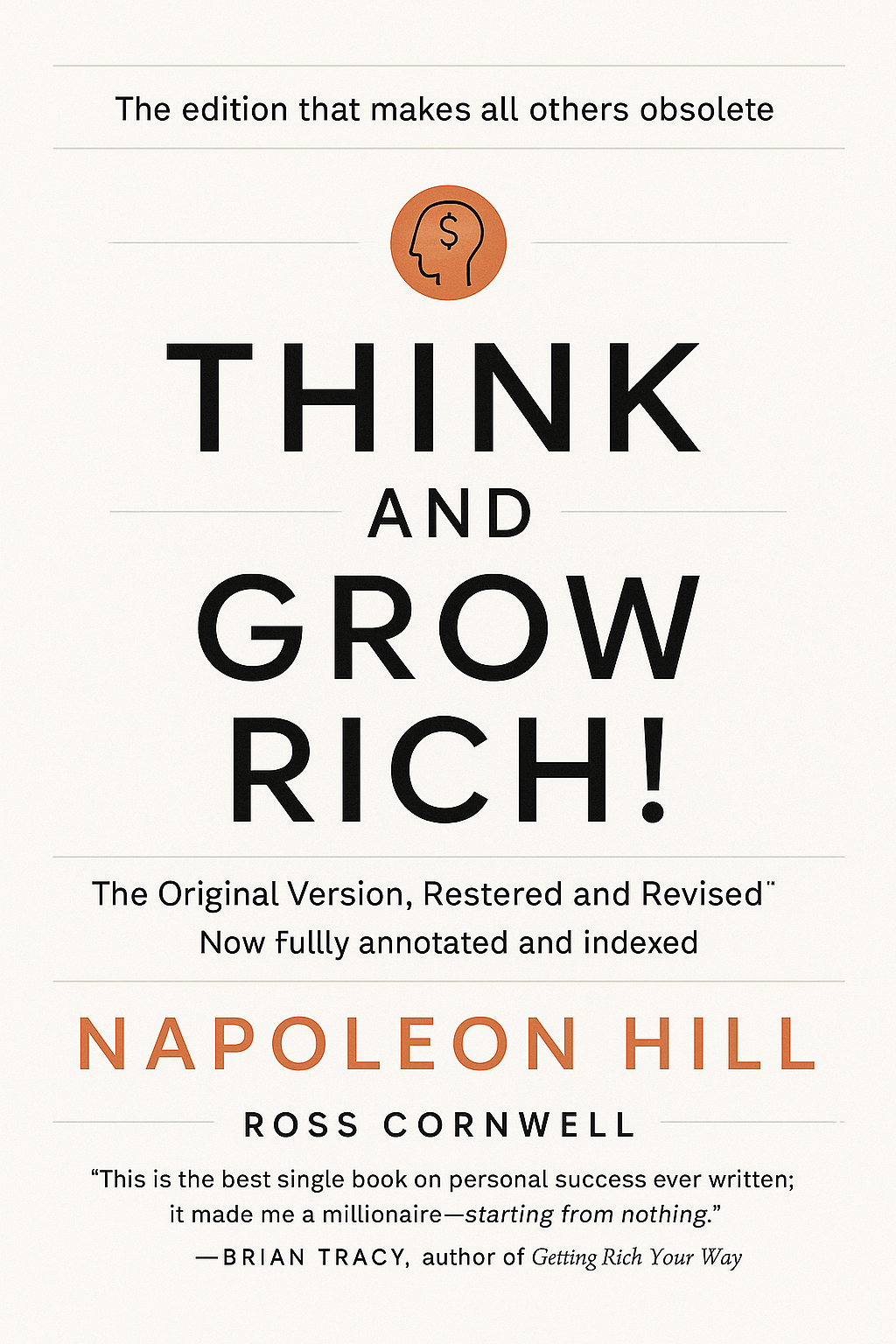
Think and Grow Rich! By Napoleon Hill
This three-lecture audio course works through Napoleon Hill's Think and Grow Rich from cover to index. The first lecture, Foundations of Mind Power, builds the mental groundwork: how a definite purpose becomes a burning desire, how faith is cultivated through repeated affirmation, and how autosuggestion programs the subconscious toward a chosen goal. It also covers specialized knowledge—why general knowledge alone rarely produces wealth—and the two forms of imagination, synthetic and creative, that turn ideas into plans. Hill's core premise runs throughout: whatever the mind can conceive and believe, it can achieve. The second lecture shifts from mindset to execution. It covers organized planning in six parts, the habit of making firm decisions quickly and changing them slowly, and persistence as the sustained effort needed to carry plans through failure and setback. It explains the Mastermind principle—coordinating knowledge and effort with others to multiply power—and examines sex transmutation, the subconscious mind, the brain, and the sixth sense as channels connecting desire to results. The third lecture completes the book with material most readers skip: the epilogue's lessons on outwitting the six basic fears, three appendices of practical tools, endnotes, and the index. It frames the book as a lifelong reference, showing how to revisit the 13 principles for ongoing application rather than a single read.
Foundations of MindPower: From Vision to Imagination
Foundations of MindPower: From Vision to Imagination
Welcome to Think and Grow Rich! By Napoleon Hill, the book that promises wealth begins in your mind long before it appears in your bank account. Here's the strange part: one man arrived looking like a tramp, with nothing, and still thought his way into a partnership with Thomas Edison. And your guide, Napoleon Hill, was a journalist who, at thirteen, was already reporting for a local newspaper.
Hill argues this book isn't motivational guesswork, and that's the part people miss. It came from a twenty-year research project commissioned by Andrew Carnegie, the steel magnate. He analyzed over 25,000 people who failed and hundreds who succeeded, including Edison, Ford, and Rockefeller. Editor F. W. Nichol, no small claim, compared Hill's rigor to Darwin's. That's, that's a bold comparison, but Hill earned it through method, not hype.
Bob Proctor's foreword adds something personal: the book taught him how to think, not what to think. He found it while working in the Toronto fire department, and it, it genuinely transformed his income and his life. He pictures the mind as a fertile field that grows whatever gets planted in it. Most people, though, let outside influences plant their seeds haphazardly. Proctor's advice: study it repeatedly, because the concepts are simple but need repetition to sink in.
Now the core principle: Desire, the psychological starting point for everything else. Hill distills Carnegie's own method into six steps, and they're practical, not theoretical. Fix the exact amount of money you desire, decide what you'll give in return, and set a definite date. Then create a definite plan, begin at once, whether or not you feel ready. Write it all down as one clear statement, and read it aloud twice daily. See and feel yourself already in possession of the goal. Wishful thinking, Hill insists, accomplishes nothing. A burning, obsessive desire is what translates into riches.
Consider Edwin C. Barnes, who showed up in West Orange, New Jersey, looking like a tramp. No money, no education, no connections, just a burning desire to become Edison's business partner, not his employee. Edison saw determination in his face and gave him a modest job. Barnes worked five years on the machine floor without losing sight of the goal. Then the Edison dictating machine flopped, and the other salesmen, well, they dismissed it. Barnes saw opportunity disguised as defeat, sold it brilliantly, and won the national distribution contract. He literally thought his way into partnership.
Hill pairs this with R. U. Darby, who quit drilling for gold in Colorado just three feet from a rich vein. Three feet! They sold their machinery to a junk dealer who hired an engineer, found the vein, and extracted millions. Darby later applied that lesson and became one of a small group selling a million dollars of insurance annually. Failure, in the author's view, comes from quitting under temporary defeat, and every failure carries the seed of an equivalent advantage. He extends this beyond money with his son Blair, born without ears, whose mother's refusal to accept the verdict helped him develop hearing and lead a remarkable life. Even the Great Depression proves the thesis: while millions froze in fear after 1929, others converted the same circumstances into opportunity. The path ahead runs through thirteen principles, beginning with desire, then faith, autosuggestion, specialized knowledge, and imagination. Success comes, Hill contends, to those who become success-conscious, and failure to those who indifferently become failure-conscious.
One secret, he promises, appears throughout the book, revealed only to minds prepared to receive it.
So here's your challenge before the next lecture: write down one definite goal, the exact thing you want, and read it aloud tonight. Hill contends the secret reveals itself only to prepared minds, so, so prepare yours. Desire is the starting point, but it's only the first of thirteen principles. Next, we take on faith, the state of mind that gives desire its wings.
Turning Desire Into Action: Planning, Decision, Persistence, and the Mastermind
Last time we saw desire as the seed, but the author insists a seed without a plan stays a seed. Every fortune begins as an idea backed by definite plans and persistent action, never as a wish. And here's his uncomfortable claim, you, no one accumulates great wealth alone.
Recall Edwin Barnes, who burned with desire but needed organized plans to reach partnership. The author argues plans must be definite and practical, and built through what he calls a Master Mind alliance. This is a group of like-minded people coordinating knowledge and effort in, in perfect harmony, each contributing ideas you could never generate alone. His steps are concrete: ally with such a group, keep friendly relations, and decide what you'll offer each member in return. He even includes a model contract, drafted by Andrew Carnegie's attorney, to formalize the alliance.
Knowledge, the author contends, is only potential power until organized into definite plans and aimed at a definite end. He splits general knowledge, mostly useless, from specialized knowledge, illustrated by a chemist who rose from a candy lab to the company presidency. Another young man, no, listen to this, traded his services to a law office in exchange for instruction. Then comes temporary defeat: if a plan fails, replace it, because defeat signals faulty plans, not an unreachable goal.
Thomas Edison failed ten thousand times before perfecting the incandescent bulb, and Henry Ford endured early business failures before his fortune. A quitter never wins, and a winner never quits. Most people surrender at the first opposition, which the author blames on weak definiteness of purpose. Since plans need people, he lists eleven leadership attributes, including unwavering courage, self-control, and mastery of detail. Leadership by consent endures, he says, while leadership by force, like Napoleon's, destroys itself.
His QQS formula demands quality of service, quantity rendered in full, and a harmonious spirit, because negativity leaks through your voice and manner. The Thirty Major Causes of Failure form a ruthless self-inventory, covering procrastination, wrong vocation, and guessing instead of thinking. Analysis of over 25,000 failures put lack of decision near the top, and opinions, he warns, are the cheapest commodity on earth. Keep your counsel, consult your Master Mind, and let deeds announce your intentions. Next time, we'll see how persistence carries plans through to riches.
Let's stay with the Master Mind, because the author treats it as the engine of every plan. He insists no single person has enough knowledge, experience, or ability to gather great wealth alone. In his view, every successful enterprise rests on cooperation, so the group matters more than the genius.
His instructions are strikingly procedural. Meet frequently, he says, until the plans are perfected, and maintain friendly harmony with every member the whole way. Decide in advance what you can offer each person in return, because nobody cooperates indefinitely for nothing.
The author even supplies a model contract, drafted by Andrew Carnegie's own attorney, to formalize the alliance. A contract, yes, for a, a pact of minds, which tells you how seriously he took this. Plans, in his framework, are not scribbles on a napkin; they are structures with people inside them.
Now, what happens when the structure cracks? Temporary defeat, the author argues, simply means your plans are faulty, not that your goal is out of reach. Replace the plan, he says, swiftly and without ceremony, and keep the goal untouched.
His evidence is hard to argue with. Edison failed ten thousand times before the incandescent bulb worked, and Ford stumbled through early business failures before his fortune arrived. Ten thousand! The author's maxim is blunt: most people quit at the first opposition, and that, he contends, is exactly why most people stay poor.
Then he turns to the people who execute plans, leaders, and his list is demanding. Unwavering courage, self-control, a keen sense of justice, definiteness of decision, mastery of detail, willingness to assume full responsibility, cooperation. He pairs these with ten causes of leadership failure, including fear of competition from subordinates and emphasizing title over substance.
Leadership by consent, earned through goodwill, endures; leadership by force destroys itself, as he saw with Napoleon and the czars. And here's a, a quietly radical note: the intelligent follower, he says, inevitably develops into a leader. The demand for leaders who understand human nature was, in his view, only growing.
Finally, decision itself, which the author defines as the mastery of procrastination. His analysis of over 25,000 failures put indecision near the very top of the causes. People who are easily swayed by opinions, he warns, never convert desire into money, because opinions are the cheapest commodity on earth.
Tell the world what you intend to do, but show it first. Careless words hand ammunition to competitors and enemies alike, so keep your counsel and consult only your Master Mind. Before next time, run one honest pass through the Thirty Major Causes of Failure, and mark which ones name you. Then we'll see how persistence carries the plan the final mile.
Beyond the Core: Epilogue Insights, Appendices, and the Complete Reference
We've climbed the whole staircase of the author's philosophy, but he saves the final obstacle for last, and it isn't money, or plans, or even persistence. It's fear, six specific ghosts of it, and he claims every one of them lives entirely in your mind, which is, somehow, the good news. Because a state of mind, in his system, can be controlled the same way desire and faith can.
Last time we saw persistence carry a definite plan the final mile, and now the author argues indecision is where failure actually begins, since indecision crystallizes into doubt, and doubt into fear. His epilogue works through the three remaining ghosts: ill health, old age, and death, tracing each back to heredity, environment, and destructive criticism. The fear of illness, he insists, makes hypochondria a self-fulfilling prophecy, and he warns that patent medicine makers and faddists deliberately profit by planting that anxiety in the public mind.
His examples are vivid, and, no, listen to this one: a man deteriorated under a supposed hex until a doctor removed the 'curse,' and the man recovered. Then there was the college 'smallpox epidemic' that was largely the product of mass fear, the thought of illness producing real physical symptoms. Thoughts of sickness can, the author argues, make the body sick.
On old age, he contends that calling yourself old accelerates decline through negative autosuggestion, while many of humanity's greatest contributions came from people past seventy. The fear of death, which he calls the most ruthless of the six, stems largely from religious fanaticism and the terror of the unknown. His counter is that death is a natural transition, and its fear dissolves when you're absorbed in a burning desire for some great work.
The antidote he prescribes is rigorous, honest self-examination, a probing questionnaire of over fifty questions spanning the closing sections. Do you complain, envy, worry, spend beyond your means, let others do your thinking, hold grudges, or, and this is the pivot, do you actually possess a definite major purpose and plan? He even names a seventh evil more destructive than the six fears: susceptibility to negative influences, guarded against only by deliberately closing your mind to negative people and thoughts.
He instructs readers to repeat this personal inventory every six to twelve months, treating it as an annual audit of the self. Then he closes with the famous 'Fifty-Seven Famous Alibis by Old Man IF,' a catalog of excuses running from 'IF I had money' to 'IF I had time.' Every alibi, he argues, is rooted in fear and self-deception, and the person who quits making excuses by declaring 'I am the master of my fate' holds the key to riches in every sense.
Thought, the author claims, is the one thing over which you have absolute control. That inheritance can't be bought, borrowed, or stolen, and claiming it is, in his view, the beginning of all riches, material and spiritual. Which brings us to the appendices, where the whole system gets its evidence and its instruments.
The author recounts the origin of his life's work: Andrew Carnegie's challenge, delivered with only twenty-nine seconds to decide, to spend twenty years distilling a philosophy of success. Twenty-nine seconds! The research drew on interviews with over five hundred extraordinary achievers, Edison, Ford, Roosevelt, Rockefeller, Woolworth, Wrigley, many of whom began with severe disadvantages, establishing that the philosophy is a synthesis of observed patterns, not speculation.
A curated collection of reader testimonials spanning decades follows, documenting salespeople who multiplied their incomes and owners who saved failing enterprises. Most frequently they cite definiteness of purpose, the master mind, organized planning, and the sixth sense, and a striking pattern emerges: many read the book annually, treating it as a working manual. They passed it along to employees and family, creating documented chains of influence.
The appendix closes with practical tools, including the Self-Analysis Test for Salespeople, roughly sixty questions built on the premise that anyone selling personal services is a merchant of their own abilities. Most people, the author notes dryly, overestimate their capabilities, so your abilities deserve the same scrutiny applied to goods. He's transferring responsibility for application from author to reader, and he knows it.
Because knowledge, as we've heard across this journey, becomes power only when organized into a definite plan of action directed toward a definite end. Fear is the final obstacle, and self-analysis is the method of overcoming it. Your challenge before we close the book: take one question from the author's inventory, the one about grudges or excuses or purpose, and answer it honestly tonight. The complete reference is now yours, and, the author would say, so is the responsibility. Master your fate.