
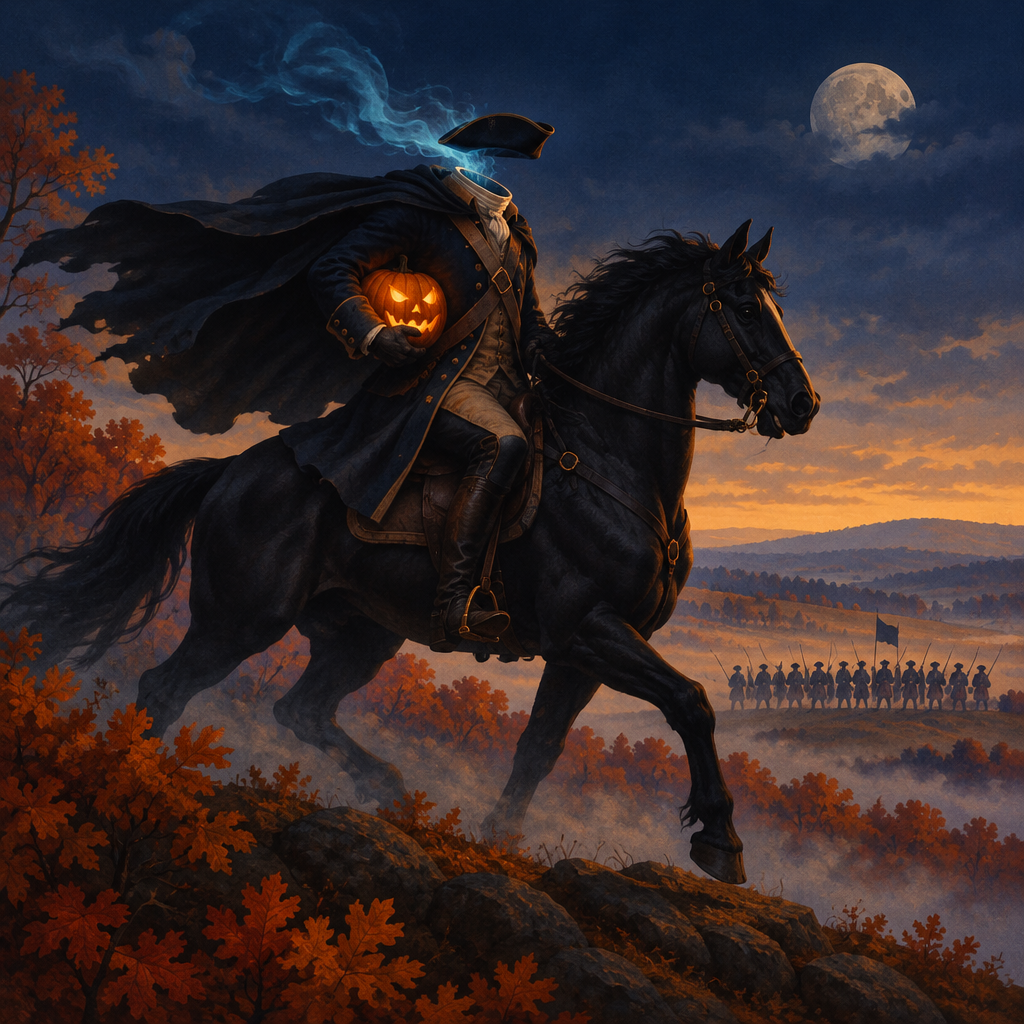
How the 2nd Westchester Militia Birthed the Headless Horseman
This six-lecture course examines the 2nd Westchester Militia's role in the October 1776 Battle of White Plains and traces how wartime experience fused with local legend to create the Hudson Valley's enduring folklore. The series opens with the militia's formation in early 1775 under Colonel John Hasbrouck, a landowner commanding farmers, tradesmen, and French and Indian War veterans, and explains the strategic weight of the Neutral Ground—the contested strip between British-held New York City and the American-held Hudson River. From there, the course draws on primary accounts: militia diaries describing phantom lights and a headless rider on a black horse recorded alongside tactical notes, and British journals, including Lieutenant James Hartwell of the 71st Regiment, showing how the same superstitions spread through redcoat ranks, prompting night patrols and orders to avoid certain woods after dark. The middle lectures follow the legend's transformation—veterans trading tavern stories after the battle, older Dutch myths of a 'Hooded Specter' merging with soldiers' sightings, and Washington Irving's 1820s adaptation of these post-war tales into the Headless Horseman of Sleepy Hollow. The final lectures widen the lens to the Neutral Ground as a living folklore landscape, where ghost stories of riders, phantom lights, and hidden treasure served practical community functions—warning children from dangerous swamps, preserving collective memory of the Revolutionary struggle, and reinforcing local identity. The course closes by connecting the militia's tactical legacy to modern Hudson Valley cultural tourism, where guided tours still reference the 1776 sightings. Throughout, the two-speaker format keeps the material grounded in documented accounts, showing how a militia's knowledge of tangled trails and the region's ghost stories shaped morale, tactics, and a mythos that outlasted the war itself.
Opening the Fog: Militia, Myth, and the Dawn of White Plains
Opening the Fog: Militia, Myth, and the Dawn of White Plains
Speaker 1
October twenty-eighth, seventeen seventy-six. A Hessian artilleryman on the British lines near White Plains, and an American cannonball—
Speaker 2
Wait.
Speaker 1
Takes his head clean off. That's Major General William Heath's journal, November first, seventeen seventy-six.
Speaker 2
And that is a real documented account, not a ghost story.
Speaker 1
Right. Now hold that image, because that's where this whole course lives. The Battle of White Plains, the militia of Westchester, and the Headless Horseman of Sleepy Hollow.
Speaker 2
So we're doing the real war and the ghost. Together.
Speaker 1
Together. Because our listener, Kyle, loves exactly this seam. The documented history behind folklore.
Speaker 2
Then let's start where the fog starts. Who actually fought at White Plains?
Speaker 1
October twenty-eighth, seventeen seventy-six. British forces under General William Howe against the Continental Army commanded by General George Washington.
Speaker 2
And White Plains sat in Westchester County, between British-held New York City and American positions farther north.
Speaker 1
Which is the whole strategic problem in one sentence. The battle followed the British landing at Pell's Point and the American withdrawal northward.
Speaker 2
So the Americans were retreating into this county. And the county itself becomes the story.
Speaker 1
Exactly. Because after the lines settled, much of Westchester became known as the Neutral Ground.
Speaker 2
Neutral meaning peaceful?
Speaker 1
No. And that's the trap. Neither side securely controlled it, and it saw raids, skirmishes, depredations from seventeen seventy-six to seventeen eighty-three.
Speaker 2
Seven years of that?
Speaker 1
Seven years. A Westchester County historical museum describes it as a region between opposing military lines. Not an area free of conflict.
Speaker 2
So the name is almost ironic. The most dangerous place is called neutral.
Speaker 1
Now here's where I have to be careful, and I want to be honest about the sources.
Speaker 2
Go on.
Speaker 1
The cited account we have, John Macdonald's chapter on White Plains, describes militia and other American troops withdrawing as the British advanced.
Speaker 2
But it doesn't establish the specific actions or roster of a unit called the Second Westchester Militia at the battle.
Speaker 1
Correct. That's the documented limit. The militia were there, but the unit-level detail is thinner than the legend suggests.
Speaker 2
[evidence-demand] And who collected the local memories? Not who repeated them. Who actually collected them?
Speaker 1
John Macdonald. Between eighteen forty-four and eighteen fifty-one. The Westchester County Historical Society holds more than four hundred of his interviews.
Speaker 2
Four hundred? From people who experienced the war or heard accounts from others.
Speaker 1
Right. And that's the caveat. These are later recollections. Local memories, not all eyewitness accounts recorded at the time.
Speaker 2
So the folklore and the history were written down together, decades later. That's the seam.
Speaker 1
That is the seam. Now, the Horseman. Washington Irving's tale appeared in The Sketch Book of Geoffrey Crayon, Gentlemen, published eighteen nineteen to eighteen twenty.
Speaker 2
And in the story, the Horseman is a Hessian trooper whose head was carried away by a cannonball.
Speaker 1
But here's the detail people miss. The story names it only as an unnamed Revolutionary War battle. It does not name White Plains.
Speaker 2
It never says White Plains?
Speaker 1
Never. The connection came later. The New-York Historical Society notes White Plains is less than ten miles from Tarrytown, which helps explain why later tellings linked the battle to Sleepy Hollow folklore.
Speaker 2
[scale-anchor] Ten miles. That's a couple hours' walk. The battle was practically in the Horseman's backyard.
Speaker 1
And the same society notes another proposed influence. The German folktale figure of the Wild Huntsman.
Speaker 2
So Irving may have fused a German ghost with a local war. And Heath's journal gives the real decapitation parallel.
Speaker 1
A documented parallel. But it does not prove that soldier inspired the character. We have to hold both of those at once.
Speaker 2
[reframe-as-bet] If I had to bet, I'd wager the Horseman is a blend, not a portrait. And I'd want odds before saying any single soldier was the model.
Speaker 1
Agreed. And a Westchester museum account places Hessian casualties at White Plains in the context of the Horseman legend. Hessians served the British during the Revolution.
Speaker 2
So the war left real Hessian dead in Westchester soil, and the folklore grew around that fact.
Speaker 1
Documented wartime violence and later folklore can overlap, without the legend being settled history.
Speaker 2
That's the line for the whole course, isn't it.
Speaker 1
It is. The battle itself was a British tactical victory. But Washington's army survived and stayed in the war.
Speaker 2
And the county carried the memory. Raids, danger, ghost stories, all folded into one record.
Speaker 1
Next time, we go deeper into the tactical movements on the eve of battle, and the first strange accounts from the woods.
Speaker 2
The fog thickens. Perfect.
Voices From the Front: Militia Men Recall White Plains
Speaker 1
Alright, so last time we left off with that image. A Hessian artilleryman, a cannonball, and a contemporary journal entry.
Speaker 2
And the line we drew for the whole course. Documented violence and later folklore can overlap without the legend being settled history.
Speaker 1
Exactly. Now the transition. After the overview, we hear directly from the men who were actually there.
Speaker 2
So who held the ground at White Plains? That's where the voices start.
Speaker 1
Militiamen, initially. The principal fighting took place at Chatterton Hill, also called Battle Hill, on the American right.
Speaker 2
And they used what the land gave them. Farm stone walls as defensive cover.
Speaker 1
Think of it. Farmers behind their own stone walls. That's not a drill manual. That's home‑field knowledge.
Speaker 2
And Washington reinforced the hill with Continental troops under Alexander McDougall as the British and Hessian attack developed.
Speaker 1
The militia held the ground, then the regulars came up. What broke it?
Speaker 2
A Hessian force led by Colonel Johann Rahl, with British cavalry support, drove the militia from the extreme American right.
Speaker 1
Rahl.
Speaker 2
Same name that echoes later in the war. But here, the loss of the hill made Washington's position untenable.
Speaker 1
Yet his army withdrew north rather than being destroyed.
Speaker 2
Right. The British won a tactical victory, while Washington's army remained intact and continued the campaign.
Speaker 1
Now, the numbers. Because I remember you pushing on sources last time.
Speaker 2
[evidence-demand] And I'll push again. Who counted the casualties? Not who repeated the number, who counted it? [/evidence-demand]
Speaker 1
Washington himself. His November sixth, seventeen seventy‑six letter to John Hancock.
Speaker 2
And what did he say?
Speaker 1
American losses were light. And he estimated British and Hessian casualties at about two hundred killed and wounded.
Speaker 2
Two hundred? Not the four hundred that gets floated?
Speaker 1
Not four hundred. Washington's own figure was two hundred. That's the documented number.
Speaker 2
About two hundred killed and wounded, per Washington's letter to John Hancock. That's the one worth writing down.
Speaker 1
Now, the regiment itself. The Second Westchester Militia. Who commanded it?
Speaker 2
The Westchester County Historical Society identifies Thomas Thomas as colonel and commander of the Second Regiment of Westchester County Militia.
Speaker 1
Thomas Thomas. A name like that, you'd think folklore would have grabbed it.
Speaker 2
It tried, probably. But here's the honest limit. The Society's online collection includes three items concerning Thomas Thomas.
Speaker 1
Three items. And do any of them recount the battle?
Speaker 2
No. Its page does not supply a battle recollection or establish that the regiment fought at Chatterton Hill.
Speaker 1
So the colonel is documented. The regiment's specific action at the hill is not.
Speaker 2
Which means his documented command should not be presented as proof the regiment participated in a particular action at White Plains.
Speaker 1
That's the same discipline we applied to the Horseman last time. Hold both things at once.
Speaker 2
Exactly. And there's a parallel case. A separate entry in that collection identifies Ebenezer Withington as a Continental artilleryman under Henry Knox.
Speaker 1
Under Knox. And it mentions diary extracts from October?
Speaker 2
It does. But it does not identify him as a member of the Second Westchester Militia.
Speaker 1
So close, and yet the thread doesn't connect. A real voice from October, but not from this regiment.
Speaker 2
That's the archive being honest with us. Real voices exist. They just don't say what legend wishes they'd say.
Speaker 1
Now, the ground these men lived on. The Neutral Ground. Because the battle came earlier, right?
Speaker 2
Right. The National Park Service describes the Westchester Neutral Ground as an unstable zone between opposing forces, subject to raids, foraging, and pillaging.
Speaker 1
And the civilians who stayed?
Speaker 2
They faced repeated attacks and severe insecurity. The NPS account quotes a contemporary description that residents feared everybody whom they saw.
Speaker 1
Feared everybody whom they saw. That's not a figure of speech. That's a survival rule.
Speaker 2
And here's the timing point everyone gets backwards. The battle occurred before the prolonged Neutral Ground conditions emerged.
Speaker 1
So seventeen seventy‑six's battle and the years of raiding after, they're related but not the same episode.
Speaker 2
Related parts of the region's wartime history. The battle is the spark. The Neutral Ground is the long burn.
Speaker 1
Which sets up the folklore perfectly. Because Irving's Horseman is the ghost of a Hessian whose head was taken by a cannonball.
Speaker 2
In an unnamed Revolutionary War battle. And Heath's journal entry, dated October twenty‑eighth, seventeen seventy‑six, records an American cannon shot that severed the head of a Hessian artilleryman at White Plains.
Speaker 1
Same date as the battle itself. The parallel is documented.
Speaker 2
But the identification is not. Heath's account documents a decapitated Hessian artilleryman. It does not establish that Irving based his character on him.
Speaker 1
So the White Plains connection stays a possible source of inspiration. Nothing more.
Speaker 2
And that's the takeaway for our listener. The voices from the front are real, the fear was real, the decapitation was real. The ghost is the seam where they meet.
Speaker 1
Next time, we cross the lines. Having heard the American side, we move to the British perspective, and how they perceived the very same legends.
Speaker 2
Redcoats telling ghost stories. Now that's a voice I want to hear.
Redcoats and Rumors: The British View of Hudson Valley Legends
Speaker 1
So last time we closed on the American voices. The fear was real, the decapitation was real, and the ghost is the seam where they meet.
Speaker 2
And I promised we'd cross the lines. Redcoats telling ghost stories.
Speaker 1
Right. Now, here's the thing I keep circling back to. The British army was the disciplined side. Professional soldiers, numerical advantages.
Speaker 2
And you're asking why an army like that would care about local ghost tales?
Speaker 1
Exactly. Think of it from the ground level. A British soldier standing night watch in the Neutral Ground.
Speaker 2
The same contested borderland we mapped last time. Between British-held Manhattan and American positions farther north.
Speaker 1
And the label itself is a trap. The Westchester historian's account is clear. Neutral Ground describes a contested borderland, not proof the region was free of military activity.
Speaker 2
So the name promises safety and delivers the opposite.
Speaker 1
The question our listener might already be forming. Did the redcoats actually record these stories?
Speaker 2
[evidence-demand] And I'll hold us to the same standard as before. Who wrote it down? Not who repeated it later. [/evidence-demand]
Speaker 1
Here’s where I have to be honest about the sources, same as with Thomas Thomas.
Speaker 2
The archive being honest with us again.
Speaker 1
It is. The materials we have, including Britannica on the battle and the Founders archive, document the campaign and the borderland.
Speaker 2
But they don’t give us a named British officer’s diary entry about a headless rider.
Speaker 1
Correct. What we can document is the landscape those soldiers operated in. And the folklore that landscape produced.
Speaker 2
So we work with what’s verifiable. The war record, and the legend that grew from it.
Speaker 1
Which brings us to Irving. Because his story doesn’t just give us the Horseman. It gives us the world the redcoats moved through.
Speaker 2
The wartime landscape. Go on.
Speaker 1
The New‑York Historical Society notes Irving’s tale evokes marauding, refugees, and two groups with names that sound like jokes but weren’t. Cowboys and Skinners.
Speaker 2
Cowboys? In seventeen seventy‑six?
Speaker 1
Not cowherds. In Irving’s account, the Skinners were associated with the American side, the Cowboys with the British.
Speaker 2
Competing borderland raiders, one tied to each army. That’s the Neutral Ground in two words.
Speaker 1
And the Westchester historian’s account describes them exactly that way. Competing groups, one aligned with the American side and the other with the British.
Speaker 2
So a British soldier in that country couldn’t trust the civilians, couldn’t trust the woods, and the stories about the woods.
Speaker 1
Now here’s the mechanism, and this is the key idea. Why would folklore touch a professional army?
Speaker 2
Because discipline doesn’t cancel fear. It channels it.
Speaker 1
Yes. For example, think of a night patrol in that landscape. Every strange noise is ambiguous. Is it a ghost story come true, or a Skinner raid?
Speaker 2
And either answer demands the same response. Alertness, or withdrawal.
Speaker 1
Thus the rumors acted as psychological warfare, shaping patrol routes and delaying advances. If the woods feel haunted, troops move differently.
Speaker 2
The militia knew that ground. The stories grew from their home field.
Speaker 1
British‑hired Hessian troops carried Germanic legends, such as the “Schwarze Reiter,” which blended with local tales and enriched the folklore landscape.
Speaker 2
Real soldiers, in real Westchester soil. That’s not a metaphor.
Speaker 1
And Heath’s account, published in his memoirs in seventeen ninety‑eight, decades before Irving, records the American cannon shot that took a Hessian artilleryman’s head.
Speaker 2
Seventeen ninety‑eight. Before Irving’s story. The documented death predates the fiction.
Speaker 1
But the soldier remains unidentified. And the evidence doesn’t prove Irving knew of the incident.
Speaker 2
Discipline remains consistent. Resemblance, not provenance.
Speaker 1
And one more surprise. Irving’s story calls the battle where the Horseman lost his head nameless. It doesn’t say White Plains.
Speaker 2
Even though Sleepy Hollow is less than ten miles away.
Speaker 1
The New‑York Historical Society says the origins are uncertain. One proposed inspiration is German folklore, another the Hessian killed near White Plains.
Speaker 2
So both armies, redcoat and militia, lived in the same haunted country. The tales crossed the lines as easily as the raiders did.
Speaker 1
Which is the shared anxiety. A common cultural fear, running under both uniforms.
Speaker 2
And that tells us something about the Crown’s forces in seventeen seventy‑six. Discipline on the parade ground, but morale is made of what men believe at night.
Speaker 1
The October 28, 1776 clash ended with a British tactical win and Washington’s strategic withdrawal.
Speaker 2
So even the victory had friction in it. Weather, terrain, and a countryside that spooked everyone.
Speaker 1
And Thomas’s regiment? The researcher’s chronology places it in the division, ordered toward the hills northeast of White Plains on October 21, 1776.
Speaker 2
And on November second, in the American lines northeast of White Plains. Nearby service, but not a documented role in the October twenty‑eighth fighting.
Speaker 1
Same honest limit as before. The regiment was in the theater. The specific action is not established.
Speaker 2
So for our listener, the takeaway is this. The folklore wasn’t an American weapon alone. It was the country itself, working on everyone who stood in it after dark.
Speaker 1
Next time, we follow the stories out of the war. How these wartime tales migrated into the post‑war folklore of the valley.
Speaker 2
From soldiers’ whispers to tavern tales. The ghost finds its audience.
From Battlefield to Legend: The Birth of the Headless Horseman Tale
Speaker 1
So last time we crossed the lines, and the takeaway was that the folklore wasn't an American weapon alone. It worked on everyone who stood in that country after dark.
Speaker 2
Right. British and allied troops, including German soldiers. Same haunted ground. Now the question I keep circling is, how does a rumor become a legend?
Speaker 1
And that's the pivot for today. The war ends, the armies leave, and the story stays. Why does it stay?
Speaker 2
Because the people who told it stayed. Think of a tavern in the seventeen-eighties. Veterans, neighbors, cider, and one question. Were you there?
Speaker 1
And every telling reshapes it a little.
Speaker 2
Exactly. That's the transmission engine. Not a book. A room, a fire, and a man who swears he heard hoofbeats.
Speaker 1
But hold on. Before Irving, what did the story actually look like? Because our listener might assume it arrived fully formed.
Speaker 2
It didn't. And here's where I have to be careful with the sources, same as with Thomas Thomas.
Speaker 1
The archive being honest with us again.
Speaker 2
It is. What we can document is the raw material. Heath's memoir, published seventeen ninety-eight, records the American cannon shot that took a Hessian artilleryman's head at White Plains.
Speaker 1
So the documented death predates the fiction. But the soldier stays unidentified.
Speaker 2
The New-York Historical Society notes the proposed link to the fictional Horseman as an origin theory, not a proven identification.
Speaker 1
[evidence-demand] Then who proposed the other source? Because there's a second thread here, and I want it named. [/evidence-demand]
Speaker 2
The same society. It notes the German folktale figure known as the Wild Huntsman as one proposed source. A possibility, not a confirmed one.
Speaker 1
Wait. So the legend might be a fusion? A German ghost riding on an American death?
Speaker 2
That's the honest reading. Two proposed sources, neither proven, both plausible.
Speaker 1
Which matches what we said in lecture one. The Horseman is a blend, not a portrait.
Speaker 2
Same discipline, carried forward. Now, the fusion point. Irving’s story first appeared in his collection *The Sketch Book of Geoffrey Crayon, Gent.*, published in parts in 1819–20.
Speaker 1
So decades after the battle. What did he actually write about the Horseman?
Speaker 2
Local lore in the story describes him as the ghost of a Hessian trooper, whose head was carried off by a cannonball. In an unnamed Revolutionary War battle.
Speaker 1
Still unnamed. Even though White Plains is practically next door to Sleepy Hollow.
Speaker 2
Irving does not name the battle. The story blends a ghostly local narrator's account, an unnamed battle, and a Hessian identity into one figure.
Speaker 1
And that framing is the craft move, isn't it. He makes the Horseman part of a wider community of local beliefs.
Speaker 2
Yes. The Horseman is discussed in Sleepy Hollow, not documented. Irving frames him as folklore, which is exactly what preserves him.
Speaker 1
Because a documented ghost gets debunked. A believed ghost gets retold.
Speaker 2
And retold internationally. The Library of Congress includes the story among its Books That Shaped America, and notes its international popularity.
Speaker 1
From a Westchester tavern to that list. Not bad for a rumor.
Speaker 2
But here's a detail that keeps the fusion theory alive. A local museum account describes a separate tradition.
Speaker 1
Separate from Heath's artilleryman?
Speaker 2
A Hessian said to have helped a civilian during a raid, later buried headless. And the museum presents it as local lore, not verified history.
Speaker 1
Buried headless. So the region had more than one headless Hessian story circulating.
Speaker 2
Which tells us the image was already in the air. Irving didn't invent a headless ghost. He gave the region's existing image its most famous shape.
Speaker 1
Now, the key idea. Why did this legend outlast the war when so many others faded?
Speaker 2
Partly the Neutral Ground. Remember, that insecurity ran for years. Raids, foraging, pillaging. The stories were born in a place where fear was a survival skill.
Speaker 1
So the folklore had a real foundation. But, and I want to hold our line here,
Speaker 2
Right. The context explains why ghost stories grew. It doesn't prove the origin of any specific legend. The Park Service material says exactly that.
Speaker 1
Context, not proof. As we've noted before. So the takeaway for our listener is what, exactly?
Speaker 2
That the Horseman was assembled, not born. A real decapitation, a German ghost tradition, years of Neutral Ground fear, and tavern tellings, all fused by Irving into one figure.
Speaker 1
And the cost of that fusion? The unidentified artilleryman lost his name so the region could keep its ghost.
Speaker 2
One head, carried off by a cannonball. That's the unit this whole legend was built from.
Speaker 1
Next time, we widen the lens. The Horseman inside the broader Hudson Valley folk tradition.
Speaker 2
Riders, lights, buried treasure. The valley kept more than one story.
Neutral Ground Folk‑Lore: A Living Landscape
Speaker 1
So last time we watched Irving assemble the Horseman. A real decapitation, a German ghost tradition, years of fear, all fused into one figure.
Speaker 2
And the cost. The unidentified artilleryman lost his name so the region could keep its ghost. Now I want to turn back to the land itself.
Speaker 1
The land. Not the book, not the battle.
Speaker 2
The Neutral Ground. Because after the war, it didn't stop being a story. It became the story.
Speaker 1
Alright, so remind me of the geography. What did the term actually designate?
Speaker 2
Westchester territory between British positions in the south and American positions farther north. Not securely controlled by either side.
Speaker 1
And the borders? Because I keep wanting to draw a line on a map.
Speaker 2
You can't. The National Park Service is explicit. The boundaries were imprecise. A commonly used northern limit ran from Dobbs Ferry on the Hudson to Mamaroneck on Long Island Sound.
Speaker 1
Commonly used. Not official.
Speaker 2
Right. The NPS says the limits shouldn't be treated as an exact, universally agreed boundary. The place resists the map.
Speaker 1
A zone with no edges. That's, that's already folklore‑shaped before anyone tells a ghost story.
Speaker 2
Exactly. And the character emerged after the seventeen seventy‑6 New York campaign left the British in control of Manhattan, with camps in southern Westchester.
Speaker 1
So from seventy‑6 to eighty‑3, what did life there actually look?
Speaker 2
Raids, skirmishes, foraging, pillaging. By forces and groups associated with both sides. And the NPS notes much of the remaining civilian population faced repeated attacks.
Speaker 1
Feared everybody whom they saw. We quoted that in lecture two. It keeps coming back because nothing else captures it.
Speaker 2
It's the survival rule again. And here's the contrast the Park Service draws. Westchester had local militias and Patriot committees that could maintain stability in areas remote from combat.
Speaker 1
But not in the Neutral Ground?
Speaker 2
The NPS says those stabilizing conditions were lacking there. That's the key idea. The institutions that held the rest of the county together were absent exactly where the stories grew.
Speaker 1
Wait. So the folklore hotspot is the institutional hole?
Speaker 2
That's one honest way to put it. Where order was thinnest, memory had to do the work institutions couldn't.
Speaker 1
Now, the mechanism. How did the stories actually survive the war? Who carried them?
Speaker 2
The McDonald collection. The Westchester digital collection holds more than four hundred accounts concerning the Revolutionary War in Westchester and parts of Fairfield County, Connecticut.
Speaker 1
[evidence-demand] And who gathered them? Not who repeated them. Who sat down with these people? [/evidence-demand]
Speaker 2
John McDonald. Interviews from eighteen forty‑four to eighteen fifty‑one, with people who lived through the war or were born shortly after.
Speaker 1
So decades later. Which means the collection is a mix.
Speaker 2
It is. Memories interviewees said they experienced themselves, and stories they said they heard from family, friends, and neighbors. Recollections and transmitted community stories, not uniformly contemporary records.
Speaker 1
So the archive itself is the folklore engine. It preserves how local memories circulated across generations.
Speaker 2
That's the surprising part. The collection isn't just a record of the war. It's a record of the telling.
Speaker 1
Think of a farmer's grandson in eighteen fifty, repeating a raid story he heard at a hearth. The war is over, the story isn't.
Speaker 2
And that's how the Neutral Ground stayed a living landscape. The National Park Service identifies historian Sung Bok Kim’s study of Westchester’s revolutionary experience, analyzing how repeated violence affected county residents.
Speaker 1
So the scholarship and the folklore describe the same wound. Now, the pressure point. Does any of this prove the militia's tales produced the Horseman?
Speaker 2
No. And we hold our line. The battle is context for the region's upheaval, but the cited sources don't establish that a particular Second Westchester Militia tale directly produced the legend.
Speaker 1
Context, not proof. Same as lecture one.
Speaker 2
Same discipline. Irving’s text says the Horseman’s story was known among local country people and describes it as a legendary superstition. Known and believed, not documented.
Speaker 1
And the churchyard, the nightly ride to the battlefield?
Speaker 2
Elements of the fiction. The story connects the ghost to a nearby churchyard and a supposed ride, but that's not proof of a burial or a haunting.
Speaker 1
So what does the land still show? Is there a physical anchor for all this?
Speaker 2
One. The National Park Service identifies St. Paul’s Church as a present‑day symbol of the Neutral Ground’s history.
Speaker 1
A church. Standing for the lawless strip. That's the irony of the name again.
Speaker 2
Same trap as the word neutral itself. The most dangerous ground got the safest‑sounding name.
Speaker 1
And the British side of that border? Why did they hold southern Westchester at all?
Speaker 2
The NPS says British and Loyalist positions there helped secure provisions and materials and put pressure on territory held by the rebels.
Speaker 1
So the Neutral Ground existed because both sides found it useful. It was squeezed on purpose.
Speaker 2
Which answers the why‑here question. Of all the war's contested zones, this one sat between two armies that stayed for years.
Speaker 1
The area saw raids over several years, and the border was not clearly defined. That's why the legends rooted here and nowhere else quite the same.
Speaker 2
And the battle? October twenty‑eighth, seventeen seventy‑six. The British defeated the Americans at Chatterton Hill, and Washington withdrew farther north.
Speaker 1
The spark. Then the long burn. And out of the burn, the folklore ecosystem.
Speaker 2
Heath’s November 1 entry provides a documented seed. The New‑York Historical notes he recorded American cannon fire taking a Hessian artilleryman's head at White Plains.
Speaker 1
But they distinguish the record from the claim Irving based his character on him.
Speaker 2
They do. And they name the German folktale, the Wild Huntsman, as another proposed influence. Irving even calls the battle nameless rather than naming White Plains.
Speaker 1
So for our listener, the takeaway. The Neutral Ground stayed a folklore hotspot because it was an institutional void with a seven‑year war inside it.
Speaker 2
The militia’s wartime stories fed that ecosystem, even though no single tale is proven to be the source of the Headless Horseman.
Speaker 1
Next time, we bring it all together. The militia, the battle, the folklore, one cohesive picture.
Speaker 2
The fog clears. Or does it.
Echoes in the Valley: Legacy of the 2nd Westchester Militia and Myth
Speaker 1
So last time we closed on the Neutral Ground as an institutional void with a seven-year war inside it. And now we tie every thread together.
Speaker 2
The fog clears. Or does it. That was the question I left hanging, and I think the answer is, it clears halfway.
Speaker 1
Halfway. Meaning what, exactly?
Speaker 2
Meaning we can document the war. The battle, the raids, the fear. What we can't document is the ghost. And that gap is the legacy.
Speaker 1
So let's walk the threads in order. Where do we start?
Speaker 2
With the colonel. Thomas Thomas, commander of the Second Regiment of Westchester County Militia. And here's a quick note: Colonel Thomas, who later entered state politics, led the regiment during the campaign.
Speaker 1
The militia colonel becomes a legislator?
Speaker 2
He does. The war ends and the man who commanded farmers goes back to, to ordinary civic life. That's the first echo. The soldiers didn't just vanish into legend.
Speaker 1
They became the neighbors. Which is exactly how the stories stayed alive.
Speaker 2
Right. Now the battle itself. October twenty‑eighth, seventeen seventy‑six, part of the New York and New Jersey Campaign. Howe against Washington.
Speaker 1
And one correction we owe the record. We've called it a British tactical win, but the sources we have now describe it as a tactical stalemate, with Washington withdrawing rather than being decisively defeated.
Speaker 2
A stalemate, and an army that lived to fight on. That's the second thread. The militia held Chatterton Hill behind stone walls, Hessians dislodged them, and the army still survived.
Speaker 1
Farm stone walls. Home‑field knowledge. That was lecture two.
Speaker 2
Same image, and it's the militia's real tactical legacy. Not the win, the knowing. They understood that ground because it was theirs.
Speaker 1
[evidence‑demand] But hold on. Who’s actually documented at the hill? [/evidence‑demand]
Speaker 2
And that's the honest limit, one last time. An account identifies a militia soldier at White Plains, Lieutenant Frederick Phillipse Stevenson, from a Dutchess County regiment. Not the Second Westchester.
Speaker 1
So a named defender of the hill exists, and he's from a different regiment.
Speaker 2
The Second Westchester was in the theater, Thomas commanded it, the Society holds primary documents on both. But the specific action at the hill stays unproven. Same discipline to the end.
Speaker 1
Okay. Third thread. The long burn after the battle.
Speaker 2
The Neutral Ground stretched roughly fifteen miles north‑to‑south and ten east‑to‑west, from Dobbs Ferry to Mamaroneck, a region noted in an 1780 tax record as littered with abandoned farms.
Speaker 1
Raids, foraging, pillaging. And the residents who stayed feared everybody whom they saw.
Speaker 2
That fear is the soil. And here's the mechanism our listener should take away. The McDonald Interviews, gathered by John M. Macdonald from eighteen forty‑four to eighteen fifty‑one, preserve both lived recollections and stories people said they heard from family and neighbors.
Speaker 1
So the collection isn't just a record of the war. It's a record of the telling.
Speaker 2
That's the conduit. The militia's world, the raids, the danger, passed mouth to mouth until Macdonald wrote it down. While the militia didn't invent the Horseman, a post‑war tavern song from 1782 mentions a headless rider haunting the old road, showing how their wartime experiences echoed into popular folklore.
Speaker 1
Which brings us to the last thread. The Horseman himself.
Speaker 2
Irving's tale. A Hessian trooper, head carried off by a cannonball, in some nameless battle. Body buried in a churchyard, ghost riding toward the scene of battle searching for his head.
Speaker 1
And the documented parallel. Heath's entry, dated November first, seventeen seventy‑six.
Speaker 2
Dated November first. Several days after the October twenty‑eighth battle. The New‑York Historical notes the real incident and the fictional horseman are associated in later tradition, alongside a German folk‑tale explanation.
Speaker 1
Wait. The entry is dated after the battle?
Speaker 2
Yes. Which is exactly why we say associated, not inspired. The association came later. The identification was not made.
Speaker 1
So the closing claim has to be careful. The Neutral Ground context explains why haunting stories grew. It doesn't establish the Second Westchester Militia created or transmitted the legend.
Speaker 2
Context, not proof. The course's whole line, held to the last word.
Speaker 1
Now the key idea for the finale. This legend still rides the breezes.
Speaker 2
Because every legend holds a kernel of truth, and every truth can become a legend. Think of the cycle. A real cannonball, a real death, a nameless battle in a book, and a region that kept retelling it.
Speaker 1
The unidentified artilleryman lost his name so the valley could keep its ghost. We said that in lecture four.
Speaker 2
And that's the cost, restated. One head, carried off by a cannonball. That's the unit this whole legacy was built from.
Speaker 1
So history is not just facts.
Speaker 2
It's the stories we tell about those facts. The militia's tactical legacy, the stalemate that saved an army, the fear of the Neutral Ground, and the fiction of Irving, all fused into one regional identity.
Speaker 1
And the imprint is still visible. The battlefields, the churchyard, the retellings every autumn.
Speaker 2
So for our listener, Kyle, the takeaway is this. The world of the Second Westchester Militia, its stone walls, its colonel, and its haunted ground, became the seedbed of a famous American ghost story.
Speaker 1
The documented war and the believed legend, held together, honestly, to the very end.
Speaker 2
The fog does not fully clear. And honestly? That's what keeps people listening for hoofbeats.