
Why Redwoods Outlive Empires: The Tallest Tree's Hidden Survival Network
Standing Tall Among the Redwoods is a concise audio course for busy professionals that explains what redwood trees are, why they matter, and what their biology and ecosystems teach us about sustainability and leadership. The course opens with Redwood Identity: Species, Size, and Habitat, which maps the three redwood species—the coast redwood, the giant sequoia, and the dawn redwood. You will learn how the coast redwood reaches over 350 feet, making it the tallest tree on Earth, with some individuals recorded at 379 feet, and how it can live up to 2,000 years. The giant sequoia, by contrast, grows to about 275 feet but holds the record for sheer volume and can exceed 3,000 years in age. The lecture also covers the dawn redwood, a distant relative native to China, and explains the specific coastal fog climate of California that supplies the moisture coast redwoods need to reach record heights. By the end, you will have a clear mental map of redwood diversity, scale, and the environmental conditions that make these trees extraordinary. The course then connects redwood biology to practical lessons. Redwoods survive through interlocking root systems, fire-resistant bark, and communal fog capture—strategies that translate directly into how organizations build resilience, share resources, and endure disruption. You will see why a single tree's strength matters less than the forest's collective structure, and how the oldest living things on the planet model long-term thinking that outlasts any individual leader or season. The result is a short, focused listen that pairs hard science with frameworks you can apply to sustainability goals, team design, and leadership decisions.
Redwood Identity: Species, Size, and Habitat
Redwood Identity: Species, Size, and Habitat
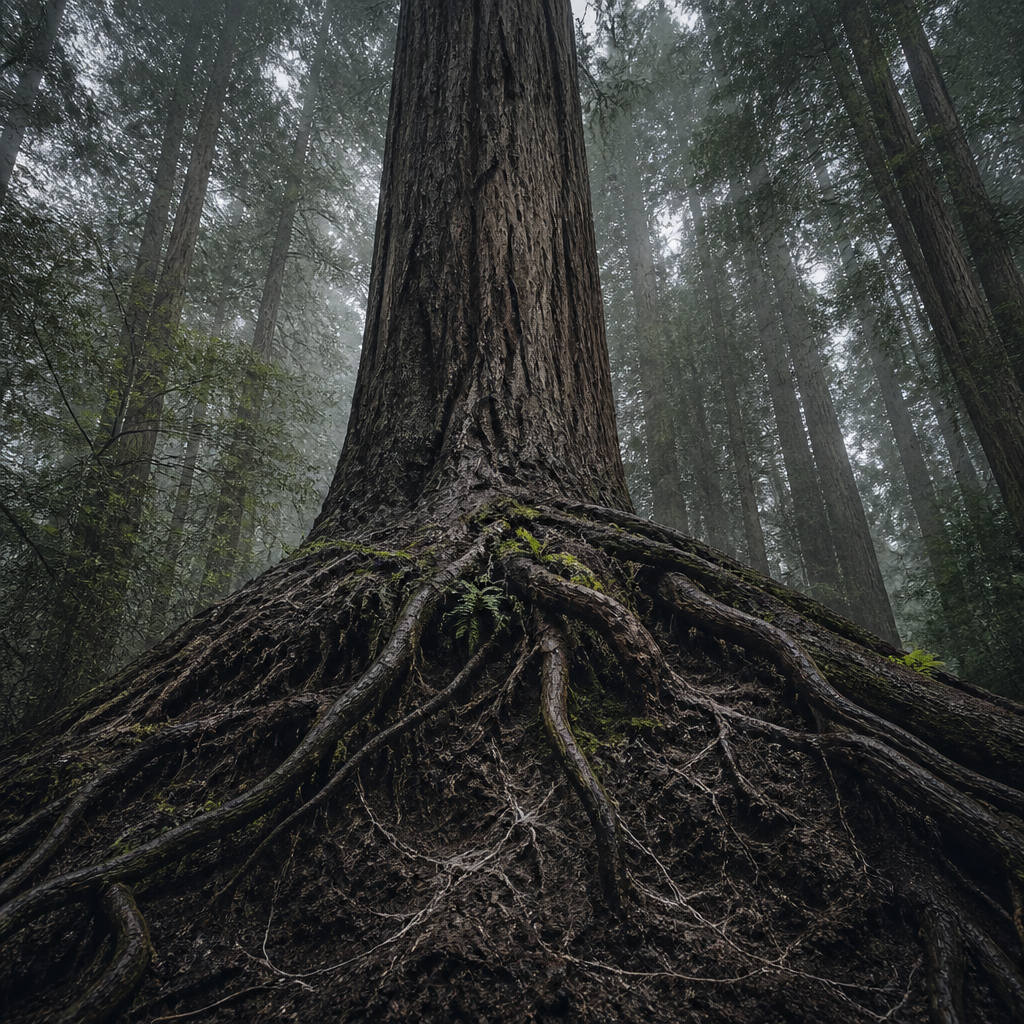
A tree taller than a football field is long. That's the first thing that stops people cold, Tealia. Stand at the base of a mature coast redwood and you're looking at a living thing that can exceed 350 feet in height, according to the National Park Service. Some visitors actually get a little dizzy tilting their head back far enough to see the crown. And here's the strange part. That towering giant produces the smallest cones of any of the three living redwood species. The tallest tree on Earth, hiding its future in cones you could close your fist around. So today, we figure out exactly what you're looking at when you stand at the base of one of these. Because "redwood" isn't one tree. It's three. And each one tells a completely different story.
Let's start with names, because the naming here matters more than you might think. The coast redwood's scientific name is Sequoia sempervirens. It's a conifer, and it belongs to the cypress family, Cupressaceae. Now, the name "redwood" is shared by three living species: the coast redwood, the giant sequoia, and the dawn redwood. Three trees. One shared name. And that shared name causes real confusion, because people use "redwood" and "sequoia" almost interchangeably at trailheads, in conversation, even in news reports. They are not the same tree. Not even close, actually. They're relatives, distant cousins who took very different paths over millions of years. The key idea for you to hold onto is this: whenever someone says "redwood," the very first question worth asking is, which one?
So which one is which? Geography is your fastest clue. Coast redwoods grow along the Pacific Coast. Giant sequoias grow on the western slope of California's Sierra Nevada, a completely different landscape, hours inland and thousands of feet higher. Two different trees, two different mountains, one state. The coast redwood is the tall one, the tallest living tree species on Earth, as the National Park Service confirms. The giant sequoia is the massive one, shorter in height but built like a fortress in terms of sheer bulk. Think of it like this, Tealia: coast redwoods are the skyscrapers, and giant sequoias are the bank vaults. One optimizes for height, the other for volume. And then there's the third sibling, the dawn redwood, native to China, which we'll get to, because it's the strangest of the three.
Now let's talk about height, because the numbers deserve their own moment. Mature coast redwoods can exceed 350 feet. Think about what that means in human terms. A football field, end zone to end zone, is 360 feet. So picture a football field stood on end, and you're in the ballpark. And these trees don't just get tall and die young, either. Coast redwoods can live for roughly 2,000 years. That's a tree that might have been a seedling when the Roman Empire was still a going concern. Let that sink in for a second. A single organism, standing in one place, photosynthesizing quietly through two millennia of human history. Empires came and went. The tree just kept growing.
Giant sequoias play a different game entirely. They top out closer to 275 feet, which sounds like a demotion until you stand next to one. Their trunks are enormous. But why the height difference? Why does the coast redwood push past 350 feet while its bulkier cousin stays lower? Part of the answer is where each tree lives. Height is expensive for a tree. Every additional foot of trunk means hauling water higher against gravity, and water is the whole story here. A tree can only grow as tall as its water supply allows. The coast redwood lives in a place where water is, well, delivered from the sky on a regular schedule. The giant sequoia doesn't. Different environment, different evolutionary strategy. That means the real secret to redwood height isn't in the tree at all. It's in the address.
And what an address it is. Coast redwoods are native to a narrow coastal belt running from southwestern Oregon down to central California. The National Forest Service documents this range as extending about 450 miles, and generally only 5 to 35 miles wide. Stop and picture that shape for a moment. A ribbon. A thin green ribbon of the tallest trees on Earth, squeezed between the Pacific Ocean and the drier interior. Why so narrow? Because the conditions that let a redwood become a redwood only exist in that thin strip. Stray outside it, in either direction, and the recipe breaks down. Elevations run from sea level up to about 3,000 feet, with most stands at low to moderate elevations, favoring moist coastal plains and flats beside streams, rooted in deep, moist soil.
Now, here's the part I find genuinely beautiful. The climate itself. Coast redwoods grow in a maritime climate with cool, rainy winters and dry summers. And that last word should worry you. Dry summers. California summers are famously dry. So how does the tallest tree on Earth survive a season without rain? The answer is the ocean. Ocean influence helps create the stable temperatures, the moisture, and critically, the fog that redwood forests depend on. The Pacific acts like a giant climate regulator, keeping things cool and damp enough that a tree with enormous water demands can actually meet them. Remove the ocean influence, and the redwoods simply can't do what they do. The coast isn't just where redwoods happen to live. The coast is why they exist at all.
Fog. Let's spend a real moment on fog, because it's the unlikeliest hero in this whole story. What is fog, really? A cloud that touched the ground. And for a coast redwood, that low cloud is a delivery service. Redwood foliage can absorb moisture directly from the air, and water that condenses on the leaves drips down to the forest floor. The tree is, quite literally, drinking from the sky. And this isn't a minor supplement, Tealia. One source from the UC Botanical Garden reports that fog can provide more than 30 percent of a coast redwood's moisture needs. More than thirty percent. During the dry season, when rain is absent for months, fog is the lifeline. Suppose a summer goes by with barely a drop of rain. The redwoods don't panic. The fog rolls in most afternoons, and the forest keeps functioning.
The redwood forest isn't just the tree, of course. It's a whole community. Coast redwood forests provide habitat for wildlife, including marbled murrelets and northern spotted owls. The murrelet, by the way, is a seabird that flies inland to nest, high in old-growth redwood canopy, which tells you something about how structurally complex these forests become when they're left alone for centuries. And the trees themselves have survival tricks that go beyond height. Their thick bark helps protect them from fire, something we'll explore more deeply later in this course. Remember that one, because fire resistance is a major thread in the redwood story. These trees didn't get old by being lucky. They got old by being armored.
Now, the biology. Coast redwoods are evergreen trees, keeping their needles year-round, unlike most of the deciduous forests people know from the eastern United States. They're gymnosperms, which means they bear cones containing seeds, like pines and firs. And they reproduce two different ways: from seeds, and by sprouting. That second method matters more than it sounds. Sprouting means new shoots can come up from a living tree's base, or even from a fallen trunk. But the seeds themselves face a hard start in life. Coast redwood seedlings tolerate shade, which helps, but they require abundant moisture. Shade-tolerant but thirsty. That combination, right there, explains why these trees cluster where they do. A seedling can survive in the dim understory, but only if the ground stays wet, which, back in that fog belt, it usually does.
Which brings us to the oddball of the family. The dawn redwood. Here's a tree that breaks the family rules. Unlike the evergreen coast redwood and giant sequoia, the dawn redwood is deciduous. It sheds its needles in autumn. A redwood that goes bare for the winter, looking for all the world like a dead tree until spring returns. It's native to China, not California, which is why you'll never stumble across one on a coastal hike. Scientists long believed this line of trees had vanished entirely, extinct for millions of years, known only from fossils. Then living dawn redwoods were discovered in 1940s China. A tree the textbooks had already written off, standing there quietly the whole time. The paleontologists, I mean, they had to rewrite the ending.
And that discovery connects to something bigger about the redwood family's past. The coast redwood's native range today is restricted, that narrow 450-mile ribbon. But fossil evidence indicates that redwood-like trees once grew across parts of the Northern Hemisphere. Much broader ranges, in the distant past. The redwoods used to be everywhere. Now they cling to a coastal strip. That contraction tells a story of changing climates over millions of years, of ranges shrinking as conditions shifted, of survivors holding on in the one place that still worked. So when you stand in a redwood grove, Tealia, you're not just looking at a tall tree. You're looking at the last chapter of a much longer book, a relic lineage that once circled the planet.
Let me put the three species side by side one more time, because the contrast is the point. The coast redwood: Pacific Coast, over 350 feet, roughly 2,000 years, evergreen, fog-dependent, tallest tree species on Earth. The giant sequoia: western Sierra Nevada, around 275 feet but far more massive, evergreen, thriving at higher, drier elevations. And the dawn redwood: Chinese native, deciduous, the smallest cones in the family by far. Coast redwood cones, despite belonging to the tallest tree species, are the smallest of the three. There's an irony there that I love. The biggest result comes from the smallest package. Nature does that sometimes. It, it doesn't always match the size of the seed to the size of the outcome.
So why does any of this matter for you, Tealia? Because the identity questions we've answered today are the foundation for everything else in this course. You now know that "redwood" is three species, not one, and that mixing them up muddles every fact that follows. You know that the coast redwood's height isn't a solo achievement. It's a partnership between a tree and a climate, between biology and geography. The fog, the narrow coastal belt, the ocean's moderating hand, none of that is background detail. It's the mechanism. When we talk later about how these forests endure fire, and about what their survival strategies can teach us about resilience, we'll be building directly on this map you now hold. The key idea: place creates possibility.
And notice what we haven't claimed. We haven't said the coast redwood is the oldest tree, because it isn't. We haven't said giant sequoias are the tallest, because they aren't. The precision is the lesson. Each species holds a different record, occupies a different niche, survives a different challenge. The coast redwood wins on height, living roughly 2,000 years. The giant sequoia is the, the volume champion, with documented lifespans exceeding that of its coastal cousin. The dawn redwood wins on sheer improbability, a fossil come back to life. Three answers to the same question: how do you endure? And each answer is shaped by the specific place where that tree stands. That's not just botany. That's a framework.
So here's where we land, Tealia. When you stand at the base of a tree taller than a football field, you now know exactly what you're seeing: most likely a coast redwood, Sequoia sempervirens, a conifer in the cypress family, native to that fog-shrouded ribbon of California and Oregon coast, drinking from summer clouds, two thousand years old at its most senior. The tallest trees on Earth are not self-made. They are made by their place. The coast redwood grows over 350 feet and lives up to 2,000 years because a narrow coastal strip supplies exactly what that ambition demands. The giant sequoia tops out near 275 feet but outlives and out-bulks its coastal cousin, exceeding 3,000 years in its Sierra Nevada kingdom. Same family name, different worlds. Next time, we go underground, into the root networks and fire survival strategies that turn these giants into a forest that protects itself. Bring your boots. It gets better from here.
One last thread before we close, because it's the detail people forget first. The wildlife. Coast redwood forests aren't just columns of wood standing in isolation. They're habitat. Marbled murrelets and northern spotted owls depend on these forests, and those are just the documented, headline species. A tree that lives two millennia doesn't just persist. It builds an economy around itself, decade after decade, century after century. Think of it like a, a very old building in a city that never got demolished. Everything around it organized to its presence. The canopy, the shade, the moisture dripping from fog-soaked needles down to the forest floor, where redwood foliage can absorb water straight from the air and let condensed droplets rain onto the ground below. That's infrastructure. Living infrastructure, built by a tree, maintained for thousands of years.
And that's the takeaway to carry out of this lecture, Tealia. Three species, three records, one shared lesson: identity is shaped by place. The coast redwood, Sequoia sempervirens, tallest tree on Earth at over 350 feet, living up to 2,000 years, made possible by fog and a narrow coastal belt. The giant sequoia, around 275 feet, exceeding 3,000 years, massive beyond compare in its Sierra Nevada home. The dawn redwood, the deciduous surprise from China, once thought lost to extinction. Now, when someone says "redwood," you'll ask the right question first: which one? That question is your ticket to everything that follows.