
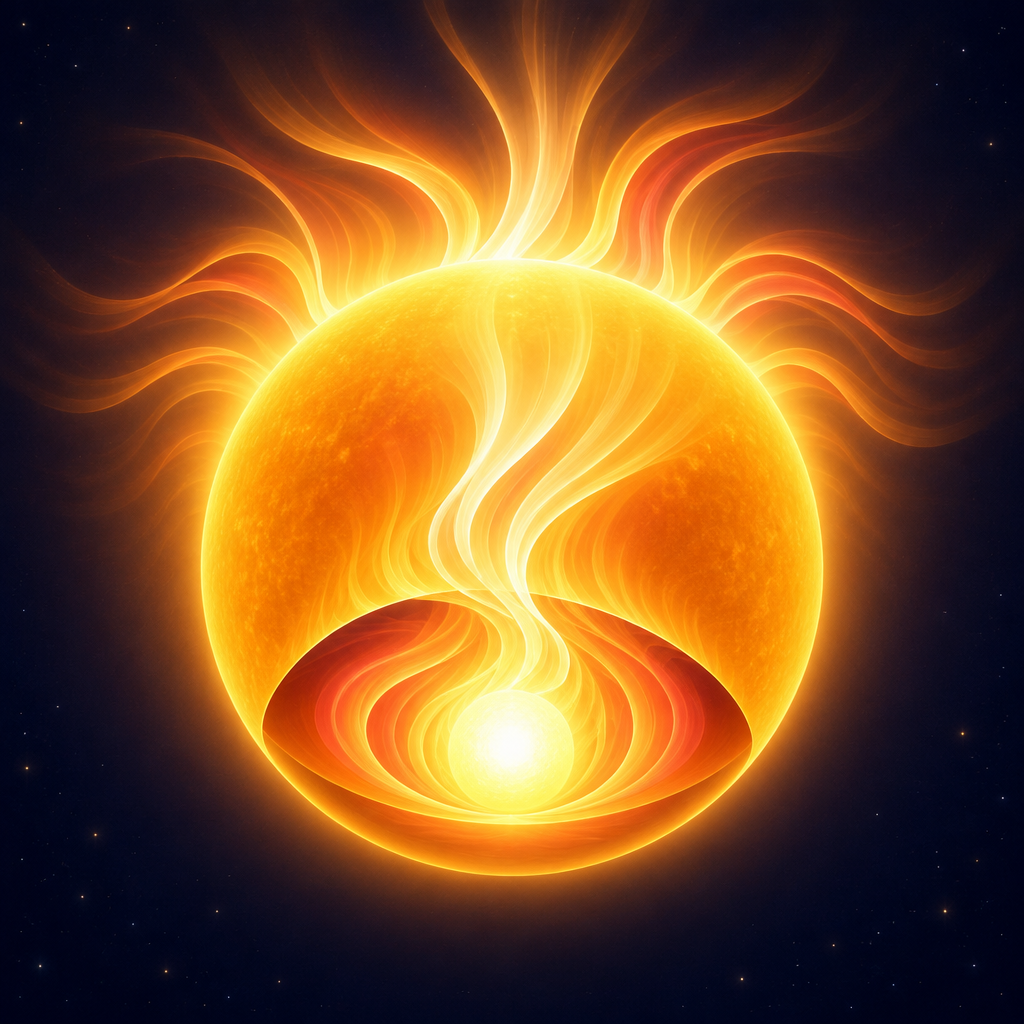
The Sun's Secret Engine and the Tokamak Quest to Copy It
This short course explains nuclear fusion in plain terms, moving from the stars to the machines built to copy them. The first lecture covers how the Sun works as a natural fusion reactor, describing the proton-proton chain reaction that merges hydrogen nuclei into helium and converts mass into energy according to Einstein's E=mc². Listeners learn why this process, repeated across billions of stars, produces the light and heat that make life on Earth possible, and why the Sun's enormous energy output sets the standard that human engineers try to match. The lecture ends by posing the central question of the course: can we recreate this stellar process on our own planet? The second lecture answers with the current state of human fusion research. It explains magnetic confinement, the method used to hold plasma at temperatures hotter than the Sun's core without touching any container walls, and the tokamak design that makes this possible: a donut-shaped chamber wrapped in superconducting magnets. The lecture covers ITER, the international megaproject working toward sustained fusion, alongside compact tokamak concepts from private companies like SPARC and TAE Technologies. It also compares fusion's energy potential against current power sources, addressing why fusion promises abundant energy without long-lived waste or carbon emissions. Across roughly ten minutes, the course builds a clear picture of what fusion is, how it happens naturally, and where the engineering effort stands today.
Stellar Sparks: How the Sun Powers the Universe
Stellar Sparks: How the Sun Powers the Universe
Every second, the Sun converts six hundred million tons of hydrogen into helium. Not by burning. Not by fire of any kind. And here's the part that gets me: about four million tons of that matter simply vanishes each second, gone from existence, and that vanishing is what warms your face on a summer afternoon. The Nobel Prize organization's own educational materials explain this as nuclear fusion in the Sun's interior, turning hydrogen nuclei into helium. Someone, that's the whole story of starlight in one sentence. But the details? The details are wilder than the headline.
So let's start with the, the basic distinction, because it trips everyone up. Nuclear fission, what powers today's plants, splits heavy atoms apart. Fusion does the opposite. It slams light atoms together until they merge. Why would merging release energy? Here's the key idea. The final product weighs less than the ingredients did. A helium nucleus made from four protons is lighter than those four protons alone. The missing mass? It became energy, following the famous mass-energy equivalence. Think of it like squeezing two lumps of clay into one and finding the new lump is lighter. The clay didn't disappear. It paid an exit fee, in energy. Terrible analogy, physically. But the, the intuition holds. Mass left the building as pure power.
Now, how does the Sun actually do this? Its main pathway is called the proton-proton chain, and it dominates in the Sun and other low-mass stars. Step one is the strange one. Two protons collide, and one of them has to change into a neutron, emitting a positron and an electron neutrino. That step is genuinely rare. Most proton collisions just bounce apart. But when it works, you get deuterium, heavy hydrogen. From there it's a relay race. Deuterium fuses with another proton to form helium-3. Then, in a major branch of the chain, two helium-3 nuclei combine, producing helium-4 plus two spare protons. Net result: four protons in, one helium nucleus out, energy released. There's a second pathway too, the carbon-nitrogen-oxygen cycle, also converting hydrogen to helium. But it's a minor contributor in our Sun. The proton-proton chain carries the load.
Here's where it gets genuinely surprising. All that fusion produces neutrinos, ghostly particles that barely touch matter. They escape the Sun's core and reach Earth in about eight minutes. The interior light, the photons? They take vastly longer to fight their way out. So the sunlight hitting you right now left the Sun's surface a while ago, but the core that made its energy, that energy's messengers arrived eight minutes after being created. Scientists have actually caught these neutrinos. The Borexino experiment, buried underground, measured neutrinos straight from the proton-proton reaction, testing the standard solar model. Remember this: solar neutrino detections are our direct evidence that fusion is what powers the Sun. And there was a puzzle. Detectors kept finding fewer neutrinos than predicted. The solar neutrino problem. The answer? Neutrinos change flavour, morphing from one type into another in flight. That discovery resolved the puzzle and showed neutrinos have mass. Borexino even reported an early measurement of the Sun's CNO cycle in 2022. We are, no exaggeration, reading the Sun's core mail.
So why can't we bottle this? If stars have run fusion for billions of years, why is it so hard down here? Because the Sun has advantages we lack. Immense gravity crushing its core, and time. Lots of time. We're trying to force protons together here on Earth without a star's squeeze, and those protons, they positively hate each other electrically. That's the engineering mountain. The takeaway: fusion is the universe's power source, mass itself traded for energy. Every star you've ever seen is running this exact trade. And the sunlight on your face, Someone? That's four million tons of vanished matter per second, delivered. The next question, the one we'll chase from here, is how humanity builds its own tiny star. Because if we ever pull it off, the payoff is, well, everything. Clean, abundant, star-grade power. That's a prize worth waiting for.
Terra‑Tokamak: Harnessing Fusion on Earth
Speaker 1
So I keep coming back to what we covered last time. The Sun fuses hydrogen because it has gravity we simply don't have.
Speaker 2
Right, that's the, the core problem. No star's squeeze down here, so we have to pay for confinement some other way.
Speaker 1
And that's why our machines run hotter than the Sun's core? Because I've heard tokamak plasmas described as ten times hotter, and that sounds, honestly, impossible.
Speaker 2
It sounds like a typo, doesn't it. But it's true. The Sun's core relies on enormous gravitational pressure. A terrestrial plasma can't, so it compensates with temperature.
Speaker 1
Compensates how? I mean, what's actually happening inside that, that doughnut?
Speaker 2
The key idea is the fourth state of matter. At fusion temperatures, atoms split into charged electrons and ions. That ionized gas is called a plasma.
Speaker 1
So it's not even a gas anymore.
Speaker 2
Not in the ordinary sense. And that's the gift, because charged particles respond to magnetic fields. That's the whole trick.
Speaker 1
The tokamak. Okay, walk me through it, because I've seen the pictures and it looks like a, a giant metal donut.
Speaker 2
That's not far off. A tokamak confines plasma in a doughnut-shaped, toroidal vessel, using magnetic fields so the hot plasma does not touch the walls.
Speaker 1
Because the walls would just vaporize.
Speaker 2
Instantly. Now, the geometry matters. The toroidal field runs the long way around the doughnut. The poloidal field circles the short way.
Speaker 1
And together they...
Speaker 2
Twist. They combine into helical field lines that cage the plasma. Think of a spiral staircase wrapping around and around the ring.
Speaker 1
Okay, and where does the poloidal field come from? Because the toroidal one, I assume, is just big external coils.
Speaker 2
Correct on the toroidal. The poloidal field comes from the plasma itself. A transformer induces an electric current in the plasma, and that current generates the poloidal field.
Speaker 1
So the plasma is part of the machine. It's fuel and, and electromagnet at once.
Speaker 2
Exactly. And that transformer current also heats the plasma, what's called ohmic heating. But here's the catch, it can't get you to fusion temperatures alone.
Speaker 1
So what fills the gap?
Speaker 2
Two main methods. Neutral beam injection fires energetic neutral atoms into the plasma. And radio-frequency heating transfers energy through plasma waves.
Speaker 1
Like a microwave for a star.
Speaker 2
That's, that's genuinely a fair picture. And what all this is buying is the triple product: temperature, density, and energy‑confinement time.
Speaker 1
Meaning the plasma has to be hot enough, dense enough, and hold that heat long enough.
Speaker 2
All three, multiplied together. The fuel itself, as we discussed, the Sun runs on hydrogen. Earth's machines mostly aim for deuterium and tritium.
Speaker 1
Why the switch?
Speaker 2
Because that reaction is the easiest to ignite. Deuterium and tritium merge into helium‑4 plus a neutron, releasing 17.6 MeV of energy.
Speaker 1
And where does that energy go?
Speaker 2
Split. The helium nucleus carries 3.5 MeV and can help heat the plasma, keeping the fire burning. The neutron carries 14.1 MeV and escapes, which is how energy leaves the machine.
Speaker 1
So the helium feeds the fire. The reaction is partly self‑sustaining.
Speaker 2
That's the dream, yes. Now, for a concrete case, look at JET, the Joint European Torus at Culham in the UK. It ran experiments with the actual deuterium‑tritium mix planned for ITER.
Speaker 1
And it actually worked? Real fusion energy out?
Speaker 2
Its final deuterium‑tritium campaign produced about 59 megajoules of fusion energy in a single pulse. A record for a tokamak.
Speaker 1
Fifty‑nine megajoules from one pulse.
Speaker 2
And here's the detail I love. According to the UK government's account, that came from about 0.2 milligrams of fuel.
Speaker 1
0.2 milligrams. That's, that's less than a grain of salt.
Speaker 2
Less. And JET's 2023 result matched its earlier 59 MJ pulse from 2021, so it wasn't a fluke. Consistent performance.
Speaker 1
Okay, so JET proved the physics. What's the next step? ITER?
Speaker 2
ITER, the international experimental tokamak under construction in France. Its purpose is studying burning‑plasma behavior and testing technologies for future fusion power plants.
Speaker 1
And the number everyone quotes is Q equals ten. What does that actually mean?
Speaker 2
500 megawatts of fusion power in the plasma, from 50 megawatts of external heating. That's the Q = 10 design target.
Speaker 1
So ten times more power out than in. That sounds like, like free energy.
Speaker 2
Careful, and this is the caveat everyone misses. Q = 10 compares fusion power to external heating power. It is not a claim the whole facility produces ten times the electricity it consumes.
Speaker 1
Ah. So the lasers, the magnets, the cooling, all of that isn't in the ratio.
Speaker 2
That's not included. And ITER is an experimental facility, not a power plant. It's not designed to convert its fusion output into grid electricity at all.
Speaker 1
So even the flagship machine isn't plugging into anyone's wall.
Speaker 2
Not yet. And there's a different approach worth mentioning. The National Ignition Facility uses lasers to compress a tiny deuterium‑tritium target. Inertial confinement instead of magnetic.
Speaker 1
That's the December 2022 announcement, right? I remember the headlines.
Speaker 2
That's the one. The target produced 3.15 megajoules of fusion energy from 2.05 megajoules of laser energy. Though that comparison excludes the energy consumed by the whole laser facility.
Speaker 1
That same caveat applies to the Q figure. The wall‑plug number is typically worse.
Speaker 2
Typically. But it was still a genuine milestone, ignition demonstrated. Now, the honest question is why this all takes so long.
Speaker 1
The joke, you mean. Fusion is often said to be thirty years away.
Speaker 2
The joke exists for a reason. Three bottlenecks, really. One, disruptions. Tokamaks relying on a large plasma current can suffer rapid losses of confinement.
Speaker 1
The plasma just, what, escapes?
Speaker 2
Collapses, suddenly, and that's a serious challenge for reactor operation. Second, materials. The high‑energy neutrons from deuterium‑tritium fusion damage structures and components.
Speaker 1
So the machine is being, being sandblasted from the inside, constantly.
Speaker 2
Good image. And the divertor, the component managing exhaust from the plasma, copes with intense heat and particle bombardment. Third, tritium itself.
Speaker 1
Because tritium is rare.
Speaker 2
Rare enough that a future power plant would need to breed it, using fusion neutrons interacting with lithium in a breeding blanket. The fuel has to manufacture itself, essentially.
Speaker 1
So the machine makes its own fuel while withstanding the radiation that makes its own fuel. It's, it's a loop that has to close perfectly.
Speaker 2
That's a beautiful way to put it. And one more wrinkle. The transformer‑driven current is inherently pulsed. Once the transformer can't induce current anymore, that drive ends.
Speaker 1
So a classic tokamak can't just run forever.
Speaker 2
Not with that method, which is why researchers are pursuing non‑inductive current drive for steady operation. That's the engineering frontier.
Speaker 1
Okay, so for our listener, the takeaway here.
Speaker 2
The takeaway is that magnetic confinement in a tokamak really does create star‑core conditions, hotter than the Sun, held by invisible fields. The physics works. JET proved it with 59 megajoules from a speck of fuel.
Speaker 1
And the remaining distance to a power plant is engineering, not physics.
Speaker 2
Materials, tritium breeding, steady‑state operation. Hard problems, but named problems. And that's exactly where we pick up next time, the machines and companies trying to close that final gap.