The Springfield Experiment: Naismith's Invention
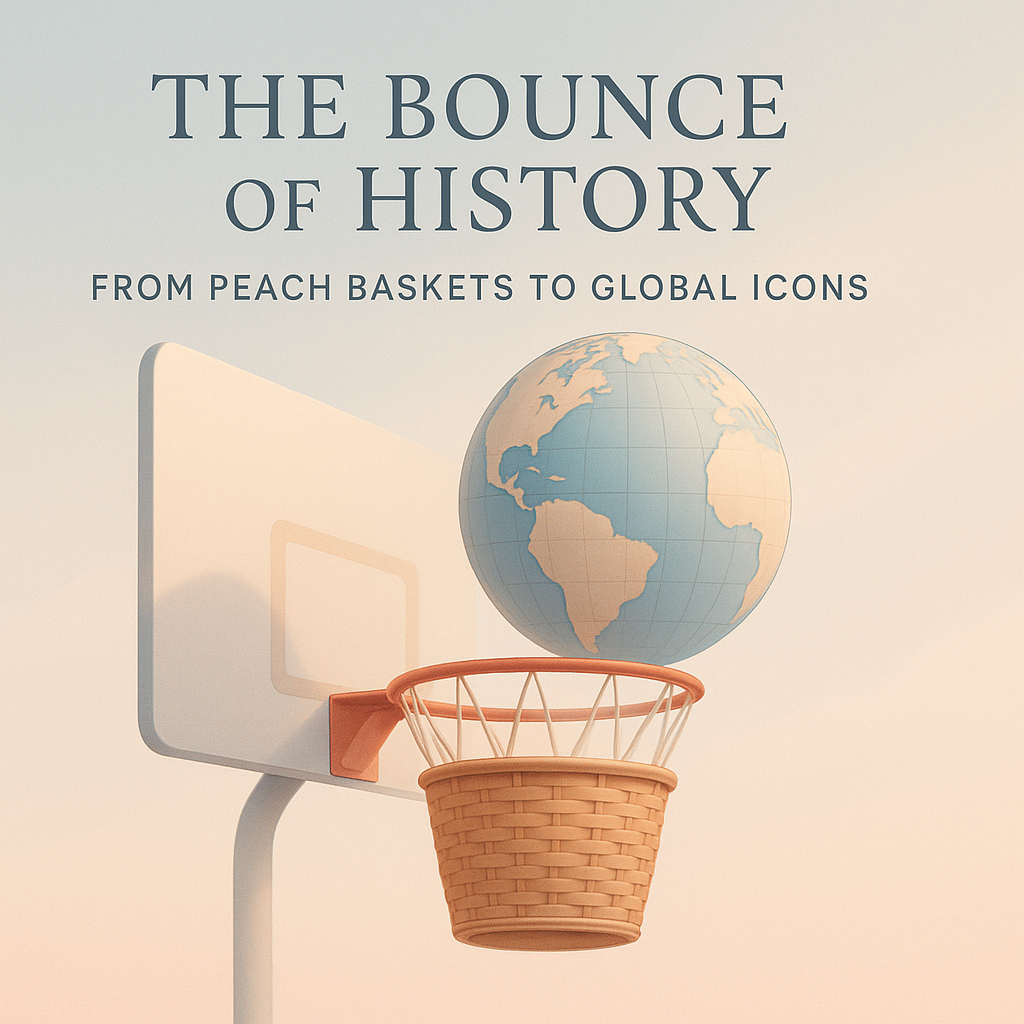
The Bounce of History: From Peach Baskets to Global Icons
The Springfield Experiment: Naismith's Invention
The Barnstorming Era: Cages and Pioneers
The College Crown: Madison Square Garden's Influence
The Merger: Birth of the NBA
The Big Men: Russell, Chamberlain, and Integration
The ABA Flash: Red, White, and Blue Innovation
The Global Explosion: Magic, Bird, and Jordan
The Modern Frontier: Analytics and the WNBA

Transcript
Welcome to your journey through The Bounce of History: From Peach Baskets to Global Icons, starting with The Springfield Experiment: Naismith's Invention. The entire sport of basketball — a multi-billion dollar global industry played by hundreds of millions — was invented in fourteen days, under a deadline, by a man who had never designed a game before. That man was Dr. James Naismith, a Canadian physical educator who arrived at the International YMCA Training School in Springfield, Massachusetts in 1890, and who would accidentally reshape the sporting world before the year 1891 was out. The problem Naismith was handed was deceptively simple. Luther Halsey Gulick, head of physical education at Springfield, needed an indoor winter game to keep restless track athletes fit and occupied between seasons. The game had to be fair, not too rough, require little space, and hold the attention of competitive young men. Naismith had fourteen days. His early experiments were brutal — players walked away with black eyes, a separated shoulder, and at least one man knocked unconscious. Those failures forced him to think differently, Tyler. He drew on a childhood game called "duck on a rock," which rewarded lobbing arcs over brute force, and that insight became the philosophical core of basketball: skill beats power. Thirteen rules. That's all it took. Naismith typed them up, his secretary posted them on the bulletin board, and on December 21, 1891, the first game tipped off in the gymnasium of the School for Christian Workers. He had requested two eighteen-inch square boxes for goals; the janitor brought peach baskets instead. Those baskets were nailed to the balcony rail exactly ten feet above the floor — not because of biomechanical research or optimal shooting angles, but because that's simply how high the balcony was. That accidental measurement became the universal standard every court on earth still uses today. Nine players per side, a soccer ball tossed up between two centers by Naismith himself, two fifteen-minute halves, and one critical rule that separated this game from football and rugby: no running with the ball. No running meant no tackling. No tackling meant no slugging. The violence that had wrecked his earlier experiments was designed out entirely. The first game was still chaotic, Tyler. Eighteen men who had never played before, competing hard, learning the rules in real time — the final score was 1-0, a single goal in thirty minutes of play. One of the scorers was Amos Stagg, a faculty member who also earned a black eye for his effort. The winning team, later called the Flying Circus and captained by a player named Mahan, became the first basketball team in history. Within weeks the game spread across campus; by January 15, 1892, the thirteen rules were published in the school newspaper, The Triangle, and distributed nationally. The first public game followed on March 11, 1892, drawing two hundred spectators to watch teachers face students. When someone suggested naming the sport "Naismith Ball," he refused. He let the game speak for itself. Here's what makes this origin story matter beyond the nostalgia, and this is the core of everything you'll build on in this course: Naismith didn't stumble onto basketball by accident. He engineered it with intention — thirteen rules built around a single principle, that athletic competition should reward skill and intelligence over brute force. A peach basket, a ten-foot balcony, and two weeks of pressure produced a framework so sound that its DNA is still visible in every game played today. Dr. James Naismith invented basketball in 1891 as a safe, indoor winter sport, and the elegant simplicity of those original thirteen rules is precisely why the game survived, scaled, and conquered the world.