Laying the Foundations: From the Pyramid's Why to Building Logical Order
The Minto Pyramid Principle: Logic in Writing, Thinking and Problem Solving by Barbara Minto

Transcript
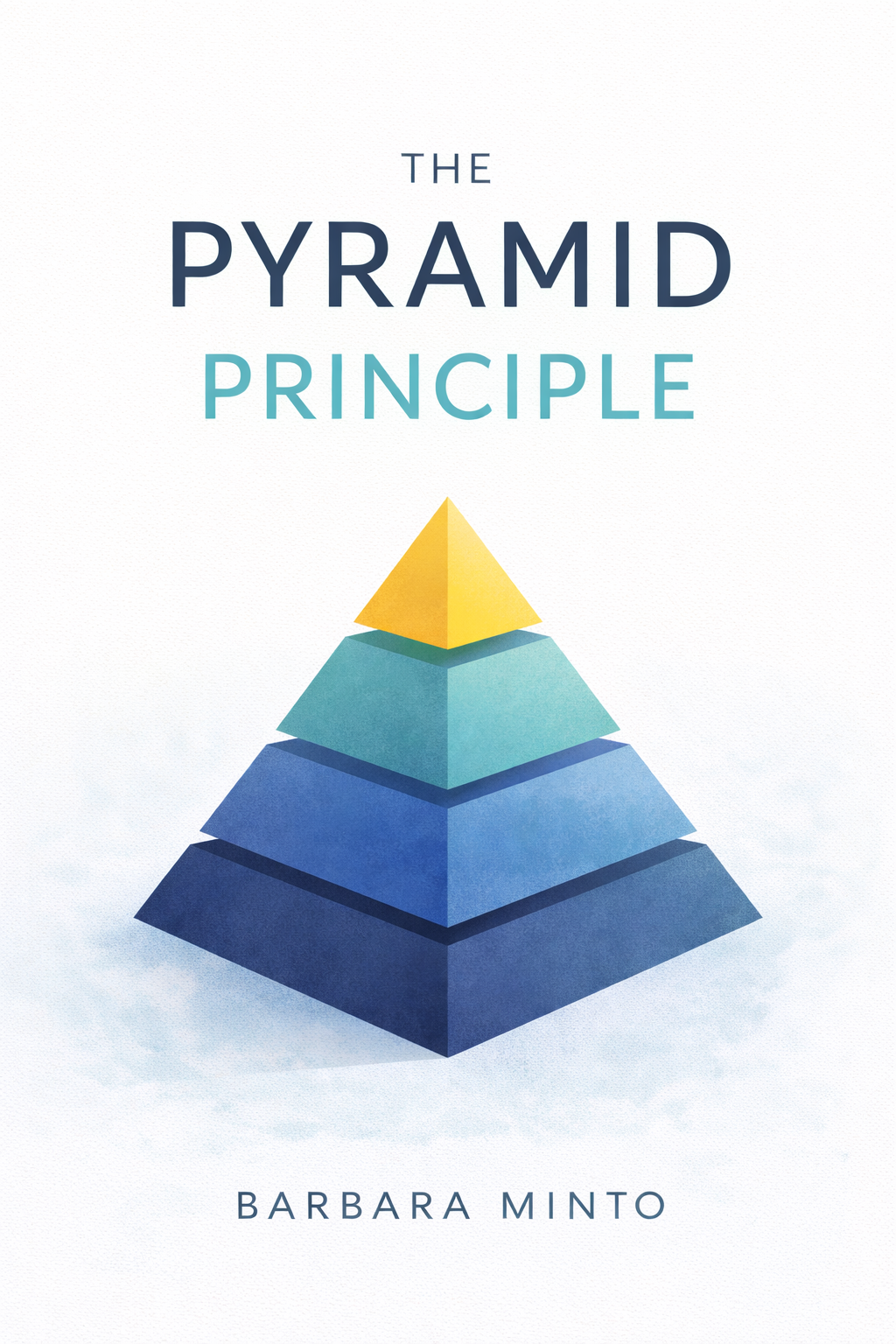
Welcome to The Minto Pyramid Principle: Logic in Writing, Thinking and Problem Solving by Barbara Minto — a book that will permanently change how you organize every idea you communicate. Most people assume that explaining their thinking process step-by-step helps readers follow along, but this approach actually guarantees confusion and poor retention. Barbara Minto, McKinsey's first female MBA hire who spent a decade revolutionizing how consultants think, discovered the counterintuitive truth hiding in plain sight. The human mind automatically organizes information into hierarchical groupings to comprehend meaning, yet most writers ignore this fundamental cognitive reality. Your short-term memory can hold only about seven pieces of information at once, which means logical grouping becomes essential rather than optional. When ideas arrive randomly or poorly organized, the reader's mind must work harder to create its own structure, leading to confusion and wasted mental energy. The pyramid structure solves this problem by presenting the main point at the top, followed by supporting arguments below, with each level providing increasingly detailed information. This top-down approach aligns with how readers prefer to receive information — they need the overall message before diving into supporting details. Minto calls this controlled abstraction, where ideas at any level are summaries of the ideas grouped below them, creating hierarchical organization that reveals relationships between ideas. The central challenge in business writing emerges from a fundamental disconnect between how we think and how we should communicate. Writers naturally develop ideas bottom-up, starting with details and working toward conclusions, but readers need the opposite presentation. This mismatch requires writers to consciously reorganize their thinking into pyramid form before writing, ensuring every grouping has a clear summarizing point above it. The pyramid functions as both a thinking tool and a communication framework, forcing writers to clarify their logic and ensure every idea serves a clear purpose. Ideas at any level must always be summaries of the ideas grouped below them, and ideas in each grouping must be the same kind of idea. Grouped ideas must be characterizable with a plural noun — such as reasons, problems, or steps — and the governing idea above must comment on that commonality. Logical relationships within the pyramid follow specific patterns depending on whether ideas are grouped vertically or horizontally. Vertical relationships follow question-answer logic, where each idea raises a question that the grouping below must answer. Horizontal relationships follow three patterns: deductive reasoning with major premise, minor premise, and conclusion; inductive reasoning that draws a single inference from similar ideas; or grouping by classification that organizes related concepts together.