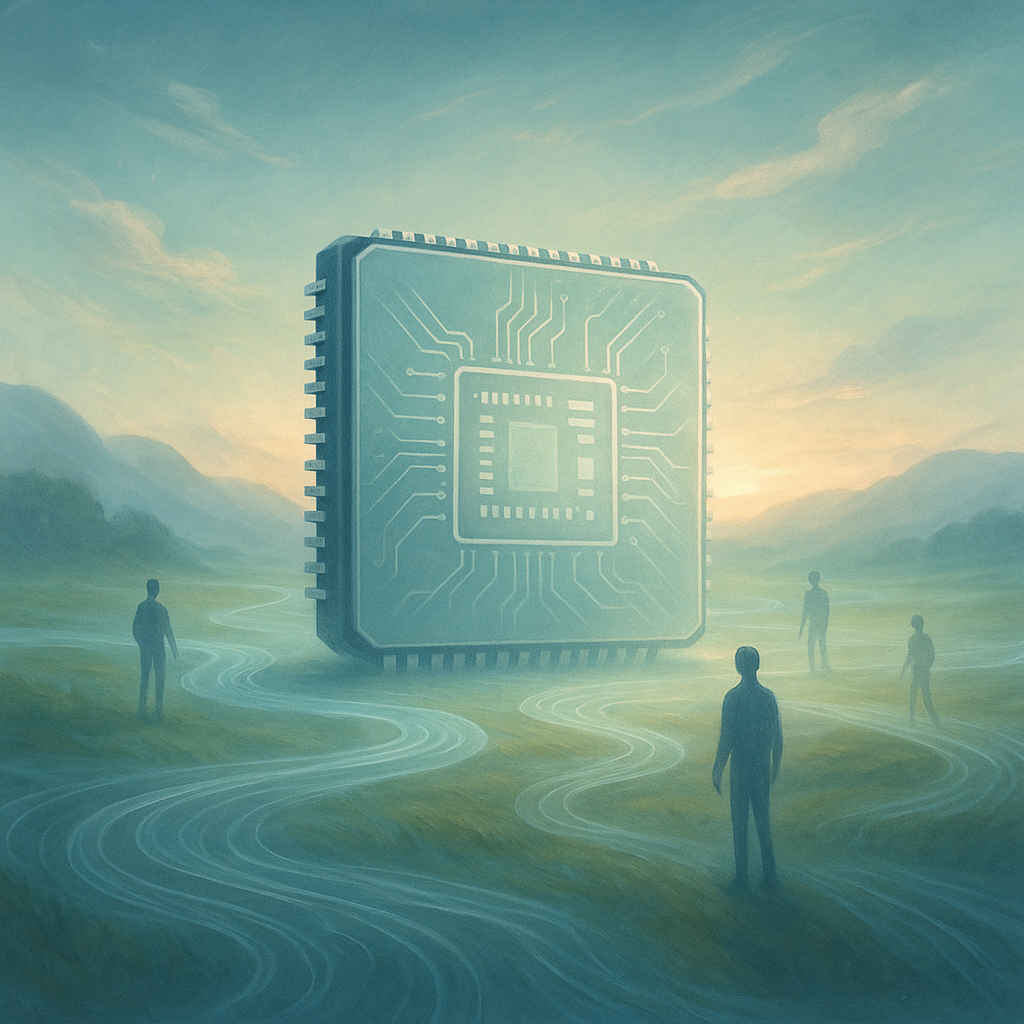
The End of Toil: Musk, Andreessen, and the Dawn of Automation
The Silicon Minds: Musk, Andreessen, and the Future of Labor
The End of Toil: Musk, Andreessen, and the Dawn of Automation
The Silicon Valley Debate: Displacement vs. Augmentation
Sam Altman: Intelligence as a Commodity
Jensen Huang and the 'Death of Coding'
Peter Thiel: Human Uniqueness in a Binary World
The Policy Frontier: UBI, UHI, and the New Social Contract
Naval Ravikant and the Sovereign Individual
Conclusion: Building the Post-Work Identity

Transcript
Welcome to your journey through The Silicon Minds: Musk, Andreessen, and the Future of Labor, starting with The End of Toil. Here is the sharpest fact to hold onto: Goldman Sachs estimates generative AI could displace 300 million jobs globally — yet that same analysis projects a nearly $7 trillion boost to global GDP within a decade. Those two numbers live in the same report, and the tension between them is exactly where this conversation begins. At the 2023 UK AI Safety Summit, Elon Musk didn't soften the prediction. He said AI will reach a point where "no job is needed." Full stop. Musk's vision goes further than most people realize, Sergey. When he talks about a post-labor economy, he deliberately avoids the phrase "Universal Basic Income." His term is "universal high income" — and the distinction matters. UBI implies a government stipend, a floor to prevent poverty. Universal high income implies abundance, not subsistence. It's a society where machines handle the physical and cognitive heavy lifting, and humans receive the surplus that productivity generates. The framing shifts the entire moral weight of the conversation: this isn't about survival. It's about what humans do when survival is no longer the point. Marc Andreessen answers that question with aggressive optimism. His Techno-Optimist Manifesto, published on the a16z platform, argues that technology is not a job destroyer — it is an intelligence amplifier. Every wave of automation in history, from the loom to the assembly line, generated fears of permanent displacement. Those fears were never wrong about disruption; they were consistently wrong about the endpoint. New industries absorbed displaced workers, often at higher wages and lower physical cost. Andreessen's argument is that AI follows the same logic, only faster and at greater scale. The new industries won't look like the old ones. That's the point. History gives this debate a longer shadow. In 1930, economist John Maynard Keynes predicted that by 2030, humanity would have solved what he called "the economic problem" — scarcity — leading to 15-hour work weeks. He was early, not wrong. The productivity gains arrived; the redistribution of leisure didn't follow automatically. That gap between technological capacity and social adaptation is precisely what today's tech leaders are trying to close by design rather than accident. The question isn't whether AI can replace cognitive labor. It already is. The question is whether the institutions around it move fast enough to convert disruption into distribution. This is where it gets most interesting for you, Sergey. When machines perform the work, human identity faces a structural crisis — because for most of modern history, professional titles have been how people answer the question "who are you?" The model that emerges from these thinkers is what you might call the voluntary hobby economy: work becomes something you choose for meaning, craft, or connection, not economic necessity. That is not a utopia handed down automatically. It requires deliberate design of incentives, education, and social structures. But the key takeaway from Musk, Andreessen, and the data behind them is this — the future of work is being redefined from a survival necessity to a pursuit of purpose, as AI prepares to handle the physical and cognitive heavy lifting of civilization. The question every institution, every worker, and every policymaker now faces is not whether that transition is coming. It's whether we build the bridge before the ground shifts beneath us.