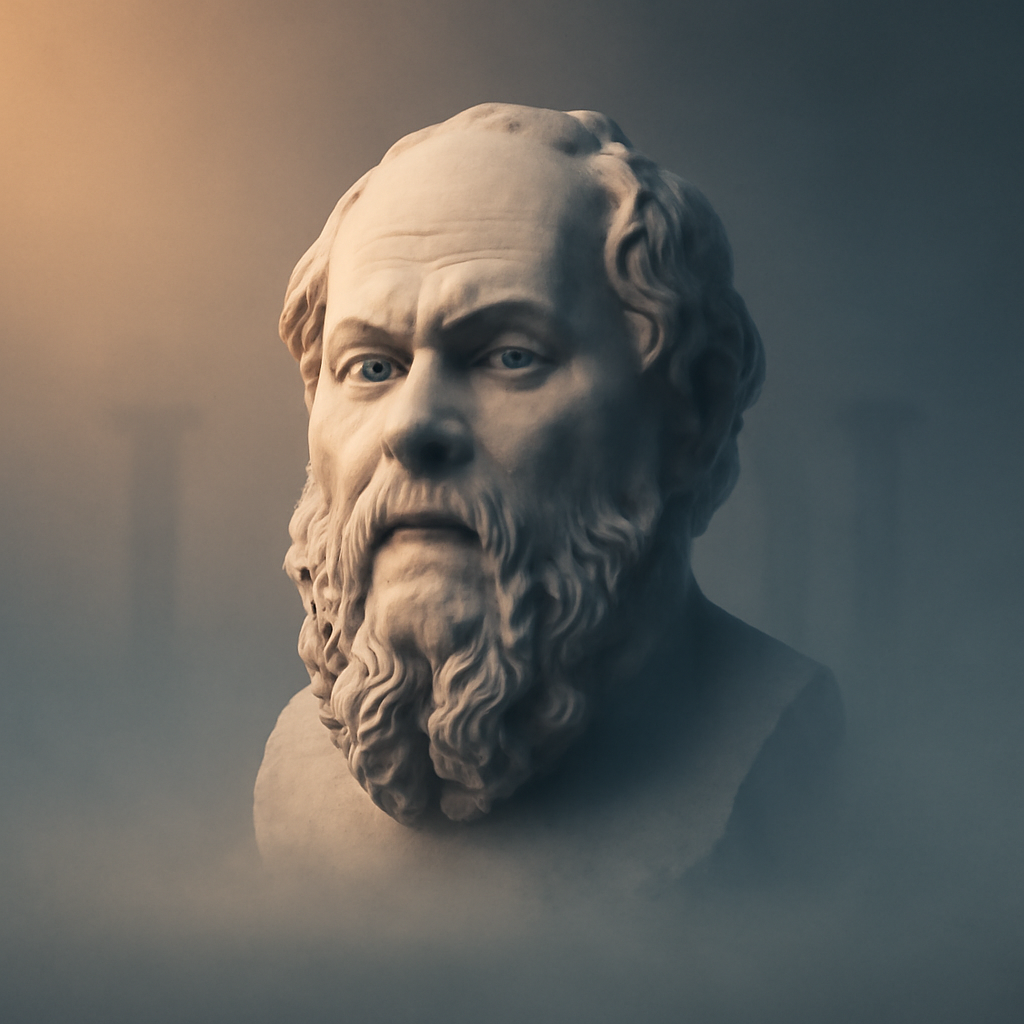
The Athenian Suspension: Pyrrho’s Voyage and the India Intersection
The Skeptic's Journey: From Indian Camps to Roman Clinics

Transcript
A philosopher who left no writings changed the entire trajectory of Western thought. That is the paradox at the heart of skepticism's origin story. Pyrrho of Elis, born around 365 BCE in a small city on the western Peloponnese of Greece, is often credited as the founding figure of what became Pyrrhonism. He wrote nothing. Every idea attributed to him arrived through secondhand accounts, filtered through his student Timon of Phlius, then preserved in a report by Aristocles of Messene, and finally transmitted by the later author Eusebius. That chain of transmission alone should make you pause. The man who taught the world to question certainty left us only uncertainty about his own views. Here is where the story gets genuinely strange, Moe. Around 334 BCE, Alexander the Great launched his eastern military campaign. Pyrrho joined it. So did Anaxarchus of Abdera, a philosopher connected to atomist thought. The expedition pushed through Central Asia and eventually reached the northwestern Indian subcontinent. There, according to ancient sources, Pyrrho encountered figures the Greeks called gumnosophistai — "naked wise men." These were Indian ascetics. Think of it this way: a Greek philosopher from a small Peloponnesian city, embedded in a conquering army, suddenly face-to-face with a radically different tradition of renunciation and detachment. The encounter is reported in Diogenes Laertius's biography of Pyrrho, though Diogenes himself lived centuries after the fact. The identity of those Indian teachers remains unknown. Whether Pyrrho absorbed specific doctrines from them cannot be demonstrated. What we can say is this: he came back transformed. The transformation produced what we can call the Equipollence Framework. Ancient reports describe Pyrrho treating things as equally indifferent, unmeasurable, and undecidable. The key idea is balance — not between two good options, but between two competing claims about reality where neither side wins. When arguments appear evenly matched, the rational move is not to force a verdict. It is to suspend judgment. Later Pyrrhonists gave this move a name: epochē. Now, epochē is not the same as saying "nothing is knowable." That is a crucial distinction. Later Pyrrhonists, including Sextus Empiricus — active roughly in the late second or early third century CE — were explicit on this point. They presented themselves as continuing to investigate, not as people who had reached a final negative conclusion. The Greek verb skeptesthai literally means "to investigate" or "to examine." A skeptic, originally, was someone disposed to keep looking. That means the popular image of the skeptic as a cynical denier is historically backwards. So what does epochē actually deliver? The practical goal, Moe, is ataraxia — tranquility, freedom from disturbance. Here is the logic: most emotional suffering comes from dogmatic commitment to contested beliefs. You are certain your interpretation is right. The other side is certain theirs is. The conflict produces anguish. Pyrrhonism offers a different path. Later Pyrrhonists drew a sharp line between unavoidable appearances — feeling heat, feeling cold, experiencing hunger — and assent to disputed theories about the hidden nature of things. You do not have to deny your sensations. You simply withhold final judgment on the theoretical claims built on top of them. For example, in a high-stakes conflict where two parties each hold compelling but contradictory evidence, applying what we might call the 50/50 Perception rule means recognizing that your certainty itself is the source of distress, not the disagreement. Suspend the verdict. The disturbance eases. That is ataraxia in practice. The takeaway here is not that Pyrrho invented doubt. The takeaway is that he weaponized it for psychological survival. Skepticism began as a tool for peace of mind, not paralysis. The pitfall to avoid — what we can call Nihilistic Paralysis — is treating epochē as an excuse to stop functioning. Pyrrho himself reportedly continued to act, to eat, to navigate the world. He simply refused to attach his emotional wellbeing to unresolvable metaphysical verdicts. The bridging rule for today is direct: when you face a conflict where evidence genuinely cuts both ways, the Pyrrhonian move is not to pick a side to feel resolved. It is to hold the suspension, stay functional, and protect your clarity. Skepticism, at its origin, was not a philosophy of despair. It was a philosophy of endurance.