The Physics of Being: Introduction to Assembly Theory
Assembly Theory: Redefining Life and Time

Transcript
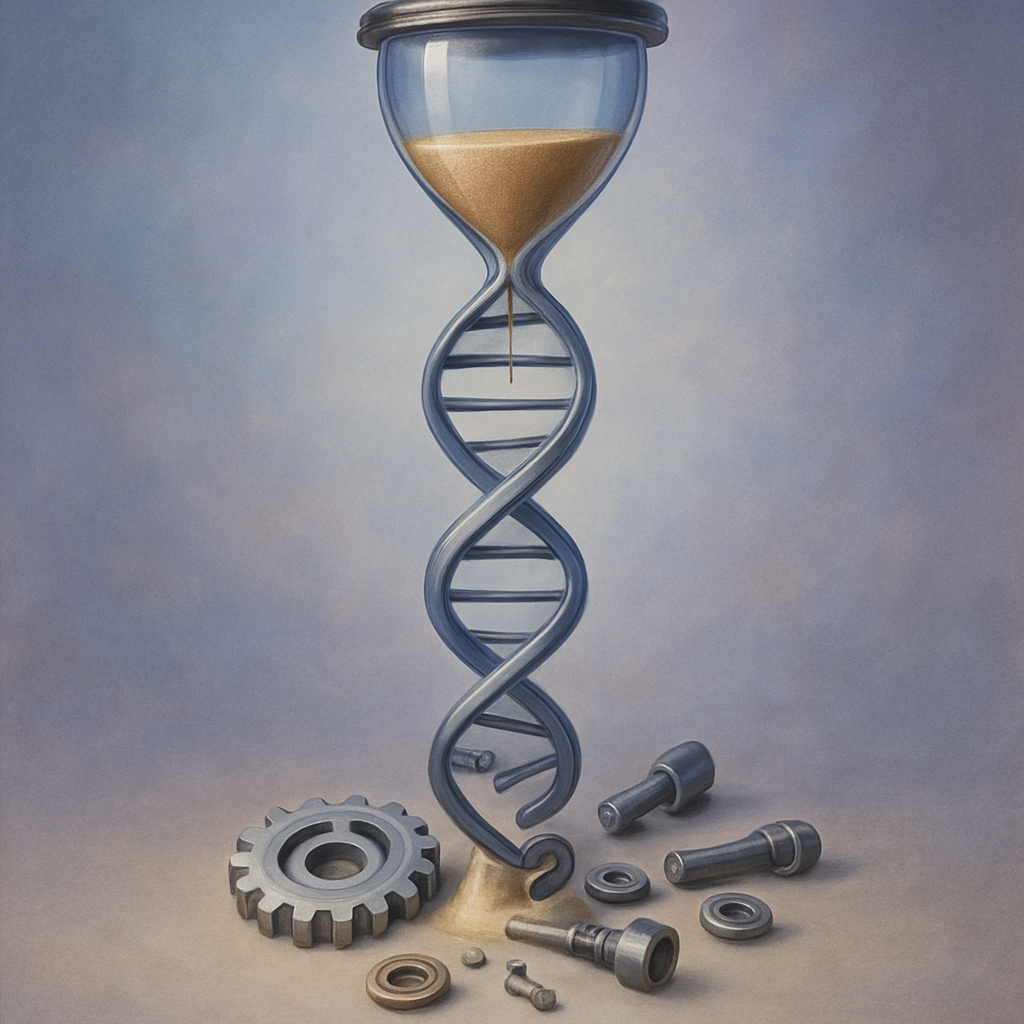
Welcome to your journey through Assembly Theory: Redefining Life and Time, starting with The Physics of Being: Introduction to Assembly Theory. A smartphone has an assembly index above 50, meaning it took more than fifty sequential construction steps to exist — and that single number, according to physicist Sara Imari Walker and chemist Lee Cronin, is enough to prove it could never have formed by random chemistry alone. Walker, a theoretical physicist at Arizona State University, argues that this isn't just a clever trick for identifying technology. It's the foundation of an entirely new way to define life itself. Here's the core idea, Sergey. Traditional physics has always struggled to define life because it treats everything as atoms obeying equations, with no room for history. Assembly theory breaks that open. Every object has an assembly index — the minimum number of steps required to build it from basic building blocks. A simple molecule might need three steps. A complex organic compound might need fifteen. That threshold of fifteen steps is critical: Walker and Cronin identified a phase transition right around fifteen assembly steps in organic chemistry, where objects become too improbable to exist unless something is actively selecting for them. Below that threshold, random chemistry can produce you. Above it, only life can. On March 15, 2025, Walker and Cronin published experimental validation using AI-driven molecular assembly simulations, confirming these phase transitions at fifteen to twenty steps for prebiotic molecules — turning a theoretical conjecture into measurable science. But the assembly index alone isn't enough. This is where copy number enters, and it changes everything. A single complex molecule appearing once could be a fluke. Finding thousands of identical copies of a high-assembly-index molecule is statistically impossible without a process that keeps rebuilding the same thing — which is exactly what life does. Reproduction, metabolism, evolution: all of them are copy-generating machines. Walker and Cronin validated this in lab evolution experiments in July 2025, showing that high copy numbers of complex objects reliably signal living processes. This is why assembly theory can function as a biosignature detector. NASA's Perseverance rover applied assembly theory metrics to Martian organic samples in November 2025, using AI assembly indexing to flag potential biosignatures — the first time this framework was deployed on another planet. And as of January 2026, SETI researchers are using assembly indices to search for technosignatures, because human artifacts like smartphones score above fifty while abiotic rocks score near zero. Assembly theory also restructures how we think about time, and this is where it gets genuinely strange, Sergey. Walker argues that time isn't just a backdrop against which events happen — it's a physical property literally stored inside complex objects. When you look at a high-assembly-index molecule, you're not just seeing chemistry. You're seeing a record of every historical step required to produce it. The object encodes its own causal lineage. This means evolution isn't just biology — it's a fundamental feature of how the universe generates complexity. Assembly theory maps four nested layers of reality: the Assembly Universe of all possible permutations, the Assembly Possible constrained by physics, the Assembly Contingent shaped by historical pathways, and the Assembly Observed — what actually exists. Life occupies that final layer precisely because selection, not randomness, built it step by step. In February 2026, Cronin's team at Chemify synthesized a twenty-five-step molecule in ten minutes using robotic chemists, accelerating origin-of-life simulations by a factor of one thousand. Life is not defined by DNA, carbon, or any specific molecule. It is defined by complexity that required history to build — objects so improbable that only a universe with memory, selection, and time baked into its structure could produce them. That's the key insight Walker and Cronin are driving toward: the universe doesn't generate complexity by accident. Life is the only mechanism it has for doing so at all, and every complex object you encounter is, in a very real sense, a physical record of time itself.