The Ghost of the Past: Time as a Physical Property
Assembly Theory: Redefining Life and Time

Transcript
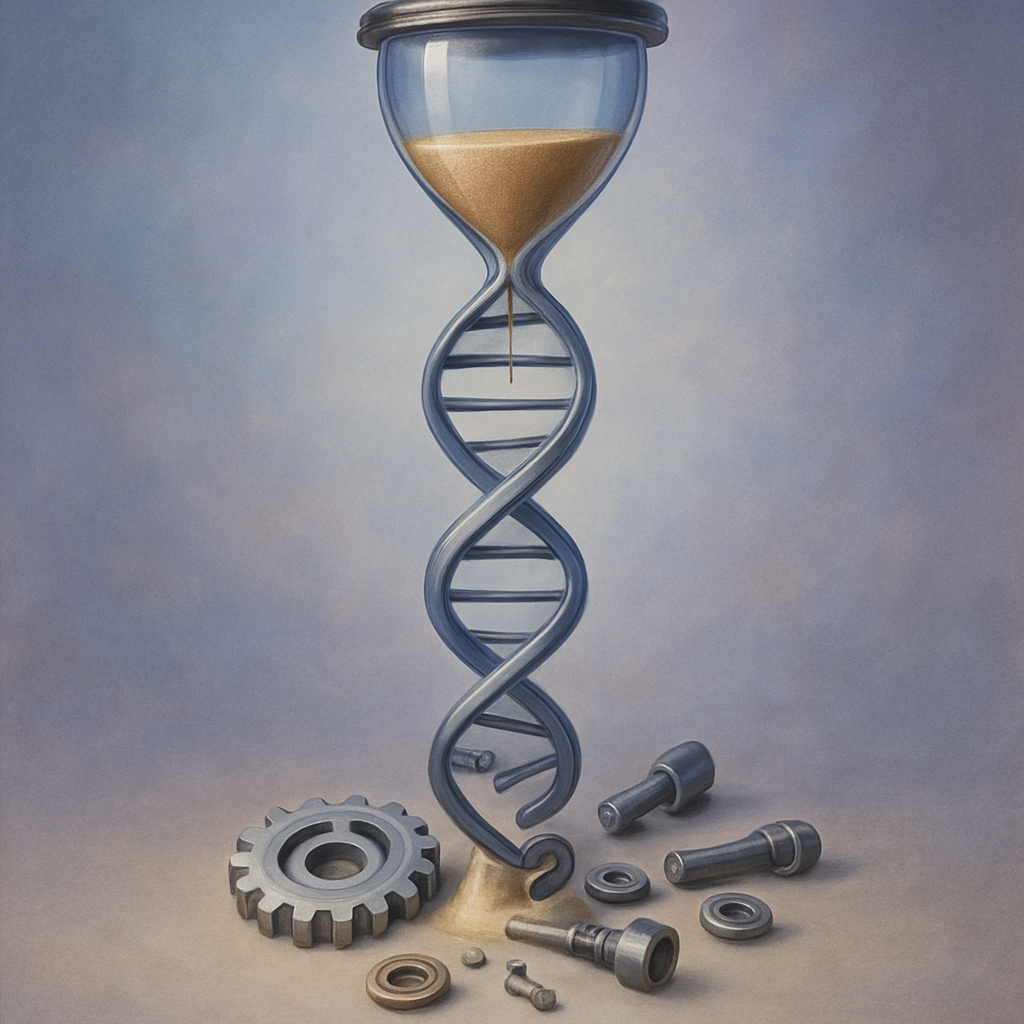
Fossilized stromatolites, 3.5 billion years old, still carry detectable assembly histories inside their molecular structure. Not metaphorically. Physically. Sara Imari Walker, theoretical physicist at Arizona State University, argues this is proof that time isn't something objects move through — it's something objects are made of. That single claim rewires everything you think you know about what time actually is. While the Assembly Index provides a universal threshold for life's complexity, the philosophical implications of this threshold are profound. Now the deeper question: why does that threshold exist at all? The answer lives in what Walker calls the physical nature of time itself. Traditional physics views time as a mere backdrop for events. However, Assembly Theory posits that time is an intrinsic part of objects, embodying causation. Every sequential construction step that built a complex object is literally stored inside that object. A DNA strand doesn't just contain genetic information — it contains compressed causal history, billions of years of selection decisions, encoded in its structure. Walker calls this 'size in time.' The more steps required to assemble an object, the larger it is in the temporal dimension. Humans, she argues, are among the largest objects in the universe — not in space, but in time, carrying 4 billion years of evolutionary history inside every cell. This is where it gets genuinely strange, Sergey. If time is embedded in objects, then the universe itself is not deterministic in the classical sense. The future stays open until physical constructions cause new possibilities to exist. Life doesn't just inhabit possibility space — it carves new paths through it, generating structures that couldn't have existed before. Experiments have shown that synthetic protocells can reach high Assembly Index values, illustrating life's complexity in a lab setting. Recent research links Assembly Theory to quantum causation, offering insights into the arrow of time in open systems. The universe, in this view, learns. It accumulates construction history, and that history becomes the scaffolding for everything more complex that follows. Simpler structures build more elaborate ones; the phylogenetic tree of life is causation propagating forward through time, reusing objects across generations. Life is an open-ended cascade, not a closed loop. Here's the synthesis, Sergey. Assembly Theory doesn't just redefine life — it redefines time. Every high-assembly object you encounter is a ghost of its own past, a physical record of every causal step that had to happen for it to exist. The 'ghost of the past' isn't a metaphor. It's the actual structure of the molecule in front of you. Time, in this framework, is not a background coordinate ticking indifferently behind events. It is a dimension physically occupied by complex objects — and the more history an object required to build, the more time it genuinely contains.