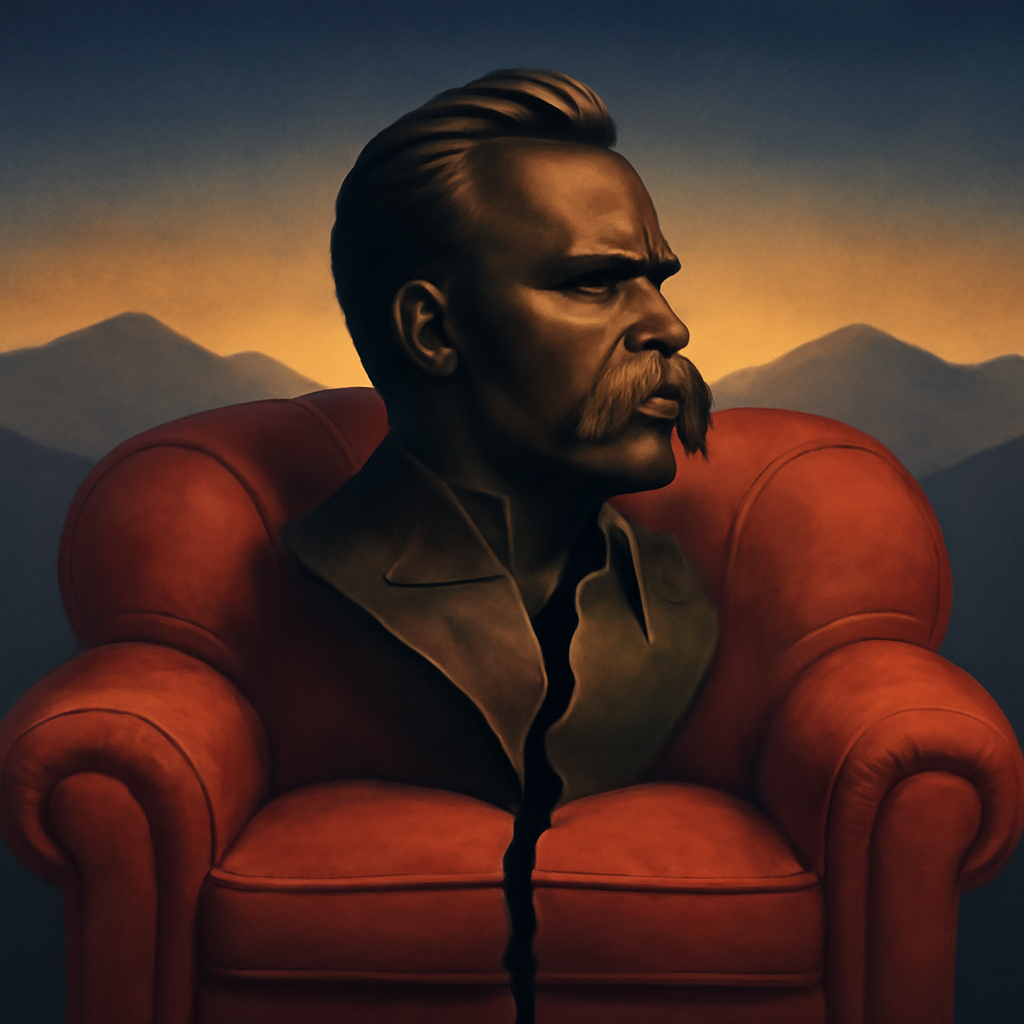
The Creative Destruction: Embracing the Will to Power
The Nietzschean Awakening: Beyond Comfort and Morality

Transcript
SPEAKER_1: Alright, so last time we established that inherited values can function like a cage — and Nietzsche’s critique of traditional morality is one way of seeing the bars clearly. Now I want to push into what comes after that diagnosis. Because tearing something down without building anything new just leaves rubble. SPEAKER_2: Exactly right. And that's where the Will to Power enters — not as a license to dominate, but as the engine of what Nietzsche calls self-overcoming. The key idea is that human behavior, in his psychological reading, is driven by a desire to expand, organize, and express one's power — not merely to survive or preserve what already exists. SPEAKER_1: So not power over other people. Power over... what, exactly? SPEAKER_2: Over oneself, primarily. Over one's own drives, habits, inherited values. Nietzsche treats the self as a plurality of competing drives — not a unified, transparent subject where the rational mind simply decides and the body obeys. Self-overcoming means transforming those drives rather than just suppressing them. SPEAKER_1: That's a meaningful distinction. Think of someone who forces themselves to stop feeling envy by sheer willpower — versus someone who redirects that envy into a creative project. One suppresses, one transforms. SPEAKER_2: That's a perfect illustration. And Nietzsche goes further in Beyond Good and Evil — he suggests that overcoming one emotion is often itself the expression of another emotion. So the idea of a clean, independent rational will standing above our drives is already a fiction. The work is always happening inside the drives themselves. SPEAKER_1: Now, where does ressentiment fit into this? Because Garry encountered that concept in the first lecture, but I want to understand the mechanism more precisely. SPEAKER_2: Right. Ressentiment is a reactive pattern in which blocked striving turns into resentment and moral condemnation rather than creative self-overcoming. Instead of acting, the person reacts. And that reactive energy curdles into a moral system. The blocked desire becomes condemnation of whoever seems to be thriving. SPEAKER_1: So it's not just bitterness. It's bitterness that disguises itself as ethics. SPEAKER_2: [emphasis] Precisely. And here's the counterintuitive part — Nietzsche would argue that constant victimhood, chronic moral outrage, blaming the system — these can themselves be disguised forms of power-seeking. The person is still trying to expand influence and control the narrative. They've just routed it through accusation rather than creation. SPEAKER_1: Mm. That's uncomfortable to sit with. SPEAKER_2: It should be. Because it forces a hard question: is a given grievance oriented toward building something, or is it oriented toward keeping the other person small? Legitimate criticism of injustice points toward a new value, a new structure. Ressentiment just needs the enemy to stay guilty. SPEAKER_1: So how does someone actually move from reactive to creative? What's the practical mechanism there? SPEAKER_2: Think of it as turning resistance into material for growth. When frustration, failure, or humiliation arrives, the Nietzschean move is to ask: what does this resistance reveal about which of my drives are still undeveloped? Nietzsche explicitly says striving against resistance is part of what makes willing meaningful. The obstacle isn't interrupting the process — it is the process. SPEAKER_1: Right — but how? Walk through the steps. SPEAKER_2: First, name the emotion precisely — envy, humiliation, exhaustion. Second, ask what value it's protecting. Third, ask whether that value is rooted in genuine affirmation or in ressentiment. Fourth — and this is the creative step — identify one concrete act that expresses expansion rather than reaction. Not a rebuttal. A creation. SPEAKER_1: And the revaluation of all values — how does that connect? Because that phrase sounds radical, but I want to make sure listeners understand it's not just 'reject society's rules and do whatever.' SPEAKER_2: That's a crucial clarification. Revaluation isn't selfishness or rule-breaking for its own sake. It's a rigorous examination — which inherited commitments are life-enhancing, which are reactive, and what new values could replace the reactive ones. The Übermensch, Nietzsche's ideal figure, participates in creating values, not just consuming or rejecting them. SPEAKER_1: One thing worth flagging — the book literally titled The Will to Power. It should not automatically be treated as Nietzsche’s definitive statement on all of this. SPEAKER_2: [inhale] And that's a real problem. That book was not a finished manuscript Nietzsche prepared for publication. It is a posthumous compilation of notebook material — Nietzsche’s sister Elisabeth Förster-Nietzsche and associates selected and arranged unpublished notes under that title after his mental collapse. Modern scholarship is clear: it should not be read as his systematic final word. SPEAKER_1: So the operational rule for applying all of this — what would it be? SPEAKER_2: Create and overcome without confusing strength with coercion. The Will to Power is not permission to harm others or dominate them. The moment it becomes about controlling other people rather than transforming oneself, it has collapsed back into exactly the reactive structure Nietzsche was diagnosing. For someone like Garry working through these ideas, the question to return to is always: am I building, or am I just reacting?