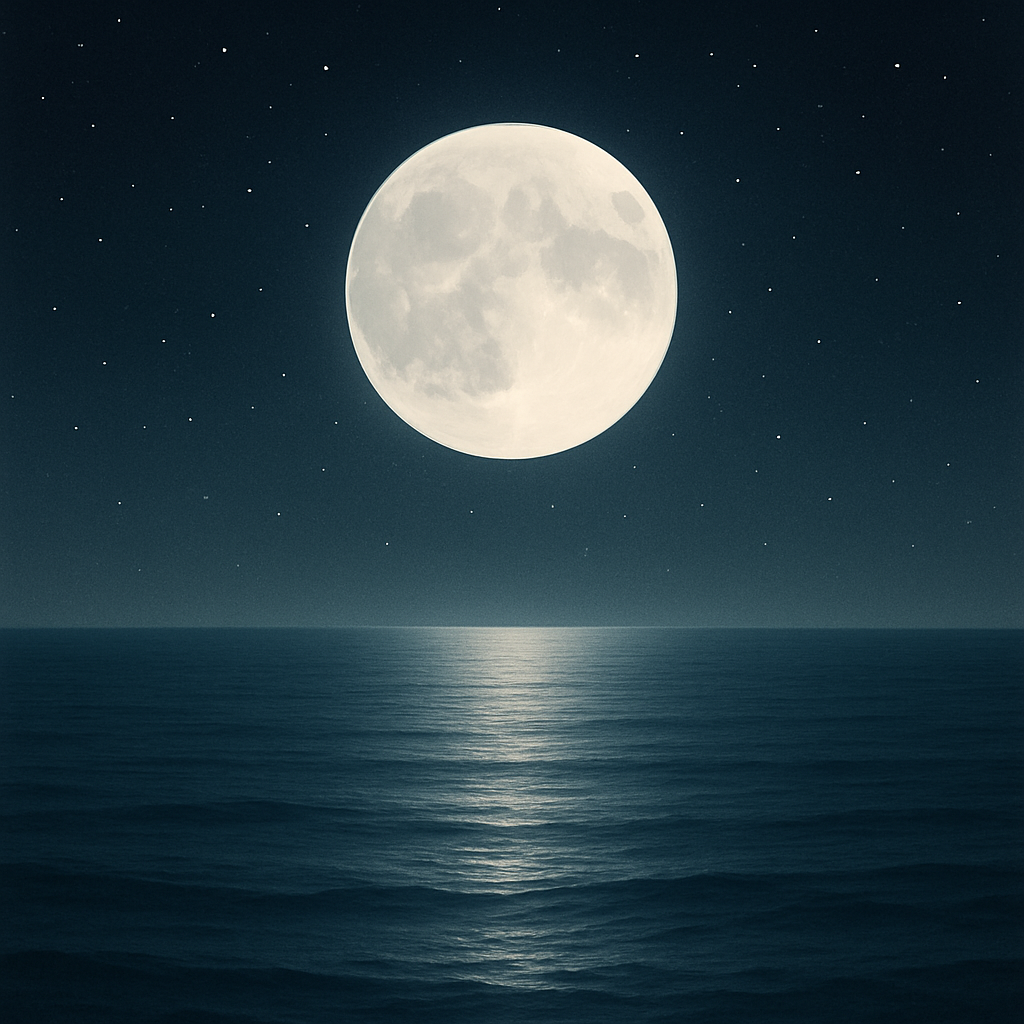
The Cosmic Collision: Origins of the Moon
Scars of the Past: Mapping the Lunar Surface
Celestial Rhythms: Tides, Phases, and Time
Silver Muse: The Moon in Culture and Myth
One Giant Leap: The Apollo Legacy
Cold Traps and Hidden Ice: The New Lunar Gold
Living on the Edge: Establishing a Lunar Colony
Artemis and Beyond: The Moon as a Launchpad

Transcript
SPEAKER_1: Alright, so last time we established that the Moon is essentially a gravitational engine—it's lengthening our days, driving tides, and gave early humans their first clock. That's the scientific story. Today I want to flip to the cultural side, because I think the mythology here is just as rich. SPEAKER_2: It really is. And the two sides aren't as separate as people assume. The same features that drove the science—the phases, the tides, that glowing face in the sky—are exactly what filled human imagination with gods, monsters, and meaning for tens of thousands of years. SPEAKER_1: So let's start with the face itself. The 'Man in the Moon'—that's a pareidolia thing, right? Our brains finding a pattern that isn't really there? SPEAKER_2: Exactly. Pareidolia is the brain's pattern-recognition system misfiring on ambiguous shapes. But what's fascinating is that nearly every culture on Earth sees *something* in the lunar surface—just not the same thing. Western traditions see a man's face. Chinese folklore sees Chang'e, a goddess who drank an immortality elixir and floated to the Moon, where she lives with a jade rabbit. Native American traditions link the Moon to wolves, rabbits, and seasonal cycles. Same object, radically different stories. SPEAKER_1: Why a rabbit specifically in the Chinese version? That seems oddly specific. SPEAKER_2: The dark patches on the lunar surface form shapes that, to East Asian observers, resemble a rabbit pounding medicine with a mortar. This interpretation is cultural, showcasing how different civilizations see unique stories in the same lunar features. SPEAKER_1: And in Greek mythology, the Moon has a specific deity too—Selene? SPEAKER_2: Yes. Selene was the goddess of the Moon, and here's the connection that should feel familiar: she was the daughter of the Titan Theia. The same name given to the Mars-sized impactor in the Giant Impact Hypothesis. That's not coincidence—planetary scientists deliberately named the impactor after the mythological mother of the Moon goddess. Science and myth folded back into each other. SPEAKER_1: That's a genuinely elegant callback. Now, the Moon is almost universally associated with femininity across cultures. Why? What's the underlying logic there? SPEAKER_2: Two things converge. First, the lunar cycle is roughly 29.5 days—nearly identical to the average human menstrual cycle. We mentioned in lecture three that prehistoric carvings may have tracked both simultaneously. Second, the Moon governs tides and water, which many ancient traditions linked to fertility and birth. The association isn't arbitrary; it's rooted in observable biological and environmental rhythms. SPEAKER_1: So the word 'lunacy'—that comes from this same tradition? SPEAKER_2: Directly. 'Luna' is the Latin word for Moon, and the ancient belief was that the full Moon could trigger madness, erratic behavior, even epilepsy. The UNM Health Sciences published a paper in early 2026 tracing how these silver Moon myths embedded themselves in medical folklore for centuries. Physicians as late as the 18th century genuinely documented 'lunar influence' on mental illness. The word outlasted the belief. SPEAKER_1: How did Galileo fit into all of this? Because I imagine pointing a telescope at the Moon and saying 'actually it's covered in craters' was not a popular move. SPEAKER_2: Profoundly disruptive. In 1610, Galileo turned his telescope on the Moon and described it as uneven, rough, full of mountains and bowl-shaped craters. The prevailing Aristotelian view held that all celestial bodies were perfect spheres—smooth, unblemished, fundamentally different from Earth. Galileo observed the terminator line, where the boundary between light and shadow cast long shadows that revealed topography. Mountains. Valleys. The Moon looked like Earth. SPEAKER_1: And that was the problem—it looked *too much* like Earth. SPEAKER_2: Precisely. If the Moon was rough and imperfect, the entire framework separating the heavenly realm from the earthly one collapsed. Galileo's observations didn't just describe the Moon—they dismantled a cosmology. That's why the cultural and scientific histories of the Moon are inseparable. Myth defined what the Moon *should* be; observation kept overturning it. SPEAKER_1: There's also a famous 19th-century case of someone seeing ruins on the Moon—Gruithuisen? SPEAKER_2: Professor Franz von Gruithuisen, 1824. He claimed to see the ruins of a lunar city through a small telescope—walls, structures, organized geometry. It's a classic example of pareidolia, where the human eye seeks patterns in random geology, illustrating our tendency to project familiar structures onto the unknown. SPEAKER_1: And that impulse hasn't gone away. In February 2026, there was that viral AI-generated image of lunar 'cities' that sparked a whole global debate. SPEAKER_2: Right, and then in March 2026, China's Chang'e-7 probe imaged what online communities immediately called 'mysterious structures.' The probe was doing legitimate geological imaging, but the myth-making machinery kicked in instantly. Gruithuisen would have recognized the dynamic completely. The technology changes; the pattern-seeking doesn't. SPEAKER_1: So what should someone listening take away from all of this? What's the thread that connects Chang'e and Selene and Galileo and Gruithuisen? SPEAKER_2: The Moon has always been a canvas. Every culture projected onto it what they needed—a goddess, a clock, a perfect sphere, a city. And every time observation pushed back, it didn't kill the mythology; it just redirected it. For our listener, the key insight is this: the Moon acted as a universal canvas for human imagination, and that imagination wasn't separate from early science—it was the engine that drove people to keep looking, keep questioning, until the myths and the mountains finally became the same story.