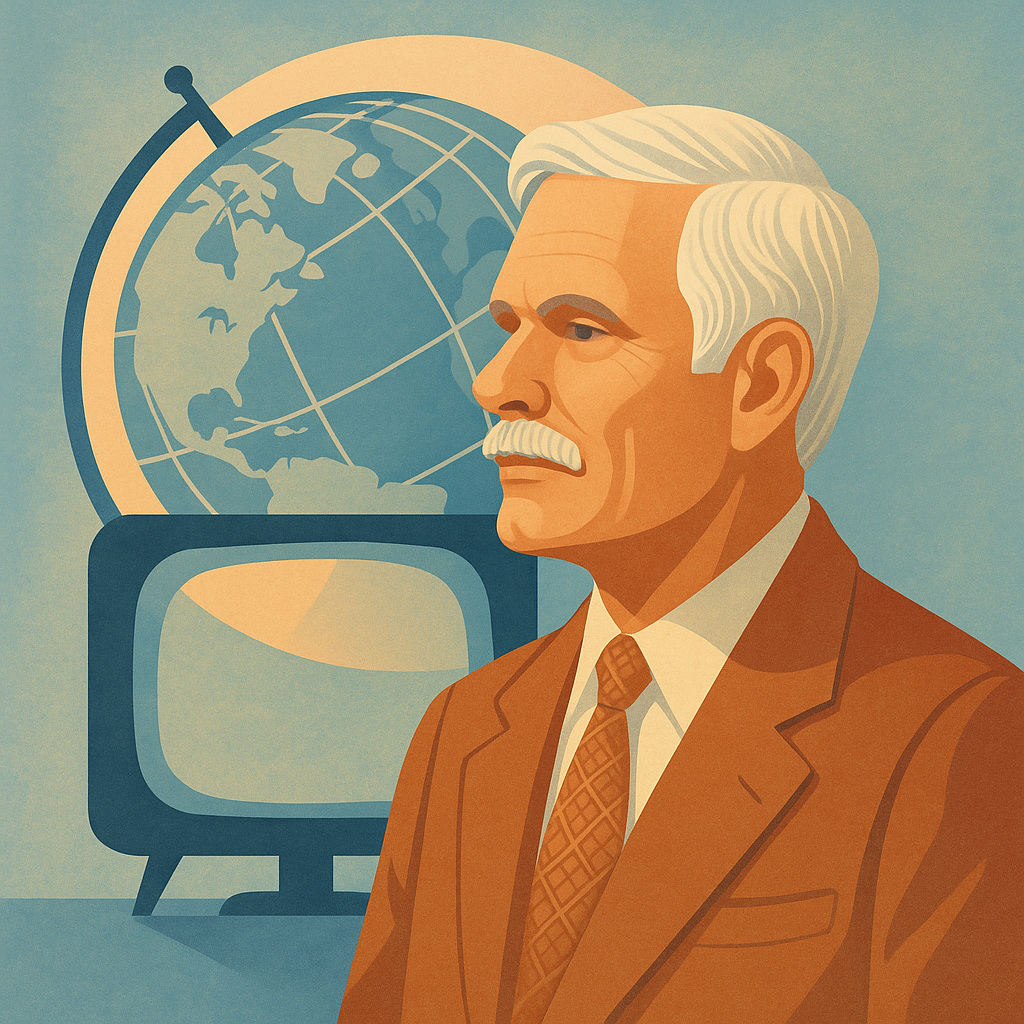
The Outsider's Bet: Launching the 24-Hour Cycle
The Mouth of the South: Ted Turner and the Birth of the 24-Hour World

Transcript
Welcome to your journey through The Mouth of the South: Ted Turner and the Birth of the 24-Hour World, starting with The Outsider's Bet: Launching the 24-Hour Cycle. On June 1, 1980, CNN launched to just 1.7 million cable households — a number so small the major networks barely flinched. Media historian Reese Schonfeld, CNN's first president, later described the venture as something the industry considered not bold but delusional. ABC, NBC, and CBS controlled audiences in the tens of millions. They had the studios, the anchors, the credibility. And yet, a man from Atlanta with a billboard fortune and zero network television experience decided he would run news twenty-four hours a day, every single day. Nobody believed him. That was his advantage. The Big Three networks had a specific reason for their skepticism, Alina, and it wasn't arrogance alone — it was math. News divisions were cost centers, not profit engines. They ran thirty minutes in the evening because that was the minimum required to maintain prestige and FCC goodwill. Producing a full day of news meant cameras, correspondents, satellite uplinks, and editors running in perpetual motion. The Georgia Encyclopedia notes that Turner had already proven he could think differently about television infrastructure, transforming his local Atlanta UHF station, WTCG, into the nation's first superstation by beaming its signal via satellite to cable systems nationwide. That move taught him something critical: distribution was the weapon, not the content budget. Cable was hungry for programming. Turner intended to feed it. His background in the billboard industry shaped everything. Selling outdoor advertising means understanding one core truth — location and repetition beat prestige every time. You don't need the fanciest sign; you need the sign people cannot avoid. Turner applied that logic to cable news. Rather than competing on the networks' terms in New York, he set up operations in Atlanta, inside a colonial-style mansion on West Peachtree Street that had formerly served as the Progressive Club. Atlanta Magazine has documented how that choice was both financial and philosophical — lower costs, yes, but also a deliberate signal that this network would not play by Manhattan rules. The address itself was a provocation. To staff the operation, Turner hired young journalists, many of them inexperienced, nearly all paid significantly less than their network counterparts, according to reporting documented by Britannica and PBS Frontline. The industry mocked the result immediately. The nickname "Chicken Noodle News" spread fast, a jab at the thin budgets and rookie reporters stumbling through live broadcasts. Here's what the critics missed, though. Those young journalists had no legacy habits to unlearn. They adapted to continuous broadcasting faster than seasoned network veterans would have. And the mockery created internal fuel — a chip-on-the-shoulder culture that pushed the team to prove the skeptics wrong. Ridicule, it turned out, was free motivation. This is where it gets important for you, Alina, because the pattern here is bigger than one eccentric billionaire with a satellite dish. Turner's entire bet rested on a single, audacious assumption: that people did not actually want news on a schedule — they wanted news on demand, available the moment something happened. The networks had built their model around the audience conforming to broadcast time. Turner inverted it. He built the infrastructure around the audience's actual behavior, then waited for the world to catch up. That is the core lesson of CNN's founding. True disruption does not come from doing the existing thing better. It comes from betting on a fundamental shift in human behavior — moving from scheduled consumption to constant, on-demand accessibility — before anyone else is willing to pay for the infrastructure to prove it.