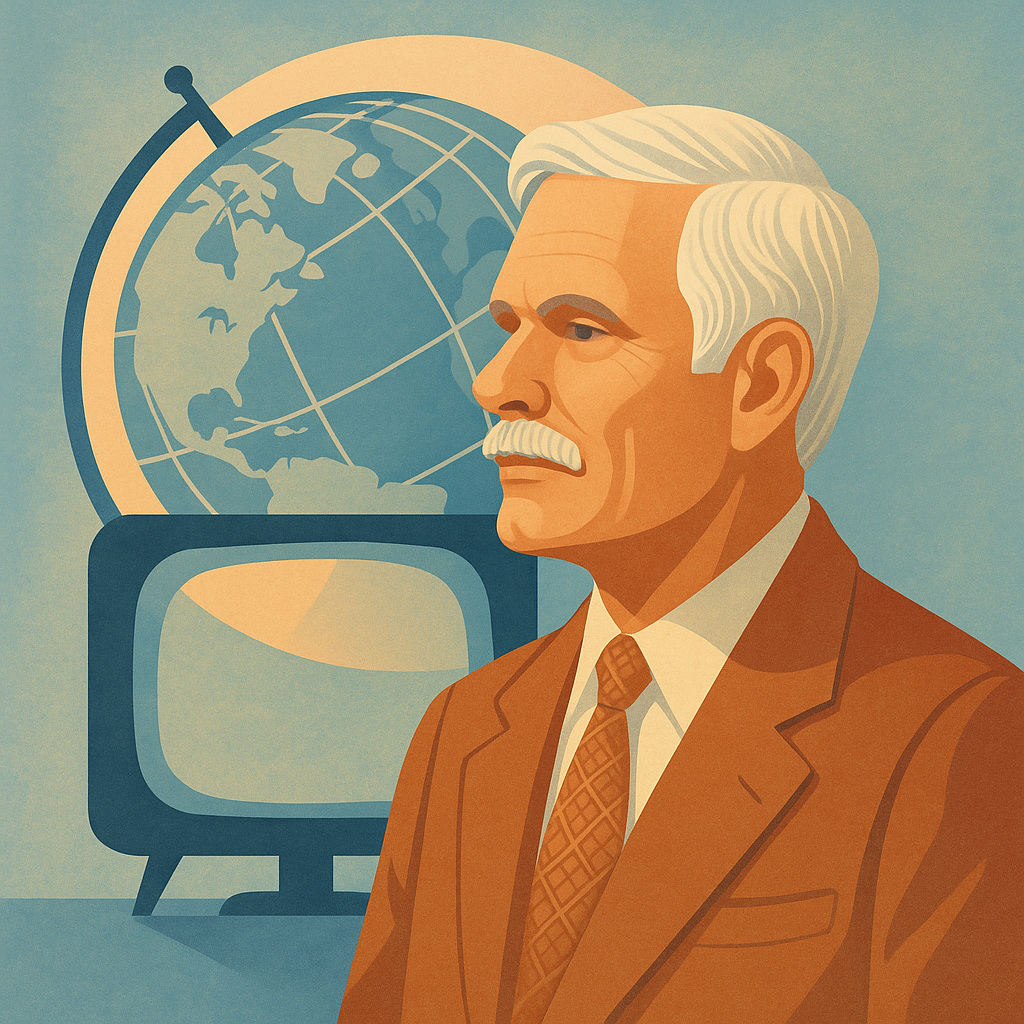
The Final Chapter: Lessons From the Man Who Rewired Attention
The Mouth of the South: Ted Turner and the Birth of the 24-Hour World

Transcript
SPEAKER_1: Alright, so last time we traced how Turner's philanthropic instincts and his business instincts were really the same instinct — long-horizon thinking, whether it was bison ranches or a billion dollars to the UN. Now I want to close the loop on the man himself. Because the story doesn't end triumphantly. SPEAKER_2: No, it doesn't. And that tension is actually what makes Turner's story so instructive. He built something that outlasted his control of it — and that's both his greatest achievement and his most painful legacy. SPEAKER_1: So let's go back to the founding moment, because our listener needs the full arc. Turner said something remarkable before CNN launched — what was it? SPEAKER_2: He said, 'We won't be signing off until the world ends.' That wasn't marketing copy. That was a genuine statement of intent. CNN launched on June 1, 1980, and the commitment was total — continuous coverage, no scheduled blocks, no signing off. That phrase captures everything about how he thought. SPEAKER_1: And the model he was replacing — just to be clear for everyone listening — was what exactly? SPEAKER_2: News in fixed blocks. Morning, evening, night. If something happened at 2 p.m., most people wouldn't know until the evening broadcast. Turner conceived CNN partly because his own irregular schedule meant he kept missing those windows. He built the solution to his own problem, and it turned out millions of people had the same problem. SPEAKER_1: And the Gulf War in January 1991 was when that solution proved itself to the world? SPEAKER_2: Completely. Bernard Shaw, John Holliman, and Peter Arnett broadcast live from Baghdad as U.S. forces attacked on January 17, 1991. It was the first live television coverage from a war zone in history. The networks that had mocked CNN as Chicken Noodle News ended up airing its footage. Time magazine named Turner Man of the Year in 1991. Viewers in 150 countries watched history unfold in real time. SPEAKER_1: That's a stunning reversal. The people who laughed at him were broadcasting his signal. But here's what I want to push on — how did that success eventually become the thing that cost him everything? SPEAKER_2: Turner sold his networks to Time Warner, which later merged with AOL. That merger is one of the most studied corporate disasters in history. Turner's personal wealth, which had exceeded ten billion dollars, was reduced by approximately eight billion dollars when the deal collapsed. He lost not just money but operational control — the ability to shape what CNN actually did. SPEAKER_1: So the man who built the network to run forever got pushed out of it. How does that happen structurally? What's the mechanism? SPEAKER_2: Corporate consolidation. When you merge into a larger entity, your equity becomes tied to the combined company's performance. AOL Time Warner's collapse wasn't Turner's failure — it was a broader implosion driven by the tech bubble. But he had no firewall. His wealth and his influence were both concentrated in the same structure, and when that structure fell, both went with it. SPEAKER_1: And what did Turner himself say about CNN's place in his life, even after all of that? SPEAKER_2: He described CNN as the greatest achievement of his life. Not TBS, not the MGM library, not the Goodwill Games. The 24-hour news network. That tells you where his identity was anchored, even after he lost control of it. SPEAKER_1: Now, the thing our listener might be sitting with is this: Turner invented the 24-hour cycle, but that cycle also gave rise to MSNBC, Fox News, the attention economy, the whole machinery of outrage-as-content. Did he create something he couldn't control? SPEAKER_2: That's the central irony. MSNBC and Fox News Channel both launched in 1996, directly following the model Turner proved viable. The 24-hour cycle increased competition for audience and advertiser attention in ways that pushed toward speed over accuracy, sensation over substance. Turner built the infrastructure. He didn't control what others built on top of it. SPEAKER_1: So is that a failure on his part, or just... the nature of disruption? SPEAKER_2: It's the nature of disruption. Every transformative platform eventually gets used in ways its founder didn't intend. The Cable Communications Policy Act of 1984 accelerated cable expansion and opened the door for competitors. Turner couldn't legislate how those competitors would use the format. What he could control was CNN's original standard — and for a significant period, that standard held. SPEAKER_1: He also dealt with something deeply personal toward the end. How did Turner handle his diagnosis of Lewy Body Dementia? SPEAKER_2: He went public with it. That transparency was consistent with how he operated his entire career — confronting difficult realities directly rather than managing appearances. The lesson there isn't about media at all. It's about how someone who spent decades projecting certainty chose honesty when certainty was no longer available to him. SPEAKER_1: So for Alina and everyone working through this course — what's the single thing to carry out of Turner's full story? SPEAKER_2: That even the most successful pioneers can be sidelined by their own creations. Turner rewired how the world consumes information, and then the system he built grew beyond any one person's ability to steer it. The challenge for the next generation isn't inventing the 24-hour cycle — it's maintaining integrity inside it. Speed without judgment is just noise. Turner knew the difference. The question is whether the institutions he built still do.