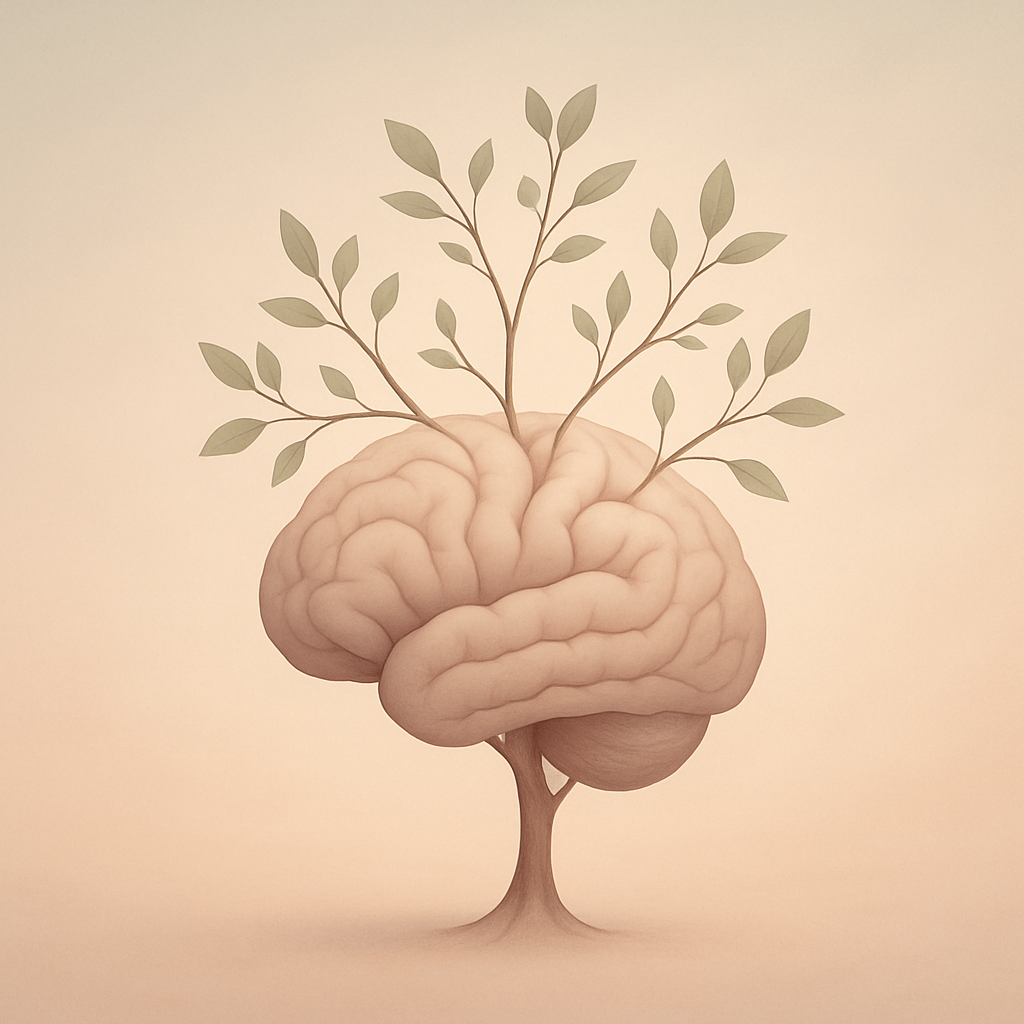
The SEEKING Engine: From Anxiety to Agency
The Science of Self-Authoring: Rewiring the Threat Response

Transcript
Anxious people do not shut down. They become more rational. That finding, from Affective Intelligence theory developed by Marcus, Neuman, and MacKuen, directly contradicts the popular assumption that anxiety paralyzes judgment. What their research showed is that anxiety causes individuals to stop acting on habit and begin acting in line with rational choice models — actively seeking new information, weighing options, updating their internal map. Anxiety, in other words, is not a malfunction. It is a search command, aligning with the SEEKING system's drive to explore and update. Last lecture's core insight was this: the recovery cycle — not the threat itself — is where model reconsolidation actually happens. Now the question is what fuels that recovery. Here is where anxiety's biology gets precise. Anxiety is sparked by uncertainty, particularly when uncertainty is linked to perceived danger, activating the SEEKING system's exploratory drive. It is future-oriented, unlike anger, which targets a concrete past event. That forward orientation is critical. It means the anxious brain is already scanning for what comes next — and that scanning behavior maps almost exactly onto Jaak Panksepp's SEEKING system. The SEEKING system runs on tonic dopamine release through mesolimbic circuits, supporting the aMCC's effort-cost calculation and maintaining engagement. When anxiety triggers hyper-vigilant information-seeking, it is partially activating this same circuitry. The aMCC, which calculates effort-cost against potential gain, reads that dopaminergic signal as a reason to stay engaged rather than escape. This is the pivot point, Bongi. Anxiety that converts into active information-seeking shifts the aMCC's calculation from 'this costs too much' to 'this is worth pursuing,' driven by the SEEKING system's tonic dopamine release. That shift is the difference between avoidance and agency. Here is what changes in the insula when SEEKING behavior activates. The insula's default posture under threat is defensive prediction — it compares incoming body signals against a stored danger model and amplifies mismatch. But vigilant information-seeking, the kind anxiety produces, introduces new data into that comparison. When the information gathered disconfirms the threat model — when reality contradicts the stored prediction — the insula's alarm signal weakens. The reconsolidation window stays open longer because the SEEKING system's tonic dopamine release maintains engagement without triggering full defensive shutdown. Curiosity holds the window. Avoidance slams it shut. This is where Self-Authoring diverges sharply from passive journaling or generic reflection, Bongi. Traditional journaling records experience. Self-Authoring, as a neurobiological practice, means deliberately reactivating a threat memory, sustaining the arousal state through SEEKING-oriented engagement — asking what this situation is actually telling you, what information you still need, what the uncertainty is pointing toward — and then allowing a disconfirming experience to land inside that activated state. Anxiety's information-seeking, when channeled efficiently through readily available and high-signal sources, is not a symptom to manage. It is the mechanism of the rewrite. MacKuen's 2000 research framed it clearly: anxiety causes people to seek information and act more rationally. The aMCC registers that rational engagement as agency. Agency perception keeps the prefrontal cortex online. And that is precisely the condition under which the insula's threat model updates rather than hardens. The takeaway for you, Bongi, is this: leveraging the SEEKING system transforms the aMCC's effort-cost calculation from a burden into a challenge. That transformation is not motivational reframing — it is a dopaminergic shift that facilitates deeper model updates. Anxiety is the ignition. SEEKING is the engine. The reconsolidation window is the road. You are not trying to eliminate the discomfort of uncertainty. You are learning to use it as the precise biological signal it was always designed to be — a command to search, update, and author the next version of your internal map.