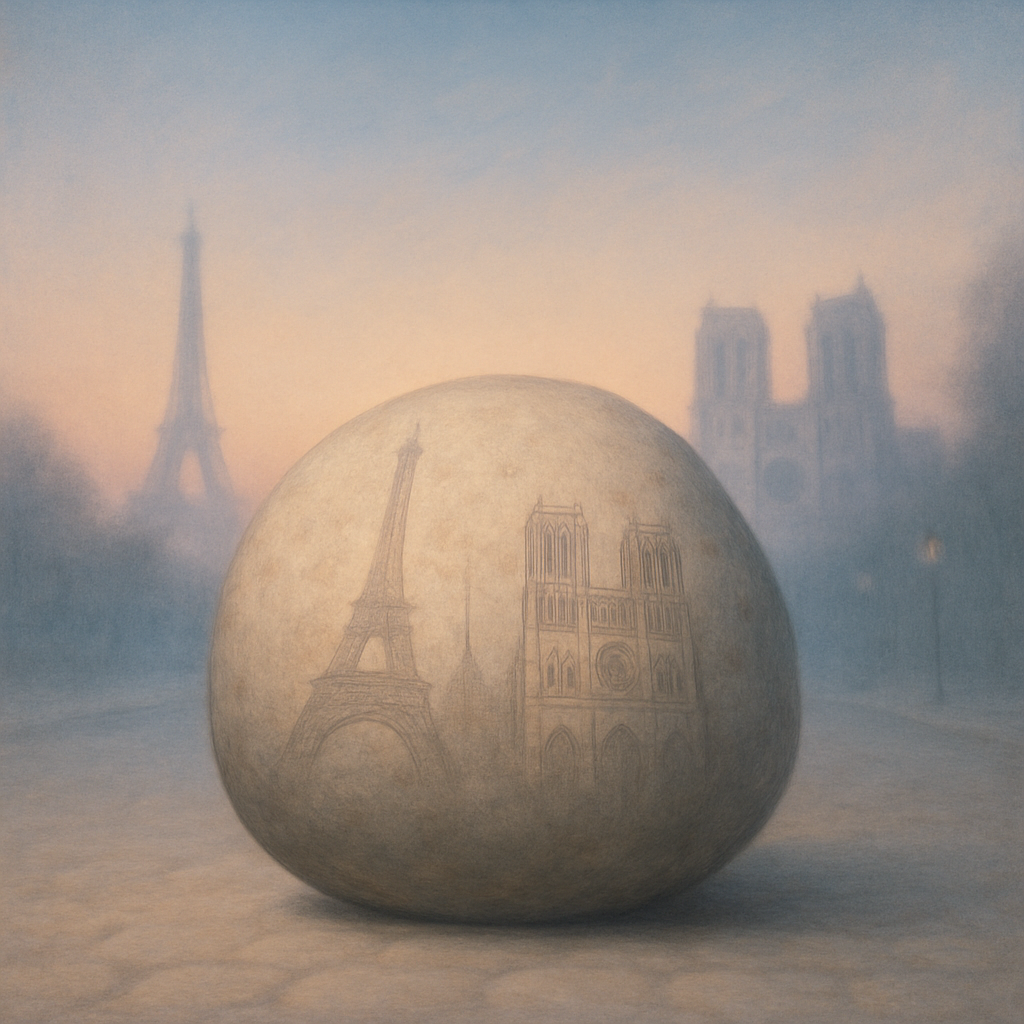
The Urban Stage: Classicism and the Sun King
The Stones of Paris: A History of Culture and Form
Lutetia's Legacy: The Birth of a Metropolis
Spires of Faith: The Gothic Revolution
Fortress to Finesse: The Renaissance Rebirth
The Urban Stage: Classicism and the Sun King
The People's City: Revolution and the Enlightenment
Haussmann’s Surgeon’s Knife: The Modern Rebirth
Iron and Art: The Belle Époque’s Industrial Bloom
Concrete and Glass: The Modernist Challenge

Transcript
SPEAKER_1: Alright, so last time we traced how the Renaissance turned Paris from a defensive medieval city into something that performed itself — open squares, classical columns, the Louvre shedding its dungeon past. Now we're moving into the 17th century, and the name everyone keeps running into is Louis XIV. SPEAKER_2: Right, and the key bridge from the Renaissance is this: Francis I imported Italian ideas to impress. Louis XIV took those ideas and weaponized them. He reigned from 1643 to 1715, and his project wasn't just beautification — it was control made visible in stone. SPEAKER_1: So what does classicism actually look like in practice? Because our listener has probably heard the word, but what are the defining features on the ground? SPEAKER_2: Symmetry, proportion, and deliberate references to ancient Greece and Rome — specifically through Vitruvius and Italian architects like Palladio. In practice: flat facades organized by classical orders, Doric below, Ionic in the middle, Corinthian at the top. Columns that carry meaning, not just weight. And above everything, an insistence on rational order — every element in its correct place. SPEAKER_1: That word 'rational' keeps coming up. Why does rationality matter so much to an absolute monarch? SPEAKER_2: Because rational order and absolute power are the same argument. If the city looks controlled — symmetrical axes, uniform facades, grand vistas that draw the eye to a single focal point — it communicates that someone is in charge of everything. The architecture isn't decorating the state. It is the state, made legible. SPEAKER_1: And Louis XIV had the institutional machinery to actually execute this. He didn't just have taste — he had Colbert. SPEAKER_2: Exactly. Jean-Baptiste Colbert, his finance minister, funded the entire program and in 1671 founded the Académie d'Architecture, which standardized classical principles across French design. That's the mechanism — you don't just build grand buildings, you train an entire generation of architects to build them the same way. SPEAKER_1: So where does the Louvre fit into this? Because we've been tracking that building since lecture one — fortress, then Francis I's Renaissance palace. What does Louis XIV do to it? SPEAKER_2: He completes it, and controversially. He brought in Claude Perrault and Louis Le Vau to design the eastern facade — the Colonnade. Perrault's design was a break from tradition: paired columns, a flat roofline, almost severe in its restraint. It was debated fiercely at the time because it departed from the established classical orders. But it became the defining image of French classicism — rational, monumental, unapologetically grand. SPEAKER_1: And then he leaves Paris. He moves the court to Versailles in 1682 and essentially never comes back. So why keep building in the city? SPEAKER_2: That's the fascinating tension. Versailles was his private theater of power — the court, the rituals, the Hall of Mirrors. But Paris was the public stage. You can't project imperial authority to Europe from a palace most people never enter. The city's monuments — the squares, the triumphal arches, the domes — those were the message broadcast to everyone. SPEAKER_1: The triumphal arches — the Porte Saint-Denis and Porte Saint-Martin, built in the 1670s. Those aren't gates anymore, are they? The city walls they were attached to were being demolished. SPEAKER_2: Precisely. They're pure propaganda architecture. No defensive function — they exist to celebrate Louis XIV's military victories, inscribed in Latin, modeled directly on Roman imperial arches. You're walking through a monument to the king's ego every time you pass them. That's the point. SPEAKER_1: And then there's Place Vendôme. Jules Hardouin-Mansart designed it in 1698 — what was the intention there? SPEAKER_2: Mansart was Louis XIV's chief architect, and Place Vendôme is classicism at its most choreographed. Octagonal layout, uniform facades on every side, a single equestrian statue of the king at the center. The square isn't a public gathering space in any organic sense — it's a frame for the monarch's image. Every facade is identical so nothing competes with the statue. The citizen standing there is an audience, not a participant. SPEAKER_1: So were these grand squares genuinely public spaces, or were they essentially monuments to royal ego dressed up as civic amenity? SPEAKER_2: Honestly, both — and the tension is real. The Invalides complex, started in 1670, was a genuine hospital for wounded soldiers. Mansart's golden dome, inspired by St. Peter's in Rome, sits above it. That's a real social institution with monumental architecture layered on top. But Place Vendôme? The surrounding buildings were sold to aristocrats and financiers. The 'public' square was ringed by private wealth. The king's statue was the only truly public element. SPEAKER_1: There's also the Collège des Quatre-Nations — now the Institut de France — which Le Vau built as a gift from Cardinal Mazarin. That dome across the Seine from the Louvre wasn't accidental placement. SPEAKER_2: Nothing in this era was accidental. The dome was positioned to create a visual axis with the Louvre Colonnade across the river. That's the logic of grand vistas — you're not just building a building, you're composing a cityscape. Every major structure becomes a node in a network of sightlines that all ultimately point back to royal authority. SPEAKER_1: So for our listener trying to hold all of this together — what's the single frame that makes sense of Louis XIV's Paris? SPEAKER_2: Think of it as a theater. Versailles was the backstage — where power was actually exercised. Paris was the stage set, built to be seen, to impress foreign ambassadors, to remind every Parisian walking past a triumphal arch or a symmetrical square who was in charge. Louis XIV used urban planning as a tool of absolute power — the symmetry, the axes, the grand vistas weren't aesthetic choices. They were political arguments, and they organized the city like a choreographed performance of monarchy. That logic, Alina, is exactly what Haussmann inherited two centuries later when he cut his boulevards through the same city.