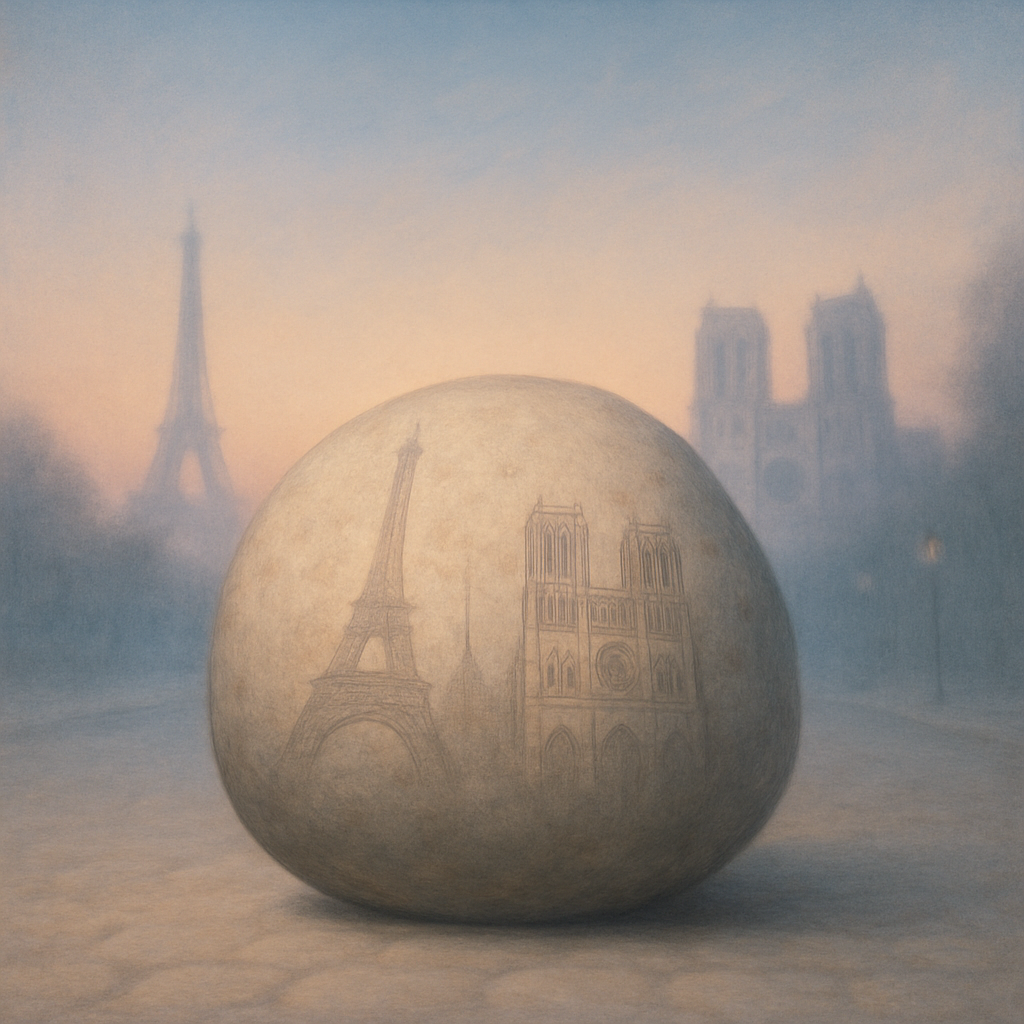
Iron and Art: The Belle Époque’s Industrial Bloom
The Stones of Paris: A History of Culture and Form
Lutetia's Legacy: The Birth of a Metropolis
Spires of Faith: The Gothic Revolution
Fortress to Finesse: The Renaissance Rebirth
The Urban Stage: Classicism and the Sun King
The People's City: Revolution and the Enlightenment
Haussmann’s Surgeon’s Knife: The Modern Rebirth
Iron and Art: The Belle Époque’s Industrial Bloom
Concrete and Glass: The Modernist Challenge

Transcript
SPEAKER_1: Alright, so last time we ended with Haussmann's double legacy — the boulevards that modernized Paris and simultaneously displaced hundreds of thousands of people. That tension between beauty and violence felt like the defining note. Now we're moving into the Belle Époque, and I want to understand what that era actually was before we get into the buildings. SPEAKER_2: Good place to anchor. The Belle Époque runs from 1871 to 1914 — roughly from the end of the Franco-Prussian War to the start of World War One. It's a period of genuine optimism, rapid industrialization, and cultural explosion. The Belle Époque was a time when Paris transitioned from Haussmann's infrastructural changes to a celebration of artistic and cultural innovation. SPEAKER_1: And the World Fairs are the clearest expression of that mood, right? 1889 and 1900 especially. SPEAKER_2: Completely. The 1889 Exposition Universelle showcased the Eiffel Tower, a symbol of innovation and modernity, challenging traditional architectural norms by being the tallest structure in Paris. SPEAKER_1: So what was the Eiffel Tower actually built for? Because most people probably think of it as a monument, full stop. SPEAKER_2: It was the entrance arch to the exposition — a temporary gateway, not a permanent monument. The plan was always to demolish it after twenty years. What saved it was its antenna mast, which became essential for wireless telegraphy. The tower survived because it was useful, not because Paris fell in love with it immediately. SPEAKER_1: Because the initial reaction was... not love. SPEAKER_2: Far from it. A group of prominent artists and writers — including Guy de Maupassant — published an open letter calling it a 'giant smokestack,' a blot on the Parisian skyline. The objection was partly aesthetic and partly material: iron was an industrial substance, associated with factories and bridges, not civic monuments. Using it at that scale felt like a category violation. SPEAKER_1: So why did iron win? How does a material associated with factories end up defining the most romantic city in the world? SPEAKER_2: That's the central paradox of the Belle Époque. Iron and later reinforced concrete allowed builders to do things stone simply couldn't — span enormous distances, create transparent roofs, build skeletal structures that let light flood through. The Gallery of Machines at the same 1889 exposition had a monumental glass dome with decorative iron framework. Gothic iron columns inside, but the actual structural weight carried by hidden reinforced columns. The decorative and the structural were being separated in a completely new way. SPEAKER_1: So the iron was doing double duty — engineering and ornament simultaneously. SPEAKER_2: Exactly. And that logic carried directly into the 1900 exposition. The Grand Palais exemplified the fusion of art and industrial progress, using iron and steel to create a luminous exhibition space. Pont Alexandre III, completed for the same fair, fused that engineering confidence with gilt-bronze statues and ornate lamp posts. Innovation and artistry weren't competing — they were fused. SPEAKER_1: Which brings us to Art Nouveau. Because that fusion seems like exactly what Art Nouveau was doing — taking industrial materials and making them look organic. SPEAKER_2: That's the core of it. Art Nouveau emerged around 1890 with curved, nature-inspired designs — vines, flowers, insects — rendered in wrought iron, ceramic tile, and plate glass. The most visible example for anyone in Paris today is Hector Guimard's metro entrances. Wrought iron bent into forms that look like dragonfly wings or plant stems. They're functional transit infrastructure that reads as sculpture. SPEAKER_1: And Guimard wasn't just doing the metro. There's the Castel Béranger as well. SPEAKER_2: Right — 14 rue La Fontaine, completed in 1898. Thirty-six apartments, and Guimard designed every single detail himself: the door handles, the window frames, the ironwork. He then actively promoted it to the press as a revolutionary building. It's one of the earliest examples of an architect using what we'd now call public relations to shape how a building was received. SPEAKER_1: That's a surprisingly modern instinct. And there's Jules Lavirotte's building on Avenue Rapp — that one goes even further. SPEAKER_2: 29 Avenue Rapp, 1901 — the facade is essentially covered in ceramic sculpture. Figures, foliage, sinuous lines from ground to roofline. It's Art Nouveau at its most maximalist. The building styles of the Belle Époque ranged widely — neo-Byzantine, neo-Gothic, classicism, Art Nouveau — but what unified them was this appetite for lavish surface decoration using new industrial materials. SPEAKER_1: So for someone like Alina, who's been tracking Paris from Celtic river settlement through Roman grids, Gothic spires, Renaissance squares, and Haussmann's boulevards — what does the Belle Époque add to that long arc? SPEAKER_2: It's the moment Paris stops treating industrial materials as a compromise and starts treating them as a medium for beauty. Every previous era had a dominant material — stone, then limestone, then classical marble surfaces. The Belle Époque said iron can be delicate. Concrete can be expressive. A metro entrance can be art. SPEAKER_1: And the Métro itself — that's a Belle Époque project too. SPEAKER_2: Construction began during this period, yes. The underground network and its Guimard entrances are the clearest proof that the era's aesthetic ambitions reached into infrastructure, not just prestige buildings. The Sacré-Cœur basilica on Montmartre also began construction during the Belle Époque — neo-Byzantine, completely different register from Guimard, but equally characteristic of the era's stylistic plurality. SPEAKER_1: So what's the frame our listener should carry forward from this? SPEAKER_2: The World Fairs of 1889 and 1900 demonstrated that industrial materials could create beauty, not just serve functional purposes. The Eiffel Tower was called a smokestack and survived to become the city's icon. Guimard's metro entrances turned transit infrastructure into sculpture. The Belle Époque is the moment Paris proved that engineering and art weren't opposites — and that tension between the industrial and the beautiful is still the city's defining creative instinct.