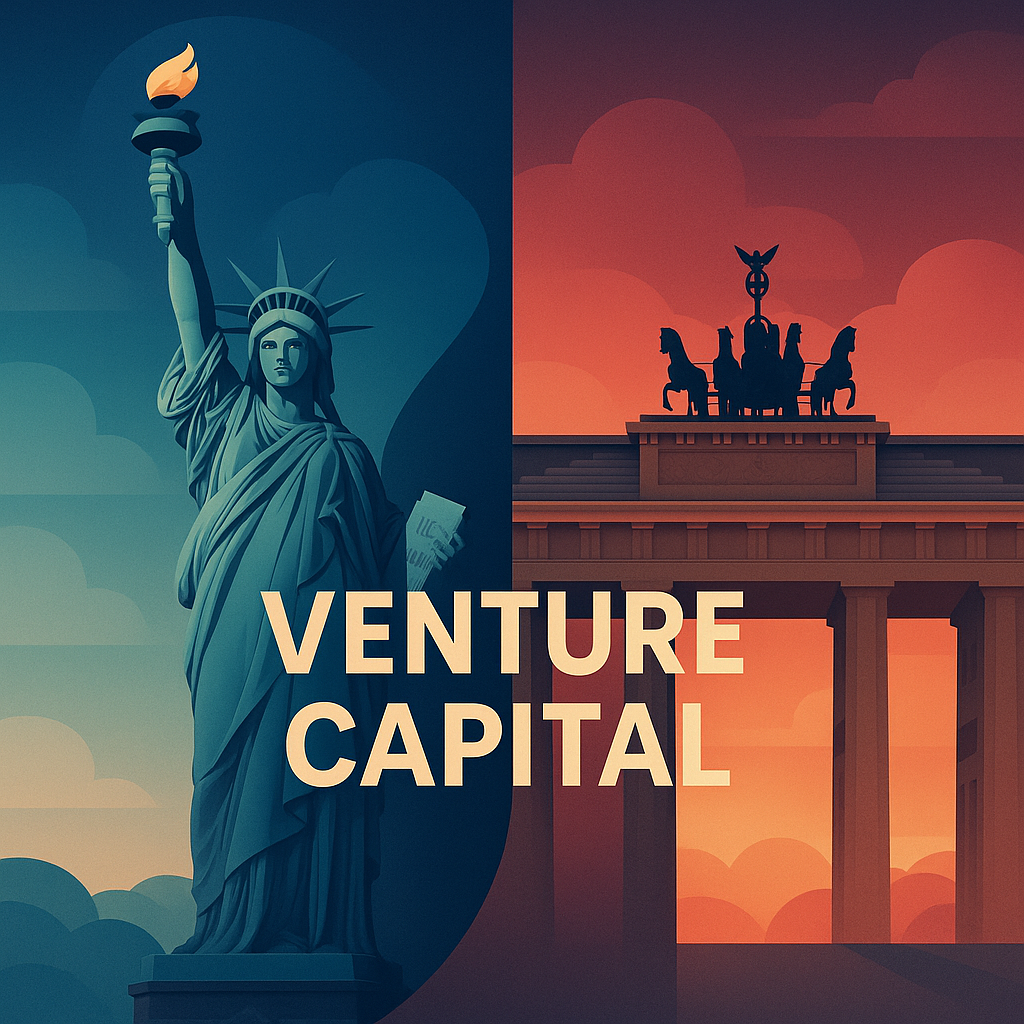
The Ambition Gap: Risk, Failure, and the First 100 Meters
The Liquidity Waterfall: Access to Capital and the Exit Engine
Storytelling vs. Engineering: The 'Why' vs. The 'How'
The 24/7 Ecosystem: Work-Life Integration and the Global Flywheel

Transcript
Welcome to your journey through The VC Divide: USA vs. Germany, starting with The Ambition Gap: Risk, Failure, and the First 100 Meters. Here is a number that should stop you cold: in 2023, US venture capital deployed approximately $170.6 billion. Germany's total that same year? Roughly $7.1 billion. That is not a gap. That is a chasm. Crunchbase's 2023 global funding review confirms this disparity is structural, not cyclical. The United States has produced over 600 unicorns — companies valued above one billion dollars. Germany has produced fewer than 40. The question is not about money supply. It is about what each culture believes is worth funding in the first place. Start with the founder's psychology, Marc, because that is where the divergence begins. The Global Entrepreneurship Monitor found that nearly 40% of German adults cite fear of failure as a primary barrier to starting a business. In the US, that fear exists too, but the cultural response to it is radically different. An American VC hears about a founder's previous bankruptcy and often calls it tuition. A German investor frequently sees the same history as a permanent character flaw. This is not a stereotype. It is a documented behavioral pattern that shapes who gets funded and who never even applies. When failure carries social stigma, founders self-censor their ambitions before they ever walk into a room. That self-censorship has deep roots, Marc. Germany's economic identity was built on the Mittelstand — the dense network of family-owned, precision-engineering companies that dominate the country's export machine. These businesses are extraordinary. They are also optimized for durability, not disruption. The Mittelstand mindset prizes Sorgfalt, meaning diligence and thoroughness. You build something that works perfectly before you claim it will change the world. That philosophy produces world-class industrial machinery. It does not produce Blitzscaling. When a German founder pitches a Series A, the narrative is often about a better machine. A US founder pitches a new world. Those are not the same story. One asks an investor to evaluate engineering. The other asks an investor to bet on a future that does not yet exist. US VCs are trained to fund the second kind of story. German VCs are structurally more comfortable with the first. This shapes capital allocation in a measurable way. Research shows US venture funds allocate a significantly higher percentage of capital to first-sequence seed rounds. They are hunting for outliers early, accepting that most bets will fail. German funding skews heavily toward later-stage companies with proven revenue. The logic is defensible. The consequence is severe. When you only back what is already working, you systematically miss the companies that will define the next decade. You also create a talent recycling problem. In Silicon Valley, a failed startup founder carries battle-tested experience. That person gets hired fast, funded again, or both. In Germany, the same person often exits the entrepreneurial ecosystem entirely. Human capital does not recycle. It disappears. That structural difference compounds over time, and it explains why the unicorn gap keeps widening rather than closing. Here is the synthesis, and this is what you need to carry into your three-minute presentation. The US VC system is not superior simply because it has more money. It is superior because it has built an entire cultural operating system around one question: what if it works? Germany's system, for all its engineering brilliance, is still largely organized around the opposite question: what if it fails? That single inversion changes everything — the size of the ask, the shape of the pitch, the tolerance for early losses, and the speed at which human capital gets redeployed after a setback. The ambition gap is not a funding gap. It is a permission gap. American founders give themselves permission to think at a scale that most German founders have been culturally trained to distrust. Until that changes, the capital will keep following the ambition — and the ambition will keep concentrating on one side of the Atlantic.