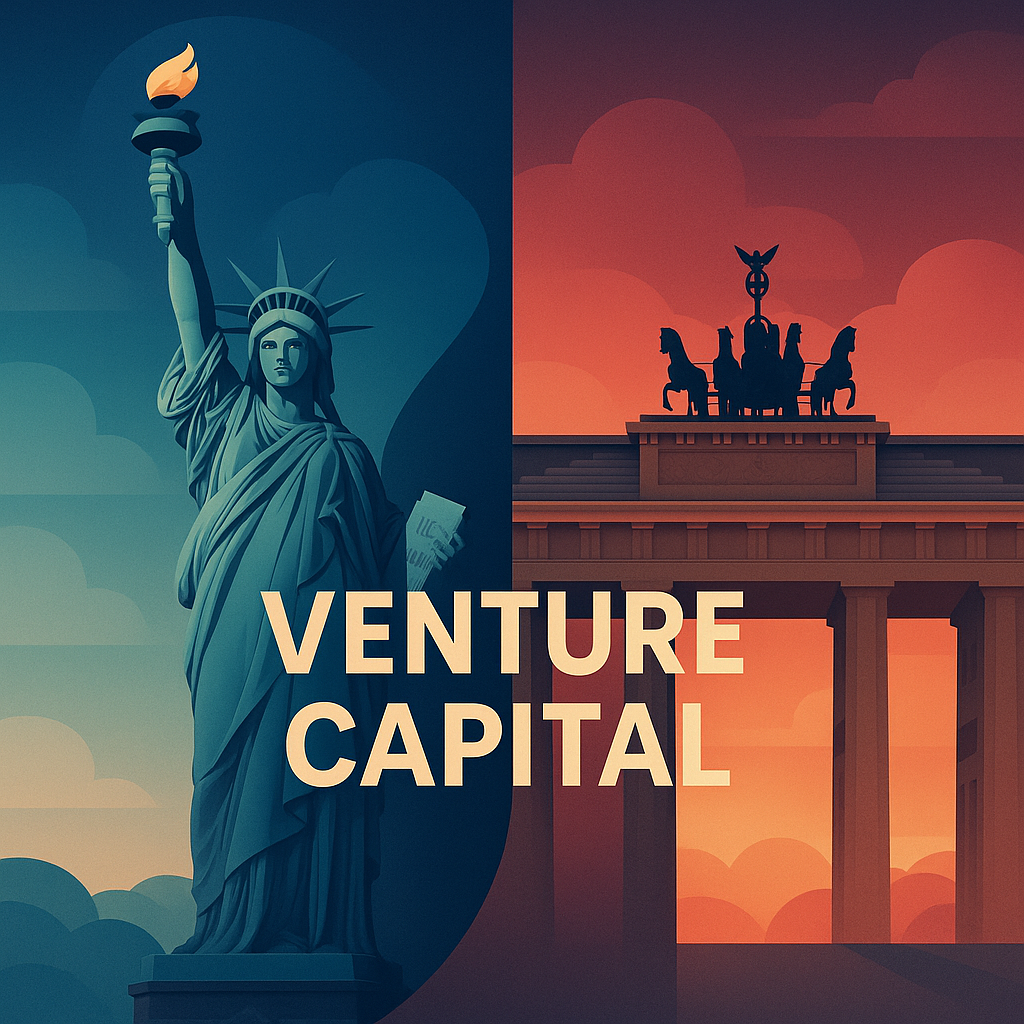
The Ambition Gap: Risk, Failure, and the First 100 Meters
The Liquidity Waterfall: Access to Capital and the Exit Engine
Storytelling vs. Engineering: The 'Why' vs. The 'How'
The 24/7 Ecosystem: Work-Life Integration and the Global Flywheel

Transcript
US venture capitalists prioritize potential growth over immediate profitability. This mindset, prevalent across the US VC landscape, emphasizes buying into a company's future potential rather than its current state. The key to unlocking this belief is storytelling, not just financial metrics. While the capital gap is significant — US VC assets at $270 billion versus Europe's $44 billion — the narrative is what truly drives investment decisions. This is often overlooked. In Silicon Valley, entrepreneurship is a normalized career path. Researchers confirm it is culturally aspirational. In Germany, announcing a startup still triggers questions about job security. That cultural starting point shapes the entire pitch. A US founder walks in selling a future that does not exist yet. A German founder walks in proving a product that already does. Both approaches have merit. Only one consistently unlocks large checks. US VCs are known for backing ambitious, visionary projects, while German VCs tend to be more cautious. This documented pattern reflects the co-evolution of pitch styles and investor expectations. This is where Grit diverges from Fleiß, Marc. Fleiß means diligence — steady, methodical effort toward a defined goal. Grit means relentless forward motion even when the goal is unclear. US founders are rewarded for pivoting fast and selling the new vision immediately. German founders are culturally rewarded for executing the original plan with precision. Americans prioritize self-responsibility and risk-taking. Germans traditionally prefer stability and security. That cultural difference is structural, not personal. It shapes who pitches boldly and who hedges every claim. Here is the synthesis for your three-minute presentation, Marc. US VC superiority is partially a marketing victory. American founders are trained in visionary storytelling — selling the Why before the How exists. German founders lead with the How and hope the Why becomes obvious. It rarely does, fast enough. US VCs prioritize double-digit quarterly growth over near-term profit. That philosophy demands a story big enough to justify the burn. When your pitch is built around engineering precision, you are answering a question no aggressive investor is asking. The story is not decoration. It is the product. Global mindshare does not go to the best product. It goes to the best story about the best product. US startups raised over €58 billion in venture capital in 2017 alone — while German founders, building comparably engineered products, captured a fraction of that attention. The gap is not purely technical. It is narrative. Last lecture established the exit engine — US VC exits at $287 billion peak versus Europe's $41 billion. The capital follows the story that promises the biggest exit. Here is why the Sales First mentality dominates in the US. The American market is unified, large, and capital-friendly. One pitch, one regulatory environment, one language, three hundred million customers. A founder can sell a vision of total market capture and make it credible. Germany's domestic market is smaller. The ambition ceiling is lower before the numbers stop adding up. UC Berkeley researchers confirm that US universities actively amplify entrepreneurial networks and storytelling culture. German universities produce world-class engineers. They do not produce the same density of founders trained to sell a future that does not yet exist. That pipeline difference is structural. It compounds every year. US VCs focus on growth over immediate profit, valuing rapid expansion over short-term margins. This approach requires a compelling narrative to justify high burn rates, as engineering precision alone doesn't attract aggressive investors. It is the product itself. So here is the synthesis for your three-minute presentation. US VC superiority is partially a marketing victory. American founders lead with the Why. German founders lead with the How and hope the Why becomes obvious. It rarely does — fast enough to matter. Visionary storytelling is not spin. It is the mechanism that converts investor belief into capital. Master the Why, Marc, and the How becomes fundable.