What Is Art? Beyond the Museum Walls
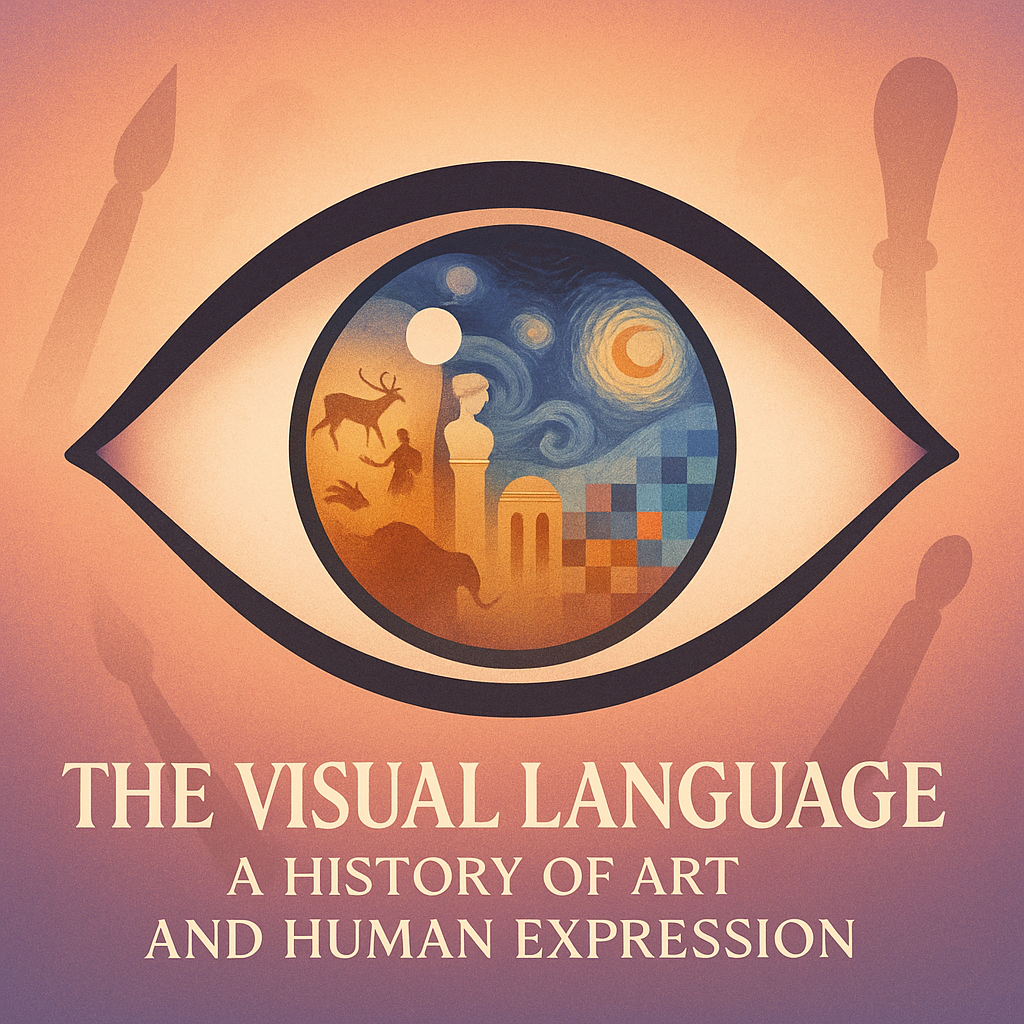
The Visual Language: A History of Art and Human Expression
What Is Art? Beyond the Museum Walls
Echoes of the Cave: The Birth of Expression
Gods and Proportions: The Classical Ideal
The Renaissance: Breaking the Second Dimension
Chasing Light: The Impressionist Rebellion
Shattering Reality: The Rise of Modernism
The Idea Is the Art: Conceptualism and Identity
The Future Canvas: Art in the Digital Age

Transcript
Welcome to your journey through The Visual Language: A History of Art and Human Expression, starting right here with the question that stumps philosophers, artists, and neuroscientists alike. The definition of art remains genuinely controversial — not settled, not agreed upon, actively debated — and the Stanford Encyclopedia of Philosophy confirms this is not a minor academic squabble but a foundational problem that has resisted resolution for centuries. Here is the counter-intuitive part: artworks have appeared in every known human culture, hundreds of thousands of years ago, long before writing, agriculture, or cities. Humans made art before they made civilization. That fact alone tells you something urgent about what art actually is. So what are the "words" and "grammar" of this language? Three classical frameworks compete for the answer. First, representational theory — art imitates reality, from cave drawings to landscapes, capturing what the eye sees. Second, expressionist theory: Leo Tolstoy argued art transmits a feeling the artist experienced directly into the audience through lines, colors, movements, or words, requiring genuine mutual feeling between creator and viewer. R.G. Collingwood pushed further, insisting art is the artist's transmutation of emotion into a shareable imaginative medium — no audience feeling required, just the honest conversion of inner experience into form. Third, formalism: Immanuel Kant defined fine art as a representation purposive in itself, promoting mental powers for sociable communication through what he called the genius of the artist. These aren't just academic positions, Bashir — they are three completely different answers to why a painting can make you cry without saying a single word. Why, then, did our ancestors crawl into the deepest, most dangerous parts of caves just to leave a mark? Representational theory gives us one answer: they were recording reality, making the hunt permanent. But expressionist theory gives us something richer — they were transmitting experience across time, ensuring that what they felt could be felt again by someone else. Arthur Danto's definition adds another layer: art requires not just a subject and a stylistic point of view, but an art historical context and audience participation. Even a prehistoric handprint on a cave wall implies an audience. It implies someone was meant to see it. That is not decoration. That is communication with intent. Now consider your smartphone. Its dimensions, weight, the precise radius of its corners, the color temperature of its screen — these are deliberate aesthetic decisions made by designers who participate in exactly what George Dickie called the "artworld": a network of people who understand and present artifacts to a public with informed intention. Dickie's institutional definition states a work of art is an artifact created to be presented to an artworld public by an artist who participates understandingly. A functional object absolutely qualifies. The difference between looking at your phone and reading it as art is the difference between consuming a signal and decoding a language. Analytic philosophy asks directly whether video games qualify as art — and by Dickie's framework, they do. The museum wall was never the boundary. It was always the intention behind the object. Here is what this all converges on, Bashir: art is not a category of objects. It is a fundamental human language — one that existed before spoken language was formalized, one that operates where words fail, and one that every culture on earth has independently invented. Susanne Langer captured it precisely: art uses symbolic forms to transmit the artist's grasp of an event's value, communicating what logic cannot reach. You do not need a museum to encounter this language. You encounter it every time a designed object moves you, every time an image communicates something you cannot quite say aloud. Art is the oldest signal humans ever sent — and you have been receiving it your entire life.