
James A. Michener's Hawaii: An Epic Journey
This course examines James A. Michener's historical novel Hawaii, tracing the development of the islands from their volcanic beginnings to their modern multi-ethnic status. The series begins with the geological formation of the land and the arrival of the first Polynesian settlers from Bora Bora, who established the initial cultural foundations. It then analyzes the 1820 arrival of American missionaries, specifically the influence of characters like Abner Hale. This period introduced Western moral codes and technology, while simultaneously leading to the decline of native sovereignty and the rise of the influential "Big Five" families that came to dominate the island's economy. The curriculum continues with the arrival of Chinese laborers in the mid-19th century. It details how immigrant families used traditional investment societies to transition from plantation labor to commercial success and land ownership. The course further investigates the Japanese experience, focusing on the harsh conditions of plantation life and the pivotal role of the 442nd Regimental Combat Team during World War II. This military service was essential in securing citizenship and political influence for the Japanese-Hawaiian community. Finally, the series explores Michener’s concept of the "Golden Men," a vision of a post-racial society where diverse heritages blend into a single identity. By reviewing these successive waves of migration, students will understand the complex factors that shaped Hawaii's transition to statehood and its unique social landscape.
From the Sea and the Stars: The Birth of Hawaii
From the Sea and the Stars: The Birth of Hawaii
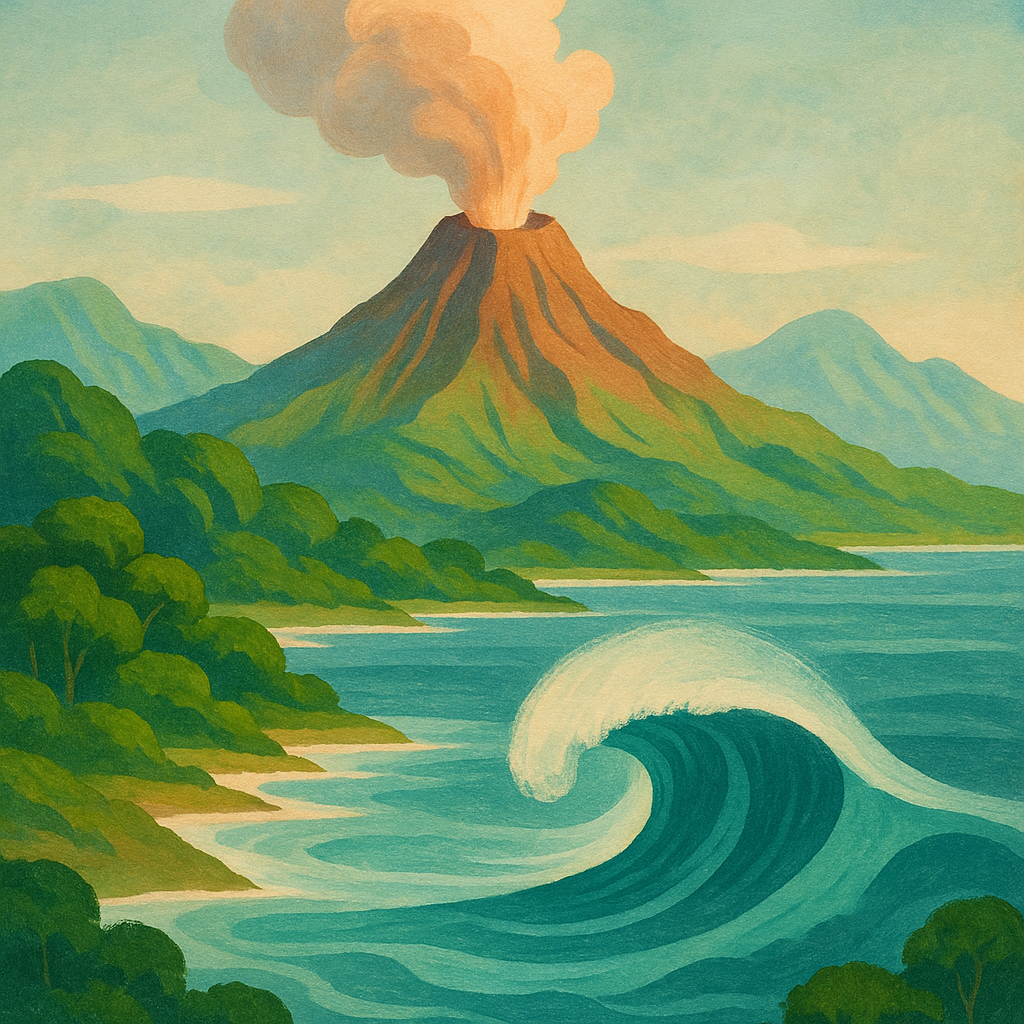
Welcome to your journey through James A. Michener's Hawaii: An Epic Journey, starting with From the Sea and the Stars: The Birth of Hawaii. The Hawaiian Islands did not exist for most of Earth's history — they were born from nothing, thrust upward by volcanic fury from the deepest ocean floor, and the process took millions of years before a single bird landed on them. Michener opens his 1959 novel, published the very year Hawaii became America's 50th state, with this geological prologue — not as decoration, but as argument. The land itself is the first character. Hawaiian scholar Clarice B. Taylor, who served as Michener's technical adviser on Polynesian customs and culture, told him directly that the truest knowledge of these islands lived not in books but in personal, inherited understanding. That insight shaped everything about how this novel breathes.
The prologue Michener constructs is an act of radical patience. Volcanoes erupt, cool, and sink. Reefs form. Atolls rise. Ocean currents carry seeds and spores across thousands of miles, depositing the raw ingredients of an ecosystem before any human foot ever touched the shore. Michener consulted experts on volcanoes, botany, and Pacific flora to render this sequence with precision. The novel details how migratory birds transported flora and fauna to Hawaii over millennia — and this is not background noise. It is Michener establishing his central argument: Hawaii was always a place defined by arrival, by things and people crossing impossible distances to begin again.
Then come the humans, Anvesha, and they arrive with everything at stake. Around 814 AD, Polynesians from Bora Bora near Tahiti set out across open ocean in double-hulled canoes, covering thousands of miles without compasses or charts. Michener fictionalizes these voyagers as outcasts — people driven from their home by religious and political conflict, by superstition and brutality that made staying more dangerous than the sea. The novel depicts early Bora Boran life as governed by fear and rigid hierarchy, where a high priest's authority could mean life or death. Leaving was not adventure. It was survival. These were the People of the Stars, and they navigated by exactly that — reading star positions, ocean swells, wind patterns, and the behavior of wildlife. The golden plover, a migratory bird that flies from Alaska toward the Pacific islands each year, became a living compass pointing toward land that the voyagers had never seen but chose to trust.
This is where Michener's genius as a storyteller locks in, and it matters for you as a reader of epic fiction. The novel is structured as a historical chronicle spanning from 814 AD all the way to 1954, with each major section focusing on a different wave of arrivals reshaping Hawaii. But the Polynesian opening section does something specific: it establishes the template. Every group that follows — missionaries, Chinese laborers, Japanese immigrants — will face the same fundamental equation. Nature is vast and indifferent. Human endurance is the only variable. Michener's account of the Polynesian settlement is openly invented fiction rather than precise historical record, yet the novel is regarded as historically accurate in all its later sections, a balance Michener achieved through rigorous research at the Hawaiian Mission Houses Historic Site and Library, and through his own deep Pacific knowledge gained during World War II naval service.
Here is the takeaway, Anvesha: geological time and human courage are the twin engines of this novel. The islands required millions of years of volcanic patience to exist. The first settlers required extraordinary navigational skill and sheer will to find them. Michener forces you to hold both scales simultaneously — the incomprehensible slowness of the earth and the breathtaking speed of human daring — because that tension is what Hawaii, as a place and as a story, is fundamentally about.
The Word and the Iron: The Missionary Wave
Speaker 1
Ok, so last time we established that Hawaii's whole identity is built around arrival — volcanic rock, migratory birds, Polynesian voyagers crossing thousands of miles. That template of arrival and transformation is exactly what sets up this next wave, right?
Speaker 2
Exactly, and Michener is very deliberate about that continuity. The Polynesians arrived fleeing danger and seeking survival. The missionaries arrive in 1821 with an entirely different motivation — salvation, both spiritual and, they believed, civilizational. Same ocean crossing, completely different ideology.
Speaker 1
So walk me through who these missionaries actually are in the novel. Anvesha and everyone following along would want to know — who are the key figures Michener puts at the center of this?
Speaker 2
The central figure is Abner Hale, a young, rigidly devout Congregationalist student at Yale University. He's the archetype of the true believer — no flexibility, no compromise. His conversion to the missionary cause is actually triggered by Keoki Kanakoa, an Indigenous Hawaiian who travels to America and essentially calls for missionaries to come to his land. That encounter sets everything in motion for Abner.
Speaker 1
And Abner doesn't go alone?
Speaker 2
No. The missionary society has a rule — only married men are sent. So Abner hastily marries Reverend Thorn's niece before departure. His friend Dr. John Whipple also answers the call. Michener sends eleven missionary families in total, and that number matters because their descendants will eventually reshape the entire island.
Speaker 1
How does Michener portray that first contact moment — when these missionaries actually land and see Hawaiian society for the first time?
Speaker 2
It's a collision of worlds. The missionaries are shocked — genuinely scandalized — by the nudity and sexual freedom of the Hawaiian islanders. Abner Hale in particular sees it as evidence of deep moral corruption requiring urgent correction. But Michener is careful not to let that be a simple villain moment. He shows Hawaiian ali'i, the nobility — characters like Malama and Kelolo — who are genuinely curious about Christianity and want to embrace it, while still holding onto their traditional practices.
Speaker 1
So it's not a clean conquest story.
Speaker 2
Not at all. That tension — between sincere religious exchange and cultural imposition — is where Michener does his most interesting work. The missionaries teach the population to read and write, introduce Western customs, attempt conversion. But they also prohibit things that are sacred to Hawaiians. There's a devastating moment where they forbid a Hawaiian king and his sister from living as husband and wife — a traditional royal practice — causing real anguish. The missionaries genuinely believe they're saving souls. The cost to Hawaiian identity is enormous regardless.
Speaker 1
How does that moral authority translate into actual political power? Because that's the part that seems like a big leap.
Speaker 2
It happens through the king. At the missionaries' urging, the Hawaiian king proclaims new laws curbing the corrupt practices of European merchants and whalers operating on the islands. And those merchants and whalers don't accept it quietly — they attack both Hawaiians and missionaries to resist. But the laws hold, and suddenly the missionaries aren't just spiritual advisers. They're the architects of governance.
Speaker 1
And then their children take that further?
Speaker 2
That's the long game Michener is tracking. Over generations, the descendants of those eleven missionary families become the backbone of Hawaii's government, society, business, and commerce. They transition from saving souls to owning sugar plantations, controlling shipping, dominating banking. These are the families that historians call the Big Five — and Michener shows how that economic empire grew directly from the moral authority their parents established.
Speaker 1
So the Bible and the ledger book end up in the same hands.
Speaker 2
That's a precise way to put it. And Michener doesn't let the reader feel comfortable about it. The same literacy and Western technology the missionaries introduced to uplift Hawaiians also gave their own children the tools to consolidate power over those same people.
Speaker 1
There's also a character — Blake — who seems to complicate the missionary picture further. What's his role?
Speaker 2
Uliassutai Karakoram Blake is based on a real historical figure, an English schoolteacher named Alatau Tamchiboulac Atkinson. In the novel, Blake educates Chinese students in Hawaii, teaching them polished English and American conformity. Remarkably, he converts his students to the Church of England while remaining Buddhist himself. Michener uses him to show that the transmission of Western culture was never purely about faith — it was also about producing a certain kind of citizen.
Speaker 1
And that education of Chinese workers — does it connect back to the missionary influence on labor?
Speaker 2
Directly. Michener makes the point that the missionaries' insistence on education ultimately doomed the indentured labor systems that plantation owners depended on. Once Chinese workers were educated, they could navigate contracts, understand their rights, and eventually exit the plantation economy entirely. The missionaries' most radical act may have been teaching people to read.
Speaker 1
So for everyone following Anvesha through this novel — what's the single thing to hold onto from this chapter of Hawaii's story?
Speaker 2
The arrival of the American missionaries introduced a rigid moral code and Western technology that permanently altered Hawaiian sovereignty and health — cultural, political, and economic. They came with Bibles and built an empire. Michener's genius is that he refuses to make that either purely heroic or purely villainous. It was both, simultaneously, and the islands carry that contradiction to this day.
The Fragrant Mountain: The Chinese Ascent
Historical Chinese immigration to Hawaii began in earnest in 1852 — contract laborers shipped into sugarcane fields, treated as interchangeable parts in a machine owned by others. The Chicago Tribune called Michener's novel, which documents this entire arc, 'a tremendous work from every point of view — thrilling, exciting, lusty, vivid, stupendous.' That praise matters because what Michener captures in the chapter titled 'From the Farm of Bitterness' is not a simple immigrant success story. It is something harder and more honest.
The Chinese immigrants arrived amidst an economic empire built by missionaries, but their story diverges significantly, focusing on resilience and adaptation rather than religious influence. Michener shows these workers coming not from ambition but from desperation — fleeing famine, leaving impoverished villages where starvation was the alternative. They arrived starting in the 1850s, and the sugarcane fields offered survival, not dignity.
The conditions were brutal.
Michener highlights the Chinese laborers' resilience in the face of harsh exploitation, cultural isolation, and legal barriers, showcasing their strategic adaptation to these challenges. They were confined, controlled, and expected to remain permanent agricultural labor. But Michener is tracking something the plantation owners missed entirely. These were people who had already survived the unsurvivable. Hardship was not new to them. What was new was proximity to a market economy — and they studied it carefully.
The entrepreneurial spirit of the Chinese immigrants is a pivotal theme. Once contract terms expired, they transitioned from plantation labor to urban commerce and independent enterprise. They moved. Into towns, into commerce, into rice farming — introducing agricultural practices the islands had never seen. Michener documents the formation of Chinatowns in Hawaii, which became vibrant centers for community life and economic development. Family associations and Chinese New Year networks weren't cultural decoration; they were infrastructure.
Michener uses multi-generational family sagas to show how this transition compounded across time. Intermarriage with native Hawaiians accelerated cultural integration while simultaneously expanding social networks. The white elite had designed a system where Chinese labor fed the plantation economy permanently. What they got instead was a community that used the plantation as a launching pad. The novel, all 1,136 pages of it, tracks these family lines through detailed genealogical charts — making the accumulation of Chinese influence visible across generations in a way that raw history rarely captures.
Here is what makes this chapter sting, Anvesha. The discrimination was real and sustained — legal restrictions, cultural isolation, the grinding weight of being seen as temporary and disposable. And yet the Chinese community's ascent defied every expectation the white establishment had built its confidence on. Michener's genius is showing that the same bitterness named in the chapter's title — 'From the Farm of Bitterness' — became the fuel. Not despite the hardship. Because of it.
The key takeaway is the Chinese immigrants' role in establishing a new economic model in Hawaii, driven by community investment and entrepreneurial ventures. It was built on the Hui — community investment networks and family associations that pooled resources across households — and on the deliberate transition from plantation labor into urban commerce and independent enterprise. The plantation owners thought they were importing a permanent underclass. What they actually imported was a generation of people who had nothing to lose and everything to build.
That shift altered Hawaii's demographic and cultural landscape permanently, and Michener makes sure you feel the full weight of it.
Honor and the Razor's Edge: The Japanese Legacy
Speaker 1
Alright, so last lecture we tracked how the Chinese immigrants used the plantation as a launching pad — they turned bitterness into enterprise. And now Michener does something similar with the Japanese, but the stakes feel even higher. What's the setup?
Speaker 2
The setup involves Japanese workers arriving in Hawaii's sugarcane fields, facing unique challenges as they navigated a system already wary of immigrant communities.
Speaker 1
So the plantation system essentially kept recruiting its own replacement workforce.
Speaker 2
Exactly. Michener makes that irony visible. The chapter is called 'From the Inland Sea,' and it introduces Kamejiro Sakagawa — the central Japanese immigrant figure in the novel. He arrives to work the cane fields, and his family becomes the lens through which Michener tracks the entire Japanese-Hawaiian experience across generations.
Speaker 1
Why Kamejiro specifically? What does he represent that a more generic immigrant figure wouldn't?
Speaker 2
Kamejiro is ordinary in the best sense — he's not exceptional by birth or education. He represents the mass of Japanese workers who came with nothing but a willingness to endure. Michener uses him to show how hard work and family cohesion, rather than individual genius, drove the Japanese ascent. The Sakagawa family becomes a kind of composite portrait of an entire community.
Speaker 1
And how does the Japanese experience differ from the Chinese one? Because our listener might assume it's basically the same immigrant arc.
Speaker 2
There's a crucial difference. The Japanese faced immediate suspicion upon arrival, unlike earlier immigrants, and this intensified during WWII. And then Pearl Harbor happened — and that suspicion became something far more dangerous.
Speaker 1
Right. How does Michener handle the Pearl Harbor moment specifically? That must be a turning point in the novel.
Speaker 2
It's devastating in the text. Overnight, the Japanese-Hawaiian community goes from being hardworking residents to being treated as potential enemies — people whose loyalty to America is presumed guilty until proven otherwise. Families that had been in Hawaii for decades suddenly had to justify their existence on the islands.
Speaker 1
And how do you prove loyalty when the accusation itself is based on ancestry, not action?
Speaker 2
That's the razor's edge Michener puts his characters on. The answer the Sakagawa sons choose is military service. Four of Kamejiro's children enlist in the U.S. military. Michener is drawing directly from the real history of the 442nd Regimental Combat Team — composed largely of Japanese American soldiers from Hawaii — which became one of the most decorated units in American military history.
Speaker 1
He doesn't use the 442nd by name in the novel, though, right?
Speaker 2
He changes it to the 222nd for fictional purposes. But the parallel is unmistakable and intentional. Michener had served in the Pacific Theater during World War II himself, and he observed Nisei soldiers — second-generation Japanese Americans — firsthand. That personal witness is what gives the military sections their weight.
Speaker 1
There's also something personal in how Michener researched this chapter specifically. What's the connection to his own life?
Speaker 2
His third wife, Mari Sabusawa Michener, was of Japanese descent. He conducted much of his research for the novel while living in Hawaii with her, and she gave him direct access to Japanese American communities and their stories. She influenced his understanding of that experience in ways no archive could have.
Speaker 1
So the research wasn't just academic — it was relational.
Speaker 2
Completely. Michener spent four years on research and three years writing the novel. The Japanese chapter in particular carries that intimacy. He also later endowed scholarships partly inspired by the Japanese American experiences he documented — so the novel's impact extended well beyond the page.
Speaker 1
Let's talk about the political consequence. How does military service actually shift the landscape for Japanese Hawaiians after the war?
Speaker 2
The veterans returned with moral authority, having fought for a country that doubted them, which shifted their societal standing. That credibility translated directly into political organizing. The Japanese-Hawaiian community moved into civic life, into law, into elected office, in ways that would have been unthinkable before the war.
Speaker 1
Michener is essentially showing that citizenship wasn't granted — it was seized through sacrifice.
Speaker 2
That's precisely it. And it mirrors the broader arc of the novel. Every group that arrives in Hawaii has to prove its right to belong — not once, but repeatedly, against systems designed to keep them subordinate. The Japanese experience is the sharpest version of that pattern because the stakes were existential.
Speaker 1
So for everyone following Anvesha through this novel — what's the single thing to hold onto from this chapter?
Speaker 2
The Japanese-Hawaiian experience was defined by the struggle for citizenship and the proving of loyalty during the crucible of World War II. Michener shows that the Sakagawa family's arc — from cane fields to combat to civic power — wasn't just one family's story. It was the mechanism by which an entire community forced America to reckon with what belonging actually means.
The Golden Men: A New Synthesis
A novel published in 1959 — the exact year Hawaii became America's 50th state — has since been translated into 32 languages. That is not a coincidence of timing. It is a statement of global relevance. James A. Michener structured Hawaii to end precisely where history was beginning: the mid-1950s, on the threshold of statehood, with a society that had no real precedent anywhere on Earth. The novel's international reach underscores Hawaii's global significance as a model for multi-ethnic societies, reflecting its unique identity and potential impact on international relations.
Last lecture established that the Japanese-Hawaiian community seized citizenship through military sacrifice — loyalty proven in blood, not granted by law. That hard-won standing feeds directly into the novel's final movement. Most of the novel's action runs from the 1820s to the late 1940s, but the story closes in the mid-1950s, and that endpoint is deliberate. Michener isn't wrapping up a history. He's pointing at a future.
The characters anchoring this final vision matter enormously.
Hoxworth Hale — a descendant of the original missionary families — represents the old white establishment, the men who arrived with Bibles and built economic empires.
He carries the weight of that inheritance: the power, the guilt, the slow recognition that the Hawaii his ancestors shaped no longer belongs exclusively to people like him. Against him, Michener places figures from the Chinese and Japanese communities whose families clawed their way from plantation labor into civic life. The novel presents multiple ethnic and cultural groups' perspectives simultaneously — not as competing claims, but as converging ones. Hawaii, Michener argues, is the place where those convergences stop being a conflict and start being an identity.
The concept Michener builds toward is the 'Golden Man,' symbolizing Hawaii's unique identity and its influence on political and economic integration into the United States. It describes a person shaped by Eastern and Western heritages simultaneously, fluent in multiple traditions, belonging fully to none and drawing from all. This is not a utopian fantasy Michener imposes on the story. It emerges from the transgenerational family sagas he has been tracking across 1,136 pages — the intermarriages, the code-switching, the children who grew up eating rice and reading Emerson.
The transformation Michener documents — from isolated island society to a modern American state — highlights Hawaii's statehood and its role as a model for multi-ethnic societies worldwide. Not any single wave of arrivals, but the cumulative result of all of them colliding, adapting, and fusing. Before Hawaii, Michener won the Pulitzer Prize for Literature in 1948 with Tales of the South Pacific. That earlier work showed him the Pacific's human complexity. Hawaii let him answer the question that complexity raised: what happens when every culture arrives at the same shore and none of them leaves?
You get something the world had never seen. That is Michener's final argument, and it lands.