
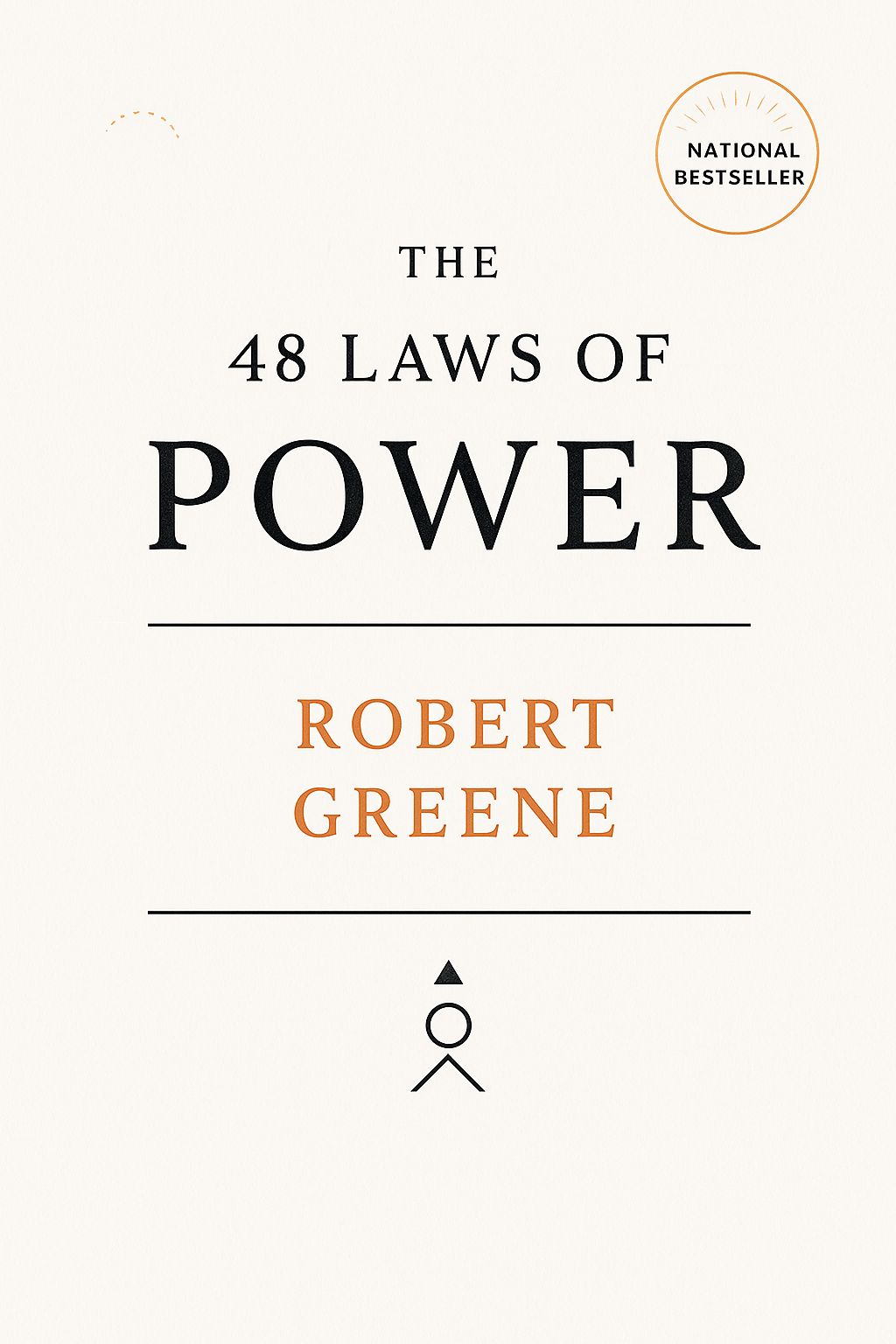
The 48 Laws of Power by Robert Greene
This course examines Robert Greene's 48 Laws of Power through nine lectures that cover emotional discipline, hierarchy management, alliances, speech control, and reputation building. Lecture 1 introduces the court metaphor, indirect action, patience, appearances, and the study of human motives, then shows how to avoid eclipsing superiors, judge friends and enemies, conceal intentions, speak with restraint, and build an unassailable reputation. Lecture 2 covers courting attention through spectacle, controversy, and mystery, using others' work, drawing people onto your ground, demonstrating rather than arguing, avoiding emotional contagion, becoming indispensable, and using selective honesty or generosity. Lecture 3 addresses appealing to self-interest, gathering intelligence, eliminating threats, creating value through absence, cultivating unpredictability, recognizing dangerous personalities, and preserving leverage by remaining uncommitted. Lecture 4 examines seeming less clever than one's target, surrendering tactically when weak, concentrating resources, the art of courtiership, self-recreation, theatrical identity, and using scapegoats or intermediaries. Lecture 5 analyzes how vague promises, rituals, enthusiasm, and sacrifice create devoted followings, then traces bold action, planning through consequences, making achievement appear effortless, limiting others to favorable choices, and appealing to fantasy. Lecture 6 investigates discovering hidden insecurities, needs, secrets, and emotional pressure points, then contrasts that with regal self-presentation, patient mastery of timing, and strategic indifference. Lecture 7 explores how images, symbols, and staged spectacles shape perception, why unconventional thought is safer behind conventional behavior, how calm actors gain advantage by provoking others, and the extended treatment of the free lunch including debt, quality, generosity, circulation, and the symbolic meaning of money. Lecture 8 discusses how successors escape comparison with celebrated predecessors, isolate the influential source of collective trouble, win cooperation through hearts and minds, and employ the mirror effect to conceal intentions, expose behavior, unsettle opponents, or create rapport. Lecture 9 concludes with gradual reform that respects habit and continuity, the strategic display of harmless imperfections to deflect envy, the danger of advancing beyond the original goal after victory, and adaptability and formlessness as the culminating principle.
The Courtly Grammar of Hidden Power
The Courtly Grammar of Hidden Power
Welcome to The 48 Laws of Power by Robert Greene — a book that will permanently change how you read every room you walk into. Most people assume that the kind, the loyal, and the transparent rise furthest, but this book reveals why those very qualities can get you destroyed. Robert Greene, a man who worked roughly eighty different jobs before writing this, spent years excavating history's most ruthless operators to show you exactly how power actually moves.
Greene argues that power is not a privilege reserved for kings — it is a game every person plays, whether they know it or not. The dangerous ones, in the author's view, are not the cruel but the naive — those who refuse to see the rules and get outmaneuvered by those who do. Greene draws on Machiavelli, Sun Tzu, and centuries of court behavior to show that these laws are descriptive, not moral prescriptions.
So what does the author say about the people above you — your bosses, your patrons, your superiors? Law 1 is blunt: Never Outshine the Master. Greene contends that even the most confident superiors harbor deep anxieties about their position, and a subordinate who shines too brightly activates those fears.
The cautionary tale here is Nicolas Fouquet, a French finance minister who threw a party so lavish it humiliated Louis XIV — and the king had him imprisoned for life. The contrast is Jean-Baptiste Colbert, who channeled every talent into glorifying the king rather than himself. The goal, Greene argues, is calibrated competence — valuable enough to be indispensable, never so dazzling as to threaten.
Law 2 inverts something most of us believe instinctively: that friends are safer allies than enemies. The author argues that friends carry emotional entitlement and unconscious envy, while former enemies are, the, the motivated ones — they have something to prove. The Byzantine emperor Michael III trusted his close friend Basilius completely; Basilius murdered him and seized the throne.
Once more, slowly. Friends carry emotional entitlement; former enemies are motivated to prove their worth. That is not cynicism about friendship — it is a clear-eyed separation between emotional bonds and strategic alliances.
Law 3 receives the most extended treatment and forms the conceptual heart of what Greene is building here. Conceal Your Intentions — the principle is simple: reveal what you want, and you hand your opponents the tools to block you. The author identifies a near-universal cognitive bias: people take surface behavior at face value, assuming what someone says reflects what they actually want.
Greene's techniques include red herrings — false desires projected to divert attention — and noble cover stories that align real intentions with publicly acceptable goals. The best concealment, he argues, does not look like concealment at all. It looks like complete openness. Taken together, these first laws form a coherent system: manage those above you by suppressing the impulse to shine, choose allies with strategic rather than sentimental logic, and never reveal your plans until the moment of action — when it is already too late for anyone to respond.
Greene's techniques include red herrings — false desires projected to divert attention — and noble cover stories that align real intentions with publicly acceptable goals. The best concealment, he argues, does not look like concealment at all. It looks like complete openness.
Visibility, Leverage, and the Architecture of Dependence
Power, the author argues, is not something you possess in private — it only exists in the perceptions and reactions of others. That is the, the central premise behind Laws 6 through 10, and it changes everything about how you think about influence. These laws form a unified architecture: visibility, leverage, credit, and the ruthless management of your associations.
Last time, the author showed us that concealing your intentions is not deception — it is the grammar of survival in any competitive environment. Now the framework expands outward, and Law 6 makes a claim that surprises most people: obscurity is more dangerous than being hated. The author contends that figures like P.T. Barnum and Andy Warhol understood attention as a, a form of currency — and they spent it deliberately.
Notoriety, in the book's view, at least keeps you relevant; being ignored erases you entirely. Obscurity is the true enemy — not criticism, not hatred, obscurity. The strategist must author their own myth using bold gestures, striking symbolism, and managed controversy to stay a focal point in others' minds.
Law 7 is where the author gets almost ruthless, and the contrast he uses is devastating. Nikola Tesla had superior technical genius; Thomas Edison had superior reputation management — and Edison won. The author argues that raw talent without positional awareness is insufficient: the person who controls how work is perceived accumulates power, while the person who merely produces the work often stays obscure.
Law 8 extends this into something the author calls the architecture of initiative. The truly powerful, in the book's view, never chase people or opportunities — they set conditions that compel others to come to them. Bismarck engineered France into appearing as the aggressor in the Ems Dispatch, remaining still while his opponent reacted, and that stillness, that's, that's where the real control lived.
Law 9 delivers what is, honestly, one of the book's sharpest reversals: winning an argument is a trap. The author contends that defeating someone in debate wounds their pride, plants resentment, and rarely changes what they actually believe. Once more, slowly. Winning an argument wounds pride and plants resentment — it rarely changes belief.
Michelangelo did not argue with his critics — he worked, and the work silenced them. The author argues that when you demonstrate your point rather than state it, the other person feels the conclusion is their own insight and embraces it fully. Action builds perception that lasts; words build perception that crumbles under the first counter-argument.
Law 10 closes with a warning the author frames almost like a public health alert: misery, bad luck, and negativity are contagious. Chronic dysfunction spreads between people the way a disease does, and the strategist must be ruthlessly selective about who enters their orbit. Together, these five laws form a single coherent command — make yourself visible on your own terms, draw others toward you, let actions speak louder than arguments, and guard your environment against those who would pull you into their collapse.
What the author is really building across these five laws is a single, coherent command. Make yourself visible on your own terms, draw others toward you, and let actions speak louder than arguments. Guard your environment against those who would pull you into their collapse.
Intelligence, Scarcity, and Strategic Independence
Last time, the author showed us that raw talent without positional awareness is insufficient — the person who controls perception accumulates power, while the producer of the work often stays invisible. Now the framework shifts inward, toward the intelligence, the psychology, and the discipline that keep a strategist dangerous over time. These next laws form a coherent operating philosophy, and each one builds on the last.
The author argues that people act from self-interest, not gratitude — and that is, that's the foundational premise behind approaching anyone who has something you need. The effective operator studies the other person's desires and fears before making any approach, then frames the request as a solution to their problem. Gratitude, in the book's view, is an unreliable currency that people rationalize away almost immediately.
Superior information is, the author contends, one of the most decisive advantages available in any competitive environment. The skilled operator gathers intelligence not through direct interrogation but through relationships that function as listening channels — paying close attention to what people avoid saying as much as what they reveal. Once more, slowly. The person who knows more about their rivals than those rivals know about themselves holds a structural advantage no talent can easily overcome.
The author's logic on conflict is blunt: a partially defeated enemy is more dangerous than one never challenged, because wounded opponents retain the desire for revenge while losing the restraint that comes with full strength. Half-measures produce pauses, not peace — they give enemies time to regroup under worse conditions for you. The prescription is strategic finality, setting aside sentiment in favor of clarity about how power and enmity actually function. Presence, when it becomes routine, loses its power — and the, the author applies basic economic logic here. By controlling the supply of your own availability, you regulate the demand others feel for you; strategic withdrawal, timed after your presence is already recognized, causes others to fill the absence with idealized projections. Familiarity, in the book's view, breeds not admiration but indifference. Predictability is a vulnerability — when rivals can anticipate your behavior, they can prepare, counter, and manipulate you.
The author points to Hernán Cortés scuttling his own fleet and Picasso repeatedly reinventing his style as examples of how calculated departures from expected behavior paralyze opponents. The key distinction, though, is between strategic unpredictability aimed at rivals and erratic behavior that simply makes you appear unstable to those who depend on you. And the final warning is this: withdrawing from social networks in response to threat cuts off the information flow and the web of allies that constitute real power. The fortress, whether literal or metaphorical, signals weakness and invites attack — it leaves you dependent on the few people who retain access, making manipulation easier, not harder. Power, the author argues, requires embeddedness in social life, not retreat from it.
Taken together, these laws describe a mode of operating that is simultaneously outward-facing and internally disciplined. The strategist gathers intelligence, manages perception, acts decisively, and stays unpredictable — all while resisting the defensive impulses that masquerade as prudence. That is, that's the operating philosophy the author is building across every one of these principles.
And that operating philosophy, the author argues, is not a collection of tricks — it is a, a unified discipline. The strategist who masters intelligence, perception, and decisive action holds an advantage no raw talent can easily overcome. That is the architecture these laws are building toward.
Indirect Ascent Through Surrender, Courtiership, and Reinvention
The author argues that the most dangerous operators in history rarely looked dangerous at all. They concealed their strength, yielded when pressed, and advanced precisely because no one saw them coming. That indirection, the author contends, is not weakness — it is the sharpest edge available.
Last time, the author showed us that the strategist who masters intelligence and perception holds an advantage no raw talent can easily overcome. Now the framework turns inward again, toward two laws that are, honestly, the most counterintuitive in the entire book. The author argues that openly displaying superior intelligence is, the, the fastest way to make enemies of the people around you.
Law 21 contends that when others feel outmatched, they respond not with admiration but with envy, fear, and quiet resentment. The person who appears less capable than they are disarms rivals and moves without scrutiny. This is not passivity — it requires iron self-discipline and a precise understanding of how ego operates in others.
The temptation to demonstrate cleverness is, the author argues, one of the most reliably self-destructive impulses a person can indulge. Suppressing that urge and weaponizing apparent ignorance instead — letting others feel smarter, more in control — creates freedom to maneuver that open brilliance never could. Once more, slowly. Apparent ignorance, deployed deliberately, creates freedom that open brilliance never could.
Law 22 extends this logic into conflict itself, and the reversal the author makes here is striking. When you are outmatched, fighting back is often, the author contends, the worst possible response — it gives the aggressor a target, burns your resources, and earns you no sympathy. Strategic surrender, by contrast, denies the enemy a victory, generates goodwill, and buys the time needed to return stronger.
The author draws on Galileo's recantation before the Inquisition as the clearest example of this principle in action. Galileo yielded publicly, preserved his life and his work, and the ideas he surrendered to suppress outlasted every institution that pressured him. Bertolt Brecht did something similar before the House Un-American Activities Committee — evasive, careful, never quite giving them what they wanted.
Taken together, these two laws establish what the author frames as a foundational operating principle for anyone navigating a competitive environment. Indirect approaches — concealment, yielding, misdirection — frequently outperform direct confrontation. The strategist who can resist the pull of proud resistance, who can absorb pressure without breaking or retaliating, holds, the author argues, a decisive and durable advantage.
What makes this principle so difficult to execute is not the logic — the logic is clear. The difficulty is emotional: most people cannot absorb pressure without either retaliating or collapsing entirely. The author argues that the strategist who masters that emotional discipline holds an advantage that raw intelligence almost never provides.
Galileo's case is worth sitting with for a moment, because the instinct most people feel is that he should have fought. He yielded publicly, and the ideas he surrendered to suppress outlasted every institution that pressured him. That is, that's the author's point — survival is the precondition for everything else.
Brecht's testimony before the House Un-American Activities Committee works the same way — evasive, careful, never quite giving them what they wanted. The author contends that both men understood something their opponents did not: a target that refuses to hold still cannot be destroyed. Yielding, in the book's view, is not the absence of strategy — it is, the, the strategy itself.
The deeper implication the author draws is that indirect approaches require more discipline than direct ones, not less. Concealment demands that you suppress the urge to prove yourself; surrender demands that you absorb humiliation without breaking. Both require a, a precise understanding of how ego — yours and theirs — operates under pressure.
Taken together, these two laws form what the author frames as a foundational operating principle. Indirect approaches — concealment, yielding, misdirection — frequently outperform direct confrontation. The strategist who can resist proud resistance and absorb pressure without retaliating holds, the author argues, a decisive and durable advantage.
Belief, Boldness, Foresight, and Engineered Choice
The most dangerous operators in history rarely relied on logic alone. The author argues that power, at its deepest level, runs on belief — and belief is something you can engineer. That is the, the unsettling premise behind what this lecture covers.
Last time, the author showed us that indirect approaches — concealment, yielding, misdirection — frequently outperform direct confrontation. Now the framework shifts toward something even more fundamental: the human need to believe in something larger than themselves. The author contends that people are fundamentally uncomfortable with uncertainty, and that discomfort makes them, the, the willing recruits of anyone who offers certainty and vision.
The skilled power player, in the book's view, does not argue their way to influence — they position themselves as a prophet. The author outlines a five-step method, and each step is designed to bypass critical thinking entirely. Keep the message vague enough that followers project their own desires onto it; emphasize spectacle and ritual over intellectual argument; and borrow the forms of organized religion to lend the movement an air of legitimacy.
The author adds two more steps that are, honestly, the sharpest of the five. Conceal financial motives so followers believe the leader is driven by higher purpose, not profit. Create an us-versus-them dynamic — it strengthens group cohesion and gives followers a sense of righteous identity.
Historical figures like Francesco Giuseppe Borri and the Comte de Saint-Germain illustrate how these techniques work across completely different eras. What matters, the author argues, is not the specific content of the belief system — it's the psychological mechanism it activates. The treatment here is double-edged: understanding these dynamics is both a tool for building influence and a, a defense against being manipulated by those who deploy them.
The danger for the leader, though, is real and the author does not soften it. Maintaining the illusion requires constant effort, and any crack in the facade risks catastrophic loss of credibility. Power built on belief is, the author contends, among the most potent and the most fragile structures a person can construct.
What makes this framework so, so unsettling is that it works regardless of the era or the ideology. The author contends that the psychological mechanism — not the content — is what drives belief-based power. That mechanism is, in the book's view, essentially timeless.
The author draws a sharp distinction between the prophet and the rational persuader, and the distinction matters enormously. The rational persuader appeals to evidence; the prophet appeals to longing, and longing, the author argues, almost always wins. Once more, slowly. Longing almost always defeats evidence.
The, the irony the author highlights is that followers often sense the vagueness in the message and embrace it anyway. Spectacle and ritual do the work that argument cannot — they bypass the critical mind entirely. The us-versus-them dynamic then locks the follower in, because leaving the group means surrendering their identity.
The author is careful to frame this as a double-edged analysis, not a simple instruction manual. Understanding how belief gets engineered is, the author contends, the most reliable defense against being engineered yourself. The person who recognizes the mechanism cannot be fully captured by it.
The danger for the leader, though, is structural and the author does not soften it. Concealing financial motives and sustaining spectacle requires constant, exhausting effort — and a single credible exposure can collapse everything. Power built on engineered belief is, the author argues, among the most potent and the most fragile structures a person can construct.
Reading Weakness, Projecting Authority, and Choosing the Moment
Last time, the author showed us that power built on engineered belief is among the most potent and the most fragile structures a person can construct. Now the framework shifts toward something more surgical: reading the hidden vulnerabilities of individuals, projecting unshakeable self-worth, and choosing the precise moment to act. These three disciplines, the author argues, form the psychological core of durable power.
The author contends that every person carries a hidden pressure point — a fear, an unmet need, or a wound they have never fully resolved. The braggart is anxious about their worth; the moralist is tempted by exactly what they condemn. Identifying that vulnerability, the author argues, gives you more leverage than any amount of resources or status ever could.
The skilled observer, in the book's view, learns to read beneath the surface by watching unguarded moments and emotional overreactions. The, the key methods the author outlines are precise: look for contrasts between public persona and private behavior, and identify whether someone's primary need is validation, inclusion, superiority, or security. Crucially, the author warns against projecting your own psychology onto others — misreading a target, or pressing too hard, produces unpredictable and counterproductive results.
The author then pivots to something that surprises most people: the world, the author contends, takes you at your own valuation. Christopher Columbus secured royal patronage not through superior credentials but through the sheer audacity of his demands — titles, percentages, the rank of Admiral of the Ocean Sea. The Spanish monarchs, accustomed to petitioners who groveled, were persuaded by his bearing alone. The practical framework the author draws here is consistent and, honestly, uncomfortable for most people to apply. Never reveal need or desperation; always ask for more than you expect; and accept good treatment as a matter of course, not as luck. False modesty, the author argues, trains others to undervalue you — and that training is very hard to undo. Victor Lustig sold the Eiffel Tower twice, not through deception alone, but because his manner left no room for doubt. Timing, the author argues, is not passive waiting — it is an active strategic discipline rooted in reading the rhythms of political and emotional environments.
The author distinguishes three modes: long time, the patient waiting that lets circumstances ripen; forced time, the deliberate acceleration that unsettles opponents; and end time, the recognition that a moment has fully matured and action must be taken without hesitation. The Roman general Fabius Maximus refused to engage Hannibal directly, understanding that attrition was, the, the real weapon — and he was right. The author references the ancient Greek concept of kairos — the qualitative, opportune moment — as distinct from ordinary sequential time. Impatience, the author contends, is one of the most dangerous flaws a power-seeker can carry: it forces situations that are not yet ready and creates unnecessary enemies. The counterbalancing danger is waiting so long the moment passes entirely, and calibrating between those two extremes requires, the author argues, experience, self-awareness, and a studied understanding of historical patterns.
Taken together, these three disciplines form what the author calls psychological precision — making people feel they act freely while guiding them toward outcomes that serve your interests. Power over people, the author argues, is achieved not through force but through reading, projecting, and timing. That is, that's the operating core these laws are building toward.
Spectacle, Social Camouflage, Emotional Provocation, and Value
Last time, the author showed us that power over people is achieved not through force but through reading, projecting, and timing. Now the framework turns outward again, toward four laws that are, honestly, among the most practically useful in the entire book. The author argues that perception, social behavior, emotional control, and the psychology of value are the real levers of influence.
The author contends that humans are fundamentally visual creatures, and that striking imagery and theatrical display communicate authority far more effectively than rational argument ever can. Spectacle is not vanity — it is a deliberate instrument that bypasses critical thinking before opposition can even form. Louis XIV's court at Versailles was a meticulously staged theater of power, and religious institutions used grand architecture and ritual to inspire awe and submission. The practical implication is that anyone seeking influence must think like a stage director, evaluating every public appearance and every symbol for its emotional impact on the audience.
The author then shifts from external staging to the internal management of belief, and the, the reversal here is sharp. Unconventional ideas must be protected through strategic conformity rather than public declaration — Galileo was forced to recant not because he was wrong, but because he failed to manage the social environment around his ideas. Once more, slowly. The lesson is not intellectual cowardice but social intelligence.
The Marquis de Sade's insistence on expressing transgressive views publicly led to imprisonment and marginalization, and the author argues that most people experience challenges to their beliefs as personal attacks. True inner freedom, in the book's view, comes from not needing external validation — you can think whatever you like while giving the social world the conformity it demands on the surface. The crowd reliably punishes those who stand apart, and the strategist who understands that holds a quiet, durable advantage. The author extends this logic of emotional management outward, arguing that remaining calm while provoking others into agitation is a, a decisive strategic weapon. Anger clouds judgment and reveals vulnerabilities; composure allows clear thinking and deliberate action. Napoleon used feigned weakness to bait enemies into overextension, and courtiers who mastered the cold shoulder forced aggressors into increasingly self-damaging behavior — the composed person always holds the advantage because they care less and wait longer.
The final and most extensively developed argument is that nothing in the social world is truly free — gifts, favors, and bargains always carry hidden costs in obligation, dependency, and loss of independence. The author draws on the Rothschild banking family, the Medici patronage system, and anthropologist Marcel Mauss's work on gift economies to show that giving and receiving are never neutral acts. They are, the author contends, moves in a social game of control and reciprocity, and accepting something for free signals weakness or naivety while paying full price signals self-sufficiency. The author identifies three psychological types: the Greedy, blinded by apparent bargains and easily manipulated; the Generous, who use giving as a tool of control; and the Powerful, who pay fair value for everything and thereby preserve their freedom of action. What is freely available is automatically discounted — whether it is money, advice, attention, or affection.
Across all four laws, the author's unifying argument is that power is fundamentally a matter of managing perception, through spectacle, social camouflage, emotional asymmetry, and the symbolic language of value.
Beyond the Predecessor's Shadow Through Influence and Mirroring
Last time, the author showed us that power is fundamentally a matter of managing perception — through spectacle, social camouflage, emotional asymmetry, and the symbolic language of value. Now the framework turns toward something even more psychologically precise: how to establish independent authority, neutralize internal threats, and build influence that feels, to the other person, like their own free choice.
The author argues that succeeding a celebrated figure is one of the most structurally treacherous positions in any domain of power. Every action gets measured against an idealized, often mythologized memory — and imitation only deepens the comparison. The successor who copies the predecessor's methods is, the author contends, already defeated.
The author illustrates this through Louis XV, who suffered perpetually in the shadow of Louis XIV, and through Alexander the Great's successors, who fragmented his empire by trying to replicate his conquests. The prescribed solution is not gradual differentiation but a decisive psychological break — what the author calls symbolically killing the predecessor. Augustus Caesar exemplifies this: rather than copying Julius Caesar's populist charisma, Augustus invented an entirely new political structure that made Caesar's approach obsolete.
The author then shifts focus inward, to managing threats within a group, and the, the logic here is surgical. Discord and low morale almost always trace back to a single individual whose influence is disproportionate to their rank. Once more, slowly — most people are not naturally rebellious; they are led into resistance by one charismatic agitator.
The effective response, the author contends, is to identify the true source of infection rather than the most vocal symptoms, isolate that person from their audience, and remove them decisively. Reasoning with the troublemaker rarely works, and punishing the group collectively only validates their narrative. Power, in the book's view, requires precision in diagnosing human problems — treat the cause, not the symptoms. The final two laws address influence and psychological disarmament, and they are, honestly, the most seductive ideas in the entire framework. The author argues that coercion produces only fragile, resentment-laden compliance — genuine influence requires understanding each person's emotional currency, their particular desires, fears, and vanities.
The most effective persuasion is invisible; it feels to the target like their own authentic choice.
Leaders who govern through fear eventually face revolt, while those who cultivate emotional bonds and shared purpose maintain power far longer — that is the author's core claim here. The author also introduces mirroring as a tool of psychological destabilization: by reflecting an opponent's own behavior back at them, you trap them in hypocrisy and confusion. Socrates used exactly this method, reflecting interlocutors' own arguments back until they exposed contradictions they could not defend — and across all four laws, the unifying insight is that durable power is built through psychological precision, not force.
The internal dimension matters equally, and this is, the, the part most successors miss entirely. Clinging to proven methods out of insecurity is itself a vulnerability — it signals that you have accepted someone else's standards as your own. You cannot build a distinct identity while measuring yourself against a predecessor's yardstick.
The author argues that genuine influence requires mapping each person's emotional currency — their specific fears, vanities, and unmet desires — then aligning your goals with those internal drivers. Coercion produces compliance that lasts only as long as the threat does. Power built on emotional bonds and shared purpose, the author contends, outlasts power built on fear by a considerable margin.
Mirroring, the author adds, works on two distinct levels that are easy to confuse. Reflect an opponent's behavior back at them and you trap them in hypocrisy; reflect a person's values and desires and you create bonds of validation they find almost impossible to resist. Socrates used exactly this — turning an interlocutor's own argument into the instrument of their undoing.
Across all four laws, the unifying insight is that durable power is built through psychological precision, not force or imitation. Know when to break decisively from the past, when to remove a single disruptive source rather than punish the whole group, and when to seduce rather than compel. The strategist who masters those distinctions holds an advantage that raw authority almost never provides.
Measured Change, Human Imperfection, Restraint, and Formlessness
Last time, the author showed us that durable power is built through psychological precision — knowing when to break from the past, when to remove a single disruptive source, and when to seduce rather than compel. Now the framework turns toward three principles that are, honestly, among the most psychologically demanding in the entire book. The author argues that managing change, envy, and the intoxication of victory requires a discipline most people never develop.
The author contends that people endorse reform intellectually while remaining emotionally anchored to familiar customs and rituals. Change that feels like rupture provokes backlash; change that feels like continuity passes almost unnoticed. Augustus preserved the outward symbols of the Roman Republic while quietly dismantling its actual power structures — and the, the population accepted transformation they never would have tolerated if it had been announced openly.
Thomas Cromwell operated by the same logic, advancing radical shifts beneath the surface of existing institutions. Mao's Cultural Revolution stands as the cautionary counterexample: aggressive, rapid reform that stripped away cultural continuity produced chaos and ultimately weakened Mao's own position. The author argues that patience and strategic framing are not timidity — they are a sophisticated understanding that people's sense of security depends on continuity.
The author then turns to a force that is, the, the most covert and corrosive in social life: envy. Unlike anger or fear, envy rarely announces itself — it disguises itself as criticism, moral concern, or sudden coldness. Joe Orton's partner murdered him out of envy; Aristides was exiled from Athens not because he had done anything wrong but because citizens grew tired of hearing him praised. Cosimo de' Medici deliberately operated in the shadows to avoid triggering the resentment that had destroyed other powerful Florentine families. The author's prescribed solution is not mediocrity but deliberate social calibration — displaying minor flaws, attributing success to luck, and occasionally letting others feel superior in some domain. These are not acts of genuine humility; they are, the author contends, strategic performances designed to close the psychological gap before envy solidifies into active hostility. The final principle concerns the moment of triumph, which the author frames as paradoxically among the most dangerous a person can face.
Success intoxicates, inflates the ego, and creates a false sense of invincibility that pushes the victor to overreach. Cyrus the Great built one of the ancient world's most formidable empires through brilliant strategy, then fell because he pressed forward against Queen Tomyris despite explicit warnings — and was destroyed. The pattern repeats throughout history: generals who win battles then lose wars by demanding too much from the vanquished. The author argues that clear objectives must be defined before any campaign begins, and achieving those objectives is a signal to consolidate, not to reach for more. Power is best preserved through restraint and timing, not relentless aggression. Taken together, these laws form a coherent philosophy — effective power requires managing human psychology, your own and others', with constant awareness and the wisdom to know when to stop.
The discipline required here is, the author contends, as psychological as it is strategic. Resisting the euphoria of momentum — that feeling that conditions favorable to victory will simply persist — is something most victors never manage. Power is best preserved through restraint and timing, not relentless aggression.
Taken together, these three principles form a coherent philosophy about how power actually survives over time. The author argues that effective power requires managing human psychology — your own and others' — with constant awareness and measured action. The wisdom to know when to stop is, in the book's view, the rarest and most decisive skill of all.
What makes these laws so demanding is that they cut against instinct at every turn. Most people accelerate change when they should slow it, display excellence when they should conceal it, and press forward when they should consolidate. The author contends that the strategist who masters those reversals holds an advantage that raw ambition almost never provides.