
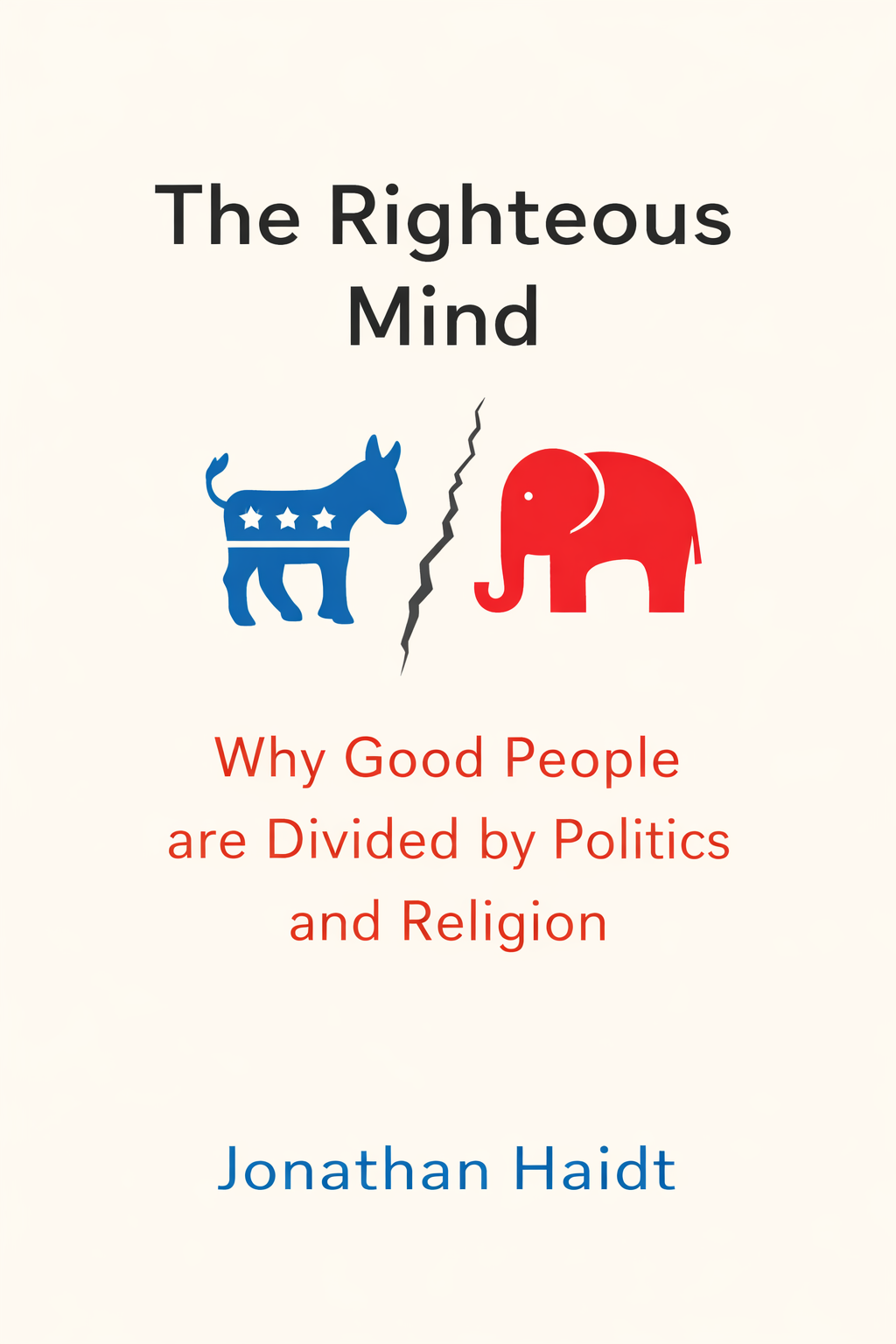
The Righteous Mind
This audio course offers a structured exploration of Jonathan Haidt’s "The Righteous Mind," guiding listeners through the book’s central arguments in six focused lectures. The course begins by examining the origins of moral intuition, emphasizing how our sense of right and wrong is shaped by automatic, unconscious processes rather than deliberate reasoning. It then analyzes the dominance of emotion in moral judgment, highlighting the metaphor of the intuitive “elephant” and the rational “rider,” and showing how reasoning often serves to justify gut reactions. The course continues by introducing Haidt’s six moral foundations—care, fairness, liberty, loyalty, authority, and sanctity—explaining how different cultures and political groups prioritize these values. Subsequent lectures connect these moral foundations to political ideology, explaining why conservatives and liberals often talk past each other and how conservatives may appeal to a broader range of moral concerns. The course also investigates the group-oriented nature of human beings, describing the “hive switch” that enables individuals to cooperate as part of a larger collective, but can also foster division. The final lecture addresses the social functions of religion and the importance of constructive dialogue, offering practical insights for reducing polarization and understanding moral disagreement. Each lecture covers a contiguous range of chapters, ensuring comprehensive and logical coverage of the book’s key ideas.
The Elephant’s Power: Chapters 3-4
The Elephant’s Power: Chapters 3-4
In understanding the dynamics of moral judgment, the rider-elephant metaphor provides a foundational framework. However, its true value lies in its application to real-world decision-making and political behavior. The elephant, representing our intuitive processes, often dictates our moral decisions, while the rider, our rational mind, constructs justifications post hoc. This dynamic is not just theoretical but has profound implications for how we navigate everyday life and societal structures.
Consider the realm of political campaigns. Politicians who understand the power of the elephant craft messages that resonate emotionally, bypassing the need for detailed policy explanations. For instance, slogans like "Make America Great Again" or "Yes We Can" are not just catchy phrases; they tap into deep-seated emotional responses, aligning with the elephant's intuitive leanings. These messages evoke feelings of nostalgia, hope, or unity, which are far more compelling than complex policy discussions.
In marketing, companies leverage the elephant's power by creating brand narratives that connect emotionally with consumers. Advertisements often focus on storytelling, using imagery and music to evoke emotions that align with the brand's identity. This approach is evident in campaigns like Nike's "Just Do It," which inspires action and perseverance, appealing directly to the elephant's intuitive nature.
The implications extend to personal decision-making as well. When faced with choices, individuals often rely on gut feelings rather than exhaustive analysis. This is evident in consumer behavior, where people might choose a product based on brand loyalty or emotional attachment rather than a detailed comparison of features. The elephant's influence is also apparent in interpersonal relationships, where first impressions and emotional connections often guide decisions more than logical assessments.
In the context of moral and ethical dilemmas, the elephant's dominance can lead to moral dumbfounding, where individuals hold strong moral convictions without being able to articulate the reasoning behind them. This phenomenon is not limited to hypothetical scenarios but occurs in everyday situations, such as debates over contentious issues like abortion or climate change. People often have immediate, visceral reactions to these topics, with the rider scrambling to justify the elephant's initial judgment.
Understanding the rider-elephant dynamic also sheds light on the challenges of changing minds. Traditional approaches to persuasion, which focus on presenting logical arguments, often fail because they target the rider rather than the elephant. Effective persuasion requires engaging the elephant through emotional appeals, narratives, and symbols that resonate with the audience's existing intuitions.
In the workplace, leaders who recognize the elephant's power can foster more effective communication and collaboration. By acknowledging the role of emotions in decision-making, they can create environments that encourage open dialogue and empathy, leading to more cohesive teams and better problem-solving.
The rider-elephant metaphor also has implications for education. Traditional educational models that emphasize rote learning and logical reasoning may not fully engage students' intuitive processes. Incorporating storytelling, experiential learning, and emotional engagement can enhance understanding and retention by appealing to the elephant's strengths.
In summary, the rider-elephant metaphor is not just a theoretical construct but a practical tool for understanding human behavior. By recognizing the elephant's influence, individuals and organizations can craft more effective strategies for communication, persuasion, and decision-making. This understanding is crucial in a world where emotional resonance often trumps rational deliberation, shaping the outcomes of personal choices, political campaigns, and societal trends.
Beyond Harm & Fairness: Chapters 5-6
Western moral psychology has long relied on research conducted primarily within WEIRD populations—Western, Educated, Industrialized, Rich, Democratic societies—particularly American college students. This narrow focus has led to a skewed understanding of human morality, suggesting that concerns about harm and fairness are the sole components of moral reasoning. However, cross-cultural research reveals a much broader spectrum of moral concerns.
Richard Shweder's work in cultural psychology highlights three distinct ethical frameworks that operate across human societies: the ethic of autonomy, the ethic of community, and the ethic of divinity. The ethic of autonomy, which emphasizes individual rights and harm prevention, dominates in WEIRD societies. In contrast, the ethic of community focuses on duty, hierarchy, and role obligations, while the ethic of divinity concerns itself with purity, sanctity, and sacred order. Most non-WEIRD cultures draw upon all three ethics simultaneously, illustrating a more complex moral landscape.
Shweder's research in Orissa, India, provides striking examples of these cultural differences in moral judgment. Actions that Americans might consider morally neutral, such as a widow eating fish or sleeping on a bed, are condemned as serious moral violations by Indians based on beliefs about spiritual contamination and the proper sacred order. These are not mere social conventions but genuine moral concerns rooted in different ethical frameworks.
Haidt's own cross-cultural research further supports this diversity in moral concerns. In studies involving harmless taboo violations, participants from different cultures consistently showed varying moral judgments. For instance, lower-class participants in both Brazil and the United States condemned actions like eating a dead pet dog or consensual sibling incest, even when no harm occurred. In contrast, upper-middle-class Americans were more likely to permit these actions, as they focused primarily on the absence of harm.
This phenomenon of moral dumbfounding, where participants insist certain actions are wrong but cannot articulate rational justifications, underscores the intuitive nature of moral judgment. It challenges the rationalist models of moral psychology that have dominated Western thought, suggesting that moral judgments arise from intuitive emotional responses rather than conscious reasoning.
Building on this cross-cultural foundation, Haidt developed Moral Foundations Theory to explain the full spectrum of human moral concerns. The theory uses the metaphor of taste receptors, proposing that our minds contain innate moral receptors that respond to different moral concerns, much like tongues detect sweet, sour, salty, bitter, and umami. These foundations are innate but require cultural learning to develop fully, explaining the variation across societies and individuals.
The theory identifies five core moral foundations that evolved as solutions to adaptive challenges faced by our ancestors. Care/harm evolved from mammalian attachment systems, making us sensitive to suffering and nurturing. Fairness/cheating evolved from reciprocal altruism, making us detect proportionality and exploitation in social exchanges. Loyalty/betrayal evolved from coalition formation, making us value team players and detect traitors within groups. Authority/subversion evolved from hierarchical social structures, making us respect legitimate authority and recognize when it's being undermined. Sanctity/degradation evolved from pathogen avoidance systems, later expanding to include spiritual purity and sacred order concerns.
These foundations provide a powerful explanation for the diversity of moral concerns across cultures. While Western societies may prioritize care and fairness, other cultures may place equal or greater emphasis on loyalty, authority, and sanctity. This diversity in moral foundations explains why moral disagreements often arise not from different factual beliefs but from different underlying moral concerns. Understanding these differences is crucial for fostering cross-cultural dialogue and cooperation.
Politics, Conservatism & Moral Foundations: Chapters 7-8
Moral Foundations Theory provides a framework for understanding the distinct moral landscapes inhabited by liberals and conservatives. This theory identifies six core moral foundations: Care, Fairness, Loyalty, Authority, Sanctity, and Liberty. While liberals tend to emphasize Care, Fairness, and Liberty, conservatives draw more evenly across all six foundations. This difference in moral emphasis significantly influences political messaging and policy-making.
Political campaigns often reflect these moral priorities. For instance, conservative campaigns frequently highlight themes of loyalty, authority, and sanctity. These themes resonate with voters who prioritize group cohesion, respect for tradition, and moral purity. A classic example is the emphasis on "law and order" in conservative rhetoric, which appeals to the Authority foundation by promising to uphold societal rules and norms. Similarly, calls to "support our troops" tap into the Loyalty foundation, fostering a sense of national unity and allegiance.
In contrast, liberal campaigns typically focus on Care and Fairness. They emphasize policies that protect vulnerable populations and promote social justice. For example, healthcare reform initiatives often highlight the moral imperative to care for the sick and ensure equitable access to medical services. This approach appeals to the Care foundation by prioritizing compassion and empathy. Similarly, advocacy for income equality and workers' rights aligns with the Fairness foundation, emphasizing justice and proportionality in economic systems.
The differing moral emphases also manifest in policy-making. Conservative policies often incorporate elements of Loyalty, Authority, and Sanctity. For instance, immigration policies that stress border security and national sovereignty appeal to the Loyalty foundation by prioritizing the interests of the nation-state. Education policies that promote traditional values and respect for authority reflect the Authority foundation, emphasizing the importance of hierarchical structures in maintaining social order.
On the other hand, liberal policies frequently prioritize Care and Fairness. Environmental regulations aimed at protecting ecosystems and vulnerable species align with the Care foundation, reflecting a commitment to preserving the natural world. Social welfare programs designed to reduce poverty and inequality resonate with the Fairness foundation, advocating for a more equitable distribution of resources.
The strategic use of moral foundations in political messaging can significantly impact electoral outcomes. Successful politicians often craft messages that resonate with the moral intuitions of their target audience. For example, Ronald Reagan's "Morning in America" campaign effectively appealed to the Authority and Loyalty foundations by projecting an image of national strength and unity. Similarly, Barack Obama's "Yes We Can" slogan tapped into the Care and Fairness foundations, inspiring hope and collective action for social change.
Understanding the moral foundations underlying political behavior can also shed light on the persistence of political polarization. When political discourse is framed in terms of competing moral values, it becomes challenging to find common ground. Liberals and conservatives may perceive each other's positions as morally deficient, leading to entrenched divisions and a lack of constructive dialogue.
To bridge these divides, it is essential to recognize the legitimacy of different moral perspectives. Engaging in dialogue that acknowledges the moral concerns of both sides can foster mutual understanding and cooperation. For instance, discussions on healthcare reform could benefit from considering both the Care foundation's emphasis on compassion and the Authority foundation's focus on maintaining efficient systems.
In conclusion, Moral Foundations Theory offers valuable insights into the moral underpinnings of political behavior. By understanding how different political groups utilize these foundations in their messaging and policy-making, we can better navigate the complexities of political discourse and work towards a more inclusive and cooperative society.
Groupishness & the Hive Switch: Chapters 9-10
Humans are not solely driven by individualistic instincts; they possess a significant capacity for groupishness, which has been crucial in the evolution of societies. This dual nature is best understood through the lens of multilevel selection, where competition occurs not only between individuals but also between groups. This perspective helps explain why humans can transcend self-interest for collective goals.
The evolutionary mechanisms that enabled this groupishness are rooted in three key processes. First, shared intentionality allowed humans to engage in joint attention and collaborative goal-pursuit, capabilities that are unique compared to other primates. This ability to coordinate and work towards common objectives laid the groundwork for complex social structures.
Second, gene-culture coevolution played a pivotal role. Cultural practices such as warfare and religion created selection pressures that favored cooperative genes. Groups that could coordinate effectively outcompeted others, leading to the proliferation of traits that supported group cohesion. This process was accelerated by the suppression of free riders through mechanisms like gossip, ostracism, and punishment, which ensured that group members contributed to the collective good.
The Baldwin effect further facilitated this transformation. Learned cooperative behaviors eventually became genetically encoded, reinforcing the capacity for groupishness. This dual evolutionary process reshaped human nature over millennia, allowing for the development of complex societies.
Historical examples illustrate the impact of groupishness on societal development. The rise of ancient civilizations, such as those in Mesopotamia and Egypt, can be attributed to the ability of humans to form large, cooperative groups. These societies were able to organize labor, construct monumental architecture, and develop intricate social hierarchies, all of which required a high degree of group coordination.
The hive switch is a psychological mechanism that enables humans to shift from an individualistic to a groupish mode. This switch can be activated by certain conditions, leading to experiences where individual identity temporarily dissolves into group unity. Synchronized activities, such as military drills, dancing, or religious rituals, increase cooperation and trust among participants, fostering a sense of collective identity.
Neurobiological evidence supports the existence of the hive switch. Oxytocin, a hormone associated with bonding and group cohesion, plays a significant role in promoting these feelings. However, it also fosters parochial altruism and outgroup hostility, highlighting the dual nature of groupishness.
Psychedelic drugs can trigger profound mystical experiences characterized by ego dissolution and feelings of unity. Research, such as the Good Friday Experiment, demonstrates how these substances can activate the hive switch, leading to a sense of connection to something larger than oneself. Similarly, experiences of awe in nature or responses to moral beauty can create feelings of transcendence and connection.
The implications of the hive switch extend throughout human social life. It explains the attraction to religious and political movements that promise collective purpose and transcendence. These movements provide structured opportunities to activate the switch, offering profound satisfaction from group unity and self-loss.
However, the hive switch also facilitates tribalism, warfare, and the dehumanization of outsiders. While it binds people into moral communities, it can also transform those communities into hostile tribes. Secular modern societies may struggle to provide adequate opportunities for experiencing groupishness, potentially leading to feelings of meaninglessness and disconnection.
Understanding this evolutionary heritage is essential for comprehending moral psychology and political behavior. Human nature is fundamentally dualistic, shaped by both individual and group-level selection pressures. These competing forces created our capacity to oscillate between self-interest and collective devotion, explaining the complexity of human moral and social life.
Religion, Disagreement & Constructive Dialogue: Chapters 11-12
In modern society, the concepts of groupishness and the hive switch manifest in various social and political movements, influencing how individuals align with groups and engage in collective actions. These concepts, rooted in evolutionary psychology, explain why people often prioritize group loyalty over individual reasoning, leading to both positive and negative outcomes.
Groupishness, the tendency to form cohesive groups, is evident in political parties, social movements, and even online communities. This inclination towards group formation is driven by the need for belonging and identity, which are fundamental human desires. The hive switch, a psychological mechanism that enables individuals to transcend self-interest for the sake of the group, is activated in situations that require collective action, such as protests, rallies, or communal gatherings.
In contemporary politics, groupishness is a double-edged sword. On one hand, it fosters unity and collective action, enabling groups to achieve common goals. On the other hand, it can lead to polarization and tribalism, where individuals become entrenched in their beliefs and view opposing groups as adversaries. This polarization is exacerbated by the hive switch, which can blind individuals to the validity of opposing viewpoints, as they become more focused on group cohesion than on critical thinking.
Social media platforms amplify these tendencies by creating echo chambers, where individuals are exposed primarily to information that reinforces their existing beliefs. This environment strengthens groupishness and activates the hive switch, as people rally around shared narratives and symbols. The result is a heightened sense of in-group loyalty and out-group hostility, making constructive dialogue and compromise more challenging.
To address these challenges, it is essential to develop strategies that foster constructive dialogue and reduce polarization. One approach is to encourage viewpoint diversity within groups, allowing for a range of perspectives to be heard and considered. This can be achieved by creating spaces for open dialogue, where individuals feel safe to express dissenting opinions without fear of ostracism.
Another strategy is to promote moral humility, the recognition that one's moral framework is not the only valid perspective. This involves acknowledging the limitations of one's beliefs and being open to learning from others. By cultivating moral humility, individuals can engage in more empathetic and respectful conversations, reducing the likelihood of conflict and misunderstanding.
Educational institutions play a crucial role in fostering these skills by teaching critical thinking and encouraging students to engage with diverse viewpoints. By exposing students to a variety of perspectives, educators can help them develop the ability to analyze and evaluate arguments, rather than simply accepting them at face value.
In addition to these individual-level strategies, systemic changes are necessary to reduce polarization. Reforming political systems to encourage collaboration and compromise, rather than competition and division, can help create a more inclusive and cooperative political environment. This may involve changes to electoral processes, such as ranked-choice voting, which incentivizes candidates to appeal to a broader range of voters.
Ultimately, understanding the modern implications of groupishness and the hive switch is essential for navigating the complexities of contemporary social and political life. By recognizing the psychological mechanisms that drive group behavior, individuals and societies can work towards creating more inclusive and harmonious communities, where diverse perspectives are valued and constructive dialogue is the norm.