
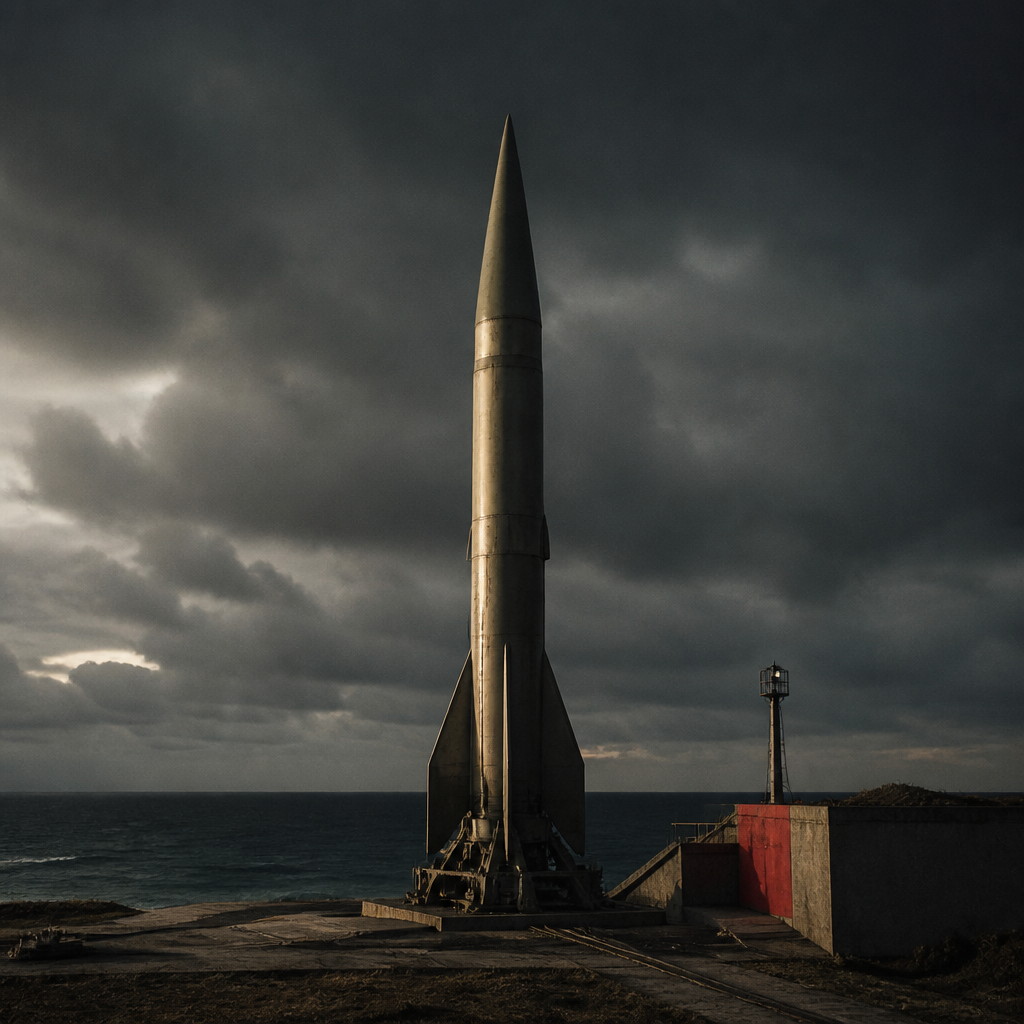
Thirteen Days on the Brink: The Anatomy of the Cuban Missile Crisis
This course examines the Cuban Missile Crisis through four lectures that trace the sequence of events from October 14 to October 28, 1962. Lecture 1 covers the Cold War standoff between Kennedy and Khrushchev, the Soviet Operation Anadyr deployment of SS-4 missiles, and the U-2 flight by Major Richard Heyser that photographed the San Cristóbal sites. Lecture 2 details the formation of the Executive Committee of the National Security Council, the debate between air strikes and a naval quarantine, and Kennedy’s October 22 address. Lecture 3 focuses on October 27, known as Black Saturday, including the shoot-down of Major Rudolf Anderson’s U-2, the B-59 submarine incident where Vasili Arkhipov blocked a nuclear torpedo launch, and the accidental U-2 flight over Alaska by Chuck Maultsby. Lecture 4 describes the backchannel meeting between Robert Kennedy and Anatoly Dobrynin that produced the secret agreement to remove U.S. Jupiter missiles from Turkey, the public Soviet withdrawal from Cuba, and the subsequent creation of the Moscow-Washington hotline and the 1963 Partial Nuclear Test Ban Treaty. The course distinguishes documented facts from disputed interpretations and shows how tactical miscommunications nearly produced nuclear war.
The Eye in the Sky: October 14, 1962
The Eye in the Sky: October 14, 1962
Speaker 1
Alright, so here's the thing that keeps nagging at me about this whole story. We're talking about the most dangerous two weeks in human history — and it almost didn't get discovered at all.
Speaker 2
That's the contradiction that sits at the center of everything. The Soviet Union nearly succeeded in placing nuclear missiles ninety miles from Florida, and the only thing that stopped it being a fait accompli was a single reconnaissance flight on a clear day.
Speaker 1
One flight.
Speaker 2
One flight. October 14, 1962. U.S. Air Force Major Richard Heyser, flying a U-2 over western Cuba, south to north across the island.
Speaker 1
And before that flight, the U.S. had no hard proof?
Speaker 2
Earlier reconnaissance had already flagged Soviet surface-to-air missile activity in Cuba. So there were warning signs. But surface-to-air missiles are defensive. What nobody had confirmed yet was the offensive ballistic missiles.
Speaker 1
Right, and that distinction matters enormously. So what did Heyser actually capture?
Speaker 2
Nine hundred and twenty-eight photographs. In a six-minute pass over the island.
Speaker 1
Wait — nine hundred and twenty-eight?
Speaker 2
In six minutes. The film was pulled from the aircraft and taken to McCoy Air Force Base in Orlando. Then analysts at the National Photographic Intelligence Center went to work.
Speaker 1
And what they found in those images — say that again, slower. The specific sites.
Speaker 2
Three medium-range ballistic missile sites under development near San Cristóbal, in Pinar del Río province. Eight large missile transporters. Four erector-launchers in what analysts called tentative firing positions.
Speaker 1
So not just equipment in crates. These were sites being actively assembled.
Speaker 2
Exactly. And the missiles in question were SS-4s — medium-range ballistic missiles. The technical indicators the analysts used were things like the distinctive shape of the erector-launchers and the specific spacing of the launch pads. These weren't ambiguous.
Speaker 1
Now, the key idea here is timing. How close were the Soviets to operational readiness?
Speaker 2
That's, that's the part that makes your stomach drop. The operation — the Soviets called it Operation Anadyr — had moved over forty thousand troops and the missile hardware to Cuba under a cover story. Agricultural equipment, they said.
Speaker 1
Agricultural equipment.
Speaker 2
Classic maskirovka — Soviet deception doctrine. And it nearly worked. Kennedy had actually approved the U-2 flight specifically because there were suspicions about medium-range missile development. The flight was planned at a meeting on October 9.
Speaker 1
But weather delayed it?
Speaker 2
Forecasts were unfavorable on October 13. The mission flew the next day. Think of how different this story looks if the clouds don't clear.
Speaker 1
That's, that's not a small thing. The entire crisis hinges on a weather window.
Speaker 2
And the Strategic Air Command had only taken operational control of U-2 overflights of Cuba on October 12 — two days before the flight.
Speaker 1
So the institutional machinery had barely clicked into place before the discovery happened.
Speaker 2
Right. And then October 15 — the day after — two more missions found another medium-range site near San Cristóbal, and two intermediate-range ballistic missile sites at Guanajay. Intermediate-range means they could reach deeper into the American mainland.
Speaker 1
Stop. Intermediate-range is a different category entirely.
Speaker 2
Much longer reach. And the October 15 photographs also showed twenty-one crates for Soviet IL-28 aircraft at San Julián airfield. So the picture was expanding fast.
Speaker 1
So when does Kennedy actually find out? Because I know there's a gap there.
Speaker 2
At 8:30 p.m. on October 15, CIA Deputy Director Charles Cabell reported the missile evidence to McGeorge Bundy. And Bundy — he did not wake the president that night.
Speaker 1
He sat on it overnight?
Speaker 2
He informed Kennedy the following morning. October 16, 8:45 a.m. And Kennedy immediately called a meeting of his principal advisers for 11:45 that morning.
Speaker 1
[reframe-as-bet] If I had to wager on what Kennedy's first instinct was in that room — I would not bet on calm deliberation.
Speaker 2
No. And remember, this is a president already burned by the Bay of Pigs failure in 1961, already rattled by the Vienna Summit where Khrushchev had pushed hard. Kennedy had reason to read this as a direct test of his resolve.
Speaker 1
So the discovery wasn't just a military shock. It was personal.
Speaker 2
It was both. The National Archives describes those October 14 images as positive proof of Soviet medium-range nuclear weapons being installed in Cuba. Not suspected. Proof.
Speaker 1
And blanket authority for unrestricted U-2 overflights — when did that come through?
Speaker 2
October 16. The same morning Kennedy was briefed. So the intelligence apparatus and the political response were, were essentially activating simultaneously.
Speaker 1
[cost-in-a-person] For everyone listening, think of Major Heyser that morning — alone, unarmed, flying over a hostile island, no idea what his film would set in motion.
Speaker 2
Heyser's aircraft passed over the Isle of Pines before reaching the Cuban mainland. He had no fighter escort. The U-2 flew too high for conventional interception, but the surface-to-air missiles the Soviets had already installed were a real threat.
Speaker 1
And he didn't know what he'd photographed until the analysts told him.
Speaker 2
That's right. The photos were on the president's desk. The clock was ticking. And the question that now had to be answered — the one nobody in that room wanted to get wrong — was what do you do next?
Speaker 1
Which is exactly where our next lecture picks up. Inside the secret meetings where the fate of the world was decided.
Speaker 2
The ExComm. Thirteen days of deliberation that the world knew nothing about. And the choices made in those rooms were anything but obvious.
The ExComm Dilemma: Quarantine or Strike?
Speaker 1
Alright, so last time we left off with Kennedy being briefed on the morning of October 16 — photographs on his desk, missiles confirmed. Now the clock is ticking and the question is what do you actually do about it.
Speaker 2
And the thing that gets lost in the popular version of this story is how genuinely open that question was. There was no obvious right answer.
Speaker 1
So walk me through who's in the room.
Speaker 2
Kennedy convened his senior advisers that same day — October 16 — and they formed what became the Executive Committee of the National Security Council. ExComm. The group brought together senior advisers to consider political, diplomatic, and military responses. A core group of roughly a dozen people.
Speaker 1
And they met in secret.
Speaker 2
Completely. Kennedy kept his public schedule running normally so the Soviets wouldn't know the discovery had been made. The ExComm tapes — the recordings Kennedy had secretly running — document those deliberations directly.
Speaker 1
So the world had no idea.
Speaker 2
The discovery had not yet been announced publicly. And inside those rooms, the options on the table ranged from doing nothing, to going to the United Nations, to negotiating directly, to a naval blockade, to air strikes, to a full invasion of Cuba.
Speaker 1
That's a wide spectrum.
Speaker 2
It is. And the military advisers pushed hard for the air strike option early. The argument was: destroy the sites before they become operational.
Speaker 1
Which sounds decisive. So why did Kennedy push back?
Speaker 2
Two reasons, really. The strikes might not destroy every relevant weapon. The U.S. didn't have a complete picture of what was on the island — and that uncertainty mattered enormously.
Speaker 1
Right. They didn't know what they didn't know.
Speaker 2
Exactly. And second — think of Pearl Harbor. Kennedy explicitly did not want the United States to be the country that launched a surprise attack without warning. That framing shaped his thinking.
Speaker 1
So the Pearl Harbor analogy was doing real work in that room.
Speaker 2
It was. Robert Kennedy reportedly raised it directly. A surprise strike felt like the kind of action that couldn't be undone — morally or strategically.
Speaker 1
So Kennedy lands on the blockade. But they didn't call it that.
Speaker 2
No. They called it a quarantine. And that word choice was deliberate.
Speaker 1
Say that again, slower — the legal distinction.
Speaker 2
A blockade implies a state of war under international law; quarantine does not. The State Department's account is explicit on this: the word quarantine helped the administration secure support from the Organization of American States, which it did.
Speaker 1
Stop. The OAS actually voted to back it?
Speaker 2
They approved a resolution supporting measures to prevent offensive weapons reaching Cuba. That multilateral cover mattered legally and diplomatically.
Speaker 1
And McNamara — what was his role in actually designing this?
Speaker 2
McNamara was central to the quarantine's operational design and enforcement. The line itself was set on an arc roughly 500 miles from Cape Maysi — not hugging Cuba's coast. Ships carrying offensive military equipment were subject to interception; other cargo was not automatically barred.
Speaker 1
So it was a targeted measure, not a total siege.
Speaker 2
Precisely. Limited and reversible. That was the strategic logic — preserve options for negotiation rather than force an immediate confrontation.
Speaker 1
Kennedy signed the proclamation on October 23.
Speaker 2
Proclamation 3504. The quarantine took effect at 9 a.m. Washington time on October 24. But before that — October 22, 7 p.m. — Kennedy went on national television.
Speaker 1
The address. What did he actually announce?
Speaker 2
He announced the discovery of the missiles, demanded their removal, and described the quarantine. He warned that any nuclear missile launched from Cuba would be treated as an attack by the Soviet Union on the United States.
Speaker 1
That's not a subtle message.
Speaker 2
No. And Khrushchev denounced the action as aggression and said Soviet ships would proceed. But here's where the popular story breaks down.
Speaker 1
The eyeball-to-eyeball moment.
Speaker 2
Right. The famous image — U.S. warships confronting Soviet freighters at the quarantine line. The ships most associated with that story had already turned back and were hundreds of miles from the line.
Speaker 1
Wait.
Speaker 2
Soviet records indicate sixteen missile-carrying ships received orders to reverse course early on October 23 — before the quarantine even took effect the next morning.
Speaker 1
So the dramatic standoff was, it was already over before it started?
Speaker 2
Largely. And here's the unsaid thing: one Soviet ship, the Aleksandrovsk, was actually permitted through. It carried nuclear warheads and reached port before the quarantine line could intercept it.
Speaker 1
That's, that's not a detail that makes it into the triumphant version of this story.
Speaker 2
No. And that's the honest lesson of the quarantine choice. A limited, reversible step preserved options for negotiation — but it did not eliminate the danger. The missiles already in Cuba were still being assembled.
Speaker 1
So the quarantine bought time. It didn't solve anything.
Speaker 2
Which is exactly what Kennedy intended. The measure was designed to exert pressure while leaving room for the diplomatic exchanges that would actually end the crisis — and that's where the story goes next.
Black Saturday: The Fog of Impending War
Speaker 1
Alright, so last time we established that the quarantine bought time but didn't actually remove the missiles. And then October 27 arrives.
Speaker 2
October 27. The twelfth day. The day historians call Black Saturday — and the name is earned.
Speaker 1
Why that day specifically? What made it different from the eleven before it?
Speaker 2
Several dangerous events converged at once, as military operations, incomplete information, and leaders' choices interacted.
Speaker 1
Start with the aircraft.
Speaker 2
Major Rudolf Anderson. U-2 pilot. He was flying a reconnaissance mission over Cuba when a Soviet-supplied SA-2 surface-to-air missile shot him down. He was killed.
Speaker 1
Wait.
Speaker 2
And Kennedy's advisers immediately pushed for military retaliation against the site responsible. Kennedy resisted.
Speaker 1
He held back? After losing a pilot?
Speaker 2
He did. The key idea here is that Kennedy understood retaliation could trigger a chain he couldn't stop. So he absorbed the loss and kept the diplomatic channel open.
Speaker 1
That's, that's not a small thing to ask of a president under that kind of pressure.
Speaker 2
No. And while that was happening, a completely separate incident was unfolding near Alaska.
Speaker 1
The other U-2.
Speaker 2
A different U-2, on an air-sampling mission near the North Pole — collecting data related to Soviet nuclear tests, not reconnaissance over Cuba — went off course.
Speaker 1
How far off course?
Speaker 2
Far enough to enter Soviet airspace over Siberia. The pilot, Charles Maultsby, had been disoriented by the aurora borealis and was dealing with a compass malfunction. Soviet MiG fighters scrambled to intercept.
Speaker 1
MiGs scrambled. And U.S. forces responded to that?
Speaker 2
American fighter aircraft were also launched. So now you have two nuclear-armed superpowers with aircraft in the air near Soviet territory, on the same day a U.S. pilot has already been killed over Cuba.
Speaker 1
That's, that's three separate military incidents running simultaneously.
Speaker 2
And there's a fourth. Underwater.
Speaker 1
The submarine.
Speaker 2
Soviet submarine B-59. U.S. antisubmarine forces had been tracking it and used signaling measures — practice depth charges — to compel it to surface.
Speaker 1
Say that again, slower — the depth charges.
Speaker 2
Practice depth charges, intended as signals to surface, not as attacks. But the Soviet crew had no way to be certain of that in the moment.
Speaker 1
Right. From inside a submerged submarine, an explosion is an explosion.
Speaker 2
And B-59 had been without reliable contact with Moscow. The crew didn't know the full picture of the crisis above them. Think of it — surrounded, depth charges going off, no word from home.
Speaker 1
What was B-59 actually carrying?
Speaker 2
A nuclear-armed torpedo. Which U.S. forces pursuing it did not know at the time.
Speaker 1
Stop. The Americans had no idea.
Speaker 2
They didn't. And according to accounts published by the National Security Archive, B-59's commander, Valentin Savitsky, considered using it.
Speaker 1
So what stopped him?
Speaker 2
Vasily Arkhipov. He was the submarine brigade's chief of staff, aboard B-59. He helped defuse the confrontation. The Archive's account draws on his recollection and other evidence.
Speaker 1
Now, there's a version of this story where Arkhipov alone saved the world. Is that, is that the accurate framing?
Speaker 2
It's an oversimplification, even though his role was crucial. The unsaid thing is that multiple officers had to approve use of the torpedo — it wasn't one person's unilateral decision. Arkhipov's refusal mattered, but the structure around him mattered too.
Speaker 1
And this whole episode — nobody in Washington knew it was happening.
Speaker 2
U.S. officials were unaware during the crisis that B-59 carried a nuclear torpedo and that its crew had faced a decision about using it. The submarine episode only became publicly known decades later.
Speaker 1
So the callback here — same as the quarantine story — is that the leaders thought they were in control, and they weren't.
Speaker 2
Exactly. Kennedy resisted retaliation for Anderson's death. But he couldn't have ordered Arkhipov to hold. That decision happened beyond his reach.
Speaker 1
And Khrushchev's message that same day — the one adding the Turkey demand — that was landing on top of all of this.
Speaker 2
Right. Kennedy and his advisers chose to respond to Khrushchev's more conciliatory October 26 message rather than accept the Turkey condition in the October 27 message as the public basis for a deal.
Speaker 1
Which is the defended choice, really. Because the strongest objection is: why ignore the harder message?
Speaker 2
And the answer is that accepting it publicly would have looked like a direct missile-for-missile trade under duress. That evening, Robert Kennedy met secretly with Soviet Ambassador Dobrynin — a non-invasion pledge in exchange for Soviet withdrawal, with a private understanding on the Jupiter missiles in Turkey.
Speaker 1
The public deal held. The private understanding held. And the world didn't find out how close it had come — not for decades.
Speaker 2
Black Saturday is the reason crisis management now takes seriously what happens at the tactical level, not just in the room where the leaders sit.
The Secret Trade: The Diplomacy of Survival
Speaker 1
After Black Saturday’s military dangers, Washington and Moscow still needed a formula both governments could accept. That formula began with a conversation at the Justice Department.
Speaker 2
And it leads us to the crisis’s exit: public commitments paired with private assurances. The public story and the private story were importantly different.
Speaker 1
So walk me through October 27, evening. Robert Kennedy, Dobrynin — what actually happened in that room?
Speaker 2
Robert Kennedy met privately with Soviet Ambassador Anatoly Dobrynin as a personal emissary for his brother. And he conveyed two things: a public assurance, and a secret one.
Speaker 1
Say that again, slower — the secret part.
Speaker 2
The United States would remove its Jupiter missiles from Turkey after the crisis, but that part had to stay secret. Dobrynin's own report of the meeting records Kennedy saying the withdrawal would take four or five months.
Speaker 1
Four or five months.
Speaker 2
Right. And the Jupiters were, in fact, removed in April 1963. Several months after the crisis ended. Exactly as described.
Speaker 1
So the public deal and the private deal were running simultaneously.
Speaker 2
And that's the key idea. The publicly stated settlement was Soviet missile withdrawal plus a U.S. pledge not to invade Cuba. The Turkey piece was not publicly acknowledged at the time.
Speaker 1
Which means — and this is the unsaid thing — the Soviet withdrawal looked like a unilateral retreat.
Speaker 2
Exactly. Because the U.S. concession was undisclosed, the narrative that Kennedy simply stared Khrushchev down could take hold. The National Security Archive describes the Jupiter removal as part of the quid pro quo that helped resolve the crisis.
Speaker 1
So the triumphant version of this story is, it's incomplete.
Speaker 2
Deliberately so. Khrushchev sent Kennedy a private letter on October 28 acknowledging the delicacy of the Turkey issue and indicating he would not discuss the arrangement publicly.
Speaker 1
And October 28 — that's when Khrushchev announced the withdrawal?
Speaker 2
Publicly, yes. He announced he had ordered Soviet missiles withdrawn from Cuba in return for the non-invasion pledge. The announcement came over Radio Moscow.
Speaker 1
But the quarantine didn't end there.
Speaker 2
It didn't. Negotiations continued over other Soviet military equipment. The quarantine ran until November 20, when the Soviet Union agreed to remove its IL-28 bombers from Cuba.
Speaker 1
So even after the headline deal, there was still weeks of—
Speaker 2
Exactly. The State Department's documentary record is explicit: the final arrangements lacked a specific set of obligations and procedures. It did not produce a comprehensive formal agreement covering every issue.
Speaker 1
Think of it like a handshake that both sides interpreted differently.
Speaker 2
That's a fair analogy. And Castro, for example, was furious. He had no say in the settlement. Cuba's sovereignty was being traded over his head.
Speaker 1
And Turkey and NATO — how did they read it?
Speaker 2
The Jupiter withdrawal was sensitive precisely because it looked like the U.S. had traded away an alliance commitment under pressure. Keeping it secret protected NATO cohesion, at least in the short term.
Speaker 1
Now, historians still debate whether the Jupiter removal was a direct trade or a coincidence of timing. Where does that stand?
Speaker 2
The secret understanding and the April 1963 removal are documented. But historians differ over how much prior U.S. consideration of removing the Jupiters changes the interpretation of the arrangement.
Speaker 1
So the public story did not present the full arrangement that way.
Speaker 2
Right. What's firmly established is the sequence: a confidential understanding, Khrushchev’s public withdrawal announcement, and the Jupiter removal months later. The causal weight historians assign to the prior U.S. planning — that is where interpretation enters.
Speaker 1
And then the longer-term consequences. The hotline.
Speaker 2
A direct link between the two governments. Established after the crisis to allow rapid communication between the two governments. Its popular nickname is technically misleading.
Speaker 1
It wasn't a phone?
Speaker 2
It was a teletype system. Not a telephone. The image of two leaders picking up a red receiver is, it's a myth that stuck.
Speaker 1
And the Partial Nuclear Test Ban Treaty?
Speaker 2
Signed in 1963. It prohibited nuclear testing in the atmosphere, underwater, and in outer space. Underground testing remained permitted. It was a direct consequence of the crisis accelerating arms control talks.
Speaker 1
The callback here — as with the quarantine and the private diplomacy — is that the resolution wasn't clean. It was ambiguous, layered, and partly secret.
Speaker 2
And that's the defended choice, really. Kennedy and Khrushchev used public commitments and confidential assurances together. The strongest objection is: doesn't secrecy undermine trust?
Speaker 1
And the answer?
Speaker 2
The answer is that transparency about the Turkey trade, in that moment, might have collapsed the deal entirely — domestically for Kennedy, politically for Khrushchev. The ambiguity was the mechanism that made survival possible. The thirteen days ended. The world of international diplomacy was forever changed.