
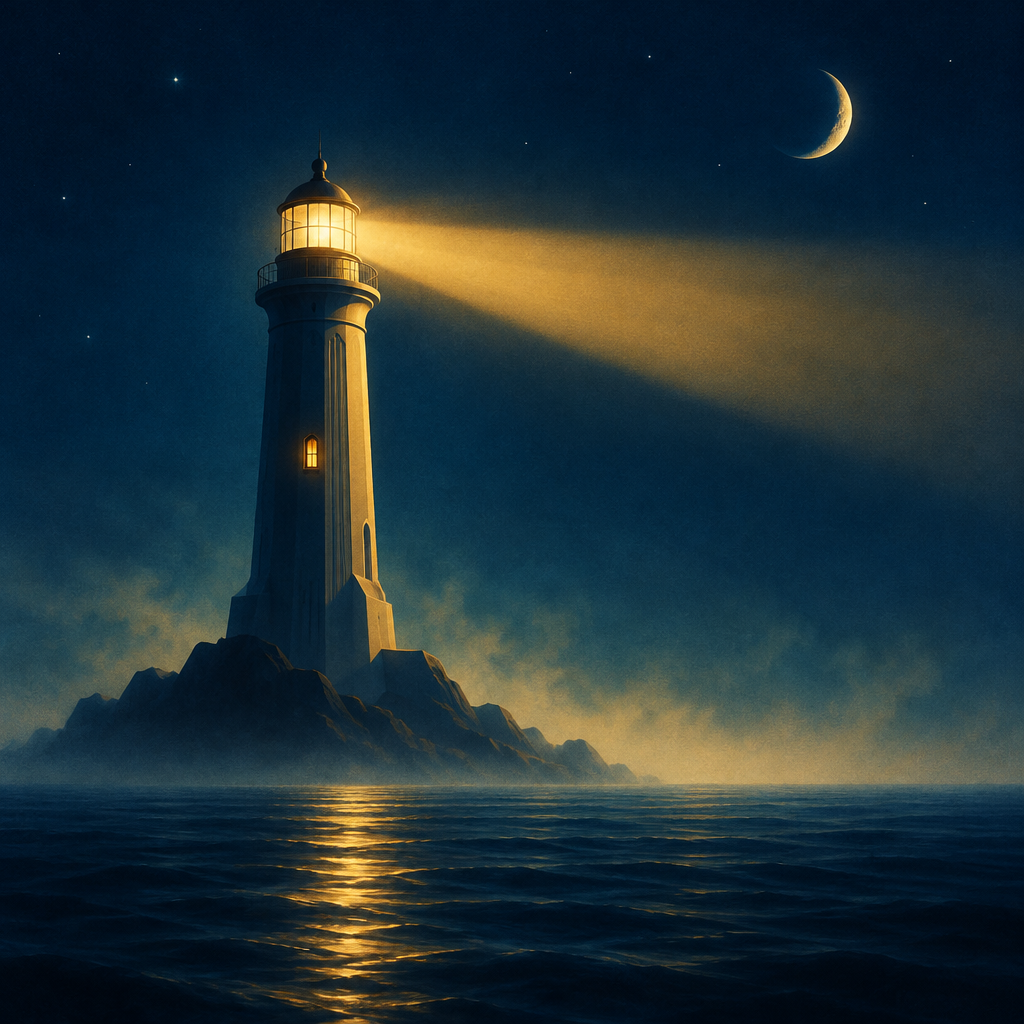
The Lighthouse Keeper's Night
The Lighthouse Keeper's Night is a six-lecture bedtime audio course that uses one continuous story—a solitary keeper tending his beacon on a rocky shore—to guide listeners toward calm sleep. The series opens by introducing the keeper and his stone tower, the sweeping beam, distant gulls, and the quiet pride of a job that never ends. From there, it examines the lantern's glass as the story's central object: the keeper lifts it from its cradle, wipes away the salt, and seals it over the flame in a ritual that steadies both the light and his own heart. Later lectures challenge the myth that the keeper never sleeps, showing instead how his vigilance rests on shift work, the tide's lull, an automatic oil feed, and a meditative attention to the sea's pulse. A morning-routine lecture walks through pouring fresh oil, checking the wick, and adjusting the lens so ships receive a clear signal. The course also builds gentle tension and reflection. One lecture explores the paradox of light and darkness: how sailors' struggles on clear nights, a jammed rotating lens, and the keeper's discovery that dimming the lamp during fog lets the beam cut through mist more cleanly. The final lecture follows a stormy-night investigation into a faltering beam—a cracked pane, a smoldering wick, and a small oil leak—showing how attention to detail prevents disaster. Throughout, vivid sensory detail, slow pacing, and reflective questions invite listeners to relax, focus on small steady rituals, and drift into sleep with the reassurance of a light that holds.
A Light in the Dark: Meeting the Keeper
A Light in the Dark: Meeting the Keeper
The last of the daylight is going, and a man is climbing a spiral staircase with a bucket of oil in one hand. His name is Unaka Jennette, and he keeps the light at Cape Hatteras, on a thin line of sand where the Atlantic crashes against hidden shoals. Tonight, like every night, he carries fuel up to the lantern room, tends the lamp, and wipes the glass until it shines. The National Park Service tells us his central job was simple to say and endless to do: keep the light burning on its exact schedule, so mariners could find their way. Before he climbs back down, picture him pausing at the gallery rail, watching the first sweep of the beam push out over dark water. That sweep is a promise, and he is the one who keeps it.
Now, so you understand what that beam actually says, I want you to think of a lighthouse as a lighthouse's own signature. Each one flashes in its own rhythm, and a sailor who times the flashes can match it to a chart and know, exactly, where he is. In 1821, a French physicist named Augustin Fresnel built an apparatus that made this possible at great distances. His lens uses concentric glass prisms to gather light and squeeze it into a narrow horizontal beam, and that design still forms the basis of lighthouse lens systems today. What gets me is the mechanical heartbeat of it all. Some lamps rotated by clockwork, which means a weight hanging inside the tower, slowly falling. Which is why the keeper climbed those stairs again and again through the night, to wind the mechanism and release the weight. Climb, wind, descend, watch, climb again. His day could begin before dawn and end well after dusk, and a station could never be left unattended.
Som Chhiring, this is the part I didn't expect when I first read about these keepers. The work wasn't only the light. At Cape Hatteras, duties included maintaining buildings, painting, repairing equipment, and keeping records and supply orders. Every single morning at South Manitou Island, the keeper and his assistants cleaned the lamp glass and the Fresnel prisms, because a smudge on a prism steals light from a ship miles away. And in a severe storm, the watch never stopped; the keeper kept the light going around the clock until the storm passed, sometimes for a day or more. These were people who lived at the station itself, families included. Jennette's son Rany remembered the grounds as a community gathering place, with sports and croquet on the lawn, and the families grew food, raised livestock, and collected rainwater in cisterns. A whole small world, built around one flame that could not go out.
There's a recording from the Boring Facts for Sleep podcast that captures what this means for you tonight, lying there in the dark. Have a listen to how they put it.
[[CLIP:d1daced9-460f-488f-b77c-055b07ce4a7f:Boring Facts for Sleep — Introducing the Lighthouse & Its Keeper:32731]]
You do not have to keep watch tonight. That line lands on me every time I hear it. Because that's the real trade the keeper made, isn't it? He stayed awake through the lonely hours so that others could sleep, somewhere safe in a harbor or beyond the shoals. The U.S. Lighthouse Service was founded in 1789, and keepers became civil-service employees in 1896, professional guardians of the coast. Later, electrification and automation made the on-site keeper largely unnecessary, and the Coast Guard took over the lighthouses in 1939. Only Boston Light, held staffed by a 1989 law, still keeps a keeper in the traditional way, according to the National Park Service.
So tonight, as your eyes grow heavy, hold this one image. Somewhere in your mind, a man winds a clockwork weight, and a beam sweeps out over black water, steady as breathing. The lamp is tended. The glass is clean. You can let go now, the way the sailors did, trusting a light they would never see the keeper of. Sleep well. The watch is kept.
The Lantern's Glass: From Spark to Beacon
Speaker 1
Can we start with the object itself? A pane of glass over a flame. Why does that pane matter so much?
Speaker 2
Because it's the hinge everything turns on. Think of the keeper lifting it from its cradle at dusk, feeling the old salt scarring under his thumbs.
Speaker 1
Salt scarring?
Speaker 2
Years of sea spray, dried and etched into the surface. You can almost read the storms in it. But every one of those marks steals light.
Speaker 1
From a ship miles out? That seems like a lot of power for a smudge.
Speaker 2
For example, at Cape Lookout, keepers trimmed the wicks every four hours just to limit smoke that could dim the lens. They were nicknamed "wickies."
Speaker 1
Wickies. So the whole job is fighting whatever dulls the light.
Speaker 2
Exactly. And before Fresnel, mirrors got you maybe twenty thousand candlepower with an Argand burner. A candle versus a searchlight.
Speaker 1
So how did glass beat mirrors?
Speaker 2
Augustin‑Jean Fresnel, in 1821, built a lens with a central bull's‑eye and concentric glass prismatic rings.
Speaker 1
Rings of, of what exactly? Prisms how?
Speaker 2
Each ring bends light that would escape upward or seaward and folds it back into one narrow horizontal beam. A solid lens that size would be too heavy for a tower.
Speaker 1
So the rings are thin because the work is divided.
Speaker 2
That's it. Smaller prisms in a frame, less weight at the top of the tower. The French Ministry of Culture credits that design with making the whole thing buildable.
Speaker 1
And the keeper's ritual, the wiping and seating of the glass?
Speaker 2
Now that's the part I love. He wipes the salt free, lowers the glass over the flame, and seals it in its cradle.
Speaker 1
What actually changes at that moment?
Speaker 2
The flame stops guttering. The beam goes from trembling to steady, and a sailor timing the flashes can trust his chart again.
Speaker 1
Because a shaky flash could be mistaken for another lighthouse entirely.
Speaker 2
Right. Distinctive flash patterns were how mariners told one light from another and marked the safer routes.
Speaker 1
Okay, but I'll push back. You're describing an object. Glass doesn't do anything. It just sits there.
Speaker 2
I used to think that too.
Speaker 1
So what changed your mind?
Speaker 2
Cordouan, the French lighthouse. In 1823, Fresnel's apparatus went in, eight stepped lenses around a five‑wick lamp, turned by a weight‑driven clock.
Speaker 1
And the keeper had to wind that weight every day?
Speaker 2
Every day. That meant the glass worked because a keeper kept returning to it. The lens holds the night the way a held breath holds a note.
Speaker 1
Hmm. So it's passive, but everything depends on it.
Speaker 2
It holds the night by refusing to change. Salt comes, storms come, and the glass just, just stays clear because someone keeps it clear.
Speaker 1
And the keeper himself? The story says lifting the glass steadies his heart too.
Speaker 2
That's the mirror of it. The same slowness, lifting, wiping, seating, that protects the flame also slows his pulse. Patience isn't decoration here. It's technique.
Speaker 1
Because haste would crack the glass or leave salt behind.
Speaker 2
Or seat it crooked, and the flame smokes, and the beam weakens. Pacing is the whole craft, done right.
Speaker 1
So tonight, the picture is just hands on glass.
Speaker 2
Hands on glass, salt falling away, and a light that holds steady because someone was unhurried with one small pane.
The Silent Watcher: Why the Keeper Never Sleeps
Speaker 1
I keep coming back to this one image. A lighthouse keeper, alone, awake every single hour of every night. And I'm starting to suspect it's wrong.
Speaker 2
It is wrong. And the strangest part is the man we picture dozing at the lamp, he'd actually be a danger.
Speaker 1
A danger? He's the hero of the story.
Speaker 2
Give the myth its best form first. One devoted man, defying sleep forever, holding the light against the sea. It's beautiful. And it still fails.
Speaker 1
Because nobody can actually stay awake indefinitely.
Speaker 2
A keeper who doesn't get enough sleep can become dull, and a dull keeper misses things. Think of him slumped over the lantern at three in the morning, the flame smoking, and no one sharp enough to notice.
Speaker 1
So what's the real arrangement?
Speaker 2
At Cape Hatteras, the keepers worked four-hour night watches, and they rotated the watch times from night to night. So the same man wasn't always dragging through the worst hours.
Speaker 1
Wait. They took turns.
Speaker 2
They took turns. And whoever finished the last watch handled the morning maintenance of the lamp and the lens. The day's work grew straight out of the night's.
Speaker 1
But the schedule, is it tied to the clock or to something else?
Speaker 2
That's the part I love. It's tied to the light itself. Before electricity, they lit the lamp at sunset and put it out at sunrise. The sea set the hours, not the clock on the wall.
Speaker 1
So the keeper's sleep follows the rhythm of the water.
Speaker 2
Exactly. And during a watch, he did something you could almost call meditation. He watched the light, but also the nearby shipping, letting the sea's pulse hold his attention instead of forcing his eyes open.
Speaker 1
That sounds lovely, but what does it actually mean, watching meditatively?
Speaker 2
Suppose a keeper sits in the watch room, waves against the rocks below. He isn't straining. He's listening the way you listen to rain, and a wrong note, an engine, a flare, would snap him wide awake.
Speaker 1
Because he's not fighting the sound. He's inside it.
Speaker 2
Right. Struggle makes you deaf eventually. Rhythm keeps you porous.
Speaker 1
Okay, but I'll push. What about emergencies? You can't schedule a shipwreck.
Speaker 2
No, you can't, and that's the honest exception. Keepers had to be ready to respond to wrecks, not just polish glass. And in a severe storm, the whole rhythm broke, they ran the light around the clock until it passed.
And if you doubt how brutal those storm watches could get, listen to this account from the Sleepy Mysteries podcast. [[CLIP:1af98a4f-b99b-441d-a4a3-d3c8f3503ddd:Sleepy Mysteries — The Cost of Keeping the Light:26227]]
Speaker 1
Fifty-four hours straight, and eight hours of sleep across eight whole days. That's the exception at its most extreme.
So sometimes the myth is true.
Speaker 2
Sometimes, for a night or two, the keeper genuinely doesn't sleep. But that's the exception that proves the rhythm, not the everyday life. The station at South Manitou couldn't be left unattended, and that meant someone, keeper or assistant, always on duty. Coverage, not one heroic insomniac.
Speaker 1
So count it up. How many pieces of evidence are we at against the myth?
Speaker 2
Four, if we're honest. The rotating four-hour watches. Sunset-to-sunrise lighting tied to the sea. The watchman's meditative attention. And the team rule that someone, not everyone, is always there.
Speaker 1
And that flips the whole thing. The keeper who sleeps in rhythm is more watchful than the one who stays up all night.
Speaker 2
Because wakefulness isn't the currency. Attention is. And attention runs on rest, the way the lamp runs on oil. Burn either one dry and the light suffers.
Speaker 1
Yeah. Which is, I suppose, the whole lesson for anyone lying awake and fighting it.
Speaker 2
And I'd say we shouldn't rush that lesson. Some nights the storm is real, and the watch runs long. But most nights, the keeper sleeps, and the sea keeps the time.
Speaker 1
And the light still holds.
Speaker 2
Because it was built to be held by more than one pair of hands, resting in turn.
Morning Mist: The Routine That Keeps the Light Alive
You've had mornings like this one. The kettle on, the same mug, the same small motions before the day properly starts. Som Chhiring, that quiet half hour when your hands know the order of things, that's where we're going, because a keeper's day began the same way. The man or woman finishing the night watch was responsible for the morning maintenance of the lamp and lens, preparing everything for the next night. And here's the detail that stopped me: burning the lamp in daylight was considered wasteful, so the keeper put it out at sunrise. The dangerous night was over, and then the most careful work began.
Let me give you a real morning, because it's more elaborate than you'd guess. Barbara Mabrity kept the light for decades, facing fierce storms that threatened her family and the tower, a personal challenge that deepened her resolve. She recorded each step in her log‑book, noting weather, fuel levels, and any soot buildup before cleaning the glass chimneys, polishing reflectors, filtering whale oil, and resetting the wicks. Think of it like brushing coffee grounds from a mug, except the mug guides ships home and the grounds are salt, soot, and smoke. What gets me is the ordinariness of it. Fifteen lamps, every single morning, done slowly, done again the next day.
So let's follow one modern lamp through the routine, step by step, like when you care for something you actually love. First, fuel: at Cape Hatteras, keepers carried oil up to the lantern room and fueled the lamp before anything else. Second, the wick: at Point Reyes, keepers trimmed it so the light burned steadily and efficiently, because a ragged wick smokes and dims everything. Third, the glass: they cleaned the lamp glass and the lens, a quick reminder of the Fresnel lens we explored in Lecture 2. Then the brass fittings and tools—brass polishing cloth, oil filter, and wick‑scissors—were polished, each tactile detail described, before the clockwork that turned the lens was cleaned and lubricated. Oil, wick, glass, brass, gears. That's the order, and the order matters.
Now the step that surprised me most. At Point Reyes, the clockwork driving the lens had to be wound every two hours and twenty minutes during the night, and the National Park Service tells us what that winding meant. The mechanism lifted a weight, a hundred and seventy pounds, about nine feet up on a hemp rope. That weight falling, slowly, all night, was the heartbeat behind the flash. Which means the routine isn't a checklist, it's choreography, timed to machinery rather than to a wall clock. Later, keepers transitioned from oil lamps to early electric lamps, comparing the warm glow of whale oil to the steadier, brighter electric filament. Even the curtains counted: by day, keepers closed lantern-room curtains to protect the lens glass from sunlight. The tower worked one way at night and another by day, and the keeper moved between the two like a tide.
So why does all this happen at dawn, after the danger has passed? Because the light must be ready before the darkness returns, and readiness is built in daylight, calmly. You could borrow one piece of this tonight, just one. Not the whole choreography. Suppose you picked the glass, the, the single slow wiping of one small thing before sleep, done in the same order every night. That is the smallest claim we can make, and it can be defended: a steady light is built by small, repeated hands. The mist is lifting out there, the lamp is out and resting, and the prisms sit clean in their curtains, waiting. So can you.
The Paradox of Light and Darkness
Speaker 1
Two things I can't make fit together. The keeper's whole job is producing light. And the light is, the light is useless without darkness. How can both be true?
Speaker 2
Both statements are true, and I prefer not to rush to a resolution. Let's sit in it a moment.
Speaker 1
Fine, but that's uncomfortable.
Speaker 2
Good paradoxes usually are. Think of Point Reyes. The rotating lens there made the light appear as a flash every five seconds.
Speaker 1
So between flashes there's... nothing.
Speaker 2
Exactly. The darkness between flashes was part of the recognizable pattern. A sailor needed the gaps to read the signal.
Speaker 1
Wait. The night is doing half the work.
Speaker 2
More than half, maybe. A steady glow with no rhythm tells a mariner almost nothing about where he is.
Speaker 1
Okay, so how did people figure that out? Somebody must have been puzzled first.
Speaker 2
Fresnel, partly. He joined a French government committee improving lighthouses in 1819, and produced his apparatus in 1821. His lens concentrated light into a narrow, far-reaching beam.
Speaker 1
But that's the brightness side. When did anyone notice the dark was essential?
Speaker 2
I'd hand that question back to you. When you see headlights on a dark road, what makes them visible?
Speaker 1
The, the black road around them. Without the black, there's no edge to the light. Huh.
Speaker 2
That's it. The lamp provides the light, but the darkness makes the beam perceptible. The signal depends on its surroundings, not just its source.
Speaker 1
So the keeper is maintaining a partnership with the night, whether he means to or not.
Speaker 2
And here's a twist on the history. The idea of dividing a lens into concentric rings? It predates Fresnel. Britannica credits Georges-Louis de Buffon with it, in 1748.
Speaker 1
Seventeen forty-eight? So Fresnel didn't invent the concept.
Speaker 2
He perfected and applied it. Even earlier lights used mirrors, and the best were visible maybe eight to twelve miles. His prismatic rings pushed beams much farther.
Speaker 1
But there's a limit, surely. Light can't conquer the whole sea.
Speaker 2
No, and that's the honest part people skip. A beam helps a mariner identify a hazard or landmark. It does not remove the sea's darkness or guarantee safety.
Speaker 1
So the keeper fights a battle he may not fully win.
Speaker 2
He fights one he can't win and keeps winning it anyway, night after night. Before Fresnel, mirror lights reached maybe twelve miles. His design stretched that reach dramatically.
Speaker 1
Is that why the lighthouse keeps showing up in literature? I keep thinking of Virginia Woolf.
Speaker 2
To the Lighthouse. A study in The Oxford Journal of Literary Imagination treats it as both a physical structure and an idea. Woolf built the novel on contrasts—light and darkness, hope and despair, stillness and movement.
Speaker 1
So she was using exactly the tension we've been circling.
Speaker 2
And the distant beam reaching observers who can't touch the tower—another scholar reads it as an image of desire and distance. Connection across separation.
Speaker 1
Which is the keeper's life, isn't it. He stands alone in the tower while the beam is meant for people far away.
Speaker 2
Solitude on one end, reach on the other. Point Reyes records keepers working shifts to hold that station together.
Speaker 1
Was there ever a keeper who closed that gap? Actually touched the people she was lighting the way for?
Speaker 2
Ida Lewis. She began serving unofficially at Lime Rock in 1857, after her father's stroke. Appointed official keeper in 1879.
Speaker 1
And she's famous for something beyond the lamp.
Speaker 2
The Coast Guard says she heard two soldiers cry out after falling through thin ice, ran out with a rope, and helped save them. Gold Lifesaving Medal, 1881.
Speaker 1
So the light and the rescue, signal and hands, same person.
Speaker 2
Which brings us back to your impossible pair of statements. Opposition doesn't blur the signal. It creates it.
Speaker 1
The night isn't the light's enemy. It's the light's frame.
Speaker 2
And tomorrow, when a porch light blinks on at dusk, you'll see the dark giving it its shape.
When the Beam Fails: The Cost of a Missed Signal
If the beam fails on a stormy night, a ship loses its warning at the exact moment it needs one. That's what breaks. Not the tower, not the keeper's pride—the ship. Lighthouses exist to mark harbor entrances, channel edges, and hazards, so mariners can navigate past them, and a signal failure leaves those sailors blind exactly when the danger is closest. So tonight, Som Chhiring, we do what the keeper does. A storm is shaking the lantern room, the beam has flickered once, and out there in the dark, a ship is turning toward the reef. The light must hold.
The keeper climbs toward the flicker like a doctor toward a fading pulse, and he knows the polite version of this story leaves something out. If the light fails, the fog signal, a bell, a horn, can still warn mariners that danger is nearby. But that sound is a crude comfort. So he investigates three clues, in order. First, the glass: a pane is cracked, salt‑scoured and split. Second, the wick: it smolders, ragged at the edge. Third, the clockwork that rotates the lens, the mechanism that had to be wound by hand before automation, which he checks and finds still turning.
Now, suppose you were standing beside him. You'd grab the cracked pane first, wouldn't you? The obvious wound. He does exactly that, working calm and slow, replacing it with the spare. And the flame still stutters. The crack wasn't the root cause. This is where I felt the floor shift, because the lens focuses light that would otherwise scatter into one concentrated beam, and before Fresnel's design, thick, poor‑quality glass let much of the light escape or become ineffective. So glass quality matters enormously. But a clean pane over a starving flame sends nothing. The obvious fault was real, and it was also, it was also a decoy.
So he kneels at the oil feed, and there it is. A pinhole leak, smaller than a grain of rice. For a heartbeat, the oil pressure drops, the flame gutters, and the beam wavers—then the feed recovers and the light steadies, over and over, like a skipped heartbeat. That's the mechanism. A tiny leak starves the lamp at its source, and even a perfect lens cannot brighten a flame that isn't fed. He seals the leak with a waxed patch and a steady hand, and the flame settles into its old hush. Which is why the smallest, most overlooked fault posed more danger than the cracked glass ever did.
Now the timing. The ship is rounding the reef, timing the flashes against its chart, and the keeper's repair lands inside one dark interval between sweeps. Moments later and the mariner might have read a wrong pattern, or no pattern, and steered onto the rocks. The Coast Guard advises people to report a navigation aid that's damaged, off station, or showing an unexpected characteristic promptly. What gets me is the keeper's calm. Panic would have hurried his hands, seated the pane crooked, missed the pinhole entirely. Resolve did the work that fear could not.
And here is what I'd want you to carry into your own night, and you can check this against the story itself. The evidence that should steady you isn't a promise that nothing will flicker. It's the small, checkable details—the sealed leak, the clean pane, the wound clockwork, all things you could go and find with your own eyes. So when your thoughts snag on some tiny fault at two in the morning, remember that attention to small detail was not the danger; inattention was. The light held, because someone looked closely and did not panic. Som Chhiring, the beam is sweeping steady again, the ship is past the reef, and you can sleep. The watch is kept.