
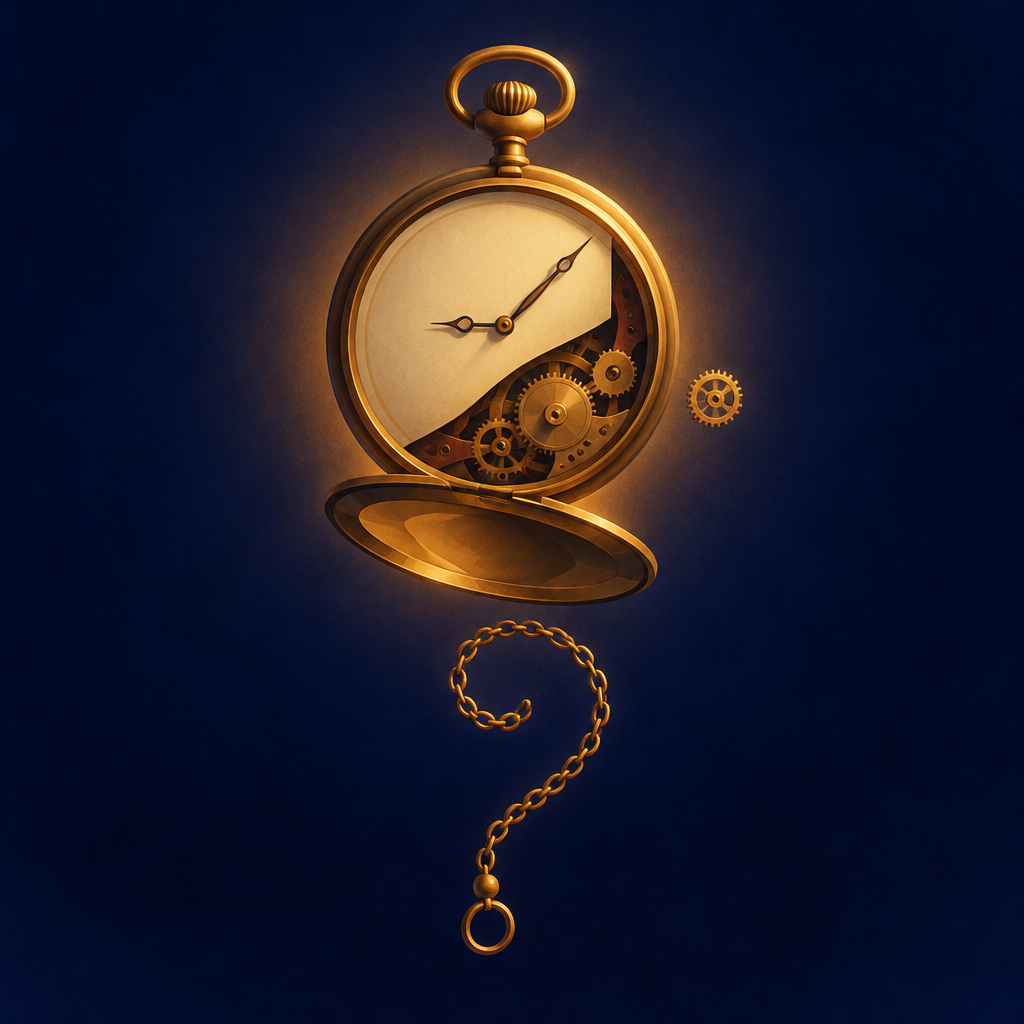
Why the Pocket Watch Would Not Tick
When Grandpa Wes's repair shop receives a mysterious pocket watch that refuses to tick, siblings Theo and Nora discover that every broken old thing holds a memory waiting to be heard. To fix the watch before the buyer arrives at dawn, they must follow its ticking backwards through a hundred lost years.
The Watch That Would Not Tick
The Watch That Would Not Tick
The bell above the door of Grandpa Wes's repair shop rang twice before anyone touched it, because the door was open and the wind liked to come in and look around.
Theo heard it from the back room, where he sat at the workbench with a broken music box laid out in front of him like a tiny silver city. Forty-one screws. He had counted them twice. Nora lay upside down on the old green sofa, her braids pooling on the floor, reading a book about shipwrecks for the third time.
"Theo," she said, upside down. "The door rang."
"Wind," said Theo.
"It rang twice."
Theo set down his smallest screwdriver. In this shop, on this street, in the last golden hour of an October afternoon, twice meant somebody was standing on the threshold deciding whether to come in.
And somebody was.
She was tall and silver-haired, wearing a gray coat that looked like it had been tailored in another century, and she held something in both hands the way you hold a sleeping bird. She crossed the floor slowly, past the shelf of orphaned teacups, past the wall of clocks that all said different times, past the barrel of doorknobs that Grandpa Wes swore could still remember every door they had ever opened.
"Wes Kramer," she said. "You still take broken things?"
Grandpa Wes came out from behind the curtain, wiping his hands on a rag that had seen forty years of repair work. He stopped when he saw her. He took off his glasses, put them back on, and smiled like a man remembering a summer from long ago.
"Ada Prynne," he said. "Fifty years, and you haven't changed but your coat."
"Liar," said Miss Ada Prynne, but she smiled too.
Nora rolled off the sofa and righted herself in one motion. Theo abandoned his forty-one screws entirely. This, they both knew without saying it, was going to be interesting.
Miss Prynne laid the thing she was carrying on the workbench, and the lamplight caught it and held on.
It was a pocket watch. Gold case, worn soft at the edges the way a stone in a river gets worn. A hunting scene engraved on the lid, hounds and horses, so fine you could count the hounds' ears. On the back, a single initial: an H, surrounded by a wreath of tiny leaves.
"This watch," said Miss Prynne, "belonged to my grandfather. He carried it up a mountain. He carried it across an ocean. He carried it on the day he met my grandmother, and she always said she could set her whole life by it." "And now it won't tick."
Grandpa Wes picked it up. He turned it over. He held it to his ear the way doctors used to hold stethoscopes, and the whole shop went quiet, all thirty-one clocks seeming to lean in and listen with him.
Nothing.
No tick. No tock. Not the ghost of one.
"Hm," said Grandpa Wes, which was the most serious thing he could say.
"Can you fix it?" asked Miss Prynne. "I sail Thursday. It was supposed to be a gift. For my granddaughter. So she'd have something of his that still works, that still goes." "A stopped watch is just a little gold stone. I don't want to hand her a stone."
Grandpa Wes wound the crown, gently, gently. The gears inside turned and caught and turned. His eyebrows went up, one at a time, like they were climbing stairs.
"It's not broken," he said slowly. "Wound tight as a drum. Clean as a bell. Every wheel in its place." "It just won't go."
"Watches don't choose to stop," said Miss Prynne.
"Most don't," said Grandpa Wes, and he looked at the watch in a way that made Theo's spine go fizzy, because Grandpa Wes only looked at things that way when they were about to become a project.
"I'll need a day," he said. "Maybe two."
"You have until dawn," said Miss Prynne. "I lied about Thursday. The taxi comes at dawn tomorrow. It's tonight, or it's never." "He'd have liked you, Wes. He liked stubborn people."
And she was gone, the bell ringing once behind her, the door swinging shut on the wind.
For a moment nobody moved. Then Nora was at the bench, nose an inch from the watch. Theo was at her shoulder. Grandpa Wes was already pulling down his loupe, his tweezers, his jar of glass cleaning fluid the color of weak tea.
"Grandpa," said Nora. "What did she mean, it won't go? Watches either work or they don't."
"That," said Grandpa Wes, "is what most people believe."
"But not you."
"Not me." He laid the watch down on a square of green felt, and the lamplight pooled around it like the ring around the moon. "Some things, when they get old enough, and loved enough, and carried through enough... they start to keep more than time." "This one's keeping something. Something it won't let go of. And until it lets go, it won't tick."
Theo leaned closer. And there, in the deep gold of the watch's face, under the faded hands and the worn numerals, he saw it.
The second hand.
It was trembling.
Not moving. Not stopped. Trembling, like a dog pointing at a rabbit it can smell but not see.
"Grandpa," Theo whispered. "It wants to go somewhere."
Grandpa Wes put one big hand on Theo's shoulder and one on Nora's, and outside the window the last gold drained out of the October sky and the streetlamps came on, one, two, three, like the shop itself was winding up.
"Then we'd better find out where," he said. "Nora, fetch the big lantern. Theo, bring the watch. And both of you eat fast, because I have a feeling this is going to be a very long night."
The second hand trembled once more, twice, and then, so faintly that only someone leaning close with a held breath could have heard it, the watch gave the smallest, most stubborn little sound in the world.
Almost a tick.
Nora's eyes went wide as saucers.
"I heard it," she breathed. "Did you hear it?"
Theo had heard it. Somewhere behind his ribs, his own heart had answered.
The watch was trying to tell them something. And tonight, before dawn, they were going to listen.
Following the Faintest Tick
They ate fast, just like Grandpa Wes said. Toast with too much jam, standing up, the plate balanced on the barrel of doorknobs. Nora was finished first. Theo was finished second only because Nora stole his last crust and ate it for him.
Grandpa Wes cleared the bench. He laid out tools like a surgeon preparing for something important: the loupe, the fine tweezers, the little brass hammer, and a shallow dish for the watch to lie in. Then he sat down, put the loupe to his eye, and became very still.
Theo and Nora pressed in on either side of him.
"Careful now," Grandpa Wes murmured. "Old things can feel you crowding them."
Nora leaned back exactly one inch. Theo leaned back one inch and a half, to be safe.
Under the loupe, Grandpa Wes opened the gold case. Inside was a small world. Golden wheels no bigger than freckles, a hairspring thin as a spider's thread, little ruby jewels glowing like drops of jam. Everything in its place. Everything clean. Everything ready.
And the second hand, still trembling.
"It's like it's waiting," said Theo.
"Or like it's lost," said Grandpa Wes. "Like it knows where it wants to be, and it can't find the way."
He touched the hairspring with his tweezers, soft as touching a soap bubble. The second hand stopped trembling. The shop went so quiet they could hear the lamp humming.
And then — tick.
One tick. Loud as a firecracker in the silence.
Then nothing. Then, a whole minute later, tick.
One tick a minute. No more.
"It ticks like a heartbeat," whispered Nora. "Slow. Like something sleeping."
Grandpa Wes sat back. He took off the loupe, and his eyes had that fizzy look that Theo knew meant trouble, the good kind.
"A watch ticks when its wheels are free," he said. "This one ticks once a minute, all together, like it's saving up. Like every tick is a step." "I've seen it once before. Fifty years ago. On this very bench."
Nora grabbed his sleeve. "On what? Whose? Tell us!"
But Grandpa Wes was already reaching under the bench, into the low drawer that was always locked and never was, and he pulled out a ledger. A big cloth-bound book, its corners soft with age. He licked his thumb and turned pages, turning, turning, until he stopped.
"There," he said.
In faded brown ink, in handwriting as elegant as a bird's footsteps, it read: H. Prynne. Pocket watch, gold, English. Presented for repair. Stopped. Will not go. Returned unrepaired.
And below that, in different ink, added later, small and slanted:
It had somewhere to be. We took it there. — W.K.
"W.K.," breathed Theo. "Wes Kramer. You."
"Me and your grandmother," said Grandpa Wes. He ran his thumb over the ink like he was petting it. "Ada's grandfather came in here fifty years ago, young as anything, with this watch stopped dead in his pocket, three days before he was to sail home to England. And the watch wouldn't go. Same trembling. Same one tick a minute." "Your grandmother figured it out. She always figured things out before me."
"Figured what out?" asked Nora, bouncing on her toes.
Grandpa Wes closed the ledger gently.
"That the watch wasn't broken," he said. "It was homesick."
Nora's mouth fell open. Theo felt the word go through him like a cold glass of water, the good kind of cold.
"For a place?" he asked.
"For a moment," said Grandpa Wes. "Old loved things hold on to moments the way we hold on to handles. That watch had been carried somewhere that mattered so much to old Mr. Prynne that the watch drank it in. And when he sailed away from that somewhere, the watch stopped. Not broken. Just pointing. Like a compass needle pointing at a moment it couldn't reach."
"So what did you and Grandma do?" demanded Nora.
"We asked him where he'd been, in the months before it stopped. And he went pale as paper, and he named a place. And that night we all four went there — him, Ada's grandmother, me, and your grandmother — and we stood in that place, all together, and I held the watch in the open air. And it ticked." "It ticked so hard it nearly jumped out of my hand. It ticked for a full minute, wound itself round, and then ran as true as a train."
"Where?" asked Theo. "Where was the place?"
Grandpa Wes smiled the smile of a man arriving at the good part.
"The bandstand in Harrow Park," he said. "Where he proposed. Where she said yes. The watch was in his waistcoat pocket, two inches from his heart, when it happened. It never forgot."
The three of them looked at the watch on the green felt. The second hand trembled. Tick. One minute. Tick.
"But Grandpa," said Nora slowly, working it out with her whole face. "Miss Prynne said he carried it up a mountain and across an ocean and on the day he met Grandma. And it kept going all that time. So why has it stopped now?"
Grandpa Wes's eyebrows climbed their stairs again.
"That," he said, "is the mystery, isn't it."
Theo picked up the lantern, and Nora picked up the watch, holding it in both hands the way Miss Ada Prynne had, like a sleeping bird. Grandpa Wes fetched his coat and his cane and the key ring that jingled like a hundred tiny bells.
"Harrow Park closes at nine," said Nora.
"For people who use gates," said Grandpa Wes, and jingled the keys.
But Harrow Park was only the first stop, and it went wrong.
They stood under the bandstand at half past nine, the moon coming through the slats in silver stripes, the watch held up in Theo's hands. It trembled. It ticked once. And then it went quiet, and the trembling got smaller, sadder, like a dog that hears the car turn down the wrong street.
"No," whispered Theo. "No, this is the place. This has to be the place."
"Maybe it changed its mind," said Nora.
"Maybe," said Grandpa Wes slowly, "it isn't remembering the same moment anymore. Fifty years is a long time. Watches don't fall in love once and never again. Maybe old Mr. Prynne gave it a new moment to hold. And we don't know where that one lives."
The wind came through the bandstand and the whole structure creaked like an old ship. Nora shivered. Theo held the watch closer to the lantern light, and the second hand was trembling, trembling, pointing — and it was not pointing at the bandstand.
It was leaning. Actually leaning, the whole movement tilted a hair toward the northeast, like a compass needle, like a dog leaning out a car window.
"Grandpa," said Theo, and his voice came out quiet and sure. "It's not homesick for the past. It's pointing. It wants to go somewhere."
Grandpa Wes turned the watch in Theo's hands, and the second hand swung, and settled, and swung back.
"Well then," he said. "We follow it."
They followed it out the park gate, Nora out front like a hound, Theo holding the watch flat on his palms like a waiter with the world's smallest tray. Down Elm Row. Past the shuttered bakery. Past the fountain with the one working spout. At every corner they'd stop, and Theo would turn slowly in a circle, and the second hand would lean and lean until it found its direction, and off they'd go again, three night travelers and one stubborn little gold heart.
Tick. Once a minute. Tick.
And then, at the corner of Harrow Lane and the river road, with the moon high and the streetlamps spaced out like beads on a string, the tick changed.
Tick. Thirty seconds. Tick.
"Faster," breathed Nora. "It's going faster."
They hurried. The river came up alongside them, black and talking to itself under the bridge. The tick came quicker. Tick. Fifteen seconds. Tick. Theo's palms were sweating. The second hand wasn't trembling anymore — it was straining, quivering like a plucked string, leaning hard toward the river road, toward the old boat landing, toward —
Toward the tall dark shape of the ferry pier, and the ticket booth with its one dim bulb, and a small figure in a gray coat sitting on a bench with a suitcase at her feet, waiting.
Miss Ada Prynne.
She looked up. For a moment nobody moved. The watch in Theo's hands went tick — tick — tick, quick as a rabbit's heart, so fast it was almost running, almost going, almost there.
"You lied," said Nora, "about the taxi at dawn."
"I lie about all taxis," said Miss Ada Prynne. "It's a habit. I came to the water because I couldn't sleep, and this is where my grandparents landed, fifty years ago, with one suitcase and a watch that had just started ticking again." "But it stopped the night before I sailed into town. And I have been sitting here all evening trying to remember how the story went, and I cannot remember, and it is nearly midnight, and my ship leaves at dawn."
The watch ticked faster. Theo held it out to her, and the moonlight and the bulb-light caught the gold and the worn old hunting scene and the little wreath of leaves around the H.
And then the ticking began to slow.
Tick. A minute. Tick.
Longer. Slower. The second hand sinking back to its trembling.
"No," whispered Theo. "No no no, we're here, we found it —"
But the watch was going quiet in his hands, going back to its stubborn almost-silence, and somewhere behind them the town clock began to strike twelve.
One. Two. Three.
They had until dawn. And the watch was slipping away, tick by tick, into the quiet.
The Night the Watch Spoke
The town clock struck four. Five. Six. The last note hung over the river like a held breath.
Miss Ada Prynne stood up from the bench so fast her suitcase toppled.
"It's slowing down," she said. "When my grandfather's watch stopped, all those years ago, it stopped the night before something mattered. It's waiting for something and it isn't here. We're at the wrong bench, the wrong spot —"
"No," said Theo.
Everyone looked at him. Theo almost never said no to grown-ups. His voice had gone quiet, the way it went when he had all forty-one screws laid out in order and had just spotted the one that didn't fit.
"It's not waiting for a place," he said. "Places don't leave. It's ticking faster near you. It sped up when it saw you. It slowed down when..." He looked at Miss Ada Prynne, silver-haired, elegant, standing in the cold with a suitcase. "When did it stop?"
"The night before I sailed here," she said.
"Why did you sail here?"
And there it was. Just a flicker, quick as a fish. Miss Ada Prynne looked away, toward the black water.
"To sell my grandparents' house," she said. "The little house on Harrow Lane. And to put their things in order. And to say a proper goodbye to a town I haven't seen since I was a girl." "That's all. It's only a house."
Grandpa Wes made a sound in his chest, halfway between a hum and a chuckle, the sound of a repairman hearing a rattle a customer says isn't there.
"Ada Prynne," he said gently. "Fifty years, and you still hold things in both hands like sleeping birds, and you still tell a story with the middle cut out of it." "What's in the middle?"
The river talked to itself under the pier. Nora sat down on the bench and pulled Miss Prynne gently down beside her, the way you'd sit a bird on a perch.
"I used to summer in that house," said Miss Ada Prynne, and her voice had changed, gone softer, less tailored. "Every year, until I was twelve. My grandfather taught me to sail off this landing. My grandmother taught me to whistle through a blade of grass on that hill. He'd take the watch out and time me — how long I could hold my breath, how fast I could run to the lamppost and back. 'Time her, Papa,' I'd shout. 'Time me!'" "And he'd hold that watch up and squint at it like it was the most important instrument in the world."
The watch in Theo's hands went tick.
Not a slow tick. A good one. A full, round, proper tick.
Everybody froze.
"It's listening," whispered Nora.
"Keep going," breathed Theo. "Please keep going."
Miss Ada Prynne looked at the watch, and something in her face came undone, gently, the way a knot comes undone, not the way a thing breaks.
"The last summer, I was twelve, and I decided I was too old for summers. There was a girl in the city, and a bicycle I wanted, and I told my grandfather I wouldn't be coming back. I told him on this landing, the night before their boat. He said, 'That's all right, little magpie.' He called me magpie, because I collected things. Shiny things. Small things. Things other people overlooked." "He took out the watch and he said, 'This has timed every important thing in my life, and you are the most important thing in it. It'll be waiting for you. Old things keep. You just have to come back to them.'"
She stopped. Her hands were folded tightly in her lap.
"And I never came back," she said. "He wrote me every month for years. I was busy. Bicycles, then schools, then work, then my own life, like a tide going out and out. He died the year I finally meant to come. And this week I sold the house, and tonight I sat here because this is where he said it, and I cannot remember —" her voice wobbled, just once — "I cannot remember his voice saying it anymore. That's what I came to find, if we're telling the truth, and I couldn't say it in your shop, Wes, because it sounded like a small thing to cross an ocean for."
The watch ticked. Tick. Tick-tick. Tick.
Faster. Alive. Straining.
"It stopped the night before you sailed," said Theo slowly, "because it heard you were coming to say goodbye. And it won't tick because —" he held the watch up, and the second hand was leaning, leaning, straining toward Miss Ada Prynne like a dog at the end of a leash — "because it's not done timing you. It timed you when you were small. It's been waiting fifty years to time you again. It doesn't want a goodbye. It wants one more go."
Silence, except for the river.
Then Grandpa Wes took off his cap.
"Well," he said. "Your grandmother and I took the last one to a place. Looks like this one needs a moment. And a moment, Ada, needs doing, not visiting." He turned to Nora, and his eyes were bright as anything. "Nora, my girl. You're the one with the legs and the lungs. There's a hill behind this landing — is there still a lamppost up there?"
Nora was already scanning the dark. "One lamppost. Top of the hill. By the bench with the broken armrest."
"Then here's what old Mr. Prynne's watch has been waiting fifty years to do." Grandpa Wes held out his hands to Miss Ada Prynne, and helped her up off the bench, and set her shoes straight on the boards of the landing. "Time her."
Miss Ada Prynne stared at him.
"Wes Kramer. I am seventy-four years old."
"And the record," said Grandpa Wes, "stands at a lamppost and back, set by a girl of twelve, on a summer evening, timed by her grandfather. As far as this watch knows, you're still twelve, and still undefeated." "It's waited fifty years for the rematch. Don't you dare hand it a stone."
And Nora took Miss Ada Prynne's hand, and Theo put the watch into it, and folded her fingers over the gold case, and something passed across the old woman's face like moonlight finding water.
"Grandpa," Nora whispered loudly. "What was the record?"
"Thirty-two seconds," said Miss Ada Prynne herself, straightening her coat. "To the lamppost and back. I never beat it. He never let me forget it. On your marks."
Nora climbed onto the bench to be the starter. Theo stood at Miss Prynne's elbow with the lantern high, so the light lay gold on the boards and the hill and the lamppost far up in the dark. Grandpa Wes set his cane aside and held the watch face where Miss Ada Prynne could see it, in her own two hands, exactly the way she'd carried it into the shop — like a sleeping bird about to wake.
"Ready!" called Nora.
The second hand stopped trembling. Went perfectly still.
"Set!"
Miss Ada Prynne took one deep breath, and fifty years went into it.
"GO!"
She went. Not fast — nobody's fast at seventy-four, and she was laughing before she'd gone ten steps, laughing and muttering "oh, you dreadful man" at the sky and at the watch and at the whole stubborn idea of it. Her coat flapped. Her shoes beat the boards of the landing and then the soft dirt of the hill path. Nora ran beside her the whole way, backwards, shouting encouragement. Theo ran to the bottom of the hill with the lantern so there'd be light at the turn.
And the watch —
The watch in Grandpa Wes's hand went off like a small gold drum.
Tick-tock-tick-tock-tick-tock, fast and full and round, no longer once a minute but every second, every half second, ticking like it used to tick in a waistcoat pocket two inches from a heart, ticking the way it must have ticked on a summer evening for a girl of twelve running for a lamppost —
Nora touched the lamppost. "TOUCHED IT! TURN!"
Miss Ada Prynne turned. The hill took her down faster than it had taken her up, and she came down through the lantern light with her silver hair loose and her hand out —
— and slapped the bench where Grandpa Wes sat with the watch —
Grandpa Wes looked at the face.
"Thirty-one seconds," he said, and his voice cracked right down the middle. "New record."
And the watch, held up in the lantern light between them all, ticking away like a cheerful little engine, with a sound like feet on a dance floor, like a train leaving on time, like every good thing that has ever arrived exactly when it was meant to —
kept going.
It was not almost a tick anymore. It was every tick. Tick, and tock, and tick, and tock, steady as a heartbeat, bright as a bell, and it went on and on and did not stop.
Miss Ada Prynne put both hands over her mouth.
"There it is," she said through her fingers. "That's the sound. That's his sound. Oh — that's the sound of his pocket on a Sunday."
And the watch ticked on in the dark, holding all of it — the landing, the lamppost, the girl, the man, the fifty years — and finally, finally, letting the last part go.
They walked back along the river road, four of them, the watch ticking in Miss Prynne's hands the whole way, and nobody hurried, and nobody needed to.
Dawn was still hours off. But it was already, somewhere behind the hills, on its way.
One More Tick Before Dawn
They went back to the shop, because that was where the green felt was, and because Grandpa Wes said no watch of his acquaintance would spend the most important night of its life without a proper inspection.
The bell above the door rang as they came in, twice, because the door was open and the wind liked to come in and look around. It seemed pleased to find them.
Grandpa Wes laid the watch on the square of green felt under the lamp. He put the loupe to his eye and looked a long time, turning the gold case this way and that. Theo and Nora leaned in on either side, one inch and one inch and a half.
"Well?" asked Nora.
"Well," said Grandpa Wes, and there was a smile hiding under his mustache like a mouse under a rug. "Cleanest movement I've ever seen. Not one thing out of place. As a repairman, I'm professionally unnecessary." "As a repairman, I'd like to point out that the watch is running eleven seconds fast."
"It is not," said Miss Ada Prynne.
"It is. Eleven seconds fast, and it'll stay that way. I could regulate it, but I won't. Old Mr. Prynne set it that way himself, I'd wager. Eleven seconds of extra time a day. A man who times the people he loves doesn't like to cut it close."
Miss Ada Prynne held the watch to her ear for a long moment.
"He did used to say he was never late," she murmured. "Fifty years I thought that was just a saying." "Well. It's a good fault. We'll keep the fault."
They made cocoa on the little stove behind the curtain, because it was that kind of four in the morning. Nora had two marshmallows. Then three. Then, when Miss Prynne wasn't looking, a fourth, and Miss Prynne looked, and smiled, and slid the bag across to her, because magpies collect things, small things, things other people overlook.
Theo sat at the workbench with the watch while the cocoa warmed. He didn't take it apart. He just sat with it, listening. Tick. Tock. Steady as anything.
"Grandpa," he said quietly. "The music box. Can Miss Prynne's granddaughter... I mean. Is there any way —"
"Out with it, boy."
"The watch is going to her. On a ship. Across an ocean. What if it gets homesick again? What if it stops, and she doesn't know why, and there's nobody to tell her?"
Grandpa Wes looked at Miss Ada Prynne over the rims of his glasses. Miss Ada Prynne looked back. Then she reached into her gray coat and took out a small notebook, silver-haired-elegant, the kind with an elastic band, and laid it on the bench beside the watch.
"Then we write it down," she said. "Everything. The bandstand. The night at the pier. The lamppost and the thirty-one seconds. What the watch is, and what it does, and what to do if it ever goes quiet." "A stopped watch is only a little gold stone if nobody knows the story. If somebody knows the story, it's just a watch asking for a walk."
So they wrote it. All four of them, taking turns, in the silver notebook by lamplight. Nora wrote the exciting parts, with exclamation points. Grandpa Wes drew the inside of the movement, every wheel and jewel, steady and exact. Miss Prynne wrote the middle of the story, the part that had been cut out of it for fifty years, in handwriting like a bird's footsteps. And Theo wrote the last page, in his careful, square letters, and this is what it said:
This watch keeps more than time. Wind it every morning. Let it hear you laugh. And if it ever stops, don't worry, and don't shake it. Take it somewhere that matters, hold it in both hands, and give it a moment worth keeping. It will start again. It always has.
Miss Ada Prynne read it twice. She closed the notebook and put the elastic band around it and held it a moment, the way you hold a sleeping bird.
The sky outside the window had gone from black to the gray-blue of a pigeon's wing, and the streetlamps were going out, one, two, three, like the shop itself winding down. Somewhere down the street, the first taxi of the morning coughed itself awake.
At the door, Miss Ada Prynne shook Grandpa Wes's hand, and then, because fifty years is fifty years, she kissed him on the cheek, and he went the color of the inside of a copper pot.
"Wes Kramer," she said. "You still take broken things."
"Nothing that comes to this bench," said Grandpa Wes, "has ever been broken. Some of them are just waiting to be understood." "Give your granddaughter my regards. And tell her the watch runs eleven seconds fast. She'll want to know she has a little extra."
She knelt down to Nora's level, and Nora hugged her, braids and all, bold as anything.
"Thirty-one seconds," Miss Prynne said in Nora's ear. "Undefeated. See that it goes in the family records."
Then she turned to Theo, who was holding out the watch in both hands for the last time, lamplight pooled around it like the ring around the moon.
"You heard it first," she said. "The almost-tick. You and your sister both. That's a rare pair of ears, and ears like that are how old things get kept." "Thank you, Theo."
She put the watch in her waistcoat pocket, patted it once, and picked up her suitcase, and the bell above the door rang once as she went out into the blue morning, down the steps, into the taxi, and away toward the harbor and the ship and a granddaughter on the far side of an ocean who did not know yet what was coming across the water toward her, ticking.
The shop was quiet. All thirty-one clocks said their different times, and the barrel of doorknobs dozed, and the orphaned teacups waited on their shelf for whoever needed them next.
Nora flopped onto the old green sofa, braids pooling on the floor, asleep before she finished saying good night. Theo sat down at the workbench and looked at his broken music box, laid out in front of him like a tiny silver city. Forty-one screws. He'd counted them twice.
He picked up his smallest screwdriver.
"Grandpa," he said, around a yawn. "Do you think the music box remembers its song?"
Grandpa Wes came and stood behind him and put one big hand on his shoulder, and outside the window the sun came up over the rooftops, slow and gold, the whole town winding itself for a brand-new day.
"Everything in this shop remembers," he said softly. "That's the whole trade. We just give things a quiet place, and good light, and enough time — and sooner or later, they tell us what they've been keeping."
Theo turned the first screw. Somewhere deep in the little silver city, so faintly that only someone leaning close with a held breath could have heard it, something went plink.
Almost a note.
Almost a note.