
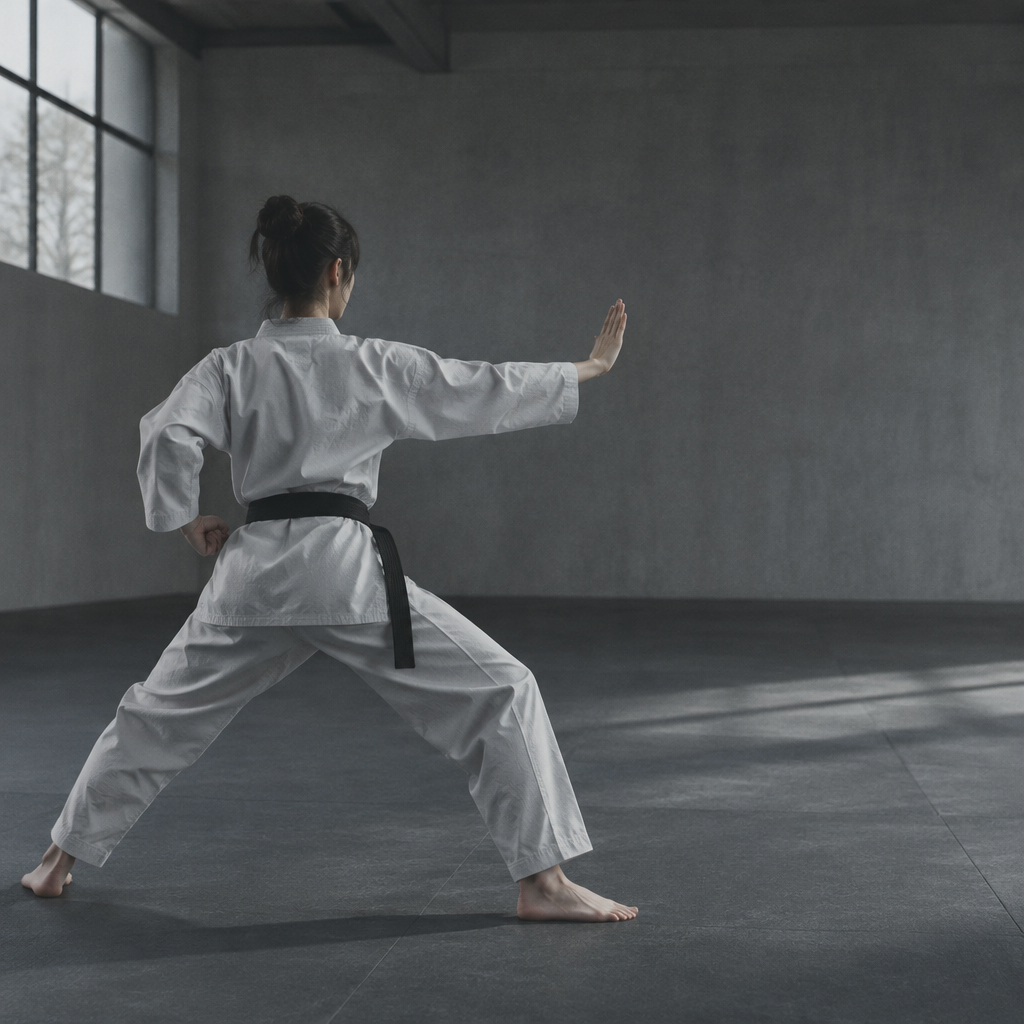
Poomsae: The Invisible Battle
This six-lecture course teaches black belts how to turn choreographed poomsae into a lethal simulation. Lecture one uses Grandmaster Lee Kyu-hyun’s 2006 World Poomsae Championships performance of Koryo to show that every block and strike must be aimed at a specific, visualized opponent whose height and weight can be felt at the moment of impact. Lecture two corrects the horse-riding stance by demonstrating that dropping the center of gravity at the instant of contact converts speed into force, turning silent footwork into audible grounding. Lecture three dismantles the myth that higher kicks score better, proving that a waist-level side kick with locked hip alignment transmits more power than a head-level kick that collapses the supporting structure. Lecture four breaks down the whip-and-hinge sequence: the chambering hand pulls the opposite hip forward, the hands cross at the chest to coil energy, and the hip snaps first so the fist arrives last with the full weight of the body behind two knuckles. Lecture five introduces the Heum-ha breath, the quiet abdominal inhale before a move and the sharp exhale on impact that protects organs and resets muscle tension for repeated strikes. Lecture six resolves the art-versus-combat debate by showing that the mountain block in Keumgang is both symmetrical and functional only when performed with the intent to stop a punch and seize the attacker’s neck. Across all lectures, practitioners learn that geometry without collision, height without stability, and speed without grounding produce empty motion rather than effective technique.
The Ghost in the Dojang: Grandmaster Lee’s Invisible Opponent
The Ghost in the Dojang: Grandmaster Lee’s Invisible Opponent
A dobok sleeve. That's the object. Not a trophy, not a diagram — just the white fabric hanging at the end of your arm.
That sleeve tells you something most practitioners never hear spelled out. When Grandmaster Lee Kyu-hyun performed at the two thousand and six World Championships, the crowd didn't respond to his accuracy. They responded to something else. What they heard — what they felt — was the crack of that sleeve snapping at the end of each technique. That sound isn't made by speed alone. It's made when two things collide: the accelerating arm, and the imagined resistance of a body that isn't there. The sleeve becomes evidence. It's a readout of an internal state that judges can hear from thirty feet away.
Now, poomsae has a formal definition worth sitting with. British Taekwondo's competition rules describe it as a sequence of fundamental movements — defense and attack — arranged logically to address one or more imaginary opponents. The imaginary opponent is built into the definition, not added as an optional interpretation. So the sleeve crack isn't a stylistic flourish. It's what the form is supposed to be doing all along. That's the gap, Kaiz — the gap between practitioners who know the pattern and practitioners who have constructed something to hit. Most people are drawing a map. Grandmaster Lee was running a collision.
Think of it this way. A camera crew filming a stunt driver on an empty track can capture clean, precise cornering. Every angle, every apex, hit on cue. Now put another car on the track. Suddenly the driver's body posture changes. The grip changes. The decision weight behind every micro-adjustment changes. The track is the same. The car is the same. But the internal calculation is completely different. That's the difference between a geometric movement and a tactical simulation. In poomsae, the opponent is imaginary — but the physics of the encounter has to be real in the practitioner's mind. A PubMed-indexed study comparing Taekwondo disciplines found that poomsae athletes actually showed greater center-of-pressure movement in all four directions than kyorugi and demonstration athletes performing the same kick. The researchers concluded that long-term poomsae practice creates distinct body-control mechanisms. What gets me is that result flips the assumption. Poomsae practitioners aren't the still, controlled ones — they're managing something complex that the other groups aren't, because their training demands it.
So what does the imaginary opponent actually need to be? This is where it gets specific, and it matters for you, Kaiz, because knowing it lets you stop improvising and start building. The opponent needs three qualities. A location — not "in front of me" but a height, a mass, a posture, a point of entry for the technique. A resistance — the forearm block that meets your block, the torso that absorbs your punch, the pressure that your body has to generate against. And a timing — a moment of arrival that your technique must reach, not simply pass through. Without all three, the visualization stays decorative. With all three, the sleeve cracks. Kukkiwon's poomsae textbook, in its two-hundred-and-eighty-page volume within a five-part treatment of Taekwondo theory, frames poomsae within principles of movement — not isolated as a performance art, but embedded in the physics of the full discipline. That framing matters. It says the opponent has always been structural.
Return to the sleeve for a second. You've probably seen your own uniform snap on a good day and hang flat on a bad one, and wondered what changed. I, the thing I keep coming back to is that you likely didn't change the technique. You changed what you were doing it to. When the opponent is fully constructed — specific height, real resistance, exact arrival time — the nervous system organizes the kinetic chain differently. The acceleration peaks at the right instant. The fabric responds. That's not mystical. That's load management with a target that happens to be invisible.
The sleeve doesn't lie about what's happening inside. A practitioner who has built a real opponent — one with weight and arrival and resistance — wears the evidence of that construction on their body every time they move. That's the standard Grandmaster Lee set. And it's, it's not about how sharp you can make a technique look. It's about how real you can make the encounter feel, Kaiz, until the fabric itself becomes the proof.
The Heavy Footfall: Finding Stability in Motion
Speaker 1
Picture it. A student drops into horse-riding stance, and the mat booms. Loud. Proud of it.
Speaker 2
And the coach frowns. Because that boom, it's, it's telling the coach almost nothing about whether the stance is right.
Speaker 1
Really? I'd have scored the boom.
Speaker 2
Most people would. But World Taekwondo's poomsae rules fold stance execution into technical accuracy. Judges care whether the stance is correct, not how loud it arrived.
Speaker 1
Fine. So what does a correct Chuchoom Seogi actually look like?
Speaker 2
Under the standard most schools teach, feet roughly parallel and pointing forward, knees pressed out over the toes, weight split evenly. But the honest rule is: reproduce your own curriculum's spec. One generic width doesn't fit every technique.
Speaker 1
Evenly split. That's not how forward stance works, right?
Speaker 2
Right. The rules give ap-seogi more weight on the front leg, dwit-seogi more on the rear, and tiger stance, beom-seogi, mostly rear-supported with the front foot on its ball.
Speaker 1
Okay, back to the student. How do they drop the center of mass without just... stomping?
Speaker 2
Bend at hips, knees and ankles together, under control. The body settles like an elevator arriving, not like a—
Speaker 1
Wait. Elevators are nice. What does the coach actually see?
Speaker 2
Torso upright. Head doesn't bob after landing. The stance is recognizable before the next technique begins. Rush the foot placement and the stance itself falls apart.
Speaker 1
So a quiet landing can be the stable one.
Speaker 2
Can be. Researchers don't measure balance as stillness, either. They track center of pressure, basically how the pressure under the feet wanders while the body adjusts. How far it wanders, and how fast.
Speaker 1
I'm still not sold. A sharp stamp feels grounded.
Speaker 2
I'm not saying the sound is wrong. I'm saying it isn't proof. A stamp can hide pressure sliding onto one foot.
Speaker 1
One foot?
Speaker 2
Yeah. Lowering the center of mass goes straight down, shared by both legs. Shifting pressure goes sideways. In a transition the supporting leg manages a changing load while the other travels, so watch both feet.
Speaker 1
So the student should just sink deeper. Lower means more rooted, right?
Speaker 2
No. Sink past the prescribed depth and the legs get stuck in a deep bend, so the next step comes slower. Same with a long forward stance: the length has to let them finish upright.
Speaker 1
Then how does the student, I mean, how do they check this alone?
Speaker 2
Two cameras. A front view shows lateral drift on entry, hips sliding sideways. A side view shows forward or backward sway. And when turning, pivot deliberately and verify the final foot angles.
Speaker 1
What about Keumgang? That one-leg hold is brutal.
Speaker 2
Hakdari-seogi. The base shrinks to one foot. Small quiet adjustments are normal, that's balance working. Repeated big corrections that pull the student out of position, that's the problem.
Speaker 1
Stronger legs fix that, though.
Speaker 2
Related, not interchangeable. One randomized study split thirty poomsae athletes into proprioception, strength, or control groups. Proprioception is the body's sense of its own position. They tested hakdari-seogi in two phases: shifting onto one leg, then holding.
Speaker 1
Two phases. So the drill splits too.
Speaker 2
Exactly. Stable arrival first, then the hold. That shows whether the wobble happens during travel or after landing. And it's why rooting matters: even when you speed up, you still want to land in the stance under control.
Speaker 1
And if the stance keeps collapsing? Or it hurts?
Speaker 2
Reduce the challenge and get qualified coaching or clinical guidance. Build a repeatable stance on a stable surface first. Even the para-poomsae rules list balance and posture, adjusted for sport class.
Speaker 1
So that boom from the start...
Speaker 2
The boom is optional. Arriving still and recognizable is not.
The Flexibility Trap: Why High Kicks Can Fail You
One point two degrees. Hold that number, because I'm not going to explain it yet. It belongs to a group of poomsae athletes whose side kicks expert judges had marked as low quality. Not low height. Low quality. What I, the thing that surprised me is that this tiny figure says more about why their kicks failed than anything about where their feet ended up. It's easy to feel a little envy watching a poomsae athlete throw a high side kick. That envy is the trap.
So let's give the belief its best shot. Height comes from flexibility, and flexibility wins. And honestly, the same study seems to agree. The high-quality kickers had more range in the kicking knee's extension, and more in the supporting leg's hip and knee. The authors even recommended flexibility training for those areas. Case closed, right? Not quite. This was a snapshot comparison, so it shows an association, not proof that stretching alone builds better kicks. And the knee range was measured seated, with the pelvis held still. But during an actual kick, the pelvis can move.
Now the opening number makes sense. That one point two was pelvic tilt, how far the hips rolled into the kick. The strong group tilted many times further. So the weaker kickers weren't short on leg. They were short on hip. A separate team studied forty collegiate poomsae athletes and found the strongest predictor of quality was the sidekick angle at maximal height. That's the shape of the kick, not its altitude. And dynamic balance, staying controlled while moving, ranked among the top physical predictors. I didn't expect balance to sit that close to the top.
Think of a crane on a construction site. Extend the boom higher and the whole machine has to rebalance, or the base tips. Kicks behave the same way. When researchers raised the target, the pelvis and leg joints changed speed during the lift, and pelvic tilt and hip opening shifted too. A higher kick, it's, it's not the same kick with the foot moved up. It's a different body. And the swinging leg isn't working alone: the supporting leg pushes against the floor to create and control everything. Better-ranked fighters also moved in sequence, from the hips outward toward the foot, like a whip cracking from the handle.
So does more stretching fix it? One recent Taekwondo study compared approaches. Core-stability training improved kick rotation and dynamic balance. Flexibility training improved range of motion, but not the measured kicks. Picture a practitioner who's proud of gaining more range of motion. Then, at testing, the kick wobbles at the top, exactly like before. The range grew. The kick didn't. A quick check separates the two problems: compare how high a partner can lift your leg with how high you can hold it unsupported. That gap, I mean the space between them, is control you haven't built yet.
So this week, throw noncontact side kicks at a few heights, filming from the side. Find the highest one you can repeat without an extra hop or a visible wobble. And don't stop watching at full extension. Retraction and landing show whether the structure held, or whether the kick just, well, borrowed balance it couldn't repay. A deliberate hip tilt is part of the kick. A lean that grabs for balance is not.
Go back to those weaker kickers, Kaiz. They didn't lose for lack of inches at the foot. They lost by one point two degrees at the hip. That was the whole bill. Look past the height and the splits for a moment: what stands out is how little the pelvis tilted in that group. Pay your degrees at the hip, and the height will settle exactly where your structure can hold it.
The Whip and the Hinge: The Path of Power
Speaker 1
So the punch lands, the shoulder jumps toward the ear, the elbow snaps straight, and the fist bounces back. That's the failure?
Speaker 2
That's the failure. A judge reads it as a forced stop. World Taekwondo scores accuracy and balance separately from presentation, which covers power, control, rhythm and expression.
Speaker 1
And the fix everybody teaches is the whip. Start soft, then pick up speed?
Speaker 2
Half right. The rules describe a soft start, then speed and power using body weight, all while keeping balance. A whip starts slow at the handle and the tip arrives last.
Speaker 1
So follow one technique. A noncontact block into a punch. Where does it actually start?
Speaker 2
At the floor, honestly. Roundhouse research treats the support leg and pelvis as part of the movement system. Even before the kicking foot leaves the floor, support-hip action relates to energy reaching the pelvis.
Speaker 1
Before it leaves?
Speaker 2
Before. So the whip's handle isn't the hip. It's, it's the foot pressing the mat.
Speaker 1
Okay, landmarks. If I film it, what do I watch?
Speaker 2
Belt knot for the pelvis. Sternum for the torso. Then elbow, then fist. Each starts a touch after the one below and finishes in that order.
Speaker 1
And the chamber hand? I was taught it's a pulley. Yank it back and it drags the opposite hip forward.
Speaker 2
No rope. There's nothing crossing the body to pull. The returning hand marks the prescribed chamber, a visible sign the rotation happened. The legs and pelvis turn the hip.
Speaker 1
Shame. Good story.
Speaker 2
Good cue, bad mechanism. Same with the chest-level crossover. Some techniques prescribe that coil. Others prescribe a different preparation path.
Speaker 1
So don't just paste on the cross—
Speaker 2
Right. Check what the form prescribes. One coil everywhere changes the technique judges expect to see.
Speaker 1
My pushback, though. If whip is good, a bigger delay between hip and arm should look more dynamic.
Speaker 2
It looks disconnected. The scoring guidance warns against exaggerating a movement to propel the next, or using the body's reaction to manufacture power. A long gap reads as two motions.
Speaker 1
I'm not sold. A big visible hip turn sells the—
Speaker 2
Sells, sure. Watch the experts. In expert roundhouse kicks, peak pelvic rotation speed coincided with a sharp drop in hip-flexion speed. One segment hands off. It doesn't wait around.
Speaker 1
Handoff. Like a relay baton.
Speaker 2
Closer than a whip, maybe. Whips mislead elsewhere too. Elite back kicks combined hip and knee extension into something push-like. And when kick distance changed, the pivot hip and pelvis adjusted, not just the foot.
Speaker 1
Fine, I'll concede the hinge isn't the whole story. So what does a crisp finish look like?
Speaker 2
Shoulder stays down. Elbow arrives without a locked jolt. No rebound. The rules call it control of power, applying appropriate power at the critical moment with speed and controlled softness.
Speaker 1
Appropriate power at the critical moment. Not maximum power.
Speaker 2
Exactly. And rhythm, in the rules, includes the flow of power, not just hitting set timing.
Speaker 1
So this week, two reps, same tempo. One with the cue, one without. What counts as proof?
Speaker 2
Identical finish, identical tempo, but the gaps between belt, sternum and fist shrink. Film both sides too. One side-kick study found left-right differences at hip, knee and support foot.
Speaker 1
No force plate in the garage, though.
Speaker 2
Sihyun Yoo's team needed motion capture and a force plate to see small shifts in Hakdariseogi. A phone won't catch that. It will catch the shoulder.
Speaker 1
So that shoulder jumping toward the ear, the bounce...
Speaker 2
It's the arm doing the floor's job. When the hip turn, and the crossover where it's prescribed, carry the chain, force builds and arrives together. Then the shoulder stays quiet.
The Breath Between Stones: The Discovery of Rhythm
A mouthpiece, a nose clip, and one hard breath pushed into a tube. That's the scene when Yong-Sub Shin and colleagues tested elite poomsae athletes in two thousand sixteen. They brought spirometry, a machine that measures how much air you move and how fast, to a question coaches usually answer by ear. What gets me is how odd that is. Coaches often go by what they see and hear when judging breathing in forms. And the reason it matters is something you've probably heard in your own forms, Kaiz. That ragged little gasp right before the final phrase.
So coaches reached for a fix, and it usually arrived as two syllables. Heum, a quiet inhale before the move. Ha, a sharp exhale on impact. I went looking for those words in the competition rules I'm working from, and, honestly, they aren't there. The rules score accuracy and presentation, not named breaths. So treat Heum-ha as coaching shorthand. Same with the story that practice shifted from constant tension to rhythmic breathing in the nineteen fifties and sixties. I couldn't find a reliable source documenting that shift. It might be true. It isn't verified. And breathing into the lower abdomen? That's, that's an image, not anatomy. Air fills the lungs, and the belly moves because the body underneath makes room.
Then came the wrong turn, and it deserves a fair hearing. If a sharp exhale helps a strike, a louder exhale should help more. Louder sounds committed. It sounds like power. Presentation is worth six points, more than accuracy, so audible intensity ought to buy some of them. And right there it comes apart. World Taekwondo's rules explicitly flag loud breathing noises as a deduction issue. The thing added to sound powerful is on the list of things that cost you. Effort climbs, timing doesn't. A kihap is different again. It's a shout at a point your chosen form prescribes, not a habit sprinkled on every exhale.
So what clicked? The rules don't treat rhythm as moving fast or evenly. They describe repeated actions with changes in duration and strength, and a flow of power. A purposeful pause belongs to the rhythm. Which is why a quiet inhale doesn't need its own extra stop. Think of a drummer who breathes on the rest, not during the fill. British Taekwondo describes control of speed as the connection between actions, so the transition is where the inhale lives. Then the controlled exhale rides the acceleration into the moment of strongest power, reached through speed and softness. I, the thing I like is that the breath simply follows a shape the movement already has.
Back to that tube. Shin's team found the athletes had a significantly larger inspiratory area on forced breathing tests than the nonathletes. You might take that as proof that a particular breathing cue improves rhythm. It isn't. They measured lungs in a lab, not which breath goes with which block. So make your own form the lab. Rehearse a passage at a comfortable pace and notice where breathing strains. Breath holding, shoulders lifting on the inhale, that gasp before the final phrase. Each one points at a transition where you carried air through a phrase that needed a release.
Keep your breathing quiet and controlled, and notice where it fits without interrupting the movement. The best objection says silence looks timid. But presentation is awarded for the whole performance, the flow of power across it, and noisy breathing is the cost the rules actually name. Let that gasp before the final phrase disappear... Your rhythm should be heard in the movement, not the throat.
Art or Combat: The Final Judgment
Speaker 1
Poomsae is combat. Every movement in Keumgang answers a real attacker, and the mountain block proves it. Stop the punch, seize the neck.
Speaker 2
I'd have said that too, once. Now I think the scoresheet tells a, a different story.
Speaker 1
Go on. What does the scoresheet say?
Speaker 2
World Taekwondo splits a ten-point score for recognized poomsae. Four points for accuracy, six for presentation.
Speaker 1
Six for presentation?
Speaker 2
Yeah. Accuracy means basic movements, balance, and each form's detailed techniques. Presentation means speed and power, rhythm and tempo, and expression of energy. You have already felt those standards in practice: stability, controlled power, and rhythm. Here is the larger point—those qualities are evaluated as performance criteria, not as proof that an application succeeds against resistance.
Speaker 1
So art outweighs the fight. That's, that's backwards.
Speaker 2
Not backwards. They're scored separately, so expression can't buy back a wrong movement. And there's no attacker anywhere on that sheet.
Speaker 1
Then where's my attacker?
Speaker 2
In Kukkiwon's framing. They call Taekwondo a martial-art sport, bare-handed defense and attack, for self-defense and self-realization. The competition rules exist for something narrower: fair, standardized events.
Speaker 1
So two institutions measuring two different—
Speaker 2
Exactly. One judges a performance. The other describes a purpose. Intent, on the sheet, shows up as expression of energy, not a stopped punch.
Speaker 1
Okay, test it on the mountain block. What defines it?
Speaker 2
Stance, both arm positions, gaze direction. I'd copy all three from the reference standard the school teaches, not a highlight video.
Speaker 1
And the neck grab? Is that history?
Speaker 2
What would convince you it was?
Speaker 1
Hmm. A text from the people who built the form... not a coach explaining it later.
Speaker 2
Right. A Kukkiwon research publication tells that origin. A commission under the Korea Taekwondo Association developed the Dan forms, Koryo to Ilyeo. Taegeuk came later, for schools.
Speaker 1
And no neck grab in there.
Speaker 2
Not that I've seen. That paper says modern poomsae serve health, education, and sport. It still calls them combat movement for bare-handed self-defense, and suggests new forms could deliberately build in self-defense.
Speaker 1
So application is a design choice. The neck grab might be a later coaching layer.
Speaker 2
Might be. I'd test any reading three ways. What's it meant to do? Are the mechanics safe and plausible? Can it adapt under pressure?
Speaker 1
Those aren't judging criteria.
Speaker 2
No. A gold-medal score shows the routine met the criteria. It can't show what happens when someone resists unpredictably.
Speaker 1
Then judges reward theater. Dramatic pauses, fierce faces.
Speaker 2
Those backfire. A pause the form doesn't prescribe breaks its rhythm. An exaggerated face pulls the judge's eye off the technique.
Speaker 1
Then how does Kaiz show where the block is aimed?
Speaker 2
Think of a fixed spot on the wall, level with the prescribed head position. The eyes lock there, and the head doesn't drift.
Speaker 1
And after a full run? I'd, I'd count every mistake twice.
Speaker 2
For accuracy, check the prescribed movements in order. Then presentation. For example, a wobble logged under accuracy doesn't get charged again as weak energy.
Speaker 1
Freestyle, though. Music, choreography. Pure art.
Speaker 2
Still bounded by Taekwondo technique. The twenty twenty-six World Championships outline lists recognized and freestyle events, even freestyle teams.
Speaker 1
Synchronized combat.
Speaker 2
Which is why I'd keep the form exactly as prescribed, and train partner applications separately.
Speaker 1
Wager, then. A top recognized-poomsae champion, a real grab. Odds they handle it cleanly?
Speaker 2
Sixty-forty, in their favor. Not because of the medal. Because of Ilyeo.
Speaker 1
Ilyeo?
Speaker 2
Kukkiwon describes the body responding freely, switching defense and attack, no longer an artificial performance. And Pyongwon pairs Bon, foundation, with Yong, application, then a return to calm.
Speaker 1
I'd take the other side. Calm inside a form isn't calm under a fist.
Speaker 2
And I'd say the form is where that calm gets built.
Speaker 1
Built, maybe. Proven? No.
Speaker 2
Then we're still arguing. And the mountain block is right where that argument stands.