
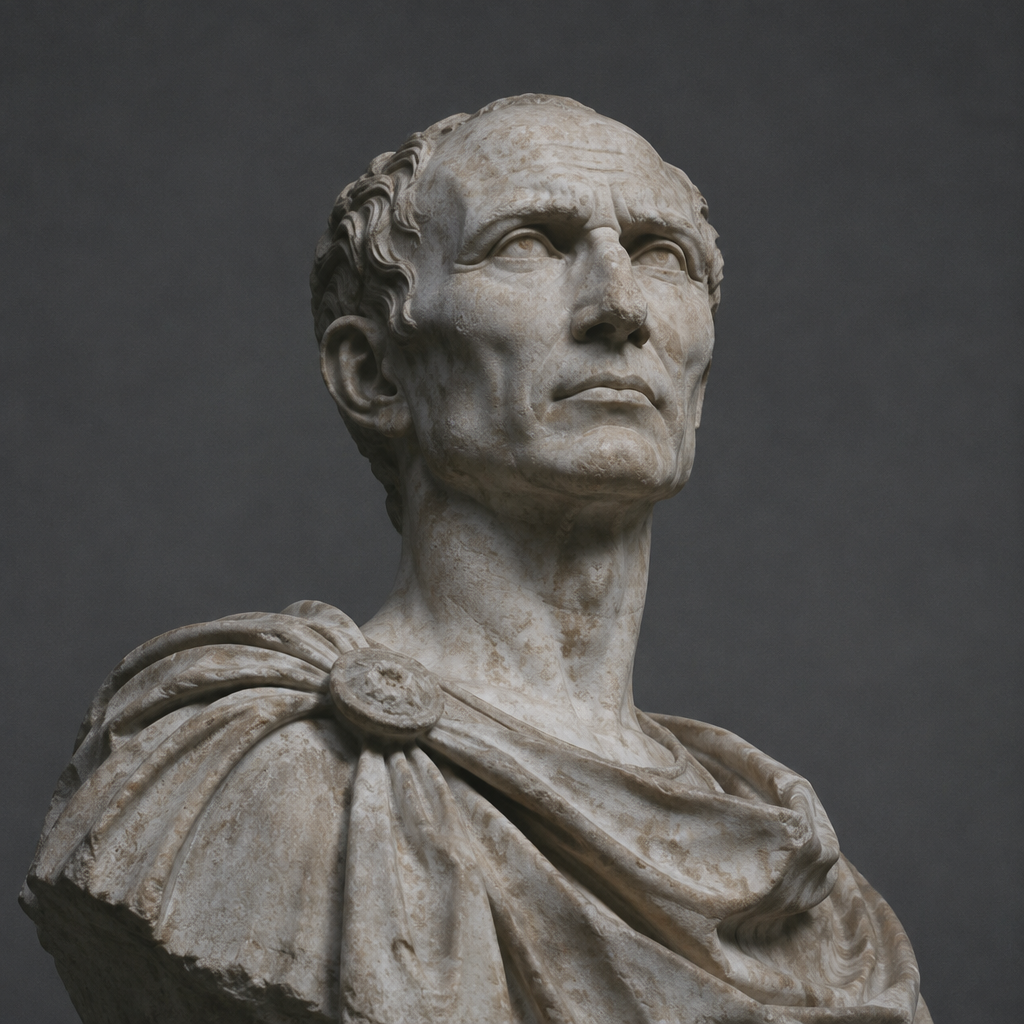
The Mind of Caesar: Power and Paradox
This three-lecture audio course examines the life of Julius Caesar through three decisive moments that shaped his rise and fall. Lecture 1 recounts his kidnapping by Cilician pirates in 75 BC. Caesar, then twenty-five, rejects the offered ransom of twenty talents, demands fifty, and spends thirty-eight days on Pharmacusa writing poetry and threatening his captors with crucifixion. After release he raises a private fleet, recaptures the pirates, and orders their execution, demonstrating the pattern of psychological dominance that later defined his career. Lecture 2 moves to the Siege of Alesia in 52 BC. Facing Vercingetorix and a second Gallic army, Caesar deploys double siege walls and rides the ramparts in his crimson paludamentum. The visible cloak steadies his exhausted troops and signals total confidence, turning a near-defeat into victory through engineering and personal presence. Lecture 3 explores the policy of Clementia. Caesar pardons former enemies, including Marcus Brutus, yet his mercy is read as an assertion of superiority. The same composure that once projected strength now blinds him to the conspiracy forming in the Senate. On the Ides of March his assassins strike, ending the Republic and sealing his legend.
The Pirate's Ransom: Audacity of a Young Caesar
The Pirate's Ransom: Audacity of a Young Caesar
A man who has just been kidnapped does not, as a rule, demand that his kidnappers charge more for him. Caesar did exactly that.
Plutarch records it plainly: the Cilician pirates who seized Caesar near the island of Pharmacusa opened their ransom demand at twenty talents of silver. Caesar laughed. Not nervously — he laughed the way someone laughs when they've been underestimated. Then he told them they clearly had no idea who they were holding, and volunteered that he was worth fifty. Suetonius confirms the same figure. That is not a minor upward adjustment. That is a man rewriting the terms of his own capture before his friends had even left to find the money.
Think of it this way, Pooja: suppose you walked into a negotiation where the other side held all the cards, and your first move was to raise the stakes against yourself. Most people would call that reckless. What Caesar understood, intuitively, was that price signals status. By demanding a higher ransom, he was not being generous to pirates. He was asserting rank. He was telling them, through the language they respected most, that they had caught someone extraordinary, and that they should feel the weight of that. His companions scattered to various cities to raise the funds, leaving Caesar with just one friend, a physician, and two attendants. For nearly forty days, he was alone in pirate company.
And what did he do with those forty days? He composed speeches. He wrote poems. He performed them for the pirates and, according to Plutarch, openly criticized the ones who failed to show sufficient admiration. He joined their games and their exercises. When he wanted to sleep, he sent someone to quiet them down. I, I keep coming back to that detail — the captive telling his captors to hold the noise. The pirates, Plutarch says, found him entertaining. They let him do it. Which is, when you stop and think about it, a staggering reversal of power achieved through sheer nerve rather than any weapon or rank. He'd already won a psychological contest he was never supposed to be in.
He also made a promise, and this is where the picture sharpens. Repeatedly, in what Plutarch frames as a joking tone, Caesar told the pirates he would have them crucified once he was free. The pirates apparently found this funny. That was their mistake. The ransom was paid, Caesar was set ashore, and he did not go home. He went directly to the port of Miletus, assembled ships, and pursued them. He found them still at Pharmacusa, their guard relaxed, the money divided. He captured every one. So that word "mercy" — Caesar's version of it deserves attention. Suetonius records that he ordered the pirates crucified, exactly as promised, but had their throats cut first. That is not cruelty abandoned. That is cruelty managed with a strange, cold precision. He kept his threat and softened the method, as though he believed in the principle of a promise even when making it had seemed like a joke.
Now, Pooja, what gets me is that this episode was not a footnote in Caesar's life — it was a preview. The same moves appear again and again across his career: the insistence on being valued above what others initially offer, the psychological composure where others would panic, the willingness to follow through on something everyone assumed was rhetoric. Rome would eventually learn what those pirates learned, that when Caesar said a thing, he meant it at a level most people didn't even bother to intend. The man who sent his companions away and ran the pirates' camp from inside their circle, who crucified his captors after slitting their throats as an act of mercy — that man, the, the same one, would one day walk into a Senate chamber and reshape the most powerful institution in the ancient world. The pattern was always there. It just took Rome longer than it took the pirates to notice it.
The Crimson Cloak: The Siege of Alesia
Speaker 1
A red cloak. That's what I keep picturing, one splash of crimson moving along a wall in Gaul.
Speaker 2
The paludamentum. It's a general's cloak, worn over armor. In Book 7 of The Gallic War, Caesar says its color is how his men recognized him in the final fight.
Speaker 1
So from the Aegean to the forests of Gaul. Where exactly are we?
Speaker 2
Alesia, 52 BCE. Today it's identified with Mont-Auxois, at Alise-Sainte-Reine. Caesar describes a hilltop with two rivers at its foot, a plain in front, and hills all around. It was naturally strong.
Speaker 1
And Vercingetorix is up there.
Speaker 2
He's there with a Gallic coalition. Caesar says the defenders numbered about eighty thousand. That's Caesar's figure, and nobody has verified it as a headcount.
Speaker 1
So Caesar just walls them in and waits for the—
Speaker 2
Not yet. Before the lines were finished, Vercingetorix sent his cavalry out by night. He wanted them to find help and not get trapped inside.
Speaker 1
Oh. He's calling for backup.
Speaker 2
Which is why Caesar builds twice. The first ring, he reports, ran eleven Roman miles. Then came a second line facing outward, against whoever was coming.
Speaker 1
Hold on. I lost track of which wall pointed where.
Speaker 2
The inner line faced the Gauls in Alesia; the outer faced the relief army.
Speaker 1
So the Romans are, they're besiegers and besieged at the same time.
Speaker 2
That's exactly how Caesar frames it. There was a deep trench, ramparts and towers. Then layers of stakes, hidden pits and sharpened iron. All of it built under pressure from both sides.
Speaker 1
I need a picture of that. What did it look like on the ground?
Speaker 2
Think of a soldier digging one ditch, then turning around to dig another. One keeps a city in, and the other keeps an army out.
Speaker 1
And meanwhile, inside, the food is running low.
Speaker 2
Badly. The besieged expelled the Mandubii, the locals who had taken them in, wives and children too. They came to the Roman lines begging for food and offering to be enslaved.
Speaker 1
Let me guess.
Speaker 2
He ordered that they not be admitted. And Caesar's account doesn't tell us what became of them.
Speaker 1
That's chilling. Then the relief army arrives?
Speaker 2
It came under Commius and other leaders. Caesar claims about two hundred forty thousand infantry. That's his number, not a census. Inside the town, hopes surged.
Speaker 1
So this is the cloak moment. He rides out, everybody sees red, and the—
Speaker 2
Slow down. First there were repeated assaults, some at night, with Gauls filling ditches to breach the lines. Then the crisis came. Vercingetorix attacked from inside while the relief army attacked from outside.
Speaker 1
Two fronts at once. How does he not break?
Speaker 2
Reserves. He sent Labienus with six cohorts to a threatened sector, with orders to withdraw and counterattack if needed. Then Roman cavalry appeared behind the attacking Gauls.
Speaker 1
Behind them?
Speaker 2
And they broke. In Caesar's telling, a retreat, then a slaughter.
Speaker 1
Okay, I'll argue the other side. Cavalry and engineering won this. The cloak is Caesar painting himself into his own story. He wrote the book!
Speaker 2
That's a strong case. Caesar tells the story, but that doesn't mean seeing him made anyone rally. But it has a weak spot. In that kind of chaos, a visible commander might help get the reserves moving fast.
Speaker 1
Hm. So the cloak is a, what's the word, a signal flag?
Speaker 2
A signal flag with a face. Like when a manager walks the floor on deadline day. Nobody types faster because of the jacket, but everyone knows who's deciding.
Speaker 1
And Vercingetorix?
Speaker 2
He called a council and offered to be killed or handed over. The leaders were brought before Caesar, Vercingetorix was surrendered, and the defenders laid down their arms. Even so, Gaul didn't go quiet overnight.
Speaker 1
Do we actually know this happened where Caesar says it did?
Speaker 2
Napoleon III, fascinated by Caesar, ordered investigations at Alise-Sainte-Reine in 1861. The excavators mapped the ditches so precisely that later aerial photography confirmed their drawings.
Speaker 1
An emperor checking Caesar's homework.
Speaker 2
Then Michel Reddé and Siegmar von Schnurbein led a Franco-German program that revisited the siege works with modern methods. Weapons and Gallic and Roman coins have turned up. Many sit in the National Archaeological Museum at Saint-Germain-en-Laye.
Speaker 1
So, cloak or walls. Which one won Alesia?
Speaker 2
I'd pick the cloak, as the thing that made the walls usable. The objection is that Caesar wrote it himself, and that's fair. But the excavations confirmed his walls, and walls hold when men stay on them. In his telling, the red is why they stayed. And Rome was watching that cloak too.
The One-Fingered Scratch: The Paradox of Mercy
Speaker 1
The detail I can't shake is a man scratching his head. With one finger.
Speaker 2
So he wouldn't disturb his hair. Plutarch has Cicero watching the perfectly groomed Caesar do it. Cicero says he can't imagine that man overthrowing the republic.
Speaker 1
So it's a mercy story! The gentle Caesar who forgives every single one of his—
Speaker 2
Wrong lead. It's not about mercy at all. Plutarch shows Cicero as suspicious of that courtesy. The story is about the gap between how a man looks and what he might do.
Speaker 1
Okay, scrap that.
Speaker 2
And Plutarch is a Greek biographer writing long after Caesar. No transcript of Cicero's remark survives.
Speaker 1
Fine. Then my real question is why the men Caesar spared ended up stabbing him.
Speaker 2
Start with what sparing looked like. At Corfinium he captured the Pompeian commander Lucius Domitius Ahenobarbus. Then he just let him go.
Speaker 1
That's, that's not normal for a civil war, is it?
Speaker 2
Not by Roman memory. In a letter kept in Cicero's correspondence, Caesar calls it a new way of winning. He means protecting himself through mercy and generosity, and not imitating Sulla's cruelty.
Speaker 1
Sounds noble. Maybe too noble.
Speaker 2
Careful. Scholars warn against a single motive. He wanted to limit bloodshed and also win back a divided community. And his war narratives were political messaging too.
Speaker 1
Give me one concrete case where the messaging is right there on the page.
Speaker 2
Ilerda. Caesar writes that beaten men laid down their arms and begged for mercy. He pardoned them and ordered his soldiers not to harm or rob them.
Speaker 1
And did people actually take the deal?
Speaker 2
In large numbers, according to a Cambridge study of his leniency. But not everyone was spared. Ancient accounts report executions too.
Speaker 1
Wait, how is a pardon different from just being found innocent?
Speaker 2
An acquittal says you did nothing wrong. A pardon says you did, and Caesar chose to let it go. He decides whether you get your political life back.
Speaker 1
Oof.
Speaker 2
In Pro Ligario, Cicero asks Caesar to pardon Quintus Ligarius. Or Pro Marcello, thanking him for sparing Gaius Marcellus. One man was the whole court.
Speaker 1
So where does Brutus fit?
Speaker 2
Brutus had backed Pompey's side. Plutarch says Caesar spared him and advanced him. Brutus and Cassius both became praetors, senior magistrates. The Senate even decreed a temple of Clemency.
Speaker 1
A temple. To his forgiveness.
Speaker 2
Now take Cato, the notable exception. Caesar hurried to Utica hoping to take him alive. But Cato died by suicide before Caesar arrived. Plutarch calls Caesar's intentions uncertain, and notes he later wrote an attack on Cato.
Speaker 1
Hold on. So refusing forgiveness was, was itself a political act?
Speaker 2
That's how I read it. Cato chose death over owing Caesar.
Speaker 1
the conspirators feared one-man rule. Caesar became dictator with no end date. The old dictatorship was a temporary emergency office. That's the motive, not wounded pride.
Speaker 2
That's a strong case, and the title mattered. But it can't explain Brutus alone. Fear explains a plot. It doesn't explain why a man spared and promoted joined it.
Speaker 1
So the mercy and the monarchy are the, um, the same thing?
Speaker 2
Every pardon proved one man held the power to give it. On the Ides of March, Brutus was among his assassins.
Speaker 1
And killing him brought the Republic back?
Speaker 2
No. Power passed to new hands, and the civil wars went on. The Republic was dead, but the legend of Caesar was just beginning.
Speaker 1
I'll hear it now whenever a boss says, 'I'll let it slide this time.'
Speaker 2
Exactly. Those five words sound like kindness, and they also announce who decides.